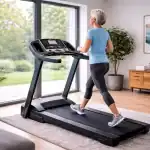
Running on a treadmill places very different demands on a machine than walking. Impact forces are higher, stride length increases, and the belt must maintain consistent speed under load. Many treadmills marketed as “budget” are designed primarily for walking and can struggle once jogging or running is introduced.
This guide focuses on budget-conscious treadmills that can realistically support jogging, interval training, and regular short runs without crossing into commercial-level pricing. For a broader comparison across all categories, see the main hub guide: Best Treadmills for Home Use (2026 Buyer’s Guide) and don’t miss the video reviews of our recommended budget treadmills.
What makes a treadmill good for running?
Running treadmills must handle repeated impact and sustained belt speed without excessive vibration or slowdown. At the budget end of the market, compromises are inevitable, but some features matter far more than others.
A treadmill that works well for running typically includes:
- A motor built for durability rather than short bursts
- A belt long and wide enough to support natural stride
- A frame that remains stable as speed increases
- Deck cushioning that reduces repetitive joint impact
Running treadmill vs walking treadmill
The difference between running and walking treadmills isn’t just top speed—it’s how the machine behaves under load.
Walking treadmills:
- Are optimized for lower speeds
- Typically use smaller motors
- Can feel unstable when pushed faster
Running treadmills:
- Maintain belt speed under higher load
- Handle repeated foot strikes more smoothly
- Stay cooler during longer workouts
If you plan to jog or run regularly, even a budget treadmill should be chosen intentionally rather than stretching a walking model beyond its design limits.
Key features runners should prioritize
When comparing budget treadmills for running, a few features make a disproportionate difference in comfort, safety, and longevity.
Motor strength
For running, consistency matters more than peak horsepower. A treadmill that holds speed smoothly at moderate paces is more useful than one that advertises high top speeds but struggles under load.
Belt length and width
Running increases stride length. Short belts can force runners to shorten stride or drift backward, affecting comfort and running form.
Cushioning and deck feel
Deck cushioning helps absorb impact and reduce joint stress. Budget treadmills vary widely here, making this one of the most important comfort factors.
Frame stability
A stable frame minimizes vibration and noise at speed. Lighter frames are easier to move and store but may feel less secure during running.
Typical price range for budget running treadmills
For this guide, “budget” means avoiding commercial pricing while still supporting real running use.
- Entry-level running treadmills: $700–$1,000
- Best-value running treadmills: $1,000–$1,500
- Upper-limit budget treadmills: $1,500–$2,000
Above $2,000, treadmills typically move out of the budget category and into heavy-duty or commercial-style designs.
Best budget treadmills for running on Amazon (2026)
The models below represent the most affordable treadmills that still make sense for jogging and light-to-moderate running. Amazon links use search results so availability remains consistent.
Treadmill Model (Click to scroll to video review) | Best for | Key strengths | Price range | Amazon link |
|---|---|---|---|---|
Walking and light jogging | Very affordable, compact footprint | $ | ||
Entry-level home use | Low cost, simple controls | $ | ||
Budget-conscious runners | Good value, compact footprint | $$ | ||
Value-focused households | Foldable design, solid belt size | $$ | ||
Interval training | Responsive motor, stable frame | $$ | ||
Durability-focused buyers | Stable deck, reliable motor | $$ |
Price legend: $ = under $1,000; $$ = $1,000–$2,000.
Note: Budget treadmills prioritize value and space efficiency. Runners training daily or at higher speeds may benefit from stepping up to mid-range or commercial-style models. See best running treadmills we recommend.
Who should choose a budget running treadmill?
Budget running treadmills are well suited for beginner to intermediate runners, apartment dwellers, and multi-user homes where cost and space matter. They work best for consistent short-to-moderate runs rather than high-mileage training.
Common mistakes runners make when buying a treadmill
Most issues come from mismatched expectations rather than faulty equipment.
- Buying a walking treadmill and expecting it to handle running
- Ignoring belt size and stride needs
- Overvaluing top speed instead of stability
- Choosing the cheapest option without checking motor durability
Frequently asked questions about budget running treadmills
Can budget treadmills handle running?
Some can, especially for jogging and short runs, but design matters more than price alone.
What motor size is enough for running?
Consistency and cooling matter more than peak horsepower numbers.
Are budget treadmills noisy?
They can be, especially lighter models, but frame quality makes a big difference.
How long do budget treadmills last?
With moderate use and proper maintenance, many last several years.
Is cushioning important for running?
Yes. Cushioning reduces joint impact and improves comfort.
Are folding treadmills good for running?
Some are, but stability matters more than whether the deck folds.
If you want to compare budget treadmills with other treadmill categories, return to the hub guide: Best Treadmills for Home Use (2026 Buyer’s Guide).
Budget Treadmill Video Reviews
XTERRA TR150
Video review for the XTERRA TR150 Treadmill
Sunny Health & Fitness SF-T7515
Sunny Health & Fitness SF-T7515 Video Review:
ProForm Pro Series
ProForm Pro Series video review
XTERRA Fitness TRX4500
XTERRA Fitness TRX4500 video review:
Horizon Fitness 7.0 AT
Horizon Fitness 7.0 AT video review:
Sole F63
Sole F63 video review: