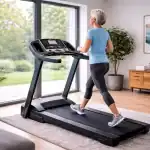
Curved treadmills are fundamentally different from traditional motorized treadmills. Instead of relying on a motor to move the belt, they use a curved running surface that responds directly to your stride. This changes how impact is absorbed, how speed is controlled, and how hard your body works during each session.
This guide focuses on curved treadmills that are suitable for running and high-intensity training at home, including what they do well, where they fall short, and who they actually make sense for. For a complete overview of all treadmill categories, see the main hub guide: Best Treadmills for Home Use: 2026 Buyer’s Guide.
What makes a treadmill good for running?
Whether motorized or manual, a treadmill designed for running must handle repeated impact, support natural stride mechanics, and remain stable under changing pace. Curved treadmills approach these requirements differently, but the fundamentals still apply.
A treadmill that works well for running typically includes:
- A running surface that supports natural stride without forcing gait changes
- A frame that remains stable during acceleration and deceleration
- A belt system that moves smoothly under repeated foot strikes
- Impact absorption that reduces joint stress over time
Curved treadmill vs traditional motorized treadmill
The difference between curved and motorized treadmills is most obvious once you start running.
Traditional motorized treadmills:
- Use a motor to control belt speed
- Allow precise pace control at the console
- Provide consistent belt movement regardless of stride
Curved treadmills:
- Rely entirely on user effort to move the belt
- Adjust speed instantly based on stride position
- Increase effort as pace increases, without a motor assist
Curved treadmills tend to feel harder at the same perceived speed, which is why they’re common in performance and conditioning environments.
Key features runners should prioritize
Because curved treadmills are simpler mechanically, build quality matters even more.
Running surface design
The curve itself determines how the treadmill feels. A well-designed curve encourages natural forward lean and smooth turnover, while a poorly designed one can feel awkward or overly taxing.
Belt quality
Curved treadmills use slatted or heavy-duty belts rather than traditional continuous belts. Smooth movement and minimal friction are essential for comfortable running.
Frame stability
There is no motor masking vibration on a curved treadmill. Any flex or instability in the frame becomes immediately noticeable during faster efforts.
Impact and joint feel
Many curved treadmills reduce joint impact by encouraging midfoot or forefoot strike, but the experience varies widely depending on belt and curve design.
Typical price range for curved treadmills
Curved treadmills are generally more expensive than motorized home treadmills due to heavier construction and specialized components.
- Entry-level curved treadmills: $2,000–$3,000
- Mid-range curved treadmills: $3,000–$5,000
- High-end curved treadmills: $5,000+
Lower-priced curved models often compromise on belt smoothness or frame stability.
Best curved treadmills on Amazon (2026)
The curved treadmills below are commonly searched and purchased through Amazon, particularly by buyers looking for motor-free running options. Links use Amazon search results to remain stable.
Curved treadmill | Best for | Key strengths | Price range | Amazon link |
|---|---|---|---|---|
AssaultRunner Pro | Serious runners and HIIT training | Heavy-duty build, smooth slatted belt | $$$ | |
TrueForm Trainer | Natural running mechanics | Consistent curve, no motor, low maintenance | $$$ | |
Sunny Health & Fitness Curved Manual Treadmill | Budget-conscious curved treadmill buyers | Lower entry cost, compact footprint | $$ | |
SB Fitness CT400 | Commercial-style home gyms | Slatted belt, strong frame | $$$ | |
IN10CT Health Runner | Compact curved treadmill setups | Space-efficient design, manual operation | $$ |
Price legend: $$ = $2,000–$3,500; $$$ = over $3,500.
Who should choose a curved treadmill?
Curved treadmills are best suited for experienced runners, athletes focused on conditioning, and buyers who prefer motor-free equipment. They’re especially popular for interval training and short, intense workouts.
Common mistakes buyers make with curved treadmills
Curved treadmills are often misunderstood, which leads to frustration.
- Expecting the same feel as a motorized treadmill
- Assuming lower price means similar performance
- Underestimating how physically demanding they are
- Buying one for long, steady-distance runs without testing
Frequently asked questions about curved treadmills
Are curved treadmills harder to run on?
Yes. Because there is no motor assistance, curved treadmills typically feel more demanding at the same perceived pace.
Do curved treadmills burn more calories?
They often do, because the runner supplies all belt movement, increasing overall effort.
Are curved treadmills better for joints?
They can be, depending on running form and belt design, but they are not automatically easier on joints for everyone.
Can beginners use curved treadmills?
Some can, but many beginners find them challenging at first due to the lack of speed control.
Do curved treadmills require electricity?
No. Most curved treadmills are fully manual and require no power.
Are curved treadmills worth the cost?
They can be for the right user, but they’re not a universal replacement for motorized treadmills.
If you want to compare curved treadmills with other treadmill types, return to the hub guide: Best Treadmills for Home Use: Our 2026 Buyer’s Guide.