Last Updated on September 23, 2026
| Quick Answer: Michael Jordan is widely reported to have worn a U.S. men’s size 13 shoe. Some game-worn and auctioned pairs connected to Jordan have also been listed with slightly mismatched sizing, often a size 13 left shoe and a size 13.5 right shoe. That is large compared with the average man’s shoe size, but not especially large by NBA standards. Players such as Shaquille O’Neal, Tacko Fall, Victor Wembanyama, Yao Ming, Kevin Durant, and LeBron James are all associated with larger shoe sizes. See related post. Jordan’s feet were not the biggest in basketball, but his Air Jordans became the most famous basketball shoes in the world. |
Michael Jordan’s shoes may be the most famous basketball shoes ever made, but his actual shoe size is surprisingly modest compared with some NBA giants. While players like Shaquille O’Neal, Bob Lanier, Tacko Fall, and Victor Wembanyama are known for enormous feet, Jordan’s shoe size was much closer to what many tall guards and wings wear.
That contrast is part of what makes the topic interesting. Michael Jordan did not have the biggest feet in basketball. He had the most influential shoes in basketball. From the Air Jordan 1 to the sneakers he wore during his championship runs with the Chicago Bulls, his footwear became part of sports history, sneaker culture, and pop culture at the same time.
This post looks at Michael Jordan’s shoe size, how it compares with other NBA stars, what shoes he wore, why Air Jordans became so important, and how size 13 shoes fit into the larger world of basketball footwear.
Michael Jordan is widely reported to have worn a U.S. men’s size 13 shoe. Some sneaker and auction listings also note that certain pairs connected to Jordan were made in a slightly mismatched fit, with a size 13 left shoe and a size 13.5 right shoe.
That kind of small difference is not unusual. Many people have one foot that is slightly larger than the other, and elite athletes often need footwear adjusted more precisely than regular retail buyers. For a player who relied on jumping, cutting, landing, and explosive changes of direction, even a small fit issue could affect comfort and performance.
Jordan’s size 13 feet were large by everyday standards, but not extreme by NBA standards. He was officially listed at 6-foot-6, and for a guard or wing of that height, size 13 is very believable. It gave him enough base and support for elite movement without the oversized proportions seen in much taller centers.
A U.S. men’s size 13 shoe is roughly around 12 inches long, depending on the brand, model, and internal construction. Basketball shoes can feel larger because they often include padding, ankle support, reinforced midsoles, and extra structure around the heel and forefoot.
Jordan’s size 13 shoes look big next to an average men’s shoe, but they are much smaller than the largest shoe sizes in NBA history.
Here’s how Michael Jordan compares with other famous basketball players:
| Player | Reported shoe size |
|---|---|
| Shaquille O’Neal | Size 22 |
| Bob Lanier | Size 22, though some sources dispute the U.S. sizing |
| Tacko Fall | Size 22 |
| Victor Wembanyama | Size 20.5 |
| Yao Ming | Size 18 |
| Kevin Durant | Size 18 |
| LeBron James | Size 15 |
| Michael Jordan | Size 13 |
That comparison helps put Jordan’s feet in perspective. His shoes were not huge for the NBA. In fact, LeBron James, Kevin Durant, Yao Ming, Shaq, and Wembanyama all reportedly wear or wore much larger shoes.
But Jordan’s size 13 sneakers became more recognizable than all of them. His feet were not the biggest. His footwear legacy was.
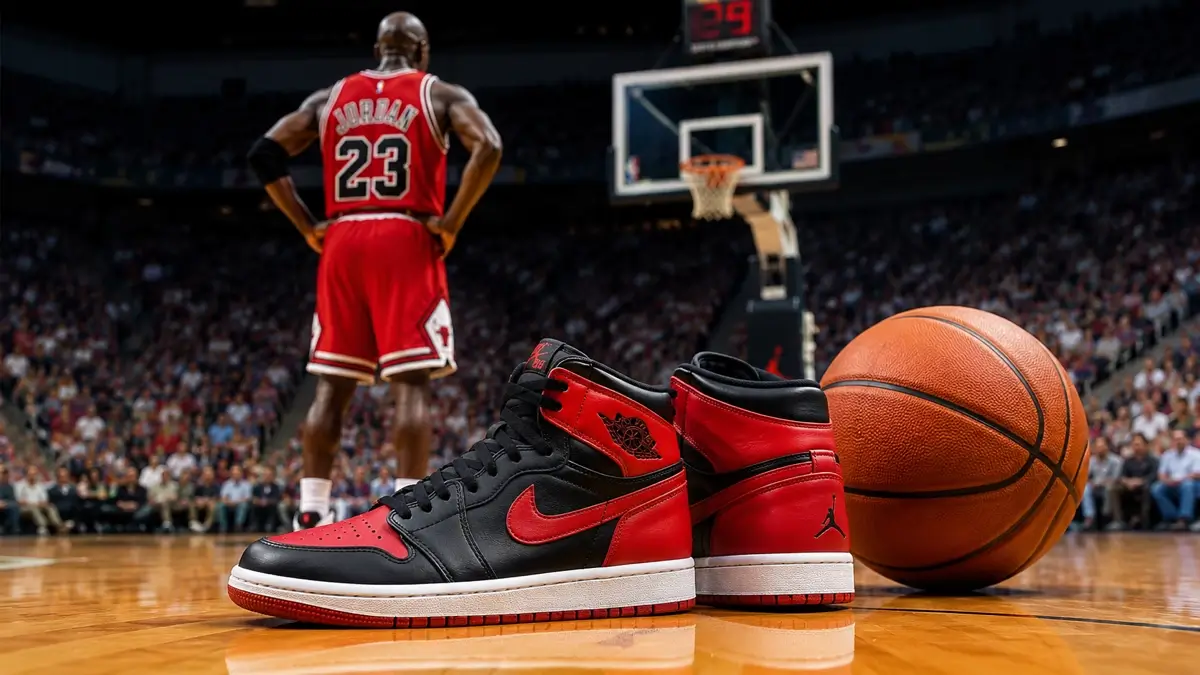
Michael Jordan is, of course, most closely associated with the Air Jordan line. The original Air Jordan 1 was designed in 1984 and released in 1985, helping launch one of the most important athlete-sneaker partnerships in history.
Jordan wore several iconic models (links go to Amazon) during his playing career, including:
- Air Jordan 1 – The original Jordan sneaker, known for its high-top shape, bold color blocking, and streetwear appeal.
- Air Jordan 3 – Famous for visible Air cushioning, elephant print, and the first Jumpman logo.
- Air Jordan 4 – A retro basketball shoe with mesh panels, wing eyelets, and strong lifestyle appeal.
- Air Jordan 5 – A bold 1990s model with a reflective tongue, lace lock, and fighter jet-inspired details.
- Air Jordan 6 – The shoe Jordan wore during his first NBA championship, known for its sculpted upper and heel tab.
- Air Jordan 11 – An iconic dress-sneaker Jordan with patent leather, a sleek profile, and collector demand.
- Air Jordan 12 – A sturdy leather-heavy model inspired by luxury footwear and Japanese rising sun imagery.
- Air Jordan 13 – Known for its panther-inspired design, hologram detail, and cushioned feel.
- Air Jordan 14 – A sports car-inspired model tied to Jordan’s final Bulls championship.
Each model became connected to a different part of Jordan’s career. The Air Jordan 1 is tied to his rookie-era rise and the early controversy around black-and-red basketball shoes. The Air Jordan 3 introduced the Jumpman era and helped cement the brand’s identity. The Air Jordan 11 became one of the most beloved basketball shoes of the 1990s. The Air Jordan 13 is closely connected to Jordan’s final championship season with the Chicago Bulls.
For sneaker fans, Jordan’s shoe size matters partly because game-worn Jordans are among the most valuable sports shoes in the world. Auction listings for Jordan-worn sneakers often include sizing details, and many famous pairs are listed as size 13 or as a size 13 and 13.5 mismatch.
Jordan’s shoes became famous for reasons that went far beyond foot size. The Air Jordan line arrived at the perfect moment: Jordan was young, explosive, marketable, and visually spectacular on the court. His shoes became tied to flight, style, rebellion, winning, and individual greatness.
Before Jordan, basketball shoes were important, but they were not usually treated as cultural objects in the same way. Air Jordans changed that. They became shoes people wanted not only because they played basketball, but because they wanted to connect with the idea of Michael Jordan.
The size 13 detail adds another layer for collectors. A game-worn Jordan shoe is not just a sneaker. It is a physical object that touched the court during some of the most famous moments in NBA history. That is one reason Jordan’s shoes can sell for extraordinary prices at auction.
One thing sneaker buyers quickly learn is that “size 13” does not always mean the same thing in every shoe. Different Air Jordan models can fit differently depending on shape, padding, materials, toe box design, and whether the shoe is an original performance model or a retro lifestyle release.
Some Air Jordans feel snug through the forefoot. Others have more room in the toe box. High-top models may feel more secure around the ankle, while low-top versions can feel lighter and less restrictive.
For people buying Jordans today, the model matters as much as the number on the box. Someone who wears a size 13 in one Air Jordan may still need to adjust up or down depending on the shoe, especially if they have wide feet, use orthotics, or prefer extra room for casual wear.
Size 13 is much easier to find than the extreme sizes worn by players like Shaq or Wembanyama. Many Jordan models are released in size 13, though popular colorways can still sell out quickly.
Here are a few Air Jordan styles that are especially relevant for people searching for Jordan-inspired shoes in larger men’s sizes:
| Shoe | Best for | Key feature | Price |
|---|---|---|---|
| Air Jordan 1 | Classic everyday style | Iconic design and broad availability | See latest price |
| Air Jordan 3 | Lifestyle wear and retro fans | Visible Air cushioning and classic shape | See latest price |
| Air Jordan 11 | Collectors and dressier sneaker outfits | Patent leather styling and famous Bulls-era history | See latest price |
| Air Jordan 13 | Jordan history fans | Strong link to the 1997–98 Bulls era | See latest price |
| Jordan Luka or Tatum models | Modern basketball use | Newer performance-focused Jordan Brand designs | See latest price |
How to find shoes for larger feet
People with size 13 feet usually have more options than those who need sizes 16, 18, 20, or 22. Even so, finding the right basketball shoe still matters. A larger foot needs secure lockdown, enough cushioning, and a stable base for cutting and landing.
Players with size 13 feet should pay close attention to a few features:
- A roomy toe box if the forefoot feels squeezed
- Strong heel lockdown to prevent sliding inside the shoe
- Cushioning that matches body weight and playing style
- Good traction for indoor or outdoor court use
- Enough ankle and side support for quick lateral movement
For basketball players, fit matters more than copying a famous athlete’s shoe. Michael Jordan could wear a custom size 13 or 13.5 shoe built around his needs. A regular buyer should focus on comfort, support, and the way the shoe handles movement.
Compared with the biggest NBA shoe sizes, size 13 is not especially difficult to find. Many athletic brands produce size 13 basketball shoes, running shoes, training shoes, and casual sneakers. The challenge is not usually availability. It is fit.
Basketball shoes often run tighter than casual sneakers because they are built to hold the foot in place during fast movement. A size 13 buyer may still need to try different widths, different models, or a half-size adjustment. This is especially true with retro shoes, which may not fit exactly like modern performance sneakers.
For Jordan, the fit would have been much more precise. NBA players often wear customized footwear with modified insoles, personal sizing tweaks, and support adjustments. Jordan’s shoes were part of his equipment, not just his look.
Michael Jordan’s feet became famous because his shoes became famous. The Air Jordan line turned a basketball sneaker into a cultural symbol, and the shoes eventually became part of fashion, collecting, music, streetwear, resale culture, and sports memorabilia.
Unlike Shaq’s size 22 shoes, Jordan’s size 13 sneakers are not famous because they are shockingly large. They are famous because of what happened in them.
Jordan soared in them. He won championships in them. He built a brand in them. He helped turn sneakers into collectibles in them.
That is why a pair of game-worn Jordans can matter more to collectors than a much larger shoe worn by another player. Size gets attention. Story creates value.
Readers looking for size 13 shoes have far more choices than someone looking for a size 20 or 22. Most major athletic brands offer size 13 in at least some models, especially in basketball, running, and training shoes.
Good places to look include:
- Nike and Jordan Brand for Air Jordans and current basketball shoes
- Amazon for wide availability and comparison shopping
- Foot Locker and Champs for mainstream basketball releases
- StockX, GOAT, and eBay for sold-out or collectible Jordans
- New Balance, Adidas, and Under Armour for non-Jordan basketball and training shoes
For everyday wear, size 13 buyers should also look at width. A shoe that is long enough may still feel tight if the toe box is narrow or the upper material does not stretch.
How Big Are Size 13 Shoes?
A U.S. men’s size 13 basketball shoe is roughly around 12 inches long, depending on the brand and model. That is much smaller than Wembanyama’s size 20.5 shoes, but still big compared with average everyday footwear.
Here are everyday items that are roughly similar in length:
- A standard ruler
- A large sub sandwich
- A vinyl record cover’s width
- A small laptop’s shorter side
- A sheet of letter paper turned sideways
- A large frying pan diameter
- A basketball rim radius
- A long hardcover book
- A typical forearm from wrist to elbow
- A large tablet
This helps show why Jordan’s shoes looked substantial without being extreme. They were big enough for a 6-foot-6 NBA guard, but not in the same category as the massive shoes worn by the tallest centers.
FAQ About Michael Jordan’s Shoe Size
Frequently asked questions and answers about Michael Jordan’s shoes and shoe size.
Michael Jordan is widely reported to have worn a U.S. men’s size 13 shoe. Some game-worn and collectible pairs associated with Jordan have also been listed with slightly mismatched sizing, often a size 13 left shoe and size 13.5 right shoe.
Michael Jordan’s size 13 shoes were large compared with the average man’s shoe size, but not especially large by NBA standards. Many NBA guards, forwards, and centers wear sizes 14, 15, 16, or larger.
Most general references list Michael Jordan as a size 13. However, some game-worn shoes connected to Jordan have been listed as size 13 on one foot and size 13.5 on the other.
Some game-worn Michael Jordan shoes have been listed with different left and right sizes because one of his feet may have been slightly larger. This is common among athletes and non-athletes alike.
Michael Jordan is generally listed as a size 13, while LeBron James is commonly listed as a size 15. That means LeBron’s feet are about two full sizes larger than Jordan’s.
Shaquille O’Neal is famously associated with size 22 shoes, making his feet much larger than Michael Jordan’s size 13 feet. More on Shaq’s shoes.
Victor Wembanyama is reported to wear a U.S. men’s size 20.5 shoe, which is much larger than Michael Jordan’s size 13.
No. Michael Jordan did not have the biggest feet in NBA history. Players such as Shaquille O’Neal, Bob Lanier, Tacko Fall, Yao Ming, Kevin Durant, LeBron James, and Victor Wembanyama are all associated with larger shoe sizes.
The Air Jordan 1 is usually considered Michael Jordan’s most historically important shoe because it launched the Air Jordan line in the 1980s.
Michael Jordan wore several Air Jordan models during his six championship seasons with the Chicago Bulls, including the Air Jordan 6, 7, 8, 11, 12, 13, and 14.
Yes. Michael Jordan’s game-worn shoes are among the most valuable sports sneakers in the world because of his career, the Air Jordan brand, and the connection between specific shoes and famous games or seasons.
Yes. Size 13 Air Jordans are commonly available in many releases, although popular models and colorways can sell out quickly. See Amazon for availablity.
Some Air Jordans fit true to size, but it depends on the model. Air Jordan 1s, 3s, 4s, 11s, and 13s can all feel different.
Some retro Air Jordans can still be worn for casual basketball, but many older models are now better suited for lifestyle wear. Modern basketball shoes usually offer newer cushioning and lighter materials.
Air Jordans are popular because they combine Michael Jordan’s basketball legacy, Nike design, limited releases, nostalgia, and sneaker culture.
A U.S. men’s size 13 shoe is roughly around 12 inches long, though exact length depends on the brand, model, and internal design.
Size 13 is usually not hard to find compared with very large sizes like 16, 18, 20, or 22. Most major athletic brands make size 13 shoes.
Size 13 buyers should look for a secure fit, good heel lockdown, enough toe room, strong traction, and cushioning that matches their body weight and playing style.
Jordan’s size 13 feet gave him a stable base, but his greatness came from his athleticism, strength, coordination, skill, and competitiveness.
People search for Michael Jordan’s shoe size because Air Jordans are deeply tied to basketball history and sneaker culture. Fans want to know what size he wore and how his shoes compare with other famous NBA players.