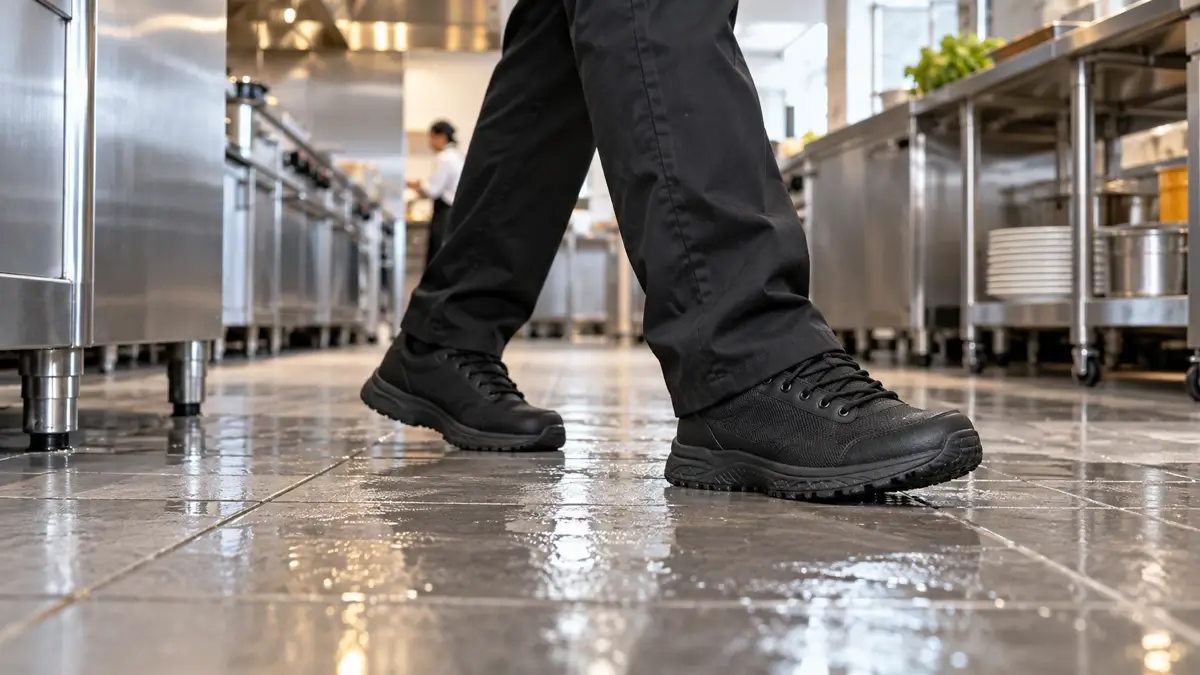
| Quick answer: Slip-Resistant Shoe Standards and Ratings. The primary U.S. slip-resistance specification is ASTM F3445-24. Its SR designation covers specified dry and wet conditions, while SRO adds a more demanding oily, wet test. ASTM F2913 describes how a complete shoe is tested but is not a pass-or-fail rating by itself. OSHA does not test, approve or certify slip-resistant shoes. Look for a model-specific ASTM F3445-24 SR or SRO designation and confirm that the tested surfaces resemble your workplace. Do not assume every work shoe from the same brand has the same rating. Click to see some common shoe models that meet these standards. |
A shoe labelled “slip resistant” should help you stay on your feet when the floor is wet, greasy or oily. But the label does not always tell you how much grip the shoe provides or where it is designed to be worn.
Some shoes must reach a minimum level of traction before they receive a recognized rating. Others are called slip resistant by the manufacturer without showing whether they passed an established performance standard.
This guide explains the most common slip-resistant shoe ratings, what they mean and which ones to look for based on where you work.
On shoe boxes and product pages, you may see ratings and standards such as ASTM F3445, ASTM F2913, SR, SRO, ISO 13287 or SRC. ASTM International and the International Organization for Standardization created these standards to make footwear testing more consistent. You may also see OSHA mentioned. OSHA, the Occupational Safety and Health Administration, is the U.S. agency responsible for workplace safety. It does not test, approve or certify individual shoes.
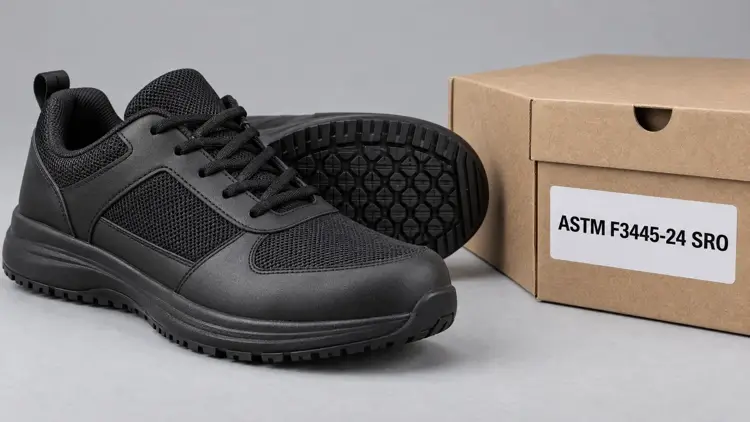
Which slip-resistant shoe rating should you look for?
The best rating depends on the surface and substance most likely to cause a slip.
| Workplace condition | Rating or evidence to look for | What it indicates |
|---|---|---|
| Dry indoor floors | ASTM F3445-24 SR | Meets the standard’s general dry-condition requirement |
| Floors exposed to water | ASTM F3445-24 SR | Meets the specified dry and wet requirements |
| Floors exposed to oil or grease | ASTM F3445-24 SRO | Meets SR requirements and adds testing under an oily, wet condition |
| International safety footwear | ISO 13287 testing under the applicable footwear standard | Tested using defined international procedures |
| Older European footwear | SRA, SRB or SRC | Tested under the previous European slip-resistance system |
| Ice, snow or mud | Surface-specific independent testing | General wet-floor ratings do not establish winter or trail performance |
| No published standard | Manufacturer claim only | “Slip resistant” may not identify a test method or minimum result |
For restaurant kitchens, food-processing facilities and other greasy workplaces, ASTM F3445-24 SRO provides more relevant evidence than a general slip-resistant claim.
For hospitals, retail stores and other workplaces where water is the primary contaminant, ASTM F3445-24 SR may be appropriate. Employers should still match the shoe to their specific floors, contaminants and safety policies.
What does slip resistant mean on shoes?
Slip-resistant footwear is designed to produce more friction between the outsole and the walking surface. This can reduce the risk of the shoe sliding when it encounters water, oil, grease or another contaminant.
“Slip resistant” does not mean “slip proof.” No shoe can prevent every slip under every condition.
The term also does not automatically confirm that the shoe passed a recognized standard. Manufacturers may use different outsole materials, tread patterns, test machines and performance thresholds. Some disclose detailed laboratory results, while others provide only a general traction claim.
A meaningful slip-resistance claim should identify:
- The standard used
- The version or year of the standard
- The floor surface
- The contaminant
- Whether the heel, forefoot or both were tested
- Whether the complete shoe or only an outsole sample was tested
- The coefficient-of-friction results
- The laboratory that performed the test
A statement such as “ASTM F3445-24 SRO” tells you more than a product description that simply promises a “slip-resistant rubber outsole.”
Slip-resistant footwear standards at a glance
Several standards and regulations appear on work-shoe labels and product pages. They do not all measure the same thing.
| Standard or regulation | What it covers | What it tells you |
|---|---|---|
| ASTM F3445-24 | U.S. footwear slip-resistance performance requirements | The shoe met defined friction thresholds under specified conditions |
| ASTM F2913 | Whole-shoe laboratory test method | Describes how footwear friction is measured |
| ASTM F2413-24 | Protective toe-cap footwear | Covers safety-toe protection and may include SR or SRO designations |
| ISO 13287:2019 | International slip-resistance test method for protective footwear | Describes how footwear is tested on specified surfaces and contaminants |
| SATRA TM144 | Laboratory testing of footwear and flooring friction | Measures dynamic friction under selected conditions |
| ANSI/NFSI B101 standards | Floor, walkway, treatment or outsole-material traction | Usually does not provide the same whole-shoe rating as ASTM F3445 |
| OSHA 29 CFR 1910.136 | U.S. workplace foot-protection requirements | Requires appropriate protective footwear but does not create an OSHA slip-resistance certification |
The most important distinction is between a test method and a performance specification. A test method explains how to conduct a test. A performance specification establishes the result a shoe must achieve to earn a designation.
ASTM F3445-24: The main U.S. performance standard
ASTM F3445-24 is the primary U.S. specification for evaluating the slip-resistance performance of footwear with the ASTM F2913 whole-shoe test method. (See more at ASTM.org)
ASTM F3445 does not describe every step of the laboratory test. Instead, it establishes the minimum performance requirements that the results must meet.
The current specification recognizes two designations:
| Designation | Conditions covered | Minimum coefficient of friction |
|---|---|---|
| SR | Specified dry and wet conditions | 0.40 |
| SRO | SR conditions plus a specified oily, wet condition | 0.33 during the oily, wet test |
The 0.33 SRO threshold is not an easier version of the 0.40 SR requirement. Oil creates a more difficult traction challenge. A shoe with an SRO designation must satisfy the general SR requirements and complete the additional oily, wet test.
What does SR mean on shoes?
An SR marking indicates that the shoe met ASTM F3445’s general slip-resistance requirements under the specified dry and wet test conditions.
SR can be a useful designation for hospitals, retail spaces, warehouses and other workplaces where water is a common contaminant.
It does not establish how the shoe performs on oil, grease, ice, mud, loose material or every type of flooring.
What does SRO mean on shoes?
An SRO marking indicates that the shoe met the general SR requirements and an additional threshold under the specified oily, wet condition.
SRO is the more relevant ASTM F3445 designation for:
- Restaurant kitchens
- Food-processing facilities
- Auto repair shops
- Manufacturing operations
- Industrial workplaces
- Areas exposed to cooking fats or machinery fluids
The standard uses controlled laboratory conditions. Even an SRO-rated shoe is not guaranteed to grip every oily surface.
What is ASTM F2913?
ASTM F2913 is the laboratory method used to measure footwear slip resistance with a whole-shoe tester.
The test places a complete shoe against a reference surface under controlled force, angle and movement conditions. The equipment measures the friction generated as the shoe moves relative to the floor.
Whole-shoe testing is useful because traction depends on more than the rubber compound. It can also be affected by:
- Heel shape
- Tread placement
- Contact area
- Outsole flexibility
- Lug orientation
- Forefoot design
- The angle at which the shoe contacts the floor
Testing can examine forward heel slipping when the foot lands and backward forefoot slipping during push-off.
ASTM F2913 produces measurements. It does not, by itself, establish whether a shoe passes or fails.
This means that the statement “tested according to ASTM F2913” is not equivalent to “meets ASTM F3445.” Look for a published SR or SRO designation if you want confirmation that the results met ASTM F3445’s performance requirements.
Slip-resistant ratings from well-known shoe brands
Slip-resistance claims vary by model. A brand may sell one shoe with an ASTM F3445-24 SRO rating and another that carries only a general traction claim.
The examples below show how differently popular footwear companies describe slip resistance.
| Brand and model | Published slip-resistance claim | What the claim establishes | Best potential use | Shop |
|---|---|---|---|---|
| Shoes For Crews Pinnacle Runner 4SG | ASTM F3445-24 SRO; tested using ASTM F2913-24 | Meets the general requirements and the additional oily, wet performance threshold | Restaurants, kitchens and greasy indoor floors | Check latest price |
| Skechers Work Slip-Resistant Glide-Step | SRO-rated outsole for wet, dry, oily and greasy surfaces | Manufacturer identifies the model as meeting the oily, wet category | Food service, health care and long indoor shifts | Check latest price |
| Crocs Bistro Pro LiteRide Work Clog | ASTM F2913-24 tested and ASTM F3445-24 certified; also listed as EN ISO 20347:2012 OB SRC | Identifies both ASTM testing and compliance with a performance specification | Kitchens, restaurants, hospitals and easy-clean workplaces | Check latest price |
| New Balance MX608v5 Slip Resistant | Outsole properties tested according to ASTM F2913 | Confirms the test method, but the product page does not publish an ASTM F3445 SR or SRO designation | General indoor work and standing | Check latest price |
| Hoka Bondi SR | Slip-resistant rubber and tread | Hoka describes the outsole as slip resistant but does not publish an ASTM F3445 designation on the cited product page | Health care, service work and long periods of standing | Check latest price |
| Reebok Guide Work RB3501 | Reebok Work’s “Best” internal rating for slip resistance | Uses a brand-specific outsole rating rather than a published ASTM F3445 designation | Warehouses, trades and safety-toe workplaces | Check latest price |
These examples are not ratings for every shoe made by each company. Always check the documentation for the exact model, style number and version you plan to buy.
Product claims were checked against the manufacturers’ published information. Models and certifications can change, so confirm current specifications when footwear must comply with an employer’s safety program.
Is there an OSHA slip-resistant shoe standard?
No. OSHA does not test, approve or certify individual slip-resistant shoes.
OSHA’s foot-protection regulation requires employers to ensure workers use protective footwear when workplace hazards could cause foot injuries. The regulation refers to recognized protective-footwear standards, but it does not establish an “OSHA-approved slip-resistant shoe” rating.
A product listing may describe shoes as appropriate for OSHA-regulated workplaces. That does not mean OSHA tested or endorsed the footwear.
Employers are responsible for assessing workplace hazards and selecting suitable protective equipment. A footwear assessment may need to consider:
- Water, oil, grease or chemical exposure
- Floor materials and surface coatings
- Indoor and outdoor work
- Ramps, stairs and floor transitions
- Toe-impact and compression hazards
- Puncture hazards
- Electrical hazards
- Outsole wear
- Cleaning and replacement schedules
Safety-toe protection and slip resistance are separate characteristics. A shoe can meet an ASTM safety-toe standard without carrying an ASTM F3445 slip-resistance designation.
How ASTM F2413 relates to slip resistance
The standard called ASTM F2413-24 covers protective footwear containing toe caps. It includes requirements for impact and compression resistance and may identify protection from additional hazards.
The 2024 edition incorporates SR and SRO slip-resistance designations. Qualifying protective footwear may therefore include:
- SR: General slip resistance under the specified dry and wet conditions
- SRO: SR performance plus the specified oily, wet condition
Do not assume every ASTM F2413 shoe is slip resistant. Read the complete marking to determine which protections apply to that model.
Many restaurant, nursing and service shoes have slip-resistant outsoles but no protective toe cap. Those models may be tested under ASTM F2913 or rated under ASTM F3445 without qualifying as ASTM F2413 protective footwear.
ISO 13287: The international test method
The standard called ISO 13287:2019 is an international method for testing the slip resistance of personal protective equipment footwear.
The method controls variables including:
- Flooring material
- Surface contaminant
- Applied force
- Shoe position
- Direction of movement
- Testing speed
ISO 13287 may appear on footwear sold in Europe and other international markets. It is a test method rather than a universal rating that applies to every shoe.
An ISO result should not be directly compared with an ASTM result unless the test conditions are equivalent. Different methods may use different surfaces, contaminants, positions and performance thresholds.
A coefficient-of-friction number obtained under one method may not mean the same thing as an identical number produced under another.
What happened to SRA, SRB and SRC shoe ratings?
Older European safety and occupational footwear may carry an SRA, SRB or SRC marking.
Under the previous system:
| Rating | Test condition |
|---|---|
| SRA | Ceramic tile covered with a soap solution |
| SRB | Steel covered with glycerol |
| SRC | Passed both the SRA and SRB tests |
Newer European footwear standards use a revised testing and marking system. Older ratings may still appear because previously certified shoes and existing stock remain available.
An SRC rating is not directly equivalent to ASTM F3445 SRO. The systems use different test conditions and requirements.
If a product page promotes an SRA, SRB or SRC rating, check the version of the European standard listed with it. A seller may be repeating outdated information from an older shoe or certification.
What is SATRA TM144?
The standard called SATRA TM144 is a method for measuring friction between footwear and flooring.
The test brings the footwear and surface into contact under a specified vertical force. One is then moved horizontally relative to the other, allowing the laboratory to calculate the dynamic coefficient of friction.
The method can be used with different contaminants and surfaces, including:
- Water
- Oil
- Grease
- Ice
- Mud
- Turf
- Gravel
The current method dates from March 2021. SATRA states that complete shoes are preferred, although outsole units, heel pieces and soling materials may also be evaluated.
“Tested to SATRA TM144” is incomplete without the results and conditions. Ask which floor, contaminant, shoe position and performance threshold were used.
Do ANSI/NFSI ratings certify slip-resistant shoes?
The National Floor Safety Institute publishes ANSI/NFSI standards related to floor and walkway traction.
Many of these standards focus on:
- Hard-surface walkways
- Floor coatings
- Cleaning treatments
- Wet-floor friction
- Individual outsole materials
For example, ANSI/NFSI B101.7 addresses laboratory measurement of heel-outsole material on liquid-contaminated surfaces. That is not necessarily the same as testing a complete shoe at the heel and forefoot.
If a shoe carries an NFSI-related claim, determine:
- Which NFSI standard was used
- Whether the complete shoe was tested
- Whether the claim applies only to the outsole material
- Which surface and contaminant were included
- Whether the result came from an independent laboratory
An NFSI claim may provide useful traction information, but it should not automatically be interpreted as an ASTM F3445 SR or SRO rating.
How is shoe slip resistance measured?
Slip testing measures the relationship between the horizontal force moving a shoe and the vertical force pressing it against the test surface.
The result is called the coefficient of friction, or COF:
Coefficient of friction = horizontal friction force ÷ vertical force
A result of 0.40 means the measured horizontal friction force was 40% of the applied vertical force under those test conditions.
Two types of friction may be discussed:
- Static coefficient of friction: Resistance before sliding begins
- Dynamic coefficient of friction: Resistance after movement starts
Dynamic measurements are particularly relevant to footwear because a dangerous slip involves movement between the outsole and the floor.
A higher coefficient generally indicates more traction under the same test conditions. It does not guarantee better traction when the floor, contaminant or testing method changes.
Slip resistant vs. oil resistant
“Slip resistant” and “oil resistant” describe different properties.
Slip resistant refers to the outsole’s ability to generate friction under specified conditions.
Oil resistant generally means the outsole material resists swelling, softening or deterioration after exposure to oil.
An oil-resistant sole is not necessarily slip resistant on oil. It may survive contact with the substance without producing enough friction to prevent sliding.
For kitchens, garages and industrial workplaces, look for both:
- Outsole materials suitable for oil exposure
- Slip testing that includes an oily or greasy condition
An ASTM F3445-24 SRO designation provides more relevant evidence of oily-surface traction than an “oil-resistant outsole” statement alone.
Slip resistant vs. non-slip
“Non-slip” is a popular marketing term rather than a promise that a shoe cannot slip.
No footwear is completely slip proof. Traction changes with the floor, contaminant, tread wear, walking speed and wearer’s movement.
“Slip resistant” is the more accurate term because it describes a reduction in risk rather than an absolute guarantee.
When a retailer calls footwear “non-slip,” look beyond the wording and check for:
- ASTM F3445 SR or SRO
- ASTM F2913 testing
- ISO 13287 testing
- Disclosed floor and contaminant conditions
- Independent laboratory results
The presence of a recognized standard is more meaningful than the words “non-slip” in a product title.
What makes an outsole slip resistant?
A slip-resistant outsole needs to contact the floor while allowing water, oil or grease to move away from that contact area.
Common design features include:
- Defined tread edges
- Multiple drainage channels
- Space between tread elements
- Rubber selected for the intended surface
- A stable heel-contact area
- Full-ground-contact outsole designs
- Tread patterns that resist clogging
Deep tread is not always better. Hiking lugs may grip dirt and loose trails but provide limited contact on smooth indoor flooring. Closely spaced tread can also trap food, mud or grease.
Research archived by NIOSH found that outsole design influences friction performance. However, tread appearance alone could not reliably predict every slip.
A shoe should therefore be judged by documented performance as well as tread design.
Why laboratory ratings have limits
A recognized rating provides better evidence than an unsupported claim, but laboratory testing cannot recreate every workplace.
Real-world traction can change because of:
- Flooring material
- Surface texture
- Floor coatings
- Cleaning products
- Type of oil or grease
- Contaminant depth
- Temperature
- Walking speed
- Ramps and slopes
- The wearer’s gait
- Outsole wear
A shoe tested on wet quarry tile may perform differently on polished concrete, stainless steel, epoxy or vinyl.
Standard wet-floor testing also does not establish performance on ice, snow, mud, loose gravel, metal shavings or dry powders.
Ratings normally describe new footwear. As tread wears down, drainage channels become shallower and outsole edges become rounded. The shoe may continue to display its original rating even after its real-world traction has declined.
How to choose genuinely slip-resistant shoes
Start with the hazards in your workplace rather than the appearance of the outsole.
Before buying, ask:
- Does the manufacturer identify ASTM F3445-24?
- Does the model carry an SR or SRO designation?
- Was the shoe tested using ASTM F2913?
- Was the complete shoe tested?
- Which floor and contaminant were used?
- Are the coefficient-of-friction results available?
- Did an independent laboratory perform the test?
- Does your employer require an approved model?
- Do you also need toe, puncture or electrical protection?
- Is the outsole appropriate for your workplace’s cleaning products?
For kitchens and greasy floors, prioritize documented oily, wet testing. For hospitals and retail environments, wet-surface performance and all-day comfort may carry more weight.
See our guide to the best slip-resistant shoes for work for model recommendations.
When should slip-resistant shoes be replaced?
Replace work shoes when the outsole can no longer make stable contact with the floor or move contaminants through its tread channels.
Warning signs include:
- Smooth or shallow tread
- Rounded tread edges
- Uneven heel wear
- Bald areas under the forefoot
- Cuts or cracks in the outsole
- Hardened rubber
- Outsole separation
- Embedded debris that cannot be removed
- A noticeable decline in traction
Clean the outsole according to the manufacturer’s instructions. Grease, food and debris can fill the channels and reduce the effectiveness of an otherwise capable tread pattern.
Replacement schedules should consider working conditions rather than age alone. A restaurant worker may wear down an outsole more quickly than someone using the same shoe in a dry retail environment.
Frequently asked questions
For current U.S. workplace footwear, ASTM F3445-24 SRO is the more comprehensive designation because the shoe must meet the general SR requirements and an additional oily, wet threshold. It is especially relevant for kitchens, food processing and workplaces exposed to oil or grease.
SR covers the specified dry and wet test conditions. SRO requires the shoe to meet the SR requirements and complete an additional oily, wet test. SRO is therefore more appropriate when oil, grease or similar contaminants are present.
No. OSHA does not test or approve individual shoe models. Employers must assess their workplace hazards and select appropriate footwear. A claim that shoes are “OSHA approved” should be treated cautiously.
No. ASTM F2913 is a test method. It describes how a whole shoe is evaluated, but it does not provide a pass-or-fail designation by itself. ASTM F3445 establishes the SR and SRO performance requirements.
Not automatically. ASTM F2413 primarily covers protective toe-cap footwear and related hazards. Check the complete shoe marking for an SR or SRO designation rather than assuming safety-toe certification includes slip resistance.
SRC indicates that footwear passed both SRA and SRB conditions under the older European system. These shoes may still provide good traction, but SRC should not be treated as identical to ASTM F3445 SR or SRO.
Not necessarily. Oil resistance generally describes the material’s ability to resist damage from oil. Slip resistance describes traction. For oily floors, look for documented oily, wet testing such as ASTM F3445-24 SRO.
A general wet-floor or oily-floor rating does not prove that a shoe performs well on ice. Ice requires surface-specific testing and may require winter rubber, specialized tread or a separate traction device.
No. Footwear can reduce risk but cannot eliminate it. Prompt spill cleanup, appropriate floor maintenance, good lighting, handrails, worker training and regular outsole replacement remain important