Last Updated on October 4, 2026
| Quick Answer: What shoe size matches my foot length? Measure both feet while standing and use the longer measurement. Compare that heel-to-toe length with the chart below to estimate your US shoe size. If your measurement falls between two sizes, start by trying the larger size. Do not automatically size up if your measured size already gives you comfortable toe room and a secure heel. Width matters too, so a shoe that feels tight across the forefoot may need a wider width rather than a longer size. |
Choosing the right shoe size starts with measuring your foot from the back of your heel to the tip of your longest toe. But there is an important catch: there is no single foot-length conversion used by every shoe brand.
The US shoe size charts below give you a practical starting point for matching your foot length in inches or centimeters to an approximate men’s or women’s size. After you find your likely size, check the manufacturer’s own size chart before ordering. Fit can vary by brand, model, toe box shape and shoe type.
Foot Length to US Shoe Size CalculatorEnter your heel-to-toe measurement to get an approximate US shoe size. This calculator is a starting point, not a substitute for the size chart supplied by the shoe manufacturer.
|
Enter your heel-to-toe measurement to get an approximate US shoe size. This calculator is a starting point, not a substitute for the size chart supplied by the shoe manufacturer.
Once you know your approximate size, use our Free Shoe Finder to narrow down current shoes based on fit, gait, width and how you plan to use them. If you’re switching brands, use the brand-to-brand shoe size converter to estimate the closest equivalent size.
If you already know your shoe size and need an international equivalent, use the country shoe-size converter. For all measurement, width and brand-switching tools in one place, visit our shoe size calculators and fit tools hub.
Approximate US Women’s Shoe Size Chart by Foot Length
| US Women’s Size | Foot Length in Inches | Foot Length in Centimeters |
|---|---|---|
| 5 | 8.7″ | 22.1 cm |
| 5.5 | 8.8″ | 22.4 cm |
| 6 | 9.0″ | 22.9 cm |
| 6.5 | 9.2″ | 23.3 cm |
| 7 | 9.3″ | 23.7 cm |
| 7.5 | 9.5″ | 24.1 cm |
| 8 | 9.7″ | 24.6 cm |
| 8.5 | 9.8″ | 24.9 cm |
| 9 | 10.0″ | 25.4 cm |
| 9.5 | 10.2″ | 25.9 cm |
| 10 | 10.3″ | 26.2 cm |
| 10.5 | 10.5″ | 26.7 cm |
| 11 | 10.7″ | 27.1 cm |
| 11.5 | 10.8″ | 27.5 cm |
| 12 | 11.0″ | 27.9 cm |
| 12.5 | 11.2″ | 28.4 cm |
| 13 | 11.3″ | 28.7 cm |
Approximate US Men’s Shoe Size Chart by Foot Length
| US Men’s Size | Foot Length in Inches | Foot Length in Centimeters |
|---|---|---|
| 6 | 9.3″ | 23.7 cm |
| 6.5 | 9.5″ | 24.1 cm |
| 7 | 9.7″ | 24.6 cm |
| 7.5 | 9.8″ | 24.9 cm |
| 8 | 10.0″ | 25.4 cm |
| 8.5 | 10.2″ | 25.9 cm |
| 9 | 10.3″ | 26.2 cm |
| 9.5 | 10.5″ | 26.7 cm |
| 10 | 10.7″ | 27.1 cm |
| 10.5 | 10.8″ | 27.5 cm |
| 11 | 11.0″ | 27.9 cm |
| 11.5 | 11.2″ | 28.4 cm |
| 12 | 11.3″ | 28.7 cm |
| 12.5 | 11.5″ | 29.2 cm |
| 13 | 11.7″ | 29.7 cm |
| 14 | 12.0″ | 30.5 cm |
| 15 | 12.3″ | 31.3 cm |
| 16 | 12.7″ | 32.2 cm |
About these measurements: US shoe sizing is not perfectly standardized between manufacturers. The reference measurements above use published heel-to-toe foot-length relationships as a practical guide. Nike, New Balance, Asics and other brands may map a measured foot to slightly different sizes. Nike also notes that the CM/JP size printed on its shoe boxes is not the same measurement as actual foot length. Always check the size chart for the shoe you are buying.
How to Measure Your Foot for Shoe Size
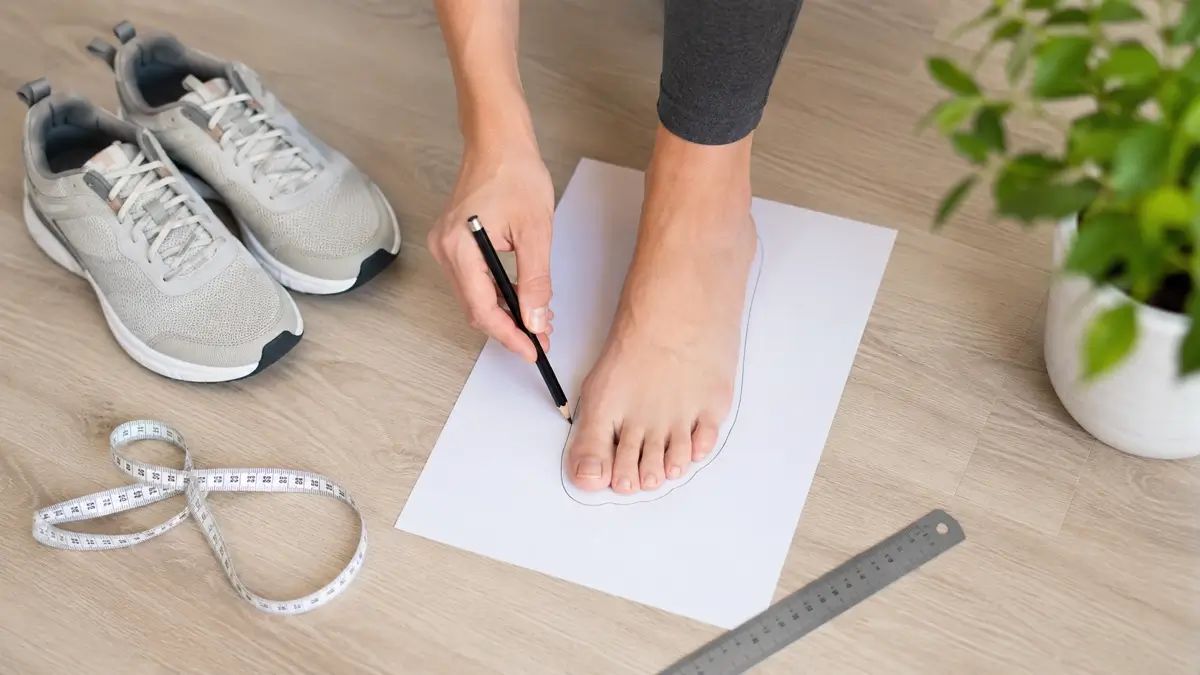
You do not need professional equipment to get a useful measurement at home. You need a sheet of paper, a pencil and a ruler or tape measure.
- Place the paper on a hard floor with one edge against a wall.
- Stand on the paper with your heel lightly against the wall.
- Keep your weight evenly distributed so your foot spreads naturally.
- Mark the end of your longest toe. Your longest toe is not always your big toe.
- Measure straight from the wall to the toe mark.
- Repeat the process with your other foot.
- Use the longer measurement when comparing your feet with a size chart.
Measure while standing rather than sitting. Your foot lengthens and spreads when it carries your body weight. Measuring later in the day can also be useful because feet may become slightly larger after hours of walking, standing, exercise or heat.
If you plan to wear the shoes with thick socks, orthotics or replacement insoles, take those into account when checking the final fit.
Foot Length Is Not the Same as Shoe Length
The number in a foot-length chart describes your foot, not the full inside length of the shoe.
A shoe needs additional space in front of your toes. Your toes should not touch the end of the shoe when you stand or walk. Running shoes in particular need enough room for the foot to lengthen and widen during movement.
This is also why measuring the outside of a shoe is not a reliable way to determine what foot size it will fit. Midsole thickness, heel construction, toe shape and upper design all affect the external dimensions.
Why Foot Length Alone Does Not Always Predict Your Best Size
Heel-to-toe length is the easiest measurement to take at home, but professional shoe fitting can consider another measurement called heel-to-ball length, sometimes called arch length.
The Brannock Device Company recommends comparing heel-to-toe length with heel-to-ball length. This matters because two feet can have the same overall length but place the ball of the foot in different positions.
A shoe is designed to flex near the ball of your foot. If that part of your foot does not line up well with the flex point of the shoe, the listed size can look correct on paper but still feel wrong when you walk.
You do not need to measure heel-to-ball length to shop online, but it helps explain why a size chart should be treated as a starting point rather than a guarantee.
Don’t Forget Shoe Width
Length is only half of the fit equation. A shoe can be the correct length and still feel uncomfortable if it is too narrow, too wide or the wrong shape for your foot.
Standard US width labels commonly use letters such as B, D, 2E and 4E. The same letter can mean something different in men’s and women’s footwear.
| Width Label | Typical Men’s Width | Typical Women’s Width |
|---|---|---|
| 2A | Extra narrow in some brands | Narrow |
| B | Narrow | Standard / medium |
| D | Standard / medium | Wide |
| 2E / EE | Wide | Extra wide |
| 4E / EEEE | Extra wide | Available as a wider option from some brands |
| 6E | Extra-extra wide from some brands | Not commonly offered |
These terms are not universal. The Brannock Device Company specifically notes that descriptions such as narrow, regular, wide and extra wide are not standardized between footwear manufacturers. New Balance, for example, publishes its own detailed shoe size and width guide.
A wide shoe is also not necessarily the same thing as a shoe with a wide toe box. Width sizing can change the volume of several parts of the shoe, while a roomy toe box describes the shape and space around the toes.
How to Measure Foot Width at Home
Stand on a sheet of paper and trace around your foot. Measure across the widest part of the forefoot, usually around the ball of the foot.
Measure both feet and pay attention to the wider one. As with length, take the measurement while standing and preferably later in the day.
Home width measurements are useful for identifying whether your foot is relatively narrow or wide, but do not try to convert a single width measurement directly into B, D or 2E across every brand. Width categories change with shoe size and manufacturer.
Do You Need a Bigger Size or a Wider Shoe?
If your longest toe reaches the front of the shoe, the shoe is probably too short. Try the next half size.
If the shoe has enough length but feels tight across the ball of your foot or squeezes the sides of your toes, try a wider width before automatically buying a longer shoe.
Sizing up simply to get more width can create a different problem. The heel may begin slipping and the foot can slide forward because the shoe is longer than you need.
People with bunions, hammertoes, swelling or a naturally broad forefoot may benefit from a wider size or a shoe with a more accommodating toe box. You can also see our guide to the best running shoes for wide feet.
Why Shoe Size Changes Between Brands
A US size 9 is not guaranteed to fit identically in every shoe. Manufacturers build footwear around forms called lasts. The last determines characteristics such as overall shape, heel width, forefoot width, toe box shape and internal volume.
Materials matter too. A soft engineered mesh upper can feel more forgiving than a rigid leather or synthetic upper even when the two shoes carry the same size label.
For the most accurate result, use this page to estimate your size and then compare it with the official chart for the brand you plan to buy:
- Nike men’s footwear size chart
- Nike women’s footwear size chart
- New Balance size and width guide
- Asics size and fit guide
Men’s and Women’s US Shoe Size Conversion
Men’s and women’s US shoe sizes use different numbering. A common starting point is a difference of about 1.5 sizes. For example, a women’s US 9 is often similar in length to a men’s US 7.5.
That does not mean the shoes fit identically. Men’s shoes are commonly built around a wider standard width than women’s shoes. A men’s standard width is often D, while a women’s standard width is commonly B.
If you are switching between men’s and women’s shoes, compare both the length and width rather than relying only on the 1.5-size conversion.
Final Shoe Fit Check
Once you have the shoes, try on both of them and walk around indoors before deciding whether the fit is right.
Your heel should feel secure rather than lifting excessively. The midfoot should feel comfortably held without painful pressure, and your toes should have enough room to move without hitting the front or being squeezed together.
Check the fit while standing and walking, not just while sitting. If the shoe immediately feels painfully tight, do not assume it will stretch enough to solve the problem.
For walking shoes, running shoes and footwear worn for long periods, test the fit with the socks and any insoles or orthotics you normally use.
More Shoe Fit Resources
- Free Shoe Finder
- Best Walking Shoes
- Best Running Shoes
- Best Running Shoes for Wide Feet
- Guide to Bunions and Footwear
FAQs About Shoe Size and Foot Length
A 10-inch foot is approximately 25.4 cm. Using the reference chart above, that is around a US women’s size 9 or a US men’s size 8. Manufacturer sizing varies, so confirm the measurement against the brand’s chart before ordering.
A 25 cm foot is about 9.84 inches. That measurement falls close to a US women’s size 9 or men’s size 8 in the reference chart. If your measurement falls between two sizes on the manufacturer’s chart, try the larger size first.
A 26 cm foot is approximately 10.24 inches. That places it around a US women’s size 10 or men’s size 9 using the reference measurements above. Exact sizing can vary by brand and model.
Measure both feet from the back of the heel to the tip of the longest toe while standing. Use the longer measurement and compare it with a shoe size chart. Then check the specific manufacturer’s sizing before buying.
Not automatically. You need enough room so your toes do not hit the front of the shoe and your foot can expand comfortably during activity. If your foot measurement falls between two sizes, trying the larger size is reasonable. If the shoe is already long enough but feels tight from side to side, try a wider width instead.
No. US men’s and women’s numbering systems differ. A women’s size is commonly about 1.5 sizes higher than a men’s size with similar length, but width and shoe shape can also differ.
Yes. Foot dimensions can change over time. The Brannock Device Company recommends having your feet measured when buying shoes rather than assuming the size you wore years ago is still correct. Changes in age, body weight and foot structure can all affect fit.