Last Updated on September 23, 2026
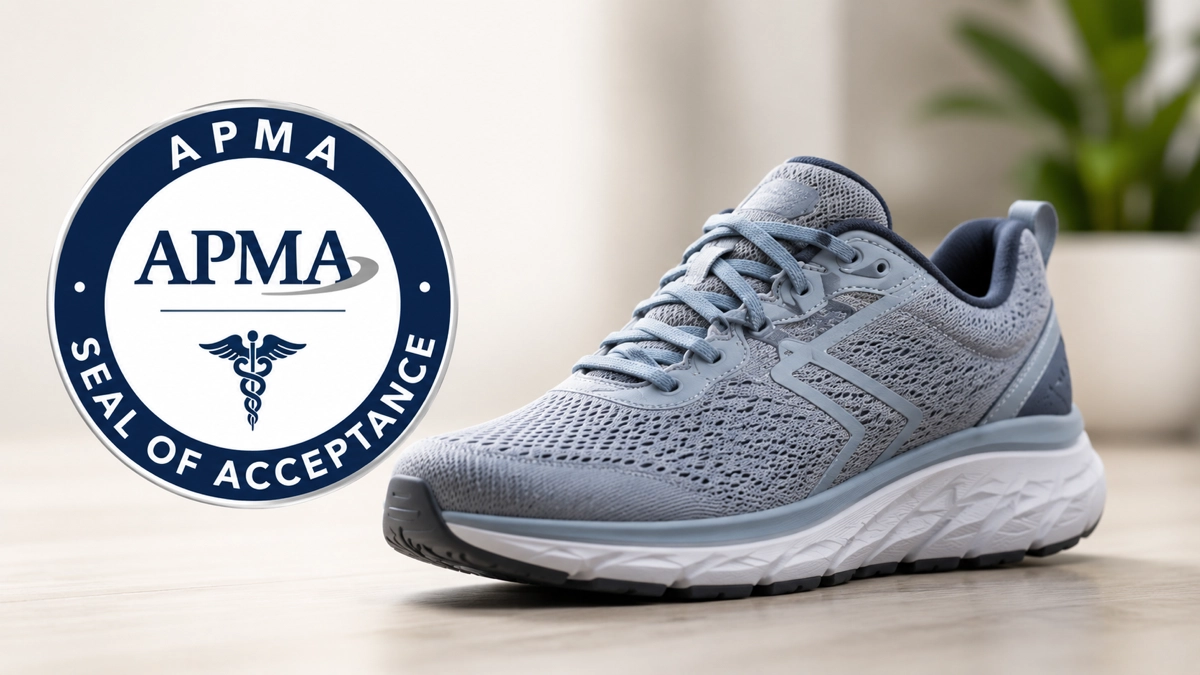
| Quick Answer: The APMA Seal of Acceptance. The American Podiatric Medical Association awards this seal of acceptance to shoes and other foot-related products that have been reviewed by podiatrists and found to promote good foot health. For shoes, the seal provides an extra level of reassurance that the design has been evaluated from a foot-health perspective. It does not mean the shoe is better than every competing model, suitable for every foot or capable of treating a medical condition. Still, it can be a useful credential when comparing walking, running and everyday shoes. Keep reading to learn what APMA acceptance really means when choosing footwear. Click to see all the shoes that have received the seal of acceptance. |
The APMA Seal of Acceptance is a designation from the American Podiatric Medical Association indicating that a shoe or other foot-related product has been reviewed by podiatrists and found to promote good foot health. The program has existed since 1967.
For footwear, the important distinction is that APMA awards the Seal of Acceptance to products such as shoes, socks, insoles and related equipment. Its separate Seal of Approval is primarily used for therapeutic products, including certain treatments and medical devices.
What does a shoe have to do to earn the APMA Seal?
A manufacturer submits the product to APMA for evaluation. An APMA panel of podiatrists reviews it and considers information about the product’s design, safety, quality control and other supporting data. The panel then determines whether the product promotes foot health.
That makes the seal more meaningful than a manufacturer’s unsupported claim that a shoe is “good for your feet.”
However, there is an important limitation: APMA does not test every shoe on the market, and receiving the seal does not mean APMA has determined that the shoe is better than competing shoes. Manufacturers voluntarily submit products for consideration, and APMA says it does not make comparisons among competing products.
Why is the APMA Seal important when choosing shoes?
It provides an additional level of independent professional review. For someone buying walking shoes, work shoes or everyday footwear, the seal gives you some reassurance that podiatrists have evaluated the shoe from a foot-health perspective rather than the recommendation coming entirely from the shoe company.
That can be particularly useful when you’re looking for footwear for:
- Long periods of walking or standing
- Everyday comfort
- Supportive footwear
- People who are concerned about foot health
- Shoes marketed around arch support or similar features
APMA’s current database includes thousands of accepted footwear products from brands such as Hoka, New Balance, Brooks, Asics, Skechers, Vionic, Altra, Topo Athletic, Dansko and others.
What the APMA Seal does NOT mean
This is worth emphasizing if you’re using the designation in BestWalkingFeet.com reviews.
An APMA Seal does not necessarily mean a shoe:
- Is the best shoe in its category.
- Will work for every person’s feet.
- Can treat plantar fasciitis, bunions, overpronation or another condition.
- Has better cushioning, stability or durability than a shoe without the seal.
- Has undergone comparative testing against competing shoes.
It also shouldn’t be interpreted to mean that a shoe without the seal is unhealthy. APMA specifically notes that only products submitted to the organization are evaluated.
Popular Shoes With the APMA Seal of Acceptance
The table below focuses on current-generation shoes that carry the APMA Seal of Acceptance as of Aug. 19, 2026. Prices are current U.S. manufacturer MSRPs and may be lower during sales.
Shoe | Type | Support | Cushioning | Best For | Check latest price |
|---|---|---|---|---|---|
Hoka Bondi 9 | Road running / walking | Neutral | Plush | Walking, all-day wear, easy runs | |
Hoka Arahi 8 | Stability road shoe | Stability | Balanced | Walking, running, overpronation support | |
Brooks Ghost 18 | Road running / walking | Neutral / balanced | Balanced | Walking, daily running, all-day use | |
New Balance 1080v15 | Road running / walking | Neutral | Extra soft | Walking, long runs, daily wear | |
New Balance Fresh Foam X 880v15 | Road running / walking | Neutral | Soft | Walking, everyday runs, long runs | |
New Balance Fresh Foam X 860v15 | Stability road shoe | Stability | Cushioned | Walking, daily running, added stability | |
Asics GEL-NIMBUS 28 | Road running / walking | Neutral | Maximum | Walking, long runs, high cushioning | |
Asics GEL-KAYANO 32 | Stability road shoe | Stability | High | Walking, running, overpronation support | |
Saucony Hurricane 26 | Max-cushion stability shoe | Stability | Maximum | Walking, daily movement, supported running | |
Saucony Guide 19 | Stability road shoe | Stability | Maximum | Walking, daily running, everyday support |