Last Updated on October 10, 2026
Outstanding support and airflow with too much weight
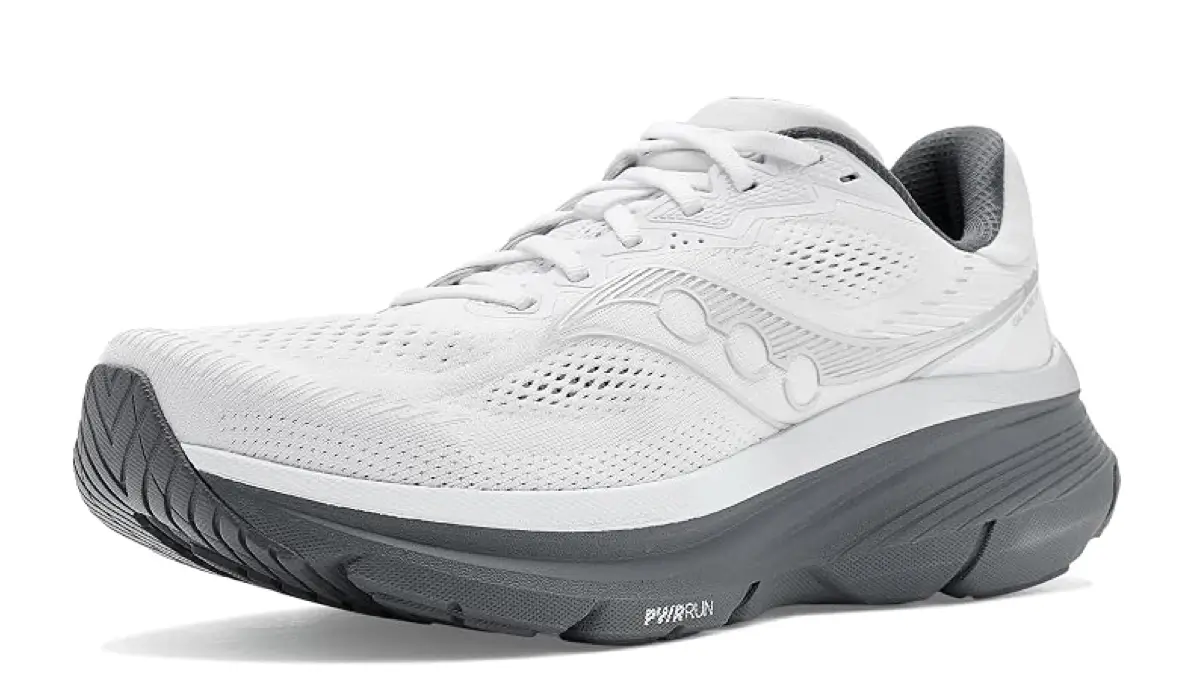
Quick Answer: Saucony Guide 19 Review: The Saucony Guide 19 is a stability daily trainer for runners and walkers who want support without anything digging into the arch. Its CenterPath system works by combining one of the widest platforms currently made with tall foam sidewalls, and the reformulated PWRRUN midsole is softer than any previous Guide. Breathability is outstanding, the outsole lasts, and the shoe stays unusually flexible for its category. The catch is weight: at over 10 ounces measured, it is heavy, and the ride is calm rather than energetic. Check latest price.
The Saucony Guide is the brand’s mainstream stability shoe, the pair a store hands to a runner who overpronates, meaning the foot rolls inward more than is comfortable after landing. Version 19 is the most refined the line has been, and it arrives at the same $140 the previous version cost, which is worth noting in a year when most rivals raised prices.
Saucony calls its support system CenterPath, and it is worth understanding because it explains how the shoe feels. There is no medial post, the wedge of firm foam older stability shoes used to jam under the arch. Instead the midsole is made unusually wide and the foam walls on either side are built up tall, so the foot sits down inside the platform rather than balancing on top of it. Measured heel width of 104.2 mm is among the broadest recorded anywhere.
That approach lets Saucony soften the foam without losing control, and it has. The compression-moulded PWRRUN midsole measures 30.5 on the Asker C durometer, clearly softer than any earlier Guide. The price is weight. At 10.5 ounces in independent measurement, this is a heavy shoe by 2026 standards and about 7 percent heavier than the Guide 18.
Check sizes and prices on Amazon.

Specs
Here are the specifications for the Saucony Guide 19:
| Type | Road stability daily trainer |
| Foot and gait type | Mild to moderate overpronation, best suited to midfoot strikers |
| Midsole foam | Compression-moulded PWRRUN, reformulated softer for this version |
| Stability system | CenterPath: an extra-wide platform with tall foam sidewalls, no medial post |
| Weight (men’s 9) | 9.7 oz / 275 g listed, 10.5 oz / 298 g independently measured |
| Weight (women’s 8) | 8.9 oz / 252 g listed |
| Heel-to-toe drop (?) | 6 mm listed, 6.0 mm independently measured |
| Stack height | 35 mm heel / 29 mm forefoot listed, 37.4 mm / 31.4 mm independently measured |
| Upper | Engineered mesh with oversized toe box vents and a moderate heel counter |
| Outsole | Rubber pods with new central forefoot coverage and weight-saving cutouts |
| Widths | Standard, wide and extra wide, availability varies by market |
| Surface | Road, treadmill, packed path |
| Price | $140 at launch, March 2026. Check latest price |
Saucony Guide 19 Pros and Cons
The good and the bad about this shoe.
Pros
- A 104.2 mm heel and 120 mm forefoot make this one of the widest platforms available, which is why it feels planted without anything pressing on the arch.
- Breathability measured 93 against an average of 72, easily the best of the current stability trainers, so feet stay dry on hot runs.
- Shock absorption jumped to 144 at the heel and 133 at the forefoot, a large improvement over the Guide 18 and welcome news for heavier runners.
- Measured stiffness of 11.1N and torsional rigidity of 10.7 Nm are both well below average, so the shoe bends naturally instead of feeling like a brace.
- Outsole durability rates as excellent and the price held at $140 while most rivals rose.
Cons
- Measured weight of 10.5 ounces is roughly 7 percent up on the previous version and well above the category average.
- Heel energy return fell to 54.8 percent, below average, so the ride feels flat when you try to pick up the pace.
- The 6 mm drop suits midfoot strikers but leaves pronounced heel strikers wanting more heel-to-toe difference.
- PWRRUN is now the oldest-feeling foam in this price bracket, and rivals with newer compounds feel livelier for the same money.
- Toe box width and height both measure marginally below average, so broad feet should order a wide.
What is new versus the Saucony Guide 18
Saucony changed how PWRRUN (learn about shoe foams) is made rather than replacing it. The Guide 19 uses a compression-moulded version of the same EVA-based foam, and the result measures 30.5 on the durometer, distinctly softer than earlier Guides. That is the change you feel first, and it is the reason the shoe now works for long easy runs in a way the firmer Guide 18 did not.
Protection improved a lot with it. Heel shock absorption rose from 124 to 144 and the forefoot climbed to 133, both now above average. Stack height crept up to a measured 37.4 mm at the heel and 31.4 mm at the forefoot while the 6 mm drop stayed put, so the extra foam went in evenly rather than tipping the geometry.
The rocker, meaning the curved sole shape that helps the foot roll forward, was redesigned with a more aggressive forefoot rise and a deeper heel curve to help heel strikers cope with the low drop. The upper gained oversized toe box vents and the central forefoot outsole gained rubber where it used to be exposed foam. The one regression is weight, up around 7 percent.
Who should buy the Saucony Guide 19
Buy it if traditional stability shoes have felt intrusive to you. Because CenterPath adds no post and no firm wedge, there is nothing pressing up under the arch. Support comes from sitting inside a very wide, walled platform, which most runners register as steadiness rather than as correction.
It suits midfoot strikers particularly well. A true 6 mm drop with a tall 31.4 mm forefoot means there is real cushioning where a midfoot lander actually loads the shoe, which is not always the case in stability models built around a high heel.
Heavier runners and anyone running in heat get a strong case too. The shock absorption gains are substantial, the outsole durability is excellent, and a breathability score of 93 puts it well ahead of anything else in the category for summer running. At $140 in three widths, it is also one of the better value stability shoes on sale.
Who should avoid the Saucony Guide 19
Avoid it if weight matters to you. At a measured 10.5 ounces this is one of the heaviest shoes in its class, and several stability trainers now deliver comparable support around a full ounce lighter. Over an hour of running the difference is noticeable.
Pronounced heel strikers should also think carefully. Saucony deepened the heel bevel to help, but a 6 mm drop still asks more of the calf and Achilles than the 10 mm or 12 mm geometry many stability shoes use, and runners coming from a high-drop shoe should transition gradually.
Finally, skip it if you want a shoe that can also handle faster running. Heel energy return of 54.8 percent is below average, and the combination of that and the weight makes any effort above an easy pace feel like work. This is a shoe for accumulating comfortable miles, nothing more.
Click to scroll to Guide 19 alternatives.
How does the Saucony Guide 19 fit?
Here is the fit and comfort info you need to have.
Fit and sizing
Order your usual size. Owner feedback points to true to size, and measured internal length of 276 mm sits above the 269.3 mm average, so there is a little more room lengthwise than in most trainers rather than less.
Interior width measured 96.2 mm, just above average, so the midfoot is comfortably standard and virtually unchanged from the Guide 18. The forefoot is more conservative: 72.8 mm of toe box width and 26.8 mm of height both sit slightly under the lab averages. That is fine for medium feet and snug for broad ones, and the answer is the wide or extra wide version rather than sizing up, since a longer shoe moves the flex point past your toes.
Upper and step-in comfort
The upper is the standout feature. Large ventilation openings across the toe box are backed by a mesh that moves air well throughout, and lab airflow testing returned 93 against a 72 average, one of the highest figures on record. Drying potential of 55 percent is above average too, so the shoe recovers quickly after a wet run or a sweaty session.
Lockdown is secure without being tight. The heel counter is deliberately moderate, rated 3 out of 5 for stiffness, because Saucony leans on the enormous heel platform for control rather than on a rigid cup around your ankle. The practical result is a rearfoot that feels held but not clamped, which is easier to live with on long days than a stiff counter.
How does the Saucony Guide 19 perform?
Here is how this shoe performs.
Midsole and cushioning
PWRRUN is Saucony’s EVA-based everyday foam, and here it is compression moulded, a process that presses the foam into shape and changes its density and feel. The result measures 30.5 on the Asker C scale, softer than average and much softer than earlier Guides, which is the single biggest change in the shoe.
Protection is genuinely good now. Shock absorption reached 144 at the heel and 133 at the forefoot, both comfortably above the 131 average, so impact is well managed at both ends of the shoe. Energy return is the weak side: 54.8 percent at the heel and 61.4 percent at the forefoot against a 58.6 percent average. Practically, the foam cushions well and returns little, which caps the shoe at easy paces.
Ride and running performance
The ride is smooth, flexible and quiet. Measured longitudinal stiffness of 11.1N is well below the 15.5N average, which is unusual for a stability shoe and means the forefoot actually bends when you push off instead of levering you over a rigid plate. The redesigned rocker adds a gentle roll on top of that, so transitions feel natural rather than mechanical.
Where it struggles is anything brisk. The weight is the main obstacle and the modest rebound compounds it, so a tempo effort in the Guide 19 feels heavy-legged. Used as an easy-day and long-run shoe, which is what a stability trainer is usually bought for, it does the job about as well as anything at this price.
Stability and support
This is a full stability shoe, and the mechanism is geometry rather than resistance. CenterPath means an extra-wide midsole with tall sidewalls that rise around the foot. A wider base means the foot has less distance to travel before the sole itself stops the roll, and the raised walls catch the foot before it slides sideways off the platform. Nothing pushes up under the arch, and the shoe makes no claim to change how you run.
The numbers explain why it feels so secure. Heel width of 104.2 mm and forefoot width of 120 mm are both far above average. What is unusual is that Saucony achieved this while keeping torsional rigidity low at 10.7 Nm, meaning the shoe still twists easily along its length. Most stability shoes buy control with stiffness. This one buys it with width, which is why it feels supportive without feeling rigid.
Outsole, grip and durability
The outsole layout carries over with two useful tweaks. Rubber now covers the central forefoot where the Guide 18 left foam exposed, which removes a known wear point, and several lateral pods have cutouts to claw back a little weight. Outsole durability rates as excellent in abrasion testing, which matters more on a shoe this heavy since it will likely be used for walking as well as running.
Wet-concrete grip measured 0.58 against a 0.52 average, a small improvement and enough for confident running on damp pavement. The 300 to 500 mile replacement guideline is broad rather than a promise, and with the Guide 19 the foam will soften before the rubber gives out.
Is the Saucony Guide 19 good for walking?
Yes, and it is one of the best running shoes to walk in. Three of its measured traits line up almost perfectly with what walking asks for. The platform is exceptionally wide, which matters at walking speed because you spend longer balanced on one foot than you do running. The shoe is very flexible at 11.1N, so the forefoot bends as you push off rather than resisting you. And the breathability score of 93 is the difference between comfortable and clammy over an eight-hour day.
The heavy weight that holds it back for running matters much less when walking, since you are not lifting the shoe as far or as often. Three widths and an excellent outsole make it a sensible choice for anyone on their feet for work who also wants guidance underfoot. The one caveat is the 6 mm drop, which some people with tight calves or Achilles issues find less comfortable for standing than a higher-drop shoe.
Check for size and availability on Amazon.
Saucony Guide 19 vs. Saucony Guide 18
Here is how the two versions compare on the points that changed:
Feature | Guide 19 | Guide 18 |
Midsole | Compression-moulded PWRRUN, 30.5 durometer | PWRRUN, firmer |
Heel shock absorption | 144 | 124 |
Heel stack (measured) | 37.4 mm | Slightly lower |
Weight (measured) | 10.5 oz / 298 g | About 7% lighter |
Central forefoot outsole | Rubber covered | Exposed foam |
Launch price | $140, March 2026 | Check latest Amazon price | $140 | Check latest Amazon price. |
Buy the new model when you want the softer foam and the much better impact protection, or when the exposed forefoot foam on the older shoe wore through early for you. Buy the previous model when you find it discounted and weight is your priority, since the Guide 18 is meaningfully lighter and the support geometry is broadly the same. There is no price incentive to choose the older shoe at full retail because both launched at $140.
Saucony Guide 19 Alternatives
Runners who like the Saucony fit but want a livelier ride should look at the Saucony Tempus 2 (check price | read review). It builds stability from a firm foam frame around a bouncier core, weighs noticeably less and can handle a steady effort, which is exactly where the Guide runs out of road.
Heel strikers who find the 6 mm drop too low have a straightforward swap in the Brooks Adrenaline GTS 25 (check price | read review). It runs a much higher differential with a stiffer heel counter, which is the more familiar setup for anyone coming from traditional stability shoes.
Anyone wanting more cushioning under the same kind of guidance should consider the Asics Gel-Kayano 33 (check price | read review). It costs more and runs warmer than the Guide, but the taller, softer platform suits long days and heavier runners better.
If it turns out you do not need support at all, the Saucony Ride 19 (check price | read review) is the neutral shoe in the same family. It is lighter and more nimble, with a similar fit and a comparable price, and plenty of runners who thought they needed a stability shoe are perfectly comfortable in it.

Price and value
The Guide 19 launched at $140 in March 2026, holding the same price as the Guide 18 in a year when most competitors added $5 to $15. For that you get a substantially better-protected shoe than the previous version, class-leading breathability, three widths and an outsole that lasts. The gap between it and shoes costing $30 more is largely about foam technology: PWRRUN cushions well but returns less energy than the newer compounds rivals are using. If you run easy and want support that lasts, that trade is easy to accept. If you want one stability shoe that also feels quick, the money is better spent elsewhere.

Final verdict
Best for: midfoot strikers who overpronate mildly, runners who dislike intrusive support, hot-weather running and anyone who walks as much as they run.
Avoid if: you count ounces, you are a pronounced heel striker, or you need one shoe that can also run fast.
Fit: true to size with slightly generous length, standard midfoot and a marginally snug toe box, available in standard, wide and extra wide.
Verdict: the Guide 19 is the best version Saucony has made, and the combination of a huge stable platform with a genuinely flexible, breathable build is unusual in this category. Weight and dated foam keep it out of the top tier, but at $140 in three widths it remains one of the smartest stability buys available. Check online prices.
Frequently Asked Questions for Saucony Guide 19
CenterPath is Saucony’s name for building stability into the shape of the shoe. Instead of a firm wedge under the arch, the midsole is made unusually wide and the foam walls on both sides are raised, so the foot sits down inside the platform and has less room to roll before the sole itself stops it.
Standard, wide and extra wide versions are produced, though availability varies by country and colorway. Since measured toe box width sits slightly under the lab average, runners with broad forefeet will usually be happier in the wide.
The Ride is the neutral version and the Guide is the stability version. If your ankles stay reasonably upright when you run, the lighter Ride is usually the better shoe. If you roll inward noticeably or want a broader, more planted base, the Guide is the one to try.
The sockliner comes out, which frees the depth most orthotics need. Because the shoe’s support comes from the width of the platform rather than from the insole, removing the stock sockliner does not undermine how the shoe works.
It is lower than most, and it asks a little more of the calf and Achilles than a 10 mm or 12 mm shoe. Saucony offsets it with a deep heel bevel and a tall 31.4 mm forefoot. Runners moving from a high-drop shoe should build up over a couple of weeks rather than switching outright.
The platform grew wider and the stack grew taller, and both add foam. Saucony trimmed some weight back with outsole cutouts, but not enough to offset the additions, which is why measured weight rose about 7 percent to 10.5 ounces.