Most babies do not need shoes until they are walking confidently outdoors.
That surprises many parents. Tiny sneakers are adorable, and shoes are often given as gifts long before a baby can stand. But from a developmental standpoint, bare feet are usually best in the early months.
Pediatric guidance consistently supports this approach.
What Pediatric Experts Say
The American Academy of Pediatrics, through its parent resource HealthyChildren.org, advises that babies learning to walk do best barefoot indoors because it helps them develop coordination, strength, and balance. Pediatric orthopedic specialists similarly note that early walkers benefit from natural foot movement rather than rigid support.
Organizations such as the American Academy of Orthopaedic Surgeons also emphasize that early shoes should be lightweight and flexible, serving primarily as protection rather than correction. In otherwise healthy children, structured or corrective shoes are not routinely recommended unless prescribed for a specific medical condition.
In short, shoes protect feet. They do not teach babies how to walk.
When Babies Typically Take Their First Steps
Most babies take their first independent steps around 12 months of age. However, a normal developmental range is broad. Many babies begin walking as early as 9 months, while others may not walk independently until 15 to 18 months.
Pediatricians generally consider this entire range typical, provided the child is progressing through other gross motor milestones. Because of that variability, shoes should follow readiness, not age.
Before Walking: Barefoot Is Best
In the first year of life, your baby’s feet are still forming. The bones are soft, the arches are developing, and balance is being learned from the ground up.
Going barefoot helps with:
- Strengthening foot and ankle muscles
- Developing balance and coordination
- Improving sensory awareness
- Supporting natural arch formation
When babies are learning to roll, crawl, pull up, cruise, and eventually take first steps, feeling the floor under their feet matters. Carpet, hardwood, tile: each surface gives feedback that helps the brain and body connect.
If warmth is needed, soft socks or booties are fine. If traction is needed on slippery floors, choose socks with non-slip grips rather than structured shoes.
When a Baby Is Learning to Walk Indoors
Once a baby begins taking independent steps, parents often assume it is time for shoes. Indoors, that is still usually unnecessary. Barefoot walking indoors continues to support:
- Natural foot movement
- Toe gripping for balance
- Proper gait development
Shoes can slightly alter how a new walker distributes weight and uses their toes. Unless your child is walking on rough or unsafe surfaces, bare feet remain ideal inside the home.
When Shoes Become Necessary
Shoes are important once your child is:
- Walking consistently outdoors
- Walking on pavement, gravel, or playground surfaces
- Exposed to extreme temperatures
- At risk of injury from sharp objects
At this stage, shoes serve one main purpose: protection.
They are not needed to “help” a child learn to walk. In fact, overly stiff or heavy shoes can make early walking harder.
Barefoot vs. Soft Sole vs. Structured Shoe
Below is a simplified comparison to help parents understand the differences.
Option | Best For | Benefits | Limitations | Where to buy |
|---|---|---|---|---|
Barefoot | Indoor learning, safe surfaces | Maximum muscle development, balance, sensory feedback | No protection outdoors | n/a |
Soft Sole Shoe | Early outdoor walking | Flexible, lightweight, protective | Less ground feedback than barefoot | |
Structured Shoe | Older toddlers, rugged terrain | Greater durability, more protection | Can restrict natural foot motion in early walkers |
For most new walkers, soft and flexible wins over stiff and supportive.
What to Look for in a First Shoe
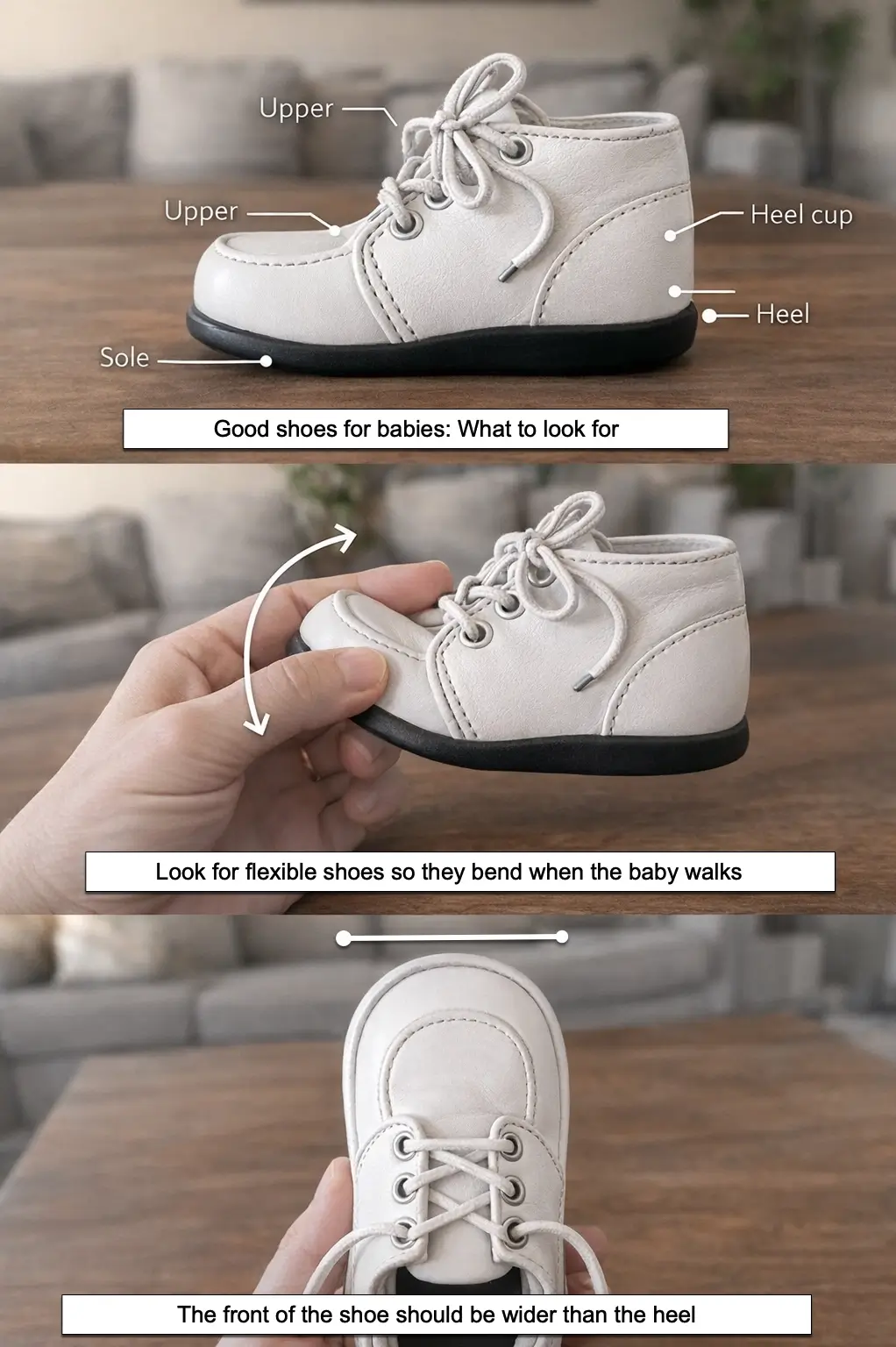
When your baby is ready for outdoor walking, choose shoes that protect without restricting. Look for:
- Flexible soles that bend easily at the ball of the foot
- Lightweight construction
- A wide toe box so toes can spread naturally
- Breathable materials
- Secure but gentle closures such as Velcro or soft straps
Avoid rigid soles, thick platforms, or built-in arch supports unless medically recommended. Babies do not need arch support inserts unless advised by a healthcare professional.
Baby Shoe Sizing Guide for New Walkers
Getting the right size matters more than the brand or style. Babies’ feet are soft, flexible, and still developing. Shoes that are too tight can restrict movement, while shoes that are too loose can cause tripping.
Here’s what parents should know about sizing.
How Fast Do Baby Feet Grow?
In the first year of walking, growth can be surprisingly rapid. Many babies go up half a size or a full size every two to three months. After age two, growth typically slows, but regular checks are still important.
A good rule: check fit every 6 to 8 weeks during the early walking stage.
How to Measure a Baby’s Foot at Home
You do not need special equipment. A simple at-home method works well.
- Place your child standing on a sheet of paper (weight should be on the foot)
- Trace around the foot with a pencil held upright
- Measure from the heel to the longest toe
- Measure the widest part of the forefoot
- Add about 0.5 inches (roughly 1.25 cm) for growing room
Always measure both feet. It is common for one foot to be slightly larger. Fit the shoe to the larger foot.
How Much Growing Room Is Ideal?
New walkers need space, but not too much.
- About a thumb’s width (approximately 0.5 inches) in front of the longest toe
- Snug but not tight across the widest part of the foot
- Heel should stay in place without slipping excessively
Too much extra length can cause instability, especially in early walkers.
U.S. Baby Shoe Size Approximation Chart
Sizing varies slightly by brand, but this general guide helps.
Foot Length (inches) | Approx. U.S. Size | Typical Age Range* | |
|---|---|---|---|
3.5 – 3.75 | 1 | 0 – 6 months | |
3.75 – 4.0 | 2 | 3 – 9 months | |
4.0 – 4.25 | 3 | 6 – 12 months | |
4.25 – 4.5 | 4 | 9 – 15 months | |
4.5 – 4.75 | 5 | 12 – 18 months | |
4.75 – 5.0 | 6 | 15 – 24 months |
*Age ranges are averages. Always size by measurement, not age.
Signs Shoes Are Too Small
Babies cannot always tell you when shoes are uncomfortable. Watch for:
- Red marks after removing shoes
- Toes pressed against the front
- Refusal to walk while wearing them
- Increased tripping
- Shoes difficult to put on
If you notice any of these, remeasure immediately.
Signs Shoes Are Too Big
Oversized shoes can also interfere with balance.
- Heel slipping excessively
- Toes gripping tightly inside the shoe
- Child dragging feet
- Frequent stumbling
A proper fit should feel secure but flexible.
Should Babies Be Professionally Measured?
If possible, having your baby measured in-store can help, especially for first shoes. However, many parents successfully measure at home. If your child has unusually wide feet, very high insteps, persistent in-toeing, or frequent falls beyond what is typical for a new walker, consult your pediatrician before assuming sizing is the issue. For most healthy children, correct length, flexibility, and comfort matter far more than structured “support.”
Frequently Asked Questions
No. Babies learn to walk through muscle development, balance, and coordination. Being barefoot indoors actually helps strengthen the small muscles in the feet and ankles more effectively than wearing structured shoes.
Occasional use for warmth or special occasions is not harmful. However, daily use of stiff or restrictive shoes before independent walking can limit natural foot movement. For pre-walkers, soft socks or booties are usually enough.
In the first year of walking, foot growth can be rapid. It is common for babies to outgrow shoes every two to three months. Check fit regularly by ensuring there is about a thumb’s width of space at the front and no tightness across the widest part of the foot.
A thin, flexible sole that bends easily at the ball of the foot is best. This allows the baby to feel the ground while still protecting against rough surfaces. Thick, rigid soles are generally better suited for older toddlers.
Many daycare centers require shoes once children are mobile for safety reasons. In that case, choose lightweight, flexible shoes that mimic barefoot movement as closely as possible.