Last Updated on September 23, 2026
| Quick Answer: Average Kids Shoe Sizes by Age. Average kids’ shoe sizes typically range from about U.S. size 4C-5C at age 1 to youth sizes 5Y-7Y around age 12. Age is only an estimate because children’s feet grow at different rates, and shoe fit varies by brand and foot width. For a better fit, measure both feet while your child is standing, use the larger measurement and compare it with the shoe manufacturer’s size chart. A general fit guideline is to leave about 10 to 15 mm, or roughly 3/8 to 5/8 inch, of room in front of the longest toe. If you know your child’s foot length, use our Kids Shoe Size Calculator to estimate the appropriate U.S., U.K. and EU size. Ready to shop? See kids’ shoes on Amazon. |
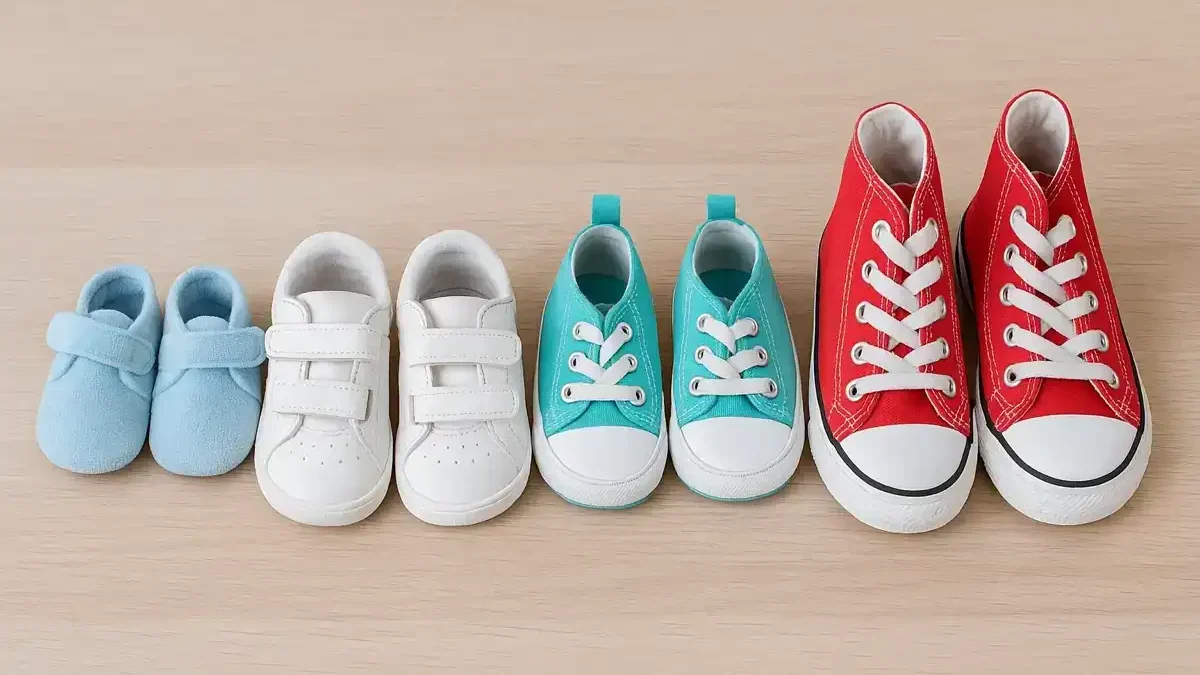
The chart below gives typical U.S. shoe-size ranges by age. These are estimates rather than rules, so a child who falls outside the range for their age does not necessarily have unusually large or small feet. In U.S. kids’ shoe sizing, C generally means child and Y means youth. After size 13C, sizing typically moves to 1Y. For sizing, fit, first-shoe and activity-specific guidance in one place, see our kids’ shoes hub.
Age | Approximate U.S. Shoe Size | Typical Sizing Stage |
|---|---|---|
Newborn to 3 months | 0C-2C | Baby |
3-6 months | 2C-3C | Baby |
6-12 months | 3C-4.5C | Baby/Toddler |
1 year | 4C-5C | Toddler |
2 years | 5C-7C | Toddler |
3 years | 7C-9C | Toddler |
4 years | 9C-11C | Little Kid |
5 years | 10C-12C | Little Kid |
6 years | 11C-13C | Little Kid |
7 years | 12C-1Y | Little Kid/Youth |
8 years | 1Y-3Y | Youth |
9 years | 2Y-4Y | Youth |
10 years | 3Y-5Y | Youth |
11 years | 4Y-6Y | Youth |
12 years | 5Y-7Y | Youth |
13+ years | Youth and adult sizes may overlap | Youth/Adult |
Use the chart to identify a reasonable starting size, then measure the child’s feet before ordering.
Kids Shoe Sizing at a Glance
If you need a fast answer, these are some of the most useful kids’ shoe-sizing facts to know.
| Question | Quick Answer |
|---|---|
| Average shoe size at age 1 | About 4C-5C |
| Average shoe size at age 2 | About 5C-7C |
| Average shoe size at age 5 | About 10C-12C |
| Average shoe size at age 8 | About 1Y-3Y |
| Average shoe size at age 10 | About 3Y-5Y |
| Average shoe size at age 12 | About 5Y-7Y |
| What size comes after 13C? | 1Y |
| Best way to determine shoe size | Measure both feet |
| Which foot should determine size? | The larger foot |
| Recommended toe room | About 10-15 mm |
| Are boys’ and girls’ sizes different? | Generally no |
| Does youth sizing overlap adult sizing? | Yes |
How Accurate Is Shoe Size by Age?
Age is useful for estimating where to start, but it is not a reliable way to determine the exact shoe size a child needs. Children grow at different rates. Two 7-year-olds, for example, can easily wear different shoe sizes while both having perfectly normal foot development.
Shoe fit also varies among manufacturers. A child who wears one size in Nike may need a slightly different size or width in another brand. The more reliable approach is to use age to identify a starting range, then measure both feet and compare the larger measurement with the manufacturer’s sizing chart.
What Matters More Than Age When Choosing Kids’ Shoes?
A child’s actual foot measurements are more useful than age when determining shoe size. Several factors can affect whether a shoe fits comfortably.
The most important factors include:
- Heel-to-toe foot length.
- Foot width.
- Differences between the left and right foot.
- The shape of the shoe’s toe box.
- The manufacturer’s sizing system.
If the age chart and the child’s measured foot length point toward different sizes, use the measurement rather than the age estimate.
How to Measure a Child’s Foot at Home
You do not need specialized equipment to measure a child’s foot. A sheet of paper, pencil and ruler or measuring tape will work.
For a useful measurement:
- Have your child stand with their full weight on the foot.
- Trace around the foot while keeping the pencil upright.
- Measure from the back of the heel to the end of the longest toe.
- Repeat the process with the other foot.
- Use the larger of the two measurements when choosing a size.
Once you have the heel-to-toe measurement, use our Kids Shoe Size Calculator to estimate the appropriate size.
If you are buying immediately afterward, browse kids’ shoes on Amazon and compare your child’s measurement with the individual manufacturer’s size chart before ordering.
What Size Kids’ Shoe Should I Buy?
Start with the size suggested by your child’s measured foot length rather than choosing a shoe only from age.
The shoe should provide roughly 10 to 15 mm of room in front of the longest toe without allowing excessive movement at the heel. The widest part of the child’s foot should also sit comfortably inside the widest part of the shoe.
If one foot is larger than the other, fit the shoe to the larger foot. Because sizing can vary among manufacturers, always compare your measurement with the size chart for the actual shoe you are considering.
Know the measurement? Use our Kids Shoe Size Calculator.
Ready to buy? See current kids’ shoe options on Amazon.
What Do C and Y Mean in Kids’ Shoe Sizes?
Children’s shoe sizes can be confusing because the numbers eventually restart.
C generally means child and is used for smaller children’s sizes. Y means youth and is used for larger children’s sizes.
A typical progression looks like this:
10C → 11C → 12C → 13C → 1Y → 2Y → 3Y → 4Y
In other words, 1Y is larger than 13C.
Retailers may also use terms such as Toddler, Little Kid, Big Kid, Preschool or Grade School. These labels are not always used identically from one company to another.
Sneaker retailers also commonly use abbreviations such as TD, PS and GS. See our guide to what PS, GS and other kids’ shoe-sizing terms mean for a more detailed explanation.
Kids Shoe Size Conversion Chart
Children’s shoe sizes use different numbering systems in the United States, United Kingdom and Europe. The chart below provides approximate conversions. Always check the manufacturer’s own size chart before ordering because conversion points can vary.
U.S. Kids Size | U.K. Size | EU Size | Approx. Foot Length |
|---|---|---|---|
1C | 0.5 | 16 | 3.5 in / 9 cm |
2C | 1.5 | 17 | 4.0 in / 10 cm |
3C | 2.5 | 18-18.5 | 4.25 in / 11 cm |
4C | 3.5 | 19-20 | 4.5 in / 11.5 cm |
5C | 4.5 | 21 | 4.75 in / 12 cm |
6C | 5.5 | 22 | 5.0 in / 12.5 cm |
7C | 6.5 | 23-23.5 | 5.25 in / 13.5 cm |
8C | 7.5 | 25 | 5.75-6.0 in / 14.5-15 cm |
9C | 8.5 | 26 | 6.0-6.25 in / 15-16 cm |
10C | 9.5 | 27-27.5 | 6.25-6.5 in / 16-16.5 cm |
11C | 10.5 | 28 | 6.75 in / 17 cm |
12C | 11.5 | 29-30 | 7.0 in / 17.5-18 cm |
13C | 12.5 | 31 | 7.25-7.5 in / 18.5-19 cm |
1Y | 13-13.5 | 32-32.5 | 7.5-8.0 in / 19-20 cm |
2Y | 1-1.5 | 33-33.5 | 8.0-8.25 in / 20-21 cm |
3Y | 2-2.5 | 34-35 | 8.25-8.75 in / 21-22 cm |
4Y | 3-3.5 | 35.5-36 | 8.5-9.0 in / 21.5-23 cm |
5Y | 4-4.5 | 37-37.5 | 9.0-9.25 in / 23-23.5 cm |
6Y | 5-5.5 | 38-38.5 | 9.5 in / 24 cm |
7Y | 6-6.5 | 39-40 | 9.75-10.0 in / 25 cm |
Shoe size by age
If you already know the child’s shoe size and simply need the equivalent in another sizing system, use our Kids Shoe Size Country Converter.
What Shoe Size Does a 1-Year-Old Wear?
A 1-year-old commonly wears around a U.S. toddler size 4C-5C. There is considerable variation at this age, particularly because some children have only recently begun walking. Measure the child’s feet before buying rather than relying on age alone.
What Shoe Size Does a 2-Year-Old Wear?
A 2-year-old commonly wears approximately a U.S. size 5C-7C. Feet can grow quickly at this age, so shoes that fit a few months ago may already be too small. Recheck the child’s foot measurement regularly.
What Shoe Size Does a 3-Year-Old Wear?
A 3-year-old commonly wears approximately a U.S. size 7C-9C. If you are shopping online, compare the child’s foot measurement with the manufacturer’s size chart instead of ordering solely by age.
What Shoe Size Does a 4-Year-Old Wear?
A 4-year-old commonly wears approximately a U.S. size 9C-11C. Retailers may begin describing shoes in this range as Little Kid or Preschool sizes. Those labels describe general sizing categories rather than strict age groups.
What Shoe Size Does a 5-Year-Old Wear?
A 5-year-old commonly wears approximately a U.S. size 10C-12C. Foot width becomes increasingly important as well. Children with the same foot length may need different shoes if one child has a wider foot.
If standard-width shoes frequently feel tight, see New Balance kids’ shoes on Amazon, where many models are available in multiple widths.
What Shoe Size Does a 6-Year-Old Wear?
A 6-year-old commonly wears approximately a U.S. size 11C-13C. Some children are approaching the transition into youth sizing at this age. Remember that 1Y follows 13C.
What Shoe Size Does a 7-Year-Old Wear?
A 7-year-old commonly wears approximately a U.S. size 12C-1Y. Because this is near the point where the numbering system restarts, measuring the foot can help determine whether the child needs 13C, 1Y or another nearby size.
What Shoe Size Does an 8-Year-Old Wear?
An 8-year-old commonly wears approximately a U.S. youth size 1Y-3Y. The difference in foot size among children of the same age becomes increasingly noticeable, so treat this range as a starting point only.
What Shoe Size Does a 9-Year-Old Wear?
A 9-year-old commonly wears approximately a U.S. youth size 2Y-4Y. Check both foot length and width before choosing a shoe because fit can vary considerably among different models.
What Shoe Size Does a 10-Year-Old Wear?
A 10-year-old commonly wears approximately a U.S. youth size 3Y-5Y.
Youth sizes begin overlapping numerically with adult men’s shoe sizes. Women’s sizing uses a different scale, so a youth size is not automatically the same women’s size.
What Shoe Size Does an 11-Year-Old Wear?
An 11-year-old commonly wears approximately a U.S. youth size 4Y-6Y. Some children may already fit adult shoe models, while others will remain within youth sizing. Foot measurement is more useful than age at this stage.
What Shoe Size Does a 12-Year-Old Wear?
A 12-year-old commonly wears approximately a U.S. youth size 5Y-7Y. By this age, age alone is a relatively poor predictor of actual shoe size because individual growth patterns can differ substantially.
How Much Growing Room Should Kids’ Shoes Have?
Children need some extra room in front of their toes, but buying shoes several sizes too large is not a good solution. A useful general target is approximately 10 to 15 mm, or about 3/8 to 5/8 inch, between the longest toe and the front of the shoe. The toe box should also be wide enough for the toes to sit naturally rather than being compressed together. Shoes that are too large can allow excessive movement inside the shoe and may make walking or running less comfortable.
Signs Your Child’s Shoes May Be Too Small
Children do not always complain when their shoes become tight. Gradual growth can make the change difficult for them to notice.
Signs worth checking include:
- Toes pressing against the front of the shoe.
- Redness, blisters or pressure marks after wearing the shoes.
- Complaints of foot or toe discomfort.
- The sides of the foot appearing squeezed.
- Shoes becoming harder to put on or fasten.
A shoe may also be the wrong shape or width even when its length appears adequate.
How Often Should You Measure Kids’ Feet?
Children’s feet grow throughout childhood, so their shoe size should be checked regularly. For school-age children, checking sizing about every four to six months is a useful general guideline. Younger children may need to be measured more frequently. Measure sooner if your child experiences a growth spurt, starts complaining about previously comfortable shoes or develops areas of rubbing or pressure.
Are Boys’ and Girls’ Kids Shoe Sizes the Same?
Standard U.S. children’s shoe sizing generally uses the same numerical scale for boys and girls. A youth 4Y, for example, does not become a different numerical size simply because a shoe is marketed to boys rather than girls.
Individual models can still fit differently because of differences in width, shape, materials and construction.
When Do Kids Move Into Adult Shoe Sizes?
There is no specific age when a child must start wearing adult shoes. The transition happens when the child’s feet become large enough to fit the adult sizes offered by a shoe manufacturer.
Youth sizing overlaps with U.S. men’s sizing. In many brands, a youth 7Y is approximately equivalent to a men’s size 7.
Women’s sizing uses a different scale. A youth 7Y is commonly around a women’s size 8.5, although brand-specific charts should always be checked.
See our guide to kids vs. women’s shoe sizes if you need to convert between the two systems.
What Kids’ Shoes Should You Buy?
Once you know your child’s approximate size, choose shoes based on how they will be used, how the child’s foot is shaped and whether any specific fit concerns need to be addressed.
For general everyday footwear, browse kids’ shoes on Amazon.
For children who need more width choices, see New Balance kids’ shoes on Amazon.
For athletic and sport-inspired footwear, see Nike kids’ shoes on Amazon.
For toddlers and younger children, see Stride Rite kids’ shoes on Amazon.
For flexible children’s footwear, see See Kai Run shoes on Amazon.
For casual and athletic options across a broad range of prices, see Skechers kids’ shoes on Amazon.
If your child has a more specific footwear need, these BestWalkingFeet guides can narrow the choices further:
- Best kids’ shoes for flat feet
- Best kids’ shoes for overpronation
- Best kids’ running shoes
- Best soccer cleats for kids
- Best winter boots for kids
These buying guides are most useful once you know the child’s approximate shoe size and are ready to choose a specific type of footwear.
Common Questions About Kids’ Shoe Sizes
Age can provide an approximate starting point, but it cannot reliably determine the correct size for an individual child. Measure both feet and use the larger measurement.
Toddler sizes vary considerably. A 1-year-old may wear around 4C-5C, while many 3-year-olds wear approximately 7C-9C.
In typical U.S. children’s sizing, 1Y comes after 13C. The sequence then continues through 2Y, 3Y and larger youth sizes.
C generally means child and is commonly used for smaller children’s shoe sizes.
Y means youth and is commonly used for larger children’s shoe sizes.
Yes. In U.S. children’s sizing, 1Y typically comes immediately after 13C.
A U.S. youth 7Y generally corresponds closely to a U.S. men’s size 7. It is not equivalent to a women’s size 7. A youth 7Y is commonly around a women’s size 8.5.
Children need some growing room, but substantially oversized shoes are not recommended. A useful general guideline is approximately 10 to 15 mm of space ahead of the longest toe.
Yes. One foot is often slightly larger than the other. Select the shoe size based on the larger foot.
Yes. Internal length, width, toe-box shape and overall fit can differ among manufacturers and even among models from the same brand.
No. Children’s shoes should feel comfortable when first worn. Do not rely on a shoe stretching enough to correct a poor initial fit.
Look for pressure or redness along the sides of the foot, bulging over the edge of the sole or toes being squeezed together. Measuring foot width can also help.
Yes. Age provides an approximate range, while heel-to-toe foot length gives you a much more useful starting point for selecting a size.
A general guideline is approximately 10 to 15 mm, or about 3/8 to 5/8 inch, between the longest toe and the front of the shoe.
School-age children’s feet should generally be checked about every four to six months, and younger children’s feet may need to be checked more frequently.
How We Built This Kids Shoe Size Guide
There is no official shoe size assigned to every age. The age ranges in this guide are intended to help parents and caregivers identify a reasonable starting point when they do not yet know a child’s actual size.
BestWalkingFeet compares commonly used U.S. children’s sizing conventions with measurement and fit guidance from major footwear manufacturers and professional foot-health organizations.
Because brands can use different shoe shapes and sizing specifications, we recommend measuring both feet and checking the size chart published for the specific shoe before buying.
For the most accurate next step, enter your child’s heel-to-toe measurement into our Kids Shoe Size Calculator.
Ready to shop? Browse kids’ shoes on Amazon.