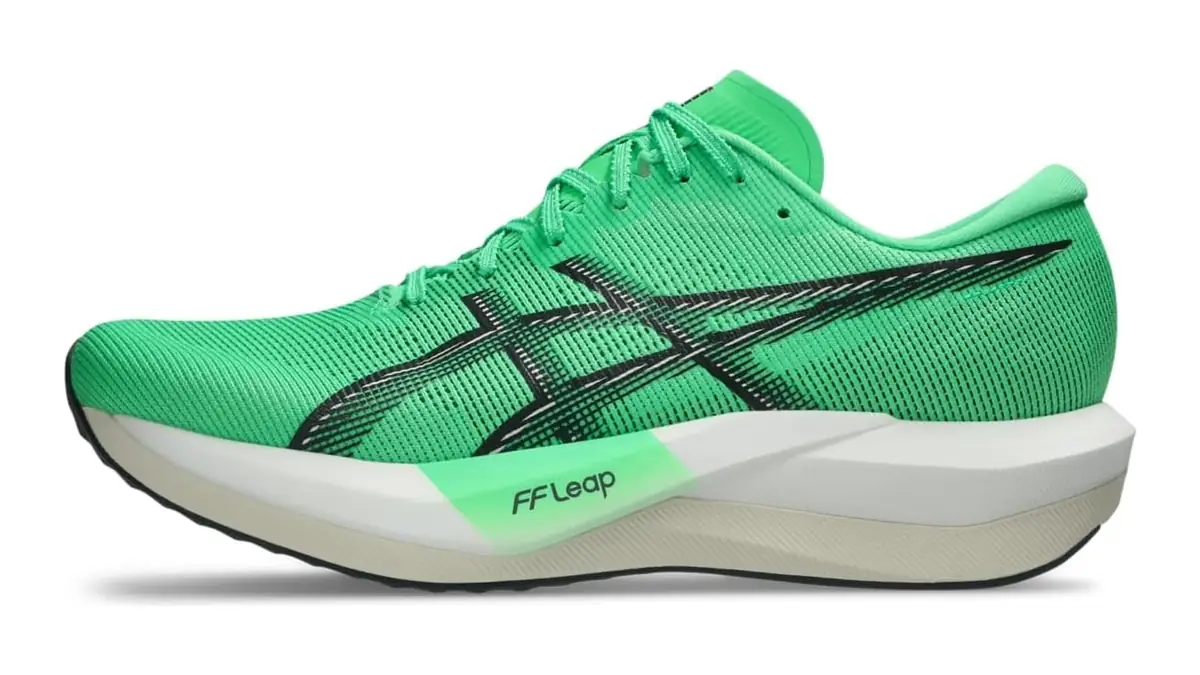
Sharp, eager speed with a firm ride and a near-racer price
Quick Answer: Asics Magic Speed 5 Review: The Magic Speed 5 is Asics’ plated shoe for fast training and shorter races, and this version is a lot leaner than the last. It is lighter, lower to the ground and firmer, with a carbon-infused plate that stiffens the sole without the harshness of a full carbon racer. Buy it if you do weekly speed sessions and race 5K to half marathon. Skip it if you want one cushioned shoe for everything, because this one is built to go fast. Check latest price.
The Asics Magic Speed 5 occupies a useful middle ground. Above it sits the Metaspeed range, which is full carbon, extremely light and priced accordingly. Below it sit the Novablast and Gel-Cumulus trainers that most people run their daily miles in. The Magic Speed is the plated shoe you can afford to train in, and its job is to give you some of the racing-shoe sensation on a Tuesday evening interval session without destroying a $270 pair of shoes.
Version 5 reinvents it. Where the Magic Speed 4 was a fairly tall, cushioned shoe that happened to have a plate, this one drops weight and stack height and turns into something much closer to the ground. That makes it feel keener and more responsive, and it also narrows what the shoe is good for. If you enjoy running fast and you have a separate shoe for easy days, we think this is a good buy. If you were hoping for one plated shoe to cover everything, look at the Superblast instead.
Specs
Here are the specifications for the Asics Magic Speed 5:
| Type | Plated speed trainer and short-distance racer |
| Gait type | Neutral |
| Midsole | FF Leap on top, a light springy foam, over a base of FF Blast+, the firmer everyday training foam |
| Plate | Carbon-infused plate, meaning nylon with carbon fibers mixed in rather than solid carbon. It stiffens the sole but bends more than a full carbon plate, which makes it easier to run slowly in |
| Stack height | Asics lists about 37 mm at the heel and 30 mm at the forefoot. Independent measurement puts the forefoot closer to 26.6 mm, so the figures are disputed. Either way it is lower than the Magic Speed 4 |
| Heel-to-toe drop | 7 mm as listed, with independent measurement closer to 8.7 mm. Your heel sits moderately higher than your toes |
| Weight | About 6.8 oz (193 g). Asics uses unisex sizing here, so that covers a men’s 9 and a women’s 10.5 |
| Upper | Thin engineered mesh with light padding, built for speed rather than comfort |
| Outsole | AsicsGRIP rubber in the high-wear areas |
| Widths | Standard only, in unisex sizing |
| Surface | Road, track and treadmill |
| Price | Launched at $180 in January 2026. Check latest price |
Pros
- At about 6.8 oz it is genuinely light, and that alone makes fast running feel easier.
- The lower stack puts you closer to the road, which makes the shoe feel sharp and connected on a track or a fast stretch of pavement.
- A carbon-infused plate is more forgiving than solid carbon, so the shoe is usable at more than one pace.
- FF Leap gives the front of the shoe some genuine spring rather than just stiffness.
- It is around $90 cheaper than a full carbon racer, and far more durable.
Cons
- It is firm. Runners who liked the Magic Speed 4 for long runs will find this much less protective.
- At $180 it sits awkwardly close to shoes that do more, which is the main argument against it.
- The lower stack makes it less suitable for a marathon than the previous version was.
- Standard width only, with a close, race-oriented fit.
What is new versus the Magic Speed 4
Asics has changed the shoe’s purpose, not just its parts. The Magic Speed 4 was a tall, cushioned plated trainer that many people used for long runs as well as workouts. The Magic Speed 5 cuts a noticeable amount of weight and lowers the whole platform, which turns it into a leaner, faster tool. Sitting closer to the ground means you feel the road more, your foot is more stable at speed and the shoe reacts more quickly when you change pace.
The foam has changed too. FF Leap now sits on top, which is the same springy ATPU foam Asics put in its Metaspeed racers, and FF Blast+ underneath provides the firmer, more durable base. The result is a top layer that gives some bounce and a bottom layer that keeps the shoe from feeling squishy. The plate remains carbon-infused rather than solid carbon, which is deliberate. A fully rigid plate is fantastic at race pace and unpleasant at any other, and this one lets the shoe bend enough to stay usable in a warm-up. If you liked the 4 because it was soft and comfortable, be aware this is a different shoe.
Who should buy the Magic Speed 5
Buy it if speed work is a regular part of your week. It is the right shoe for intervals, tempo runs, parkrun and racing from 5K to a half marathon, and it is light enough that it makes those sessions feel good rather than laborious. If you have never run in a plated shoe, this is a sensible first one, because the semi-flexible plate is easier on the calves than solid carbon and you are not risking $270 to find out whether you like the sensation.
It also suits people who want race-shoe feel with real durability. Full carbon racers wear out fast and are too expensive to train in, while this shoe has a proper outsole and a firmer base foam, so it will handle a training block. If you already own a comfortable daily trainer and want one shoe that makes you feel quick, this is a good fit. Runners with narrower feet will get on with it best.
Who should probably skip it
Skip it if you want one shoe for everything. The firm, low platform is not comfortable for slow easy miles and it is not enough shoe for a marathon, so it needs a cushioned companion in the rotation. Skip it if you ran in the Magic Speed 4 specifically because it was tall and soft, because this version has moved away from that. And skip it if $180 is a stretch, since the sessions this shoe improves are ones you can complete perfectly well in a light daily trainer.
If that is the case, spend the money here instead:
- Asics Novablast 6: bouncy, light and enthusiastic enough to handle a tempo run while still being comfortable for daily miles (check price | read review).
- Asics Gel-Cumulus 28: the straightforward cushioned trainer, and the better buy if most of your running is easy (check price | read review).
- Asics Gel-Nimbus 28: deep, soft cushioning for long runs, standing and walking, which is the opposite of what the Magic Speed offers (check price | read review).
How does the Asics Magic Speed 5 fit?
The fit leans toward racing: close through the heel and midfoot, with just enough space at the toes. It is not as severe as a full carbon racer, but it is not a relaxed trainer either. Order your usual size and remember the sizing is unisex.
Fit and sizing
True to length. Because Asics uses one unisex size run for this shoe, a woman who normally buys a size 8 should be looking for around a 6.5 in this shoe’s numbering, so check the conversion chart rather than guessing. The midfoot holds firmly, which is what you want when you are running fast, and the toe box is adequate rather than roomy. Wide feet will struggle, since there is no wider option and the upper has little stretch. Anyone with a high instep should try loosening the middle of the lacing before writing the shoe off.
Upper and step-in comfort
The mesh is thin and breathes well, with just enough padding at the collar and tongue to stop the shoe feeling harsh. Step-in comfort is better than a racing shoe and clearly below a daily trainer, which is the right balance for something you will do fast sessions in. Heel hold is secure without a stiff plastic counter. It is a light, honest upper, and it should stand up to a training block better than the fragile mesh on a full carbon racer.
How does the Asics Magic Speed 5 perform?
The Magic Speed 5 is a shoe that gets better the faster you run. It is light, firm and quick to respond, and it holds a fast pace with very little fuss. At easy pace it is merely adequate.
Cushioning and ride
This is a firm shoe and it makes no apology for it. The FF Leap top layer supplies the spring you feel when you push off, and the FF Blast+ underneath keeps the platform from sinking. Because the whole thing is lower than the Magic Speed 4, you sit closer to the road and you feel more of it. For fast running that is a benefit, because a low, firm platform is stable and gives you something to push against. For a slow run on concrete it is less kind, and long efforts will leave your legs more tired than a cushioned shoe would.
Ride and running performance
What creates the forward motion is the plate stiffening the front of the shoe so your toes do not have to hold the load, combined with a modest upward curve at the toe that helps you roll off. Because the plate is carbon-infused rather than solid, the effect is a nudge rather than a shove, which is why the shoe still works at a range of paces. Interval sessions are where it shines, and it holds a fast, controlled rhythm nicely over 5K and 10K. A half marathon is within reach for most people. A marathon is asking too much of the cushioning.
Stability and support
This is a neutral shoe with no support features, and it is more stable than most fast shoes for a simple reason: it is low. Stability problems in modern shoes come from sitting high on soft compressible foam, where the foot has room to tip sideways before anything stops it. Dropping the stack height removes most of that risk, and the firm base foam does the rest. That makes it a confident shoe on a track or a cambered road. It offers nothing for feet that roll inward and it will not influence how you run, so anyone who needs support should look at a stability trainer instead.
Outsole, grip and durability
AsicsGRIP rubber covers the areas that actually take the wear, and grip on dry road and on a track is very good. Wet pavement is fine with a little care. Durability is one of the reasons to choose this over a racing shoe: the firmer FF Blast+ base holds its shape longer than a pure PEBA midsole, and there is real rubber on the sole. A shoe like this used for one or two fast sessions a week should last a full training block, and the usual 300 to 500 mile guideline for a trainer is a reasonable expectation, though it varies with your weight, stride and surfaces.
Is the Asics Magic Speed 5 good for walking?
It is a poor choice for walking, and there are two reasons. The plate is there to stop the sole bending, and walking depends on the forefoot flexing through every step, so the shoe feels stiff and awkward at walking speed. The semi-flexible carbon-infused plate makes it less rigid than a full carbon racer, so it is not as bad as a Metaspeed, but it still fights you rather than helping.
The second reason is cushioning. A low, firm platform is exactly what you want when you are pushing off hard at speed and exactly what you do not want when you are landing gently on concrete for an hour. Walkers and anyone on their feet all day will be far more comfortable in a cushioned trainer. If you want one Asics shoe for walking and easy running, the Gel-Cumulus or Gel-Nimbus are built for it and cost less.
Magic Speed 5 versus Magic Speed 4
The two versions have quite different personalities:
Magic Speed 5 | Magic Speed 4 | |
Weight | About 6.8 oz, noticeably lighter | Heavier |
Stack height | Lower, closer to the road | Taller and more cushioned |
Top foam | FF Leap, the springier racing foam | FF Blast Turbo |
Ride | Firm, direct and quick to react | Softer and more forgiving |
Best use | Intervals, tempo runs, 5K to half marathon | Faster long runs and marathon distance |
Buy the new model if you want a sharper shoe for speed sessions and shorter races, and if you already have something cushioned for easy days. Buy the previous model if you liked using one plated shoe for long runs and marathons, because the 4 has the cushioning for that and this one does not. Discounted stock of the 4 makes that an easy decision.
Asics Magic Speed 5 Alternatives
The Magic Speed 5 is light, firm, plated and priced between a trainer and a racer. These options each sit somewhere different on that scale.
- Asics Superblast 2: no plate at all but a huge stack of bouncy foam, which makes it the shoe to buy if you want one pair for long runs, tempo work and everything between (check price | read review).
- Asics Metaspeed Sky Tokyo: the full carbon racer with a marathon stack of foam, and the right purchase if you are actually chasing a time rather than training (check price).
- Brooks Hyperion 3: cheaper, unplated and extremely light, and a good answer if you want a fast shoe for 5K work without paying for a plate (check price | read review).
- Asics Magic Speed 4: the more cushioned version of the same concept, and the better pick if marathon distance is on your calendar (check price).
Price and value
Asics launched the Magic Speed 5 at $180, and this is the one place the shoe is genuinely open to criticism. It is $40 more than a good daily trainer and $90 less than a full carbon racer, which sounds reasonable until you notice how narrow its job is. Where it earns the money is durability: unlike a racing shoe you can use this once or twice a week for a whole training block. If speed sessions are a fixed part of your routine, that works out well. If they are occasional, a light daily trainer covers the same ground for less.
Final verdict
Best for: runners who do a weekly speed session and race from 5K to half marathon, and who already own a cushioned shoe for easy days.
Avoid if: you want one shoe for everything, you run marathons, you mostly walk or you need a wide fit.
Fit: true to length in unisex sizing, snug through the midfoot, standard width only. Check the unisex conversion before ordering.
Verdict: Asics has turned the Magic Speed back into a proper speed shoe, and on a track or a fast road session it is a pleasure. Lighter, lower and keener than the 4, with a plate that helps without punishing your calves. The trade is real, because it is no longer the versatile long-run shoe some people bought the last version for, and $180 asks a lot of a specialist. Get it if you like running fast. Check the latest price.
Frequently Asked Questions for Asics Magic Speed 5
Yes on length, but check the sizing system. Asics sells this shoe in unisex sizing, so a women’s US 8 corresponds to roughly a 6.5 in this shoe’s numbering. The fit is snug through the midfoot and there is no wide option.
It is nylon with carbon fibers mixed into it rather than a solid sheet of carbon fiber. That makes it stiff enough to help you push off but flexible enough to run slowly in, and it is considerably cheaper to produce. It is the reason this shoe is usable in training while a full carbon racer is not.
You can finish one in it, but we would not choose it. The lower, firmer platform gives less protection than the previous version and the last 10 kilometers will be harder on your legs than they need to be. For marathon distance, look at a taller shoe.
It is one of the better ones. The semi-flexible plate is easier on the calves and Achilles than solid carbon, the shoe is affordable enough to experiment with and it is durable enough to use regularly. Introduce it gradually, starting with short fast segments rather than a whole session.
The Metaspeed shoes are lighter, taller, use solid carbon plates and cost about $90 more. They are faster on race day and useless for training. The Magic Speed is the shoe you actually wear week to week, and for most amateur runners it is the more sensible purchase.
Asics measures its shoes one way and independent reviewers cut them open and measure them another, and on this model the forefoot figures differ by several millimeters. The direction of travel is not in dispute: this shoe is lower than the Magic Speed 4.