Last Updated on October 10, 2026
The most cushioned Cumulus yet
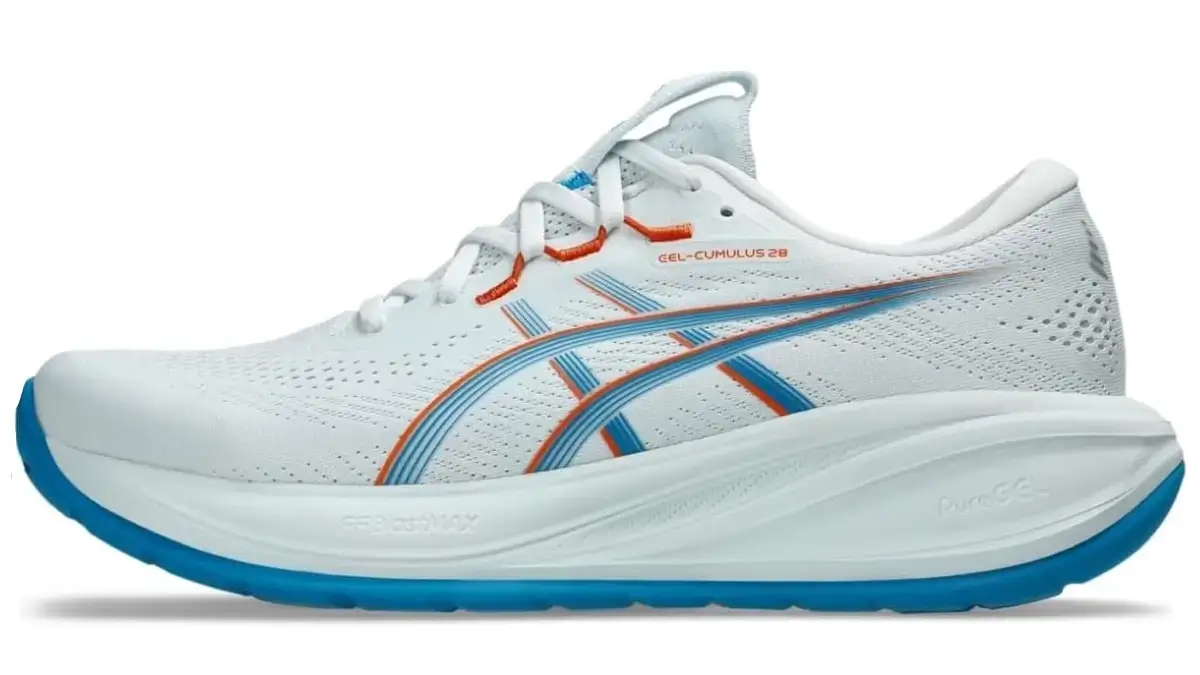
Quick Answer: Asics Gel-Cumulus 28 Review: The Asics Gel-Cumulus 28 is a neutral daily trainer for heel strikers who want plush, protective cushioning at a sensible price. New FF Blast Max foam sits on a very tall, wide platform with a PureGEL insert under the heel, and the result is one of the softest landings in the category alongside a genuinely stable base. It is also lighter and roomier in the toes than the Cumulus 27. The catch is a muted, low-rebound ride and a foam outsole that wears faster than rubber. Check latest price.
The Asics Gel-Cumulus 28 (check price) has quietly stopped being Asics’ modest mid-range trainer. Stack height, meaning the amount of foam between your foot and the road, has grown for two versions running and now measures about 42.8 mm at the heel in independent testing, which puts it above shoes that market themselves as maximum cushion. The Cumulus now sits close to the Gel-Nimbus in feel while costing less.
The headline change is the foam. Asics replaced FF Blast Plus with FF Blast Max, the same compound family used in its bouncier models, and paired it with a firmer secondary layer called FluidRide that doubles as most of the outsole. That combination is what makes a shoe this tall feel steady rather than wobbly, and it is also why the Cumulus 28 weighs a light 8.9 ounces in independent measurement despite all that height.
Where the shoe falls short is the payback. Energy return, the share of the force you put into the foam that comes back out, measured 50.5 percent at the heel against a 58.6 percent average. FF Blast Max delivers bounce in other Asics models but not here, most likely because the PureGEL insert and the firm FluidRide layer absorb it. You get comfort and protection, not propulsion.

Specs
Here are the specifications for the Asics Gel-Cumulus 28:
| Type | Road neutral daily trainer |
| Foot and gait type | Neutral, best suited to heel strikers, workable for mild pronation |
| Midsole foam | FF Blast Max with a PureGEL insert under the heel and a firmer FluidRide layer below |
| Stability system | None. Stability comes from platform width, a heel flare and a stiff heel counter |
| Weight (men’s 9) | 9.1 oz / 259 g listed, 8.9 oz / 252 g independently measured |
| Weight (women’s 8) | 7.8 oz / 221 g listed |
| Heel-to-toe drop (?) | 8 mm listed, 13.3 mm independently measured. Treat the listed figure as approximate. |
| Stack height | 38 mm heel / 30 mm forefoot listed, 42.8 mm / 29.5 mm independently measured |
| Upper | Engineered mesh with an inner comfort layer, knit tongue and stiff heel counter |
| Outsole | Exposed FluidRide foam with rubber at the heel and a new rubber forefoot section |
| Widths | Standard, wide and extra wide, depending on market and colorway |
| Surface | Road, treadmill, paved path |
| Price | $145 at launch, February 2026. Check latest price |
Pros
- Landings are genuinely plush, with heel shock absorption measuring above average and a soft 31.9 durometer reading on the foam.
- A wide base, a flared heel and a stiff heel counter make a 42 mm stack feel planted rather than tippy, which is rare at this height.
- At 8.9 ounces measured it is lighter than the category average despite having far more foam than most rivals.
- The toe box grew from 71.1 mm to 74.4 mm, fixing the tapered forefoot that put people off the Cumulus 27.
- The knit tongue and inner-lined mesh give it a step-in comfort closer to a shoe costing $40 more.
Cons
- Energy return measured well below average at both heel and forefoot, so the ride feels flat as soon as you speed up.
- Most of the outsole is exposed foam rather than rubber, which wears faster and is the shoe’s clearest durability weakness.
- Independently measured drop of 13.3 mm is far higher than the listed 8 mm, which will bother forefoot and midfoot strikers.
- Breathability scored 3 out of 5 because a second inner layer under the mesh blocks airflow, so feet run warm in summer.
- The PureGEL heel insert adds softness but appears to be part of why rebound is so muted.
What is new versus the Asics Gel-Cumulus 27
Three things changed that you will actually notice. First, the midsole switched from FF Blast Plus to FF Blast Max, which drops the durometer reading to 31.9 and moves the shoe from cushioned into plush. Second, the heel grew again, from roughly 40.9 mm to 42.8 mm in independent measurement, on top of the large jump the Cumulus 27 already made.
Third, and most welcome, the forefoot opened up. Measured toe box width went from 71.1 mm to 74.4 mm, which moves the shoe from below average to above it and removes the single most common complaint about the previous version. Toe box height stayed generous at 29.1 mm.
Elsewhere the changes are smaller. Weight came down about 3 percent, wet-concrete traction improved slightly from 0.50 to 0.54 thanks to a new rubber panel in the forefoot, and the price rose $5. Shock absorption stayed essentially identical, which tells you the foam swap changed the feel of the shoe more than its measurable protection.
Who should buy the Asics Gel-Cumulus 28
Buy the Asics Gel-Cumulus 28 if you land on your heel and want as much foam under it as you can get without giving up stability. The combination of a flared heel, a wide platform and an aggressive rearfoot rocker, meaning the curved shape that helps the foot roll forward, makes this one of the smoothest heel-to-toe transitions in the price bracket.
It is also the right pick if firm shoes bother you. At 31.9 on the Asker C scale the foam is measurably softer than average, and the PureGEL insert takes the edge off the initial contact. Runners returning to training after time off, heavier runners who want protection, and anyone doing most of their mileage on concrete will get on well with it.
Finally, consider it if the Cumulus 27 fit you badly. The wider forefoot changes the shoe more than the numbers suggest, and with standard, wide and extra wide options it now covers a much broader range of feet than it used to.
Who should avoid the Asics Gel-Cumulus 28
Avoid it if you land on your forefoot or midfoot. The measured drop of 13.3 mm is one of the highest in current testing and nearly 5 mm more than Asics lists. That geometry props your heel up and makes the shoe feel like it is working against a forward landing rather than with it.
Skip it too if you want one shoe that covers easy runs and faster work. Nothing here creates forward motion: the rebound is low, the forefoot rocker is deliberately mild, and there is no plate. Push the pace and the shoe simply feels heavy underfoot even though it is not heavy on the scale.
High-mileage runners on rough asphalt should also think twice. Because the outsole is mostly exposed FluidRide foam rather than rubber, abrasion shows up sooner than it would on a conventional trainer, and that is the shoe’s weakest long-term point.
How does the Asics Gel-Cumulus 28 fit?
Here is what you need to know about the Cumulus 28 fit, comfort and sizing.
Fit and sizing
Order your usual size. Owner sizing feedback points clearly to true to size, and measured internal length of 270 mm sits within a millimetre of the lab average, so there is nothing unusual about the length.
Overall width measured 94.5 mm, marginally under the 95.2 mm average, so the midfoot is a standard, slightly close fit. The forefoot is where the shoe improved: 74.4 mm of toe box width now sits above average, and 29.1 mm of height is comfortably above it. In practice that means toes have room to splay without the shoe feeling sloppy. Wide and extra wide versions exist in most markets for feet that need more, and they are a better answer than sizing up, which would push the flex point past your toes.
Upper and step-in comfort
Step-in comfort is the best thing about the upper. The engineered mesh carries a soft secondary layer underneath, the tongue is knit rather than padded foam, and the heel collar is well shaped. Nothing needs breaking in and there are no seams sitting where they can rub.
That inner layer costs airflow. Breathability rated 3 out of 5 against an average of 3.6, and microscope inspection shows the second layer blocking much of the mesh. The tongue lets some air through, which helps, but this is a warm shoe for July. The heel counter is stiff, which combined with the padded collar locks the rearfoot down firmly, and the sockliner lifts out for anyone using custom orthotics.
How does the Asics Gel-Cumulus 28 perform?
Here’s how the shoe performs.
Midsole and cushioning
The midsole is a three-part system. FF Blast Max makes up the bulk and measured 31.9 on the Asker C durometer, placing it in plush territory. A PureGEL insert sits under the heel to take the sting out of contact. Underneath both sits FluidRide, a much firmer foam at 54.9 durometer that stabilises the stack and forms most of the ground contact surface.
Shock absorption measured 139 at the heel and 110 at the forefoot, both above average, so the protection is real. Energy return is the problem: 50.5 percent at the heel and 52.5 percent at the forefoot against a 58.6 percent average. Practically, that means the foam swallows impact but hands very little of it back, so the shoe feels calm and quiet rather than springy.
Ride and running performance
The ride is unhurried. A pronounced heel flare and clear rearfoot curvature roll a heel strike forward smoothly, and measured longitudinal stiffness of 13.7N is below average, so the forefoot still bends rather than forcing you over a rigid platform. That flexibility is unusual on a stack this tall and it is a large part of why the shoe works for slow running and walking alike.
Ask for pace and it declines politely. There is no plate and no meaningful rebound, so effort goes into the foam and stays there. Treat the Cumulus 28 as an easy-day and long-run shoe and it is excellent value. Treat it as a do-everything trainer and the tempo runs will feel like a chore.
Stability and support
This is a neutral shoe with no support features added, so it is best described as stable-neutral: the steadiness comes from geometry rather than from any system pushing back at your arch. Independent lateral stability assessment rates it highly for a neutral trainer, and the reasons are a broad midsole footprint, a heel that flares outward to widen the landing zone and a stiff heel counter that stops the rearfoot sliding.
Torsional rigidity measured a moderate 14.7 Nm, meaning the shoe resists twisting about as much as a typical daily trainer. Runners with mild pronation often find the Cumulus steady enough without a dedicated stability shoe, though it does not limit inward roll the way GuideRails or a support frame would, and it makes no claim to change how you run.
Outsole, grip and durability
Asics uses the FluidRide foam itself as the main ground contact surface, with AHAR rubber at the heel and a new rubber panel in the forefoot. The upside is weight saving and a softer, quieter footfall. The downside is durability, since foam abrades faster than rubber and this is the area independent testing flags as the shoe’s real concern.
Grip improved slightly, with wet-concrete friction measuring 0.54 against a 0.52 average and up from 0.50 on the previous version. That is adequate for wet pavement but well short of the AsicsGRIP compound the brand uses on its racing shoes. The 300 to 500 mile replacement window is a broad guideline at best, and with this shoe it is sensible to watch the outsole rather than the foam for the first sign that it is done.
Is the Asics Gel-Cumulus 28 good for walking?
Yes, and it is arguably better at walking than at running fast. Walking means longer, heavier heel contact than running does, and this shoe answers that with the most heel foam in its class plus a gel insert directly under the contact point. The tall heel and high effective drop, which hold back a runner landing on the forefoot, simply do not matter when you walk, since walking is a heel-first activity by nature.
Two other traits help. The measured 13.7N flexibility means the forefoot bends when you push off, avoiding the stiff, rolling feel that plated shoes give at walking speed. And the roomier toe box gives toes space to spread over a long day, which matters more when walking than running. The compromises are the same ones runners face: a warm upper and a foam outsole that will show wear if this becomes your everyday shoe on abrasive pavement.
Asics Gel-Cumulus 28 vs. Asics Gel-Cumulus 27
Here is how the two versions compare on the points that changed:
Feature | Gel-Cumulus 28 | Gel-Cumulus 27 |
Main midsole foam | FF Blast Max | FF Blast Plus |
Heel stack (measured) | 42.8 mm | 40.9 mm |
Toe box width (measured) | 74.4 mm | 71.1 mm |
Weight (men’s 9) | 9.1 oz / 259 g | 9.3 oz / 265 g |
Wet grip (measured) | 0.54 | 0.50 |
Launch price | $145, February 2026 | $140 |
Buy the new model when the narrow forefoot of the Cumulus 27 was the reason you passed on it, or when you want the softest version of this shoe Asics has made. Buy the previous model when you find it discounted and you prefer a slightly firmer, lower-stack feel, since shock absorption is effectively the same between the two and the $5 saving is not the real argument. Anyone stepping up from a Cumulus 26 will find both far taller and softer than the shoe they remember.
Asics Gel-Cumulus 28 Alternatives
Runners who want the bounce the Cumulus 28 fails to deliver should start with the Asics Novablast 6 (check price | read review). It uses a related FF Blast Max setup without the gel insert dampening it, and the result is a livelier shoe that handles a wider range of paces at a similar price.
Anyone who likes what the Cumulus does but wants more of it can move up to the Asics Gel-Nimbus 28 (check price | read review). The Nimbus costs more and weighs more, but it puts rubber where the Cumulus puts foam, which is the sensible trade for high-mileage runners worried about outsole wear.
Forefoot and midfoot strikers, the group this shoe suits least, are better served by the New Balance Fresh Foam X 1080 v14 (check price | read review), which offers comparable softness on a much lower differential and comes in four widths.
A firmer, more connected option for the same money is the Nike Pegasus 42 (check price | read review). It is heavier and has far less foam underfoot, but the full rubber outsole lasts longer and the lower stack gives better ground feel for runners who dislike sitting up high.

Price and value
The Gel-Cumulus 28 launched at $145 in February 2026, a $5 increase on the previous version. For that you get a genuinely premium-feeling upper, more foam than most $180 trainers carry and a weight figure below the category average, which is a strong package on paper. The value question turns on how you run. If you want cushioned easy miles and you land on your heel, few shoes give you this much for the money. If you need one pair to cover every kind of run, the flat rebound makes it a poor single choice. The foam outsole also shortens the useful life, which matters when comparing against rubber-soled rivals at the same price.

Final verdict
Best for: heel strikers who want plush, protected easy miles, walkers who spend long days on hard surfaces, and anyone who found the Cumulus 27 too narrow.
Avoid if: you land on your forefoot, you want one shoe that also handles speed, or you log heavy mileage on abrasive roads.
Fit: true to size, standard midfoot with an above-average toe box, available in standard, wide and extra wide.
Verdict: the Cumulus 28 is the softest and best-fitting version of this shoe Asics has built, and at $145 it undercuts most shoes carrying this much foam. The gap between what FF Blast Max promises and what the lab measures keeps it from being a category leader, but as a comfort-first trainer for heel strikers it is very easy to recommend. Check online prices.
Frequently Asked Questions for Asics Gel-Cumulus 28
It is a neutral shoe with no dedicated support features. The wide platform, flared heel and stiff heel counter give it a steady feel that suits mild pronation, but it does not limit inward roll the way a true stability shoe does.
The Nimbus is Asics’ flagship cushioned trainer and costs more. It uses a full rubber outsole and carries more weight, while the Cumulus 28 saves weight and money by using exposed foam for most of its ground contact. Ride feel between the two is now closer than it has ever been.
Standard, wide and extra wide versions are listed, though availability varies by market and colorway. The standard width already measures above average across the toes in this version, so many runners who needed a wide in the Cumulus 27 will not need one here.
The FluidRide layer serves as both the firm stabilising base and the ground contact surface. That saves weight and softens the footfall, which is how a shoe with this much stack stays under 9 ounces. The cost is faster wear than a rubber outsole would show.
Yes. The sockliner lifts out cleanly, which frees the depth most custom or over-the-counter orthotics need. The shoe’s own support comes from its shape rather than from the insole, so removing it does not undermine the ride.
Asics lists 8 mm, but independent measurement of a retail pair returned 13.3 mm. Treat the listed figure as approximate. The practical takeaway is that the shoe feels distinctly heel-raised, which suits rearfoot strikers and works against forefoot strikers.