A broken toe sounds minor—until you try to walk, sleep, or put on a shoe. One of the biggest frustrations is that toe fractures often feel better before they’re truly ready for normal life. People get a few good days, do a little more, and suddenly the pain and swelling spike again.
This guide walks you through what “normal” healing looks like, realistic recovery timelines, and the steps that actually help you heal without turning a simple injury into a months-long annoyance.
What Is a Broken Toe?
A broken toe (toe fracture) is a crack or break in one of the small bones (phalanges) of the toes. It usually happens from a direct hit (stubbing, dropping something heavy) or a twisting injury.
Toe fractures are typically described as:
- Nondisplaced: the bone is broken/cracked but stays aligned
- Displaced: the bone ends shift out of position
- Closed: skin intact
- Open: skin broken near the fracture (higher infection risk and needs urgent care)
Big toe fractures matter more than most people think. The big toe plays a major role in balance and push-off during walking, so injuries there are more likely to need medical assessment and sometimes immobilization or other treatment.
How Long Does a Broken Toe Take to Heal?
Most broken toes heal in about 4 to 6 weeks, but it can sometimes take several months for swelling, stiffness, and discomfort to fully settle.
A realistic recovery timeline often looks like this:
- First 3–7 days: pain, bruising, and swelling are most noticeable; walking may be difficult.
- Weeks 2–3: pain usually calms down, but the toe can still be tender and puffy—especially at the end of the day.
- Weeks 4–6: most simple fractures are largely “knitted,” and many people can return to normal daily walking in supportive footwear.
- Weeks 6–12+: lingering swelling, stiffness, or sensitivity is common, especially after long days on your feet.
A key detail: symptoms often improve before the bone is fully strong. That “I’m fine now” feeling is when people commonly re-aggravate the injury.
What Broken Toe Recovery Feels Like in Real Life
Toe healing is rarely a straight line. More often it looks like:
- Morning feels okay → swelling increases by late afternoon
- A short walk is fine → a longer day on hard floors brings soreness back
- Shoes feel tolerable one day → tight or narrow toe boxes feel brutal the next
This doesn’t automatically mean the bone “re-broke.” It usually means the toe is still sensitive and doesn’t like extra load, pressure, or bending.
What Actually Helps a Broken Toe Heal
Broken toe recovery is mostly about protecting the toe from bending, reducing swelling, and keeping your overall movement sensible while the bone repairs.
1) Protect it from bending (the biggest lever)
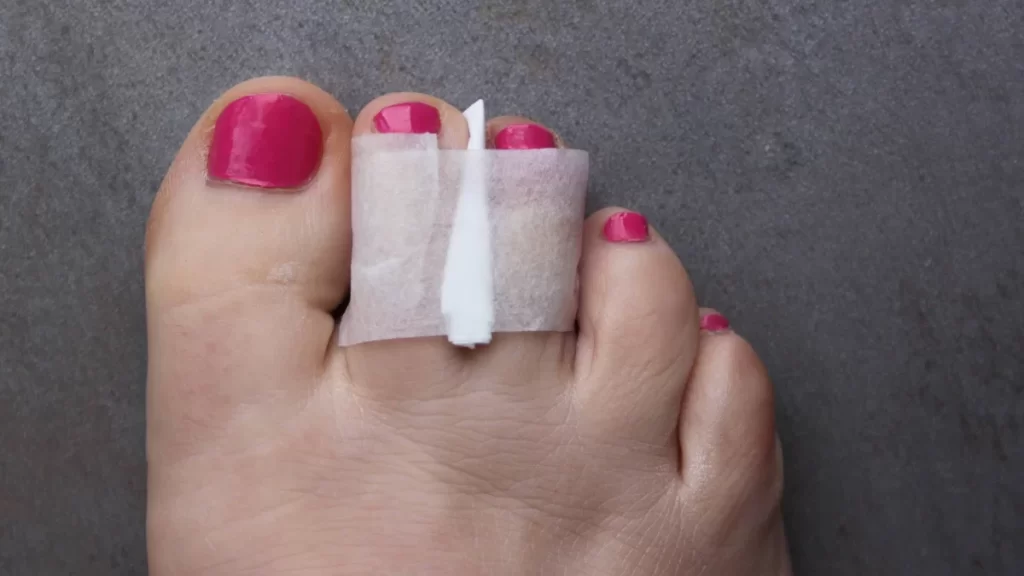
For many smaller-toe fractures, buddy taping (taping the injured toe to the neighboring toe) may be recommended as a simple way to splint and stabilize it.
How buddy taping usually works (high level):
- Place a small piece of gauze/cotton between toes to reduce skin irritation
- Tape the injured toe gently to the neighboring toe for support
Important: don’t tape a toe that’s crooked/pointing the wrong way without medical advice.
2) Use the right footwear (more important than people expect)
Your shoe choice changes how much your toe bends with every step.
Helpful options commonly include:
- Stiff-bottom or rigid-sole shoe (limits toe motion)
- Post-op style shoe (stiff sole + extra room for swelling)
- Wide toe box shoes (reduces pressure on a swollen toe)
If pain is significant, some people are given a removable boot for walking for a period (often within a few weeks range depending on the case and clinician instructions).
A detailed breakdown of what to look for is covered here: Best Shoes for Stress Fractures and Broken Bones in Legs and Feet.
3) Elevation + ice for swelling control
Swelling is a huge driver of pain and stiffness. Common advice includes:
- Rest and elevate the foot when you can
- Ice wrapped in a towel for short intervals (don’t apply ice directly to skin)
4) Walk less—then build back up gradually
You usually don’t need to be completely immobilized for a simple toe fracture, but you do want to avoid the trap of “I can walk, so I should do everything.”
A simple rule that helps:
- If activity causes sharp pain, worsening limp, or a big end-of-day flare → you did too much.
5) Pain relief (to support mobility and sleep)
Over-the-counter pain relief is commonly recommended for symptom control.
(If you have medical conditions, take other meds, are pregnant, etc., follow clinician/pharmacist guidance.)
Best Shoes to Support Broken Toe Recovery
Footwear plays a measurable role in recovery because every step creates bending forces through the forefoot and toes. During a broken-toe recovery, the goal isn’t to “cure” the injury with shoes—it’s to reduce daily aggravation by choosing models that emphasize cushioning, stability, and smooth (often rocker-style) transitions, which can make walking feel safer while tissues settle.
These models are commonly recommended in our stress-fracture/broken-bone guide because they combine shock absorption with a more controlled stride.
- HOKA Bondi 9 (maximum cushioning; rocker sole; wide base)
- ASICS GEL-NIMBUS 27 (shock absorption; plush feel; smooth transitions)
- Brooks Ghost Max 2 (rocker support; stable platform)
- Saucony Triumph 23 (plush comfort; supportive upper)
- Nike Vomero 18 (balanced cushioning; cushioned yet stable ride)
- HOKA Clifton 10 (lighter “recovery” option; soft cushion; smooth stride)
- Altra VIA Olympus 2 (wide toe comfort; foot-shaped fit; rocker sole)
- New Balance Fresh Foam X 1080v14 (all-day wear; soft foam; stable fit)
Note: These are not “cure” shoes. But by reducing impact and encouraging smoother transitions, they can meaningfully cut down the day-to-day irritation that slows recovery.
Click here to learn more: Best Shoes for Stress Fractures and Broken Bones in Legs and Feet.
Walking Shoes vs Running Shoes for Broken Toe Recovery
Walking shoes are often the easier choice during broken-toe recovery because they’re more likely to feel stable and predictable at slower speeds, and many supportive walking-friendly models reduce harsh loading by combining a stable base with softer cushioning and (in many cases) a rocker-style transition that helps you move forward without as much aggressive push-off.
Running shoes can work well for walking during recovery—especially max-cushion models designed around shock absorption and smoother transitions (like the HOKA Bondi 9 or ASICS GEL-NIMBUS 27) and rocker-support options (like the Brooks Ghost Max 2). These features are highlighted in the stress-fracture/broken-bone guide specifically because they help reduce impact and make each step feel less jarring.
What to avoid until pain is fully resolved:
- Minimalist/thin-soled shoes and unsupportive casual footwear that provide little shock reduction or control. (They usually feel fine for a few minutes, then make symptoms worse after a longer day.)
- Highly flexible shoes that let the forefoot/toes bend a lot (this typically increases irritation during bone healing).
What Slows Broken Toe Recovery
These are the habits that most often keep a toe tender for way longer than necessary:
- Wearing tight or pointy shoes (compresses the toe and increases pain/swelling)
- Too much walking too soon, especially on hard surfaces
- Letting the toe bend repeatedly (flexible shoes, barefoot walking, lots of stairs)
- Ignoring deformity (a toe pointing at an odd angle needs assessment)
- Smoking can slow bone healing in general, and some patient leaflets explicitly note longer healing in smokers.
When to Get Medical Help
Even though many broken toes can be treated at home, certain situations should be evaluated urgently.
Seek urgent/emergency care if:
- You think you broke your big toe
- The toe is pointing at an odd angle or looks obviously deformed
- There’s an open wound or bone appears exposed
- You have numbness/tingling in the toe or foot
- Pain is severe or you can’t function normally
Also consider follow-up if:
- Pain/swelling isn’t improving after a few days, or
- It still hurts to walk well around 6 weeks after the injury
When to Expect Meaningful Improvement
With a straightforward fracture and good protection:
- Within a couple of weeks: swelling should start trending down, and walking becomes easier in supportive shoes.
- By 4–6 weeks: many simple toe fractures are largely healed.
- By 3–6 months: it’s common for the last bits of swelling, stiffness, and sensitivity to fade—especially after long days.
If your toe still can’t tolerate normal daily walking, or it stays very swollen and painful, it’s worth getting reassessed to rule out displacement, joint involvement, or complications.