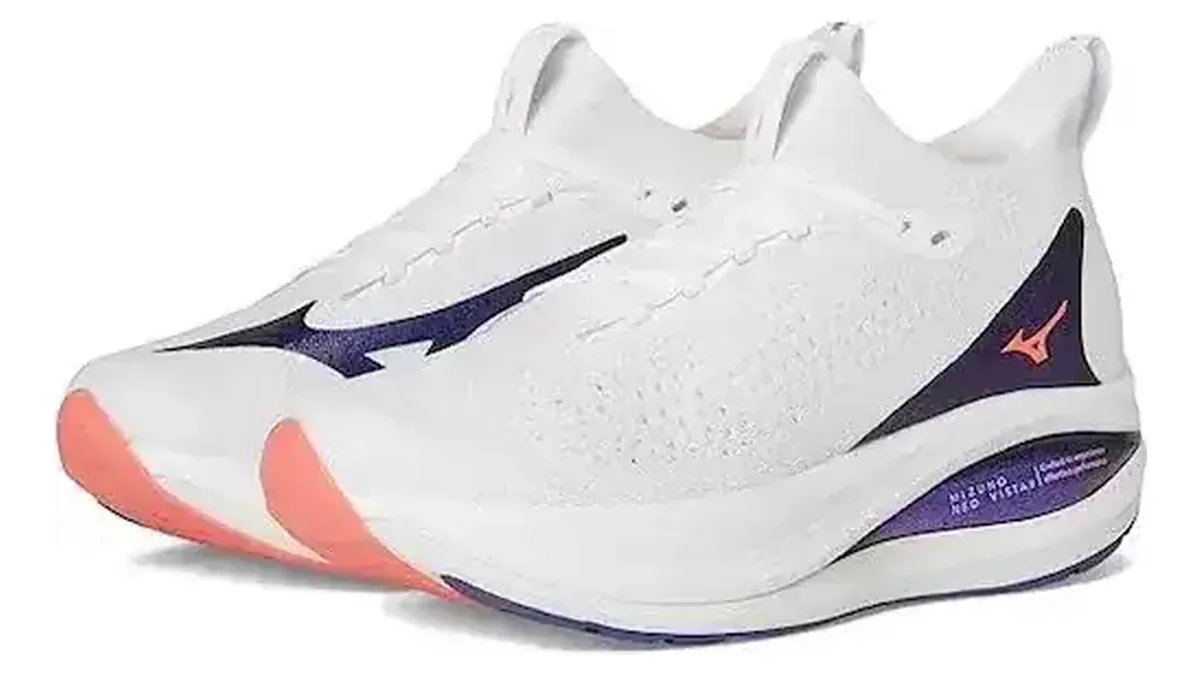
Quick Answer: Mizuno Neo Vista 2. The Neo Vista 2 is a tall, soft running shoe for people who want long runs to feel easier on their legs. It has a flexible plate inside, but this is not a stiff racing shoe. The plate mainly helps the very soft platform feel more controlled. That makes it appealing for runners in their 30s, 40s and 50s who want comfort for longer outings without wearing a heavy traditional trainer. The tradeoff is that it sits high off the ground and costs more than a regular daily shoe. See what the Neo Vista 2 feels like in everyday use.
The Mizuno Neo Vista 2 is the second version of the shoe that took Mizuno, a brand historically associated with firm, structured trainers, into the max-stack super trainer category. It sits noticeably high off the ground, which gives your legs a lot of protection but also makes the shoe feel less planted than a traditional trainer.
The cushioning is very soft under the heel and a little firmer toward the front. In everyday terms, your landing feels cushioned, but the shoe does not collapse completely when you push off.
There is also a flexible plate inside the shoe. You do not feel it like a stiff racing plate; its main job is to keep the very soft, tall platform from feeling floppy.
What the Mizuno Neo Vista 2 feels like in real life
| Best for | Long runs, easy miles, recovery runs and runners who want plenty of cushioning without a heavy shoe. |
| Overall feel | Soft, tall and smooth. It feels more protective than a normal daily trainer and less aggressive than a carbon racing shoe. |
| Cushioning | Very deep cushioning helps reduce the harshness of pavement over longer runs. The heel feels softer while the front of the shoe gives you something firmer to push against. |
| The plate | A flexible nylon-based plate adds structure. In plain English, it helps keep all that soft foam from feeling sloppy rather than trying to launch you forward like a carbon racer. |
| Heel-to-toe drop | 8 mm. Your heel sits moderately higher than your toes, which gives the shoe a familiar running-shoe feel despite the tall platform. |
| Height underfoot | About 45 mm at the heel and 37 mm at the forefoot. That means there is a lot of material between you and the road, which is great for comfort but less ideal if you dislike feeling high off the ground. |
| Fit | Roomier than many performance shoes, with a stretchy knit upper that gives broader or higher-volume feet more space. |
| Launch price | $200 | Check latest price |
What you may like
These are the reasons it is worth considering at the price:
- Very soft and bouncy in the heel, which makes long runs on pavement far less punishing
- The front of the shoe is a little firmer, so it does not feel mushy when you push off
- The flexible plate adds steadiness without making the shoe feel stiff
- Light for a 45 mm shoe at around 9.4 ounces in a men’s US 9
- The knit upper is genuinely roomy, which is rare in a performance shoe
- Works as an easy-day, long-run and recovery shoe rather than only one of those
What to keep in mind
These are the reasons to think twice:
- Expensive at $200, a $20 jump over the original Neo Vista
- A 45 mm stack of soft foam feels tall, and it is less planted on cambered roads and corners
- It is not a race-day shoe; the plate is there more for control than speed
- Some foam is exposed underneath, so the sole may show wear sooner than a shoe with rubber covering the entire bottom
- It does not have built-in guidance for people who know they prefer a stability shoe
What is new versus the original Neo Vista
The original Neo Vista was Mizuno’s first attempt at a max-stack super trainer, and it was praised for comfort and criticized for feeling a little unrefined. The 2 keeps the concept and improves the execution.
The midsole is the main change. Mizuno moved to a dual-layer ENERZY NXT setup, with a softer, bouncier heel and a firmer, more responsive forefoot, rather than a single foam throughout. The practical effect is that the shoe absorbs the landing more generously while still giving something back at toe-off, which addresses the slightly dead feel of the original.
The knit upper was also reworked to be wider and higher in volume. That is an unusual decision in a performance shoe, where the trend runs the other way, and it makes the Neo Vista 2 one of the more accommodating shoes in the category. The price went up from $180 to $200, which is the least welcome change.
Gender-specific buy links: Men’s version | Women’s version
Who this shoe is likely to suit: Mizuno Neo Vista 2
Buy the Neo Vista 2 if long runs are the backbone of your training and you want maximum protection for them. Forty-five millimeters of soft foam is a lot of material between you and the road, and for runners building marathon mileage that translates into fresher legs the day after.
It also suits runners who want plate-assisted structure without a carbon plate. Nylon flexes far more than carbon, so the shoe does not force a particular foot position or demand a fast turnover to feel right. Runners whose calves object to stiff racing shoes usually get on much better with a nylon plate.
Finally, the upper makes this one of the few performance shoes worth trying if you have a wider or higher-volume foot. Mizuno deliberately built the knit roomier, and that alone puts it on the shortlist for runners who normally cannot wear shoes in this category.
You may want something else if…
Avoid it if you want a race shoe. The nylon plate provides structure rather than propulsion, and on a soft 45 mm platform some of your force disappears into the foam. Runners chasing a time will be faster in a carbon racer.
Avoid it if you dislike feeling high off the ground. A tall, soft neutral platform is inherently less planted than a lower one, and on cambered roads, tight corners or uneven pavement the Neo Vista 2 can feel unsettled. Runners who value ground feel should look at something considerably lower.
Runners who need stability features will find nothing here designed to limit inward roll of the foot, and anyone with persistent pain should seek a professional assessment rather than solve it with a shoe. At $200, it is also hard to justify for anyone whose weekly mileage does not include genuinely long runs.
Not sure which shoe fits your needs? Find the ideal shoe for you with our free Shoe Finder.
How the Neo Vista 2 feels on your foot
How the fit works
The Neo Vista 2 fits true to size with a notably roomy shape for a performance shoe. Mizuno widened the knit and raised the volume over the original, so the forefoot has space and the instep does not feel compressed, which is the opposite of the trend in super trainers.
There is no separate wide fitting, but the knit stretches enough that many runners who normally need one will manage. If you have narrow feet, expect to lace it more firmly than you would a typical racing-oriented shoe.
Comfort when you first put it on
Step-in comfort is excellent. A knit upper wraps softly without pressure points, the collar is comfortable and there is no break-in period. Combined with the depth of foam underneath, the shoe feels immediately inviting in a way most $200 shoes do not.
The trade-off with knit is security. A stretchy upper holds the foot less firmly than a woven mesh with overlays, and on a tall platform that matters, since the foot has further to move if it slides. Lacing it properly is worth the attention.
How the Neo Vista 2 feels when you run
What the cushioning feels like
ENERZY NXT is Mizuno’s nitrogen-infused foam, and infusing gas under pressure makes it lighter and more resilient than standard EVA. Using it in two densities is what gives the Neo Vista 2 its character: the heel compresses deeply and springs back, while the forefoot resists enough to give a definite push-off point.
At 45 mm the cushioning depth is close to the maximum permitted in road racing, and the practical benefit is that repeated impact over a two-hour run is absorbed rather than transmitted. That is the shoe’s clearest strength.
What it feels like once you get moving
The ride is soft and rolling at steady paces. The heel gives generously on landing, the plate carries the foot through the middle and the firmer forefoot provides a definite toe-off. At long-run and easy effort it feels effortless, and the shoe holds together late in a run when form deteriorates.
Faster efforts are less convincing. Nylon does not snap the way carbon does, and a very soft heel swallows some of the force you put in, so short intervals feel imprecise. Treat this as a long-run and easy-day shoe with enough versatility for a steady effort, rather than a workout shoe.
Will it feel steady?
This is a neutral shoe with no support features, and it is one of the taller platforms available, so it is not especially planted. What holds it together is the full-length wave plate, which resists the shoe twisting along its length and stops the soft foam collapsing unevenly. Without that the platform would feel considerably worse.
Runners who need genuine stability should choose a stability shoe rather than rely on the plate, and anyone with persistent or worsening pain should get a professional assessment rather than expect footwear to resolve it.
Grip and everyday wear
Mizuno places rubber where wear happens and leaves foam exposed elsewhere to keep the weight down on such a tall shoe. Grip on dry and damp road is dependable, with the usual caution required on wet paint and metal.
Durability is the compromise. Exposed midsole foam abrades faster than rubber, particularly for runners who scuff, and a soft high-stack foam gradually loses its bounce. The usual 300 to 500 mile guideline is a broad range, and a shoe like this tends to feel noticeably less lively toward the end of it.
Is the Neo Vista 2 good for walking?
For walking on pavement, yes, and the cushioning depth is the reason. Forty-five millimeters of soft foam under the heel makes concrete far more forgiving than a normal shoe, and the 8 mm drop suits a heel-first walking stride. The roomy knit upper is comfortable for hours and accommodates feet that swell, which is a genuine advantage over most performance shoes.
Two things work against it. A tall, soft platform is less steady at slow speeds, particularly on uneven sidewalks and curbs, and the full-length plate resists the forefoot bending, which walking asks for more than running does. It is a comfortable shoe to walk in on flat ground and an expensive way to do it. Anyone buying primarily for walking should choose a cushioned walking shoe instead.
For walking-first recommendations, see our Best Walking Shoes guide.
Neo Vista 2 vs. the original Neo Vista
Here is how the two versions compare:
Neo Vista 2 | Neo Vista | |
Midsole | Dual-layer ENERZY NXT, soft heel and firmer forefoot | Single foam setup |
Ride | Bouncier on landing, more definite toe-off | Comfortable but flatter |
Upper | Wider, higher-volume knit | Closer fitting |
Plate | Full-length glass-fiber-infused nylon wave | Nylon wave plate |
Price | $200 | Check latest price | $180 | Check latest price |
Buy the 2 if you want the improved ride and the roomier fit, which together justify the update. Buy the original while it is discounted if your priority is cushioning at the lowest price, since the fundamental comfort is similar.
Mizuno Neo Vista 2 alternatives
Shoe (links go to full reviews) | Choose it instead when… | Check price |
|---|---|---|
You want a livelier daily trainer without a plate and at a lower price. | ||
You want a more planted, walking-friendly high-cushion shoe. | ||
You want a more traditional, lower and less expensive Mizuno daily trainer. |
Is it good value?
The Neo Vista 2 launched at $200 in 2025, up from $180 for the original, which puts it at the top of the super trainer bracket. The money buys a dual-density nitrogen-infused midsole, a full-length wave plate and one of the tallest legal stacks available, in a shoe that still weighs under 10 ounces. For a marathon runner logging genuinely long weekly runs, that is defensible. For anyone whose longest run is an hour, it is a lot of money for cushioning you will not fully use, and cheaper max-cushion trainers cover that ground well.
Our take for everyday runners
Best for: long runs, steady efforts and recovery days, and runners with wider feet who want a max-stack shoe that fits them.
Avoid if: you want a race shoe, you dislike a tall platform, you need stability features or the price is hard to justify against your mileage.
Fit: true to size, unusually roomy knit upper, standard width only but accommodating.
Verdict: Splitting the midsole into a soft heel and a firmer forefoot fixed the original’s flat feel, and the roomy knit makes this one of the few max-stack shoes that fits a normal foot. It is expensive and it is tall, and if long runs are your priority it earns its place. You can check size availability before ordering.
Frequently Asked Questions About the Mizuno Neo Vista 2
Yes. It is roomier than many performance shoes, with a stretchy knit upper that gives the forefoot and instep more space.
No. Its flexible nylon-based plate adds structure to the tall soft platform, but it does not have the aggressive feel of a carbon racing shoe.
The plate helps the very soft, tall midsole feel more controlled. Think of it as a stabilizing layer rather than a springboard.
Yes. Long, steady runs are one of its strongest uses because the deep cushioning reduces the harsh feel of repeated pavement impact.
It is comfortable on flat pavement, but the tall soft platform is less steady than a walking-first shoe on curbs or uneven sidewalks.
There is no dedicated wide version, but the knit upper is more accommodating than most performance shoes and may work for moderately broad feet.
The U.S. launch price was $200. Current pricing may be lower depending on size and color. Check latest price and available colors.