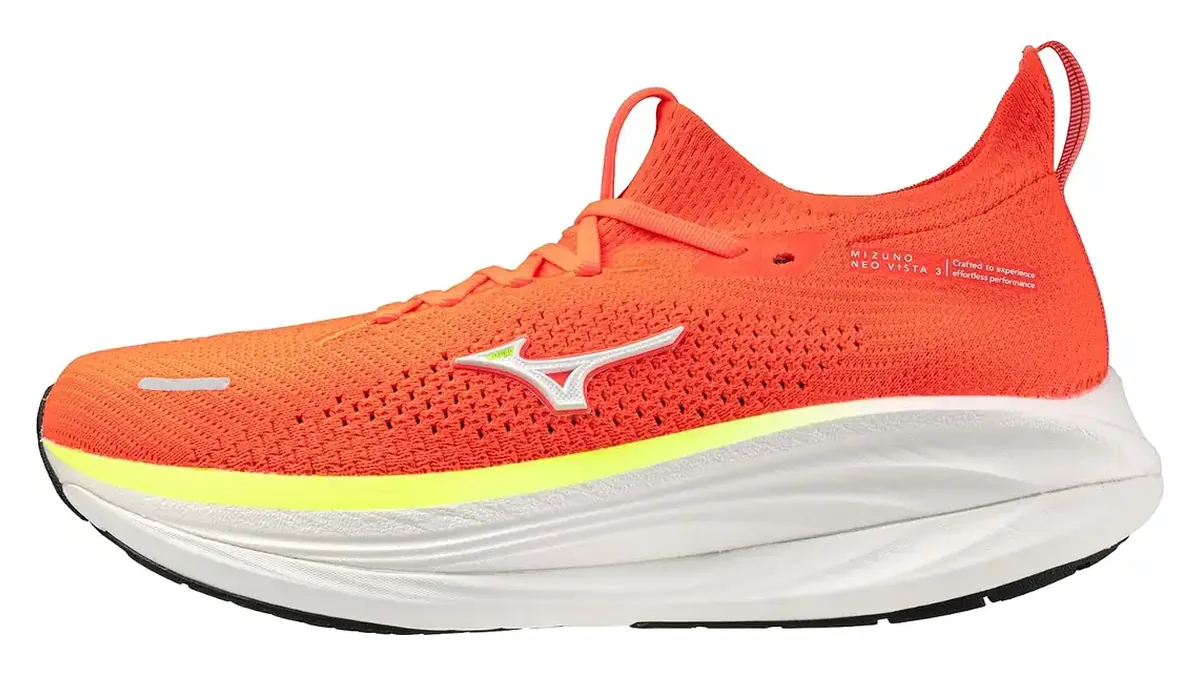
Quick Answer: Mizuno Neo Vista 3. The Neo Vista 3 is a tall, deeply cushioned shoe for runners who want easy and long runs to feel smoother and less punishing. It uses a full-length Wave plate, but the plate is there mainly to keep the soft platform controlled rather than make the shoe feel like a stiff racer. Compared with the Neo Vista 2, it feels more refined and more secure around the heel. Choose it for comfort and long steady miles. Skip it if you want ground feel, wide sizing or a light shoe for fast running. See what the Neo Vista 3 feels like in everyday use.
The Mizuno Neo Vista 3 is the brand’s super trainer: a shoe with racing-shoe levels of foam underfoot, but built for everyday running rather than race day. It sits at the top of Mizuno’s cushioned road range, above the Wave Rider, and it is the pair you reach for when you want a long run to feel easier than it should.
Super trainers have become a crowded category, and most of them do the same thing: pile on soft foam, add a stiff plate, then hope the shoe stays upright. Mizuno takes a different route. Its plate is plastic rather than carbon and curved rather than flat, so it works more like a spring than a lever. The first two Neo Vistas were fun but wobbly and awkwardly shaped. The third is the one Mizuno has finally got sensible, and it went on sale at about $200 in June 2026.
What the Mizuno Neo Vista 3 feels like in real life
| Best for | Long runs, easy mileage and runners who want lots of cushioning without a heavy traditional trainer. |
| Overall feel | Soft, tall and smooth, with a more secure heel than the previous version. |
| Cushioning | There is a lot of protection from hard pavement. The ride is plush rather than sharp or race-like. |
| The plate | The full-length Wave plate helps spread impact and keep the tall shoe feeling controlled. Think of it as a support layer inside the foam rather than a racing springboard. |
| Heel-to-toe drop | About 8.5 mm in independent measurement. Your heel sits moderately higher than your toes, so the shoe still feels familiar despite the tall platform. |
| Height underfoot | About 43.5 mm at the heel and 35 mm at the forefoot in independent measurement. In practical terms, this is a very cushioned shoe that keeps you well separated from the road. |
| Fit | Secure, sock-like knit with no U.S. wide version listed. The front can feel tapered for broader feet. |
| Weight | About 9.4 oz. men’s. Reasonable for this much cushioning, but not especially light when you try to run fast. |
| Launch price | $200 | Check latest price |
What you may like
Here is what the Neo Vista 3 does well:
- A deep, springy ride that makes long easy runs feel less tiring than they should
- Far steadier than the previous Neo Vista, so the height no longer feels precarious
- The plastic plate adds bounce without making the shoe rigid, which suits slower paces
- Grip on wet pavement is good, which is unusual for a shoe with this much exposed foam
- The thin rubber wears slowly, so durability is better than the outsole looks
What to keep in mind
And where it will lose people:
- The toe box narrows sharply, so broad feet may feel crowded as runs get longer
- No wide fitting, so there is no easy fix for that shape
- At about $200 it costs as much as a decent race shoe
- It weighs more than most rivals in this class, which you notice when you try to run fast
- The stack is too tall for it to be legal in most road races
What is new compared with the Neo Vista 2
The headline change is that Mizuno has made the shoe behave. The Neo Vista 2 was tall, soft and tippy, and a lot of runners simply did not feel safe in it. Version three brings the stack down slightly, firms up the heel counter (the stiff cup at the back that holds your heel in place) and widens the base under the middle of the foot. None of those sound dramatic on their own. Together they turn a novelty into a shoe you can use four times a week.
The Wave plate has also been reworked. Mizuno’s Wave is a curved sheet of plastic that runs the length of the midsole, and rather than stiffening the shoe the way a carbon plate does, it flexes and springs back. In this version it is shaped to do more of that work through the middle of the foot, so the sensation of being pushed forward arrives sooner in the stride. The upper is knit again but with a bit more structure, and the shape of the fit has changed enough that people who found the Neo Vista 2 unwearable should try this one before writing off the line.
Pros
- Tall cushioning helps take the sting out of long runs
- Plastic Wave plate adds spring without the rigid feel of a carbon racer
- Works well at ordinary long-run paces, not just fast workouts
- Secure heel and upper suit narrow-to-average feet
Cons
- Too tall and heavy to be an ideal race shoe
- More shoe than most runners need for short daily runs
- Premium price is hard to justify if you do not regularly run long
- Fit is less accommodating for broad feet
Who this shoe is likely to suit: Mizuno Neo Vista 3
Buy it if your long run is the run you dread. This is a shoe built to take the sting out of distance. There is a lot of foam between you and the road, and the plate keeps the ride from feeling mushy the way a very soft shoe usually does after an hour. If you finish long runs with sore legs rather than tired lungs, this is the type of shoe that helps.
Buy it if you like a bouncy ride but dislike stiff shoes. Most super trainers use a carbon plate, which makes the shoe rigid and rewards you only when you are moving quickly. The plastic Wave plate here works at ordinary paces too, so you get some of that spring on a gentle Sunday plod rather than only in a workout. That makes the Neo Vista 3 one of the friendlier shoes in a category that often feels like it was designed for someone faster than you.
Buy it if you have narrow or average feet and want one premium pair to do everything easy. Lockdown is excellent for that foot shape, the heel is secure and there is nothing here you have to learn to run in. Runners coming from a normal cushioned trainer will find it familiar, just taller and livelier.
You may want something else if…
Skip it if you want one shoe that also races, because the shoe is taller than the 40 mm road-racing limit used in sanctioned competition, and the weight would hold you back anyway. Skip it if most of your runs are short, since almost everything this shoe is good at only shows up after an hour. And skip it if $200 is a stretch, because a good deal of what you are paying for is height and novelty rather than everyday usefulness.
These suit that runner better:
- Brooks Ghost Max 4: a tall, soft, rockered trainer that costs less and is happy doing short runs and long walks alike (check price | read review)
- Hoka Bondi 9: the obvious pick if the appeal is deep cushioning for walking and standing rather than running fast, and it comes in wide and extra wide (check price | read review)
- Mizuno Wave Rider 30: the same brand’s normal daily trainer, much cheaper, softer than it used to be and race legal if you ever want to pin a number on (check price | read review)
Gender-specific buy links: Men’s version | Women’s version
Not sure which shoe fits your needs? Find the ideal shoe for you with our free Shoe Finder.
How the Neo Vista 3 feels on your foot
The Neo Vista 3 fits like a performance shoe rather than a comfort shoe. It is snug, it holds the foot closely and it rewards a narrow to average foot with the kind of locked-in feel you usually only get from a racing flat. If your feet are wide, none of that will matter, because the shape simply is not built for you.
How the fit works
Order your usual size. Length runs true and the heel and midfoot are held well, with no slipping. The problem area is the last inch. The toe box narrows quickly toward the front, which pushes the big toe inward and limits how much the shoe can bend there. Some broader-footed runners may notice the taper more as a run gets longer. Narrow feet, on the other hand, get one of the better fits in this class. There is no wide version on sale in the US, so sizing up is the only workaround and it costs you the secure heel.
Comfort when you first put it on
The upper is knit from end to end, which means a soft, stretchy, sock-like feel with no seams to rub. Mizuno has added a firmer heel counter this time, and it makes a real difference: the back of the shoe now feels anchored rather than vague. Step-in comfort is excellent. You sink in slightly, the foam feels alive under the heel and there are no pressure points anywhere except the front. Breathability is fine for warm weather, and the padding around the collar is modest rather than pillowy, which keeps the weight down.
How the Neo Vista 3 feels when you run
This is a shoe with one clear talent: covering distance comfortably at a relaxed pace. It is not quick, it is not light and it does not want to sprint. What it does is make the second hour of a run feel a lot like the first.
What the cushioning feels like
Stack height is the depth of foam between your foot and the ground, and at about 43.5 mm under the heel in independent measurement this is about as much as a running shoe legally carries. The top layer is Enerzy NXT, a nitrogen-infused foam, which simply means gas is blown into it during manufacture to leave tiny bubbles that make it lighter and springier. Underneath sits a firmer layer that stops the whole thing collapsing. The result is a landing that is soft without being vague, and a push-off that genuinely returns something. Mizuno calls the sensation bounce, and for once the marketing word is the right one.
What it feels like once you get moving
At easy and steady paces the Neo Vista 3 is a joy. The Wave plate flexes as you load it and springs back as you leave the ground, and because it is plastic rather than carbon it does this at 10 minutes per mile as happily as at seven. Push harder and the shoe’s weight becomes the limit. At around 9.6 oz it is heavier than most rivals with this much foam, so tempo efforts feel like hard work and anything shorter than a 10K is the wrong job for it. Treat it as a long-run and recovery-run shoe and it is excellent. Ask it to be your only pair and it will frustrate you on the fast days.
Will it feel steady?
This is a neutral shoe, so it has no support posts and it does nothing to guide a foot that rolls inward. What it does have is sensible geometry: a wider base than the version before it, raised foam walls that cradle the foot and a firm heel counter. Those three things together mean the height no longer feels like a liability, which was the main complaint about the Neo Vista 2. Runners with mild pronation who already get on with neutral shoes should be fine. Anyone who genuinely needs guidance should look at a stability model instead, because a tall neutral platform is the wrong tool no matter how well it is braced.
Grip and everyday wear
Mizuno uses its X10 rubber, laid down as separate pods with deep grooves and exposed foam between them rather than as one slab. The rubber is thin, about 1.9 mm, which normally rings alarm bells. In this case it does not: abrasion testing shows very little wear, so the coverage lasts better than it looks like it should. Wet grip is the bigger surprise. Independent friction testing puts it well ahead of the previous Neo Vista on damp concrete, so rainy mornings are not a problem. The 300 to 500 mile figure often quoted for running shoes is only a rough guideline, and with this much foam the midsole will usually soften before the rubber gives up.
Is the Mizuno Neo Vista 3 good for walking?
It walks better than most plated shoes, and worse than a purpose-built comfort shoe. The depth of foam is genuinely useful on concrete, and the curved plate helps roll you from heel to toe rather than forcing you to bend the shoe yourself, which is welcome if your feet get tired on hard floors.
Two things hold it back for all-day wear. Feet swell over a long day upright, and a snug performance fit that is fine for an hour of running gets less comfortable by hour six of standing. The second is the height. Walking is slower and less controlled than running, and a tall cushioned platform can feel less steady on uneven pavement or curbs. For a long airport day or a brisk fitness walk it is fine, and the rocker earns its keep. For standing all day at work, a lower and wider shoe is the smarter buy, and you would be spending $200 on the wrong tool.
For walking-first recommendations, see our Best Walking Shoes guide.
Mizuno Neo Vista 3 vs Neo Vista 2
Here is how the two versions compare:
Feature | Neo Vista 3 | Neo Vista 2 |
Stack height | About 43.5 mm heel / 35 mm forefoot | About 45 mm heel / 37 mm forefoot |
Steadiness | Wider base, firmer heel counter | Noticeably tippy |
Wave plate | Reworked for more spring through the midfoot | Less active underfoot |
Upper | Knit, more structured | Knit, softer and vaguer |
Wet grip | Much improved | Weaker on damp ground |
Price | $200 | Check latest price | $190 | Check latest price |
Buy the Neo Vista 3 if the previous version felt unstable or did not fit, because both of those are exactly what Mizuno set out to fix. Buy the Neo Vista 2 on clearance only if you already know it fits your foot and you liked how it felt, since the saving is the only thing it now has going for it.
Mizuno Neo Vista 3 alternatives
Shoe (links go to full reviews) | Choose it instead when… | Check price |
|---|---|---|
You want another tall long-run shoe but prefer a firmer, more directed feel underfoot. | ||
You want a lighter, more versatile high-cushion shoe that can also handle faster running. | ||
You want maximum comfort without a plate and with a simpler, more relaxed ride. |
Is it good value?
At about $200 the Neo Vista 3 sits in awkward company, because that is what a proper carbon racing shoe used to cost. What the money buys is a premium nitrogen-infused foam, a full-length plate and one of the better-finished uppers Mizuno makes, all of which are real. What it does not buy is versatility: this is a long-run and easy-day shoe rather than a do-everything trainer, and the lack of a wide fitting narrows who it works for at all. If you run long often and the fit suits you, it earns its keep. If you run three or four miles at a time, you are paying for foam you will never use.
Our take for everyday runners
Best for: long easy runs, recovery days, runners with narrow to average feet, and anyone who likes a bouncy ride without a stiff carbon plate.
Avoid if: you have wide feet, you want one shoe that also races, or you mostly run short.
Fit: true to size, secure heel, distinctly narrow toe box. Standard width only.
Verdict: Mizuno has spent two versions making an interesting shoe and this one is finally a sensible one as well. The extra steadiness transforms it, the plate gives it a character no carbon-plated rival can match at gentle paces and the cushioning does exactly what a super trainer should. The fit is the catch, and with no wide option it is a catch Mizuno has chosen not to fix. Try a pair on before you commit.
Frequently Asked Questions About the Mizuno Neo Vista 3
Yes for most runners, but the front of the shoe tapers. People with broad forefeet should try it on before buying because there is no U.S. wide version.
Not really. It is built more for long, comfortable training miles than race day, and its tall platform sits above the 40 mm road-racing limit used in sanctioned competition.
It helps the tall, soft midsole feel more controlled and smooth. Think of it as structure inside the foam rather than a stiff racing springboard.
Yes. Long, steady runs are its strongest use because the deep cushioning helps reduce the harsh feel of repeated pavement impact.
It can feel very comfortable on flat pavement, but its height and snug performance fit make it less practical than a walking-first shoe for all-day use.
Mizuno currently lists standard width in the U.S. The tapered forefoot can be limiting for broad feet.
The U.S. launch price was $200. Current pricing may be lower depending on size and color. Check latest price and available colors.