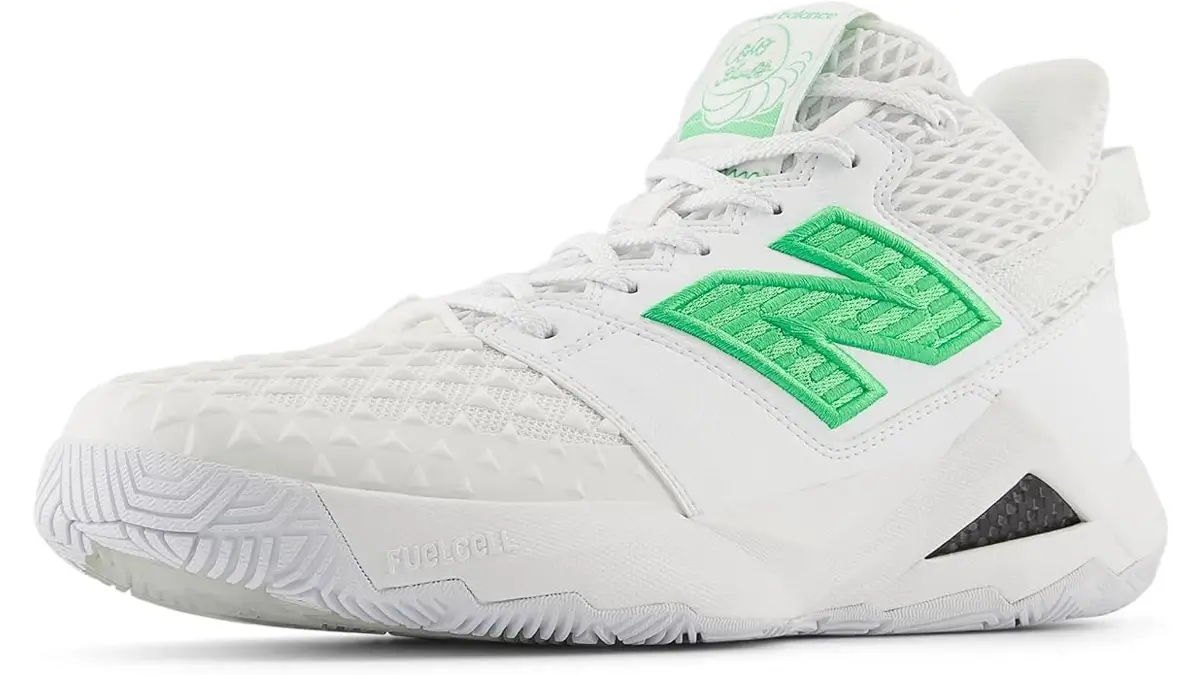
Plush, protective cushioning in a heavy, narrow-fitting shoe
Quick Answer: New Balance Coco CG2 Review: The Coco CG2 is a women’s tennis shoe built for players who want protection and a planted feel rather than lightness. A thick layer of FuelCell foam and a curved carbon plate soak up hard landings and steady you through side-to-side movement, which makes long matches easier on your legs. The fit is snug through the toes and the shoe feels substantial underfoot, so light, quick-footed players may prefer something slimmer. For comfort and outsole durability on hard courts, it is one of the safer picks. Check latest price.
The New Balance Coco CG2 is Coco Gauff’s second signature tennis shoe, and it sits at the top of New Balance’s tennis range. New Balance released it on Aug. 21, 2024 at $159.99, and it remains the brand’s flagship performance tennis model. It is sold in women’s sizing, in two widths, and it is aimed squarely at hard courts.
Two things define it. The first is cushioning: there is a lot of foam here by tennis standards, and it is New Balance’s softer, bouncier FuelCell foam rather than a firm court compound. The second is a curved carbon fiber plate that New Balance calls Energy Arc, which sits inside the foam and stiffens the middle of the shoe so it does not fold or twist when you push off sideways.
That combination is unusual. Most tennis shoes ask you to choose between a soft, forgiving ride and a stable one. The Coco CG2 tries to give you both, and the cost is weight and a close-fitting toe box. If you play long matches, if your knees and hips complain after a few sets on concrete or if you have worn through the sole of a cheaper court shoe in a season, this is the kind of shoe you should be looking at. If you like to feel the court under your foot and hate anything bulky, read on carefully.
Specs
Here are the specifications for the New Balance Coco CG2:
| Shoe type | Women’s performance tennis shoe, hard court and all court |
| Best for | Baseline players who want cushioning and lateral support over low weight |
| Midsole foam | FuelCell, New Balance’s soft and springy foam |
| Support system | Energy Arc, a curved carbon fiber plate set inside the midsole |
| Heel stack (lab measured) | 28.2 mm |
| Forefoot stack (lab measured) | 22.0 mm |
| Heel-to-toe drop (lab measured) | 6.2 mm, so your heel sits only slightly higher than your toes |
| Weight | About 10.1 oz in a women’s size 8 as listed by specialist tennis retailers. A lab teardown of one pair weighed 12.6 oz, so treat both figures as approximate and expect a substantial shoe |
| Upper | Structured engineered mesh with layered overlays and a mid-cut collar |
| Outsole | NDurance rubber with a hexagonal tread pattern |
| Toe box width (lab measured) | 70.3 mm at the big toe, narrower than average |
| Widths | Two, standard and wide |
| Outsole guarantee | Six-month outsole durability guarantee from New Balance |
| Released | Aug. 21, 2024 |
| Price | $159.99 at launch in August 2024. Check latest price |
Pros
- One of the most cushioned tennis shoes on sale, which means less pounding through your legs across a long match on concrete.
- The carbon plate keeps the shoe from twisting when you change direction, so the foam stays soft without feeling wobbly.
- The reworked NDurance outsole is noticeably tougher than the first Coco, and it comes with a six-month durability guarantee.
- Two widths, which is rare in performance tennis shoes and useful if you are between sizes.
- The mid-cut collar holds your ankle without pinching, and it does not need breaking in.
Cons
- It is heavy and it looks it. Players who like a low, quick shoe will feel every ounce.
- The toe box measures narrower and shallower than average, so wide or high-volume feet should size up or try the wide.
- At $159.99 at launch it is expensive for a shoe most club players will use once or twice a week.
- All that foam sits you further from the court, which blunts the feel some players rely on for touch shots.
What is new versus the Coco CG1
The recipe underfoot carries over. Both Cocos pair FuelCell foam with the Energy Arc plate, so the basic feel of a soft midsole held steady by a stiff carbon spine is the same. What changed is everything around it.
The upper is the bigger visual change. New Balance rebuilt it with a more structured mesh and a fresh panel layout borrowed from the 550, its lifestyle sneaker, and reshaped the collar. In practice the CG2 holds your foot more firmly when you push hard into a wide ball, and it breathes better than the first version.
The more useful change is underneath. The first Coco wore through its outsole quickly on abrasive hard courts, which was the single most common complaint about it. New Balance answered with a revised NDurance rubber compound and a hexagonal tread pattern, and it now backs the shoe with a six-month outsole guarantee. If you play on rough concrete, that is the reason to pick the CG2 over a discounted CG1.
Who should buy the New Balance Coco CG2
Buy this if you are a baseline player who spends long stretches moving side to side and you want your legs to survive it. The depth of foam here does real work over two or three sets, and it is the main reason to pay flagship money.
It also suits anyone who has been frustrated by court shoes wearing out. The outsole change and the guarantee behind it make this one of the safer buys if you play several times a week on hard courts, or if you drag your toe when you serve.
Finally, it suits players who need a little more support than a low, flexible court shoe gives them. The plate and the wide, flat base keep the shoe from rolling underneath you, which is reassuring if your ankles have taken a knock before. It is not a medical device and it will not change how your foot moves, but it does feel planted.
Who should probably skip it
Skip it if you play a light, quick serve-and-volley style and want to feel the court through your shoe. The stack of foam here puts distance between your foot and the ground, and the weight is real. Skip it too if you have wide or deep feet and the wide width is not stocked in your size, because the toe box is one of the snugger ones on the market. And if you play once a fortnight on a soft court, you are paying for durability and cushioning you will never use up.
Three shoes that suit that player better:
- New Balance Coco Delray: the cheaper Coco, which swaps the carbon shank for TPU plastic but keeps the same outsole, so it is lighter on the wallet and less rigid underfoot (check price)
- K-Swiss Hypercourt Express 3: a lighter, breathable court shoe with a famously generous forefoot, which is the obvious answer if the CG2 pinches your toes (check price)
- Skechers Viper Court Pro 2.0: built for pickleball rather than tennis, with a certified arch-support insole, and a sensible choice if most of your court time is on a pickleball court (check price)
How does the New Balance Coco CG2 fit?
The Coco CG2 fits like a performance court shoe should: close and locked down, with very little spare room anywhere. Most players will take their normal size. The one area to think about is the front of the foot, where this shoe is tighter than most.
Fit and sizing
Order your usual size to start. Lab measurement puts the toe box at 70.3 mm across the big toe joint, which is narrower than the average court shoe, and the height over the toes is below average too. If your feet are wide, or if you wear an orthotic that takes up volume, go for the wide width rather than sizing up, because a longer shoe in a court sport just lets your foot slide forward when you stop. The heel and midfoot are secure and did not need extra lace work.
Upper and step-in comfort
The upper is engineered mesh, a woven synthetic that can be made denser in some places and more open in others, backed by layered overlays around the sides. The result is a shoe that feels ready to play straight from the box, with no stiff panels to break in. The mid-cut collar rises a little higher than a standard court shoe and is padded enough to sit comfortably against the ankle bone. Breathability is fine for indoor and outdoor club play, though this is a substantial upper and not a hot-weather mesh slipper.
How does the New Balance Coco CG2 perform?
This shoe is built around protection. It absorbs impact better than nearly anything else in tennis, and the plate stops that softness turning into instability. What you give up is ground feel and quickness, which is the trade every max-cushioned court shoe asks you to make.
Cushioning and ride
FuelCell is New Balance’s soft, springy foam, the same family it uses in its running shoes, and there is a generous helping of it here. Stack height, the amount of material between your foot and the ground, measures 28.2 mm at the heel and 22.0 mm at the forefoot in lab testing. In plain terms that means landings from a jump serve or a hard stop feel muffled rather than sharp, and your knees and lower back notice the difference late in a match. The flip side is that touch shots at the net feel slightly remote.
Movement and court performance
The 6.2 mm drop, meaning your heel sits about a quarter of an inch higher than your toes, is lower than most court shoes and it helps here. A flatter platform keeps more of the outsole on the ground when you lunge, so you feel planted rather than perched. Acceleration is where the weight shows: this is not a shoe that flatters a quick first step, and players who like to dart forward will find it deliberate. Where it shines is the long rally, when your legs are tired and the cushioning is still doing its job.
Stability and support
We would call this a stable neutral shoe rather than a stability shoe. It does not have a posted midsole or a guidance rail, and it makes no attempt to change how your foot rolls. What it has instead is a wide base and the Energy Arc carbon plate, a stiff curved insert that resists twisting through the middle of the shoe. That matters with soft foam, because soft foam on its own compresses unevenly and lets the shoe lean. Here it stays flat, so the ride feels secure without feeling corrective. If you have a diagnosed foot or gait problem, talk to a podiatrist rather than relying on a court shoe.
Outsole, grip and durability
The outsole is NDurance, New Balance’s hard-wearing rubber, laid out in a hexagonal pattern. Grip on hard courts is confident in both directions, and the pattern clears dust well enough for indoor play. Durability is the headline improvement over the first Coco, and the six-month outsole guarantee is New Balance putting its money behind that. No shoe lasts forever, and how long yours survives depends on your court surface and how much you slide, but this is a durable outsole by tennis standards.
Is the New Balance Coco CG2 good for walking?
It is better than most tennis shoes for walking, and still not what we would choose. The cushioning is genuinely comfortable for standing around, and the flat, wide base is steady on hard floors, so wearing it for a day of coaching, a tournament or an afternoon of errands is no hardship. The rubber is grippy on pavement and easy to clean.
The problems are weight and flex. Court shoes are built stiff so they do not fold sideways, and the carbon plate here makes the CG2 stiffer than most. Walking asks your shoe to bend at the toes with every step, and this one resists. Over a mile or two you will not notice. Over a full day of city walking you will feel your calves working harder than they would in a cushioned walking shoe. Treat it as a court shoe you can comfortably wear to and from the club, not as a travel shoe.
If you are looking for a more conventional walking shoe, see our guide.
Can you use the New Balance Coco CG2 for other sports?
The New Balance Coco CG2’s tennis design makes it a reasonable crossover option for pickleball, especially on outdoor hard courts. Both sports demand side-to-side movement, sudden stops and quick changes of direction. Its structured upper, FuelCell cushioning and durable NDurance rubber outsole address those shared demands, giving players a reason to consider it beyond tennis.
Badminton and squash are more conditional options for occasional play. The CG2 offers court-oriented support, and New Balance lists a nonmarking outsole, but that does not guarantee ideal traction on every indoor floor. Check your venue’s footwear requirements and make sure the shoes grip securely during controlled movements before playing at full speed. The main compromise is its substantial build: players who prioritize fast, light footwork may prefer a dedicated indoor shoe designed around flexibility and agility.
These crossover recommendations reflect the CG2’s construction rather than separate performance testing in each sport.
Coco CG2 versus Coco CG1
Feature | Coco CG2 | Coco CG1 |
Midsole | FuelCell with Energy Arc plate | FuelCell with Energy Arc plate |
Upper | Restructured mesh, new panel layout, reshaped collar | Original upper and collar |
Outsole | Revised NDurance rubber, hexagonal tread | Earlier NDurance rubber, criticized for wear |
Launch price | $159.99, August 2024, check current price |
Buy the CG2 when you play regularly on abrasive hard courts, when you want the more secure upper or when you simply want the current model with its outsole guarantee. Buy the CG1 when you find it heavily discounted, you play on softer surfaces where outsole wear is not an issue and you are happy with the older fit.
New Balance Coco CG2 Alternatives
The Coco CG2 answers one question well: how do I stay comfortable and steady through a long match. If your question is different, these are the shoes worth looking at instead.
Asics Gel-Resolution X: the long-standing choice for players who want structure and durability above all, with a firmer, more traditional court feel than the soft FuelCell ride here (check price).
Should quickness matter more to you than protection, the Nike Vapor Pro 3 goes the other way entirely: a low, light shoe built for players who want to feel the court and get moving fast, at the cost of the cushioning that makes the Coco easy on tired legs (check price).
The Adidas Barricade 14 is the other durable workhorse in this class. It is a heavier, highly supportive shoe like the Coco, but its support comes from a rigid chassis around the foot rather than a plate inside soft foam, which some players find more locked down and others find less forgiving (check price).
Price and value
The Coco CG2 launched at $159.99 in August 2024, which puts it in flagship territory alongside the top shoes from Asics, Nike and Adidas. What that money buys is a carbon plate, a deep FuelCell midsole and an outsole New Balance is confident enough to guarantee for six months. For a player who is on court two or three times a week, that guarantee alone changes the math: a cheaper shoe you replace twice as often is not cheaper. For an occasional player, it is more shoe than the situation calls for, and the Coco Delray covers the same ground for less.
Final verdict
Best for: baseline players who want maximum cushioning and a planted, secure feel through long matches on hard courts.
Avoid if: you play a quick, light game, you want to feel the court or you have wide feet and cannot get the wide width.
Fit: true to size in length, snug and shallow through the toes. Two widths available.
Verdict: The New Balance Coco CG2 is the most comfortable way to get through three sets on concrete that we can point you at, and the fixed outsole removes the one real black mark against the first Coco. It is heavy, it is snug and it costs flagship money, but for the player it is built for it earns that.
Frequently Asked Questions for New Balance Coco CG2
It is sold in women’s sizing. Men with narrower feet sometimes buy women’s court shoes by converting the size, but New Balance does not list a men’s version of the Coco CG2.
It is designed as a hard court and all court shoe. The hexagonal tread does not clear clay as well as a dedicated herringbone clay outsole, so if you play mostly on clay, look for a clay-specific model.
Yes. It is a court shoe with a durable outsole and plenty of lateral support, all of which transfer to pickleball. Dedicated pickleball shoes are usually lighter and cheaper, so it is more shoe than most pickleball players need.
New Balance backs the Coco CG2 outsole against wearing through for six months. Terms and the claims process are set by New Balance, so check the current wording on its site before you buy.
The sockliner comes out, which frees up some room, but the toe box is shallow. If you use a bulky custom orthotic, choose the wide width and try the shoe with your insert in it before committing.
The Delray shares the outsole but uses a plastic TPU shank in place of the carbon plate, so it is less rigid and less expensive. If you play often and want the extra cushioning and stiffness, the CG2 is worth the difference. If you play casually, the Delray is the sensible buy.