Last Updated on October 16, 2026
Flip-flop with a real footbed, held on by nothing but a toe post
Quick Answer: OluKai Ohana Review: The ‘Ohana is OluKai’s best-selling beach sandal and the one to buy if you want a flip-flop that is actually comfortable to walk in. A shaped drop-in footbed gives it more arch contour than a flat rubber thong, the synthetic straps shrug off salt water and the lugged rubber outsole grips wet decks and paths. It looks smart enough for a restaurant too. There is no heel strap and no way around the toe post, which limits how far you will want to go. Check latest price.
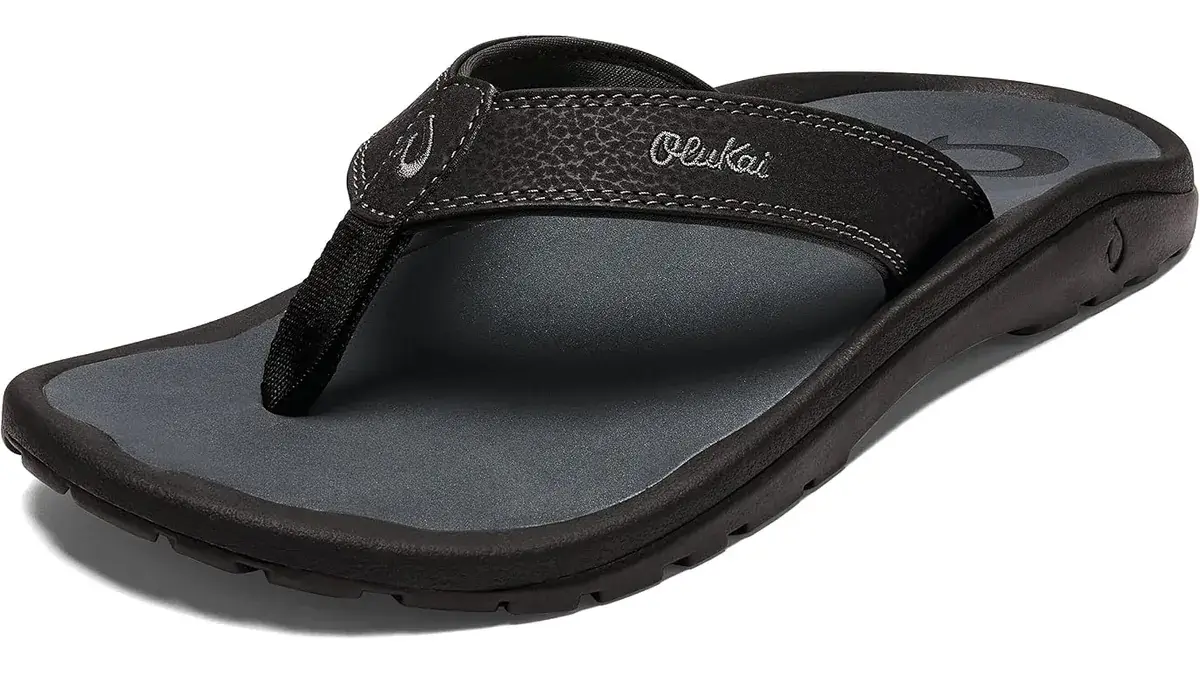
The OluKai ‘Ohana is a thong sandal, which is to say a flip-flop, but built to a standard that most flip-flops are not. Instead of a flat slab of rubber it has a molded midsole with a shaped footbed dropped into it, a proper rubber outsole underneath and straps made from a water-resistant synthetic that looks like leather and behaves better than leather would in the sea.
OluKai is a Hawaii-based brand and the ‘Ohana is its volume seller, the model that turns up in almost every store that stocks the brand. It sits in the middle of the range: more shoe than a beach thong, less shoe than the brand’s closed styles and leather sandals. Men’s and women’s versions are sold in a wide spread of colors on the same basic build.
The buyer this suits is going somewhere warm and wants one pair of open shoes that will not embarrass them. Pool, beach, boat, a walk along a promenade and then dinner: the ‘Ohana does all of that without looking like outdoor equipment. It is not a hiking sandal and it is not a support sandal, and buying it as either will disappoint.
Specs
Here are the specifications for the ‘Ohana:
| Type | Thong sandal for beach and casual wear |
| Straps | Water-resistant synthetic leather, fixed, not adjustable |
| Strap lining | Quick-drying jersey knit with a neoprene backer |
| Midsole | Anatomical compression-molded EVA |
| Footbed | ICEVA drop-in footbed that takes a light impression of the foot |
| Outsole | Non-marking rubber with a coral reef lug pattern |
| Heel retention | None |
| Widths | Standard only |
| Price | Listed at $85 on olukai.com as of September 2026. OluKai does not number ‘Ohana generations or publish a launch month, so we have not invented one. Check latest price |
Pros
These are the things the ‘Ohana does better than an ordinary flip-flop:
- There is a real footbed under your foot. It is shaped along the arch and cupped at the heel, which is why an hour on your feet in these is pleasant rather than punishing.
- The outsole is proper rubber with a lug pattern, not smooth foam, so wet tile, boat decks and gravel paths are all manageable.
- Salt water does nothing to it. The synthetic straps and the knit lining dry quickly and do not stiffen, crack or stain the way a leather thong does.
- It looks like a sandal rather than a piece of kit, which matters if you want one pair of open shoes for a whole trip.
- The neoprene backing on the strap lining means the toe post is softer against bare skin than most.
Cons
And these are its real limits:
- Nothing holds your heel. Every step means gripping slightly with your toes to keep the sandal on, which is tiring over distance and is simply how thong sandals work.
- The toe post is the toe post. Softer than most, but if the skin between your toes objects to flip-flops, this will not change that.
- The straps do not adjust at all, so the fit you get is the fit you get.
- The arch shaping is gentle. It is far better than a flat rubber thong and well short of a Chaco or a Birkenstock.
- At $85 it is expensive for a flip-flop, even a good one.
What is new in the current ‘Ohana
OluKai does not number the ‘Ohana the way footwear brands number running shoes, so there is no ‘Ohana 2 sitting behind this one. The sandal has been refined quietly instead, and if you own an older pair the shape and feel will be broadly familiar.
The change worth knowing about is the footbed material. Current pairs use what OluKai calls ICEVA, a drop-in footbed that takes a light impression of your foot with wear, so the contours end up slightly personalized rather than fixed. It is a modest effect, nothing like the way cork molds, but it is the reason a broken-in pair feels better than a new one.
Otherwise the design is stable: the same anatomical EVA midsole, the same coral reef lug outsole and the same water-resistant synthetic strap with a jersey knit lining. That consistency is part of the appeal. People who get on with the ‘Ohana tend to buy the same sandal again, and there is no annual redesign to worry about.
Who should buy the ‘Ohana
Buy it if you want one pair of open shoes for a warm holiday. It handles the pool, the beach, the walk to the shops and a meal out without you having to change, and it will not be ruined by any of them. For packing light, that versatility is the whole argument.
It is also the right call if you already wear flip-flops and your feet ache. The step up from a flat rubber thong to a shaped, cupped footbed on a rubber outsole is a bigger improvement than the price difference suggests, and it is the most common reason people switch to OluKai and stay.
And it suits anyone around salt water regularly. Leather thongs go hard, crack and stain with repeated soakings. The ‘Ohana’s synthetic straps and quick-drying lining simply do not care, which makes it a better boat and beach sandal than anything made of real leather at the price.
Who should probably skip it
Skip it if you plan to walk serious distances. A sandal with no heel retention makes your toes work on every step, and by mile three that becomes a real fatigue. Skip it if you need genuine arch support for a foot condition, because the contour here is gentle. And skip it if anything between your toes irritates you, because there is no version of this sandal without a toe post.
- Teva Hurricane XLT2: three adjustable straps including one around the heel, so the sandal stays on your foot without any gripping, and it handles trails and rivers properly (check price)
- Chaco Z/1 Classic: a firm sculpted footbed with real arch structure and a strap that secures the heel, for feet that ache in flat sandals (check price)
- Crocs Neria Pro II: a closed work clog for anyone whose real need is standing on wet floors for a shift rather than walking a beach (check price | read review)
How does the ‘Ohana fit?
The ‘Ohana fits true to size for most people, with a footbed that is moderately wide and a strap that sits fairly low across the foot. Nothing adjusts, so the fit comes down to picking the right size and having a foot shape that suits the strap.
Fit and sizing
Order your usual size and check two things when you stand in it. First, your heel should sit inside the cup at the back rather than hanging over the edge, because an overhanging heel will catch on curbs and steps. Second, the toe post should sit comfortably in the web between your first two toes without pulling them apart. If you have a broad forefoot the strap can feel tight across the top, and since it does not adjust, that is worth checking in person. There is no wide fitting.
Upper and step-in comfort
Step-in comfort is good and gets better. The jersey knit lining with its neoprene backer is soft against bare skin from the first wear, which is the main reason the toe post here causes fewer complaints than a plain rubber one. There is a short settling-in period while the footbed takes a light impression of your foot, after which the sandal feels more like yours. The one thing to watch is sand. Fine grit works its way under the footbed edge and, because nothing lifts out, rinsing it through is the only way to clear it.
How does the ‘Ohana perform?
Measured against other flip-flops, the ‘Ohana is at the top of the class, and by a clear margin. Measured against strap sandals it is a different proposition, because the thing that makes it easy to slip on is also the thing that limits it. Both judgements are true at once.
Cushioning and ride
The midsole is compression-molded EVA, the light foam used in most sports footwear, and here it is tuned to a middling firmness. Underfoot the ‘Ohana feels cushioned but not soft, which is the right call: too much squish in a sandal with no heel strap and you would be fighting it on every step. The footbed’s shaping does most of the comfort work, cupping the heel so your foot sits in the sandal rather than on it, and lifting gently under the arch. On pavement it takes the hardness out of the ground without feeling spongy.
In and around water
This is where the ‘Ohana justifies its price. The strap is a water-resistant synthetic rather than leather, the lining is a quick-drying knit and the outsole is non-marking rubber, so nothing about a soaking bothers it. Rinse and it is dry within the hour. The coral reef lug pattern, a dense arrangement of small shallow lugs, is designed for wet smooth surfaces, and on a pool surround or a boat deck it grips noticeably better than a flat foam sole. Salt, sand and chlorine all wash off.
Stability and support
Support here means the shape of the footbed, nothing more. The heel cup and the arch contour give your foot a defined place to sit, which stops it sliding around and is the reason the sandal feels secure standing still. What is absent is any retention at the back, so on uneven ground or a slope the sandal will move independently of your foot unless your toes hold it. Nothing in the design influences how your foot moves through a stride, and the arch shaping is too gentle to help a foot that needs proper structure.
Outsole, grip and durability
Having a genuine rubber outsole rather than exposed foam is the single biggest reason the ‘Ohana lasts. Foam-soled flip-flops wear through at the heel within a season, and rubber simply does not. Grip is good on wet smooth surfaces and dry paths, average on loose gravel and unremarkable on mud, which is fair for a sandal that was never meant to leave a boardwalk. The part that eventually gives up is the strap anchor where it meets the sole, and rinsing sand out after beach days is the best thing you can do to delay that.
Is the ‘Ohana good for walking?
For a mile or two, yes, and for a flip-flop that is genuinely impressive. The shaped footbed and the cupped heel mean your foot is held in position rather than sliding, and the rubber outsole gives you enough grip and protection for a promenade, a boardwalk or a wander around a town. It is the sandal to take on holiday if you expect to be on your feet a fair amount. Past that, physics catches up. With no heel strap, your toes have to grip on every step to keep the sandal attached, and that low-level effort is what makes your feet tired rather than the cushioning running out. For a full day of sightseeing, a sandal with a heel strap is the better tool, and for standing all day on hard floors this is not the right shoe at all.
‘Ohana versus the Teva Hurricane XLT2
Because OluKai does not number the ‘Ohana, there is no previous generation to compare it against. The comparison that actually helps a buyer is against the other sandal at this price that people cross-shop:
| Feature | OluKai ‘Ohana | Teva Hurricane XLT2 |
| Style | Thong, no heel strap | Three-strap with heel retention |
| Adjustability | None | Three independent adjustment points |
| Footbed | Shaped drop-in with a heel cup | Lightly contoured EVA |
| Best use | Beach, pool, boat and casual wear | Rivers, trails and long walks |
| Looks | Smart enough for a restaurant | Unmistakably outdoor gear |
| Price | Check latest price | Check latest price |
Buy the ‘Ohana when convenience and appearance matter as much as function. Slipping a sandal on and off all day, and not looking out of place at dinner, are real advantages on a holiday.
Buy the Hurricane when you intend to cover ground or go anywhere uneven. A heel strap changes what a sandal can do more than any other feature.
OluKai Ohana Alternatives
Three sandals cover the most common reasons the ‘Ohana is not the answer.
The Birkenstock Arizona is the move if you want the same slip-on convenience with far more shape underfoot. Two adjustable straps hold the foot without a toe post, and the cork footbed gradually takes the impression of your own foot, so the arch becomes yours rather than the factory’s. It is not a water sandal, and repeated soakings are bad for cork (check price | read review).
Where the price is the objection, the Crocs Classic Clog does a surprising amount of the same job for a fraction of the money. It is waterproof, it rinses clean, the closed toe protects against stubbing and the pivoting heel strap gives you retention the ‘Ohana does not have. It looks nothing like a smart sandal, which is the whole trade (check price).
For feet that are simply tired rather than going anywhere, the Hoka Ora Luxe is a different category of comfort. It is a thick, soft recovery slide with an adjustable strap and far more foam than any beach sandal carries, made for the end of a long day rather than the middle of one (check price).
Price and value
At $85 the ‘Ohana asks several times what a supermarket flip-flop costs, and the honest answer is that most of the difference is visible. A rubber outsole instead of exposed foam, a shaped drop-in footbed instead of a flat slab, and a strap system that survives salt water are all things that show up in how long the sandal lasts and how your feet feel after a day. Set against other premium thong sandals it is competitively priced. Set against a strap sandal like a Teva it looks expensive for what it does, because you are partly paying for how it looks. Whether that is good value depends on how much you care about that.
Final verdict
Best for: beach, pool and boat use, warm-weather travel, and anyone who wants one pair of open shoes that works from the sand to a restaurant.
Avoid if: you want to walk long distances, you need real arch support, or you cannot get on with a toe post.
Fit: true to size, standard width only, nothing adjustable. Check that your heel sits inside the cup and the strap does not pinch across a broad forefoot.
Verdict: the ‘Ohana is the best version of a simple idea. It takes everything that makes a flip-flop convenient and fixes the two things that usually make one uncomfortable, by putting a shaped footbed and a real rubber sole underneath. Accept the limits that come with having no heel strap and it is an excellent warm-weather sandal that will last several summers of salt water.
Frequently Asked Questions for OluKai Ohana
They have a shaped footbed with a gentle arch contour and a cupped heel, which is far more than a flat rubber flip-flop offers. It is not the level of structure you get from a Chaco or a Birkenstock, so it suits most feet rather than feet that need real support.
Yes, and that is part of the point. The straps are a water-resistant synthetic with a quick-drying knit lining, and the outsole is non-marking rubber, so nothing stiffens, cracks or stains after a soaking. Rinse the salt and sand off and they dry within the hour.
For most people, yes. Check that your heel sits inside the cup at the back rather than overhanging it, and that the strap does not pinch if you have a broad forefoot. Nothing on the sandal adjusts, so the size has to be right.
It is OluKai’s drop-in footbed material. It takes a light impression of your foot over the first weeks of wear, so the contours end up mildly personalized. The effect is subtle and nothing like the way a cork footbed molds.
Rinse with cool fresh water to clear salt and sand, work any grit out from around the footbed edge, then let them air dry away from direct sun. Sand left under the footbed is what wears the sandal out fastest.
Longer than a foam flip-flop, because the outsole is real rubber and does not wear through at the heel in a season. Most pairs eventually fail where the strap anchors into the sole, and regular rinsing is what delays that.