A tall heel with room for wide feet, in the heaviest shoe of its kind
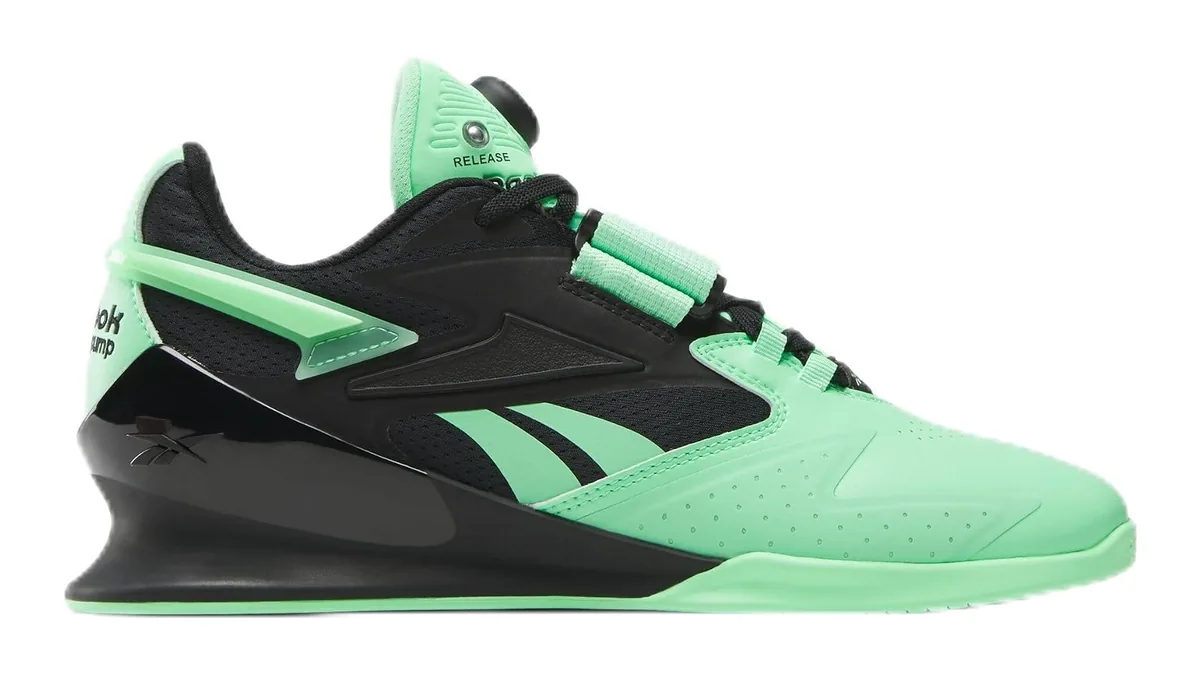
Quick Answer: Reebok Legacy Lifter III Review: The Legacy Lifter III is a dedicated weightlifting shoe built around a 22 mm heel and an unusually roomy toe box. That pairing is rare, and it makes this the standout choice if other lifting shoes pinch your feet. A hard plastic heel, a midfoot strap and an inflatable Pump tongue keep everything locked in place. The trade-off is weight, because this is the heaviest lifter in its class, and the outsole is less grippy than its rivals on dusty floors. Check latest price.
The Reebok Legacy Lifter III is Reebok’s flagship weightlifting shoe and the direct rival to the Nike Romaleos 4 and the Adidas Adipower 3. It reached wide release on Feb. 13, 2023 at $220, though some retailer listings date first availability to mid-2022, so treat the exact launch date as approximate.
Lifting shoes all do the same basic job. A hard wedge under the heel raises you up so your knees can travel further forward, which lets most people squat deeper with a more upright chest, and the rest of the shoe exists to stop your foot sliding around while you do it. The differences come down to how tall that heel is, how firmly the shoe holds you and, more than people expect, how it fits.
Fit is where the Legacy Lifter III makes its case. Most lifting shoes are cut narrow, and lifters with wide feet spend years compromising. This one has the roomiest toe box of the mainstream lifters while still giving you 22 mm of heel, which is as much elevation as anything on sale. That is a combination nothing else quite matches. If your training mixes lifting with jumps, short runs or conditioning, see our best CrossFit shoes and best cross-training shoes instead.
Specs
Here are the specifications for the Reebok Legacy Lifter III:
| Shoe type | Dedicated weightlifting shoe, squats and Olympic lifts |
| Best for | Wide-footed lifters who also want a tall heel |
| Heel height | 22 mm, a little over three quarters of an inch |
| Heel material | TPU, a hard plastic that does not compress |
| Closure | Laces, a midfoot strap and the Reebok Pump inflatable tongue |
| Upper | Synthetic leather with a textile lining |
| Toe box | The widest among mainstream lifting shoes |
| Weight | About 575 g, roughly 20.6 oz, per shoe. That is the heaviest in its class |
| Outsole | Rubber. Lab testing measured a friction coefficient of 0.22, lower than most lifters and trainers |
| Released | Feb. 13, 2023 for the wide release |
| Price | $220 at launch in February 2023. Check latest price |
Pros
- The roomiest toe box of any mainstream lifting shoe, which lets your toes spread for balance at the bottom of a squat.
- A 22 mm heel, level with the tallest on the market, so nothing is given away in elevation to get that width.
- The TPU heel is genuinely rigid, so the platform underneath you never feels soft when the bar is heavy.
- Three ways to tighten it, laces, strap and the Pump tongue, so you can dial in the hold around your instep.
- The synthetic leather upper is built to last and shrugs off the scuffs a barbell inflicts.
Cons
- At roughly 575 g per shoe it is the heaviest lifter you can buy, and you notice when you move your feet quickly.
- Lab testing found the outsole rubber less grippy than rivals, which can matter on a dusty or sweaty gym floor.
- The Pump adds a novelty more than a transformation. Plenty of lifters barely use it.
- It is little changed from the Legacy Lifter II, so an upgrade is hard to justify if you own the older shoe.
- At $220 it is priced with the most expensive shoes in the category.
What is new versus the Legacy Lifter II
Honestly, not much. Reebok carried over the upper materials, the lacing and eyelet layout, the strap and the heel, so the shoe lifts almost identically to the Legacy Lifter II. The changes are cosmetic plus one functional addition.
That addition is the Pump. Reebok’s old inflatable system returns, this time built into the tongue. Press the button and air fills a bladder that presses down onto the top of your foot and around the ankle, closing the gap that laces alone leave over a low instep. For lifters with skinny ankles or a shallow foot it is a genuine improvement in hold. For everyone else it is a party trick, and a fair number of owners inflate it once and forget it.
The practical upshot is simple. If you own a Legacy Lifter II in good condition, there is no performance reason to replace it with the III. If you are buying new, the III is the current model and the Pump costs you nothing to ignore.
Who should buy the Reebok Legacy Lifter III
Buy it if you have wide feet. This is the headline reason and it is a strong one. Lifting shoes have historically been cut for narrow feet, and if you have spent a decade cramming into Adipowers or sizing up in Romaleos, this is the shoe that solves your problem without asking you to give up heel height in exchange.
It also suits lifters who want maximum elevation. At 22 mm it is level with the Adidas Adipower 3 and above the Nike Romaleos 4, which makes it a natural fit if your ankles are stiff, if you are tall or if you squat with a narrow stance and struggle to reach depth without your heels lifting.
Finally, it suits anyone who has trouble getting a shoe to hold their instep. Between the laces, the strap and the Pump you have three separate ways to close the shoe around your foot, and that is more adjustment than any rival offers. A shoe cannot change how your foot is built, but it can stop it sliding.
Who should probably skip it
Skip it if weight bothers you. This is a heavy shoe and there is no way around that. Olympic lifters who move their feet fast under a bar often prefer something slimmer. Skip it if you train on a dusty or sweaty floor and grip is already marginal, because the outsole compound is less tacky than the competition. And skip it if you have narrow feet, because a roomy toe box is a benefit only when you need the room, and a foot swimming in a shoe is less stable than one held snugly.
Three shoes that suit that person better:
- Reebok Lifter PR 3: Reebok’s cheaper, lighter lifting shoe, which is the sensible option if you want a raised heel without the flagship weight or price (check price)
- Reebok Nano X5: a cross-training shoe for people whose sessions mix barbell work with running and jumping, where a rigid lifter is the wrong tool (check price)
- Vivobarefoot Primus Lite IV: a flat, thin-soled shoe for deadlifts and hinge work, where you want to be as close to the floor as you can get (check price)
How does the Reebok Legacy Lifter III fit?
This is the friendliest-fitting shoe in a category not known for friendly fits. Length runs true for most people, the heel is held firmly and the front of the shoe gives your toes room to move. If lifting shoes normally hurt you, start here.
Fit and sizing
Take your normal size. The toe box is the widest among mainstream lifting shoes, and that is not just a comfort point: at the bottom of a heavy squat you want to be able to spread your toes and grip the floor, and a shoe that clamps them together takes that away from you. Wide-footed lifters who have been sizing up in other brands can usually stop doing that here. Narrow feet will find it roomy, and the strap plus the Pump go some way toward taking up the slack. The insole lifts out if you use an orthotic.
Upper and step-in comfort
The upper is synthetic leather over a textile lining, which is the traditional recipe for a lifting shoe and the reason this one feels solid rather than sporty. Step-in comfort is more like putting on a boot than a sneaker: heavy, close and reassuring. The heel counter, the stiffened cup at the back that stops your heel lifting, is firm. There is no meaningful break-in, and the shoe will not stretch or soften, so judge it on the first fitting. Breathability is limited, as it is with any padded synthetic-leather shoe, but a lifting session is not a hot-weather run.
How does the Reebok Legacy Lifter III perform?
Under load this shoe is exactly what you want: still, solid and unfussy. The heel does not budge, the base is wide and you can lock the upper down as tightly as you like. The two things holding it back are how much it weighs and how much the sole bites.
Heel height and squat position
The 22 mm heel is at the top of the mainstream range, level with the Adidas Adipower 3, above the 21 mm TYR L-2 Lifter and the 20 mm Nike Romaleos 4. In practical terms, a taller heel lets your knees push further forward before your heels want to leave the floor, and for most people that means reaching a deeper squat with the chest more upright and less lean through the hips. How much benefit you get depends entirely on your own ankle and hip movement. Lifters who are already flexible sometimes find this much lift tips them onto their toes, in which case a 15 mm shoe suits them better.
Stability and support
The heel is a solid TPU wedge, which means it behaves like part of the floor rather than like foam. That is the whole point of a lifting shoe, and this one delivers it convincingly even under heavy loads. Above it, the closure system does the rest: laces set the basic tension, the midfoot strap clamps the middle of the foot down and the Pump fills the space over your instep so your foot cannot lift inside the shoe. The wide base resists tipping sideways. What you will not get is the extreme torsional rigidity of the Nike Romaleos 4, which is stiffer through the middle, though for the overwhelming majority of lifters that difference never shows up. A shoe supports a movement, it does not correct one, and pain under load is a reason to see a professional.
Outsole, grip and durability
Day to day the outsole is confident on wooden platforms and clean rubber flooring. The caveat comes from the lab: measured friction on the Legacy Lifter III came out at 0.22, lower than most lifters and cross-trainers, which means the rubber is harder and less tacky than the competition. On a clean surface that is irrelevant. On a dusty commercial gym floor or one slick with sweat it is worth knowing about, particularly if you jump your feet out to receive a clean. Durability is a strength. There is very little to wear out on a shoe you only lift in, and the synthetic leather upper is tougher than the woven uppers used by some rivals.
Is the Reebok Legacy Lifter III good for walking?
No. It is a specialist tool and walking is not on the list. The heel is hard plastic with no cushioning, so every step lands with a jolt that travels straight up your leg, and the sole is deliberately stiff so it will not roll you through your stride the way a walking shoe does. Add the weight, which is the highest in the category, and a walk around the block becomes hard work.
Crossing the gym floor between sets is fine. Standing in it for a long session is tolerable but not comfortable, because a raised heel tilts you forward the whole time and your calves take the load. Wear normal shoes to the gym, change into these for your working sets and change back before you leave. Anyone wanting one pair that can handle both lifting and walking should be shopping for a cross-training shoe instead.
Legacy Lifter III versus Legacy Lifter II
Feature | Legacy Lifter III | Legacy Lifter II |
Heel | TPU wedge, 22 mm | TPU wedge, carried over |
Upper | Synthetic leather, same materials as before | Synthetic leather |
Closure | Laces, strap and Pump tongue | Laces and strap |
Everything else | Largely unchanged plus cosmetic updates | The template |
Buy the III when you are buying new, when you want the extra instep adjustment or when you simply want the model that is still in production. Buy a discounted Legacy Lifter II when you find one in your size, since it lifts the same and the only thing you give up is an inflatable tongue.
Reebok Legacy Lifter III Alternatives
The Legacy Lifter III is the wide, tall and heavy option. Lifters who want something else from those three variables have clear choices.
Nike Romaleos 4: the stiffest lifting shoe there is, with a second strap that threads through the sole for the most complete lockdown available. Its heel is slightly lower at 20 mm and its toe box is snug, so it is a step sideways for wide feet, but nothing else feels quite as welded to the floor (check price).
Lifters who want the same 22 mm heel in a much lighter shoe should look at the Adidas Adipower 3. It is slimmer and easier to move quickly in, and the compromise is a narrow toe box that rules it out for exactly the feet the Reebok serves best (check price).
The closest thing to a straight rival is the TYR L-2 Lifter. It also builds around a wide toe box, at 21 mm its heel is nearly as tall and it weighs less than the Reebok, which makes it the one to compare directly if the Legacy Lifter’s bulk is what is putting you off (check price).
Price and value
The Legacy Lifter III launched at $220 in February 2023, putting it level with the Adidas Adipower 3 and above the Nike Romaleos 4. That is a lot for a shoe that carries over almost everything from its predecessor. The value case rests entirely on fit. If you have wide feet, this is the only mainstream lifter that gives you room and a 22 mm heel at the same time, and being able to train comfortably is worth real money. If your feet are average or narrow, you are paying flagship prices for a heavy shoe whose main advantage does not apply to you.
Final verdict
Best for: wide-footed lifters who want a tall heel, and anyone who struggles to get a shoe to hold their instep.
Avoid if: you want a light shoe, you have narrow feet or you already own a Legacy Lifter II.
Fit: true to size, with the roomiest toe box in the category. One width.
Verdict: The Reebok Legacy Lifter III solves a problem nobody else solves properly, giving wide feet somewhere to go without dropping to a lower heel. The Pump is a gimmick, the weight is real and the update over the II is thin, but if the shape fits you, none of that matters much.
Frequently Asked Questions for Reebok Legacy Lifter III
Yes, and it is the main reason to choose it. It has the roomiest toe box among mainstream lifting shoes and still uses a 22 mm heel, a combination no direct rival matches.
It inflates a bladder in the tongue that presses onto the top of your foot, closing the gap laces leave over a low instep. Lifters with shallow feet or thin ankles notice it. Most people inflate it once and leave it.
About 575 g, roughly 20.6 oz, per shoe, which makes it the heaviest of the mainstream lifting shoes. For slow, heavy squatting that is irrelevant. For fast Olympic lifting it is a real consideration.
Not at the time of writing. The Legacy Lifter III remains Reebok’s current flagship weightlifting shoe, alongside the cheaper Lifter PR line.
Only for the barbell portions. The heel is rigid, the sole does not flex and the shoe is heavy, so running, jumping and rope climbs are awkward. Use a cross-training shoe for mixed sessions.
Not to start with. A flat, firm shoe covers most people for a long time. A raised heel earns its place when you cannot reach squat depth without your heels lifting, or when your torso pitches forward more than you would like.