If you’ve ever shopped for kids sneakers online, you’ve probably seen extra letters tucked into a product name—PS, GS, SE, and a handful of others. These aren’t random. They tell you who the shoe is sized for (PS and GS) or what kind of release it is (SE). Once you know what they mean, it’s easier to buy the right pair, compare prices, and avoid ordering a shoe that looks right but fits completely differently than expected.
Quick definitions
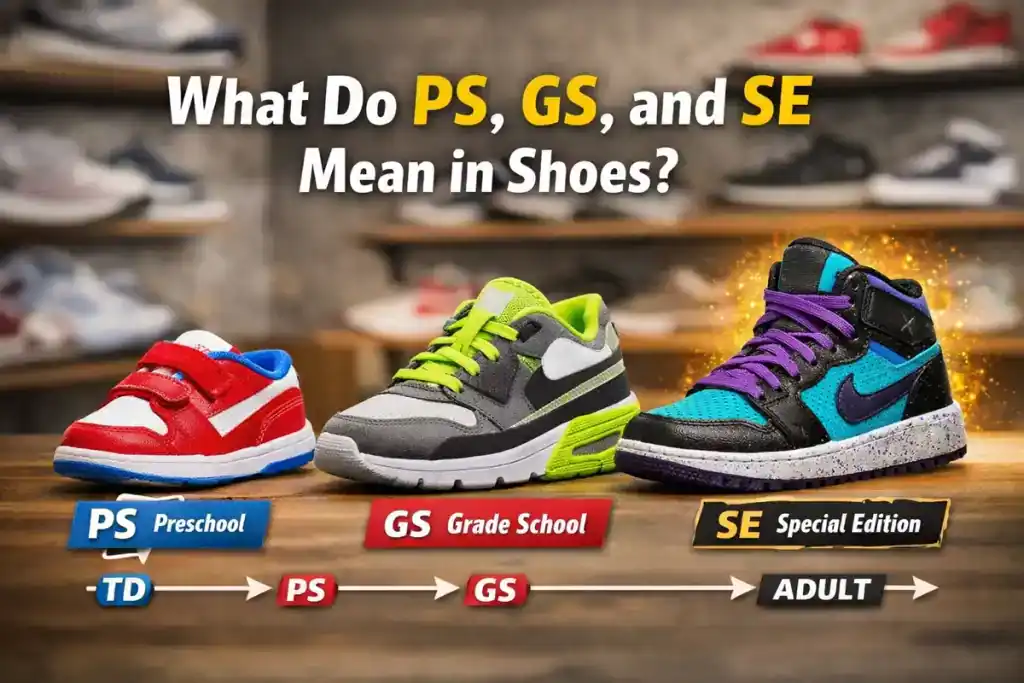
PS means Preschool, a children’s sizing category.
GS means Grade School, a youth sizing category that typically runs larger than PS.
SE means Special Edition, a label used for a unique or themed version of a shoe.
That’s the short version. The details matter, especially if you’re shopping for kids—or if you have smaller feet and you’re trying to save money by buying youth sizes. (Click to scroll to our women’s to kid’s size calculator.)
PS: Preschool sizing (kids)
PS stands for Preschool sizing, which sits between toddler sizes and older youth sizes. You’ll see it often in popular sneaker lines such as Nike, Jordan, Adidas, and Puma.
This category generally covers children who have outgrown toddler sizing but aren’t yet in “big kids” or youth sizing. In practical terms, PS shoes are usually listed in the range that includes “Child (C)” sizes and sometimes up to the smaller “Youth (Y)” sizes, depending on the retailer and how they label their inventory.
Preschool shoes are designed for the realities of childhood: constant movement, quick on-and-off routines, and durability. That’s why PS versions of popular sneakers frequently use easier closure systems (like hook-and-loop straps or elastic laces), lighter materials, and more rugged outsoles. They’re built less for performance metrics and more for everyday wear and tear.
For preschool shoes on Amazon, click the button below.
GS: Grade School sizing (youth)
GS stands for Grade School, which is the next step up from PS. This is the youth category that covers older children and pre-teens, and it often overlaps with adult sizing at the lower end.
GS shoes are popular for a few reasons. First, they often look nearly identical to adult versions—same colorways, same style name, same overall design. Second, they’re frequently priced lower than the adult model. That makes them especially appealing to anyone who can wear youth sizing, including women with smaller feet.
There are differences to keep in mind, though. Some GS versions use simpler cushioning systems or different materials compared with adult pairs. The goal is usually cost control and durability, not matching every performance detail of the adult shoe. For casual wear, that may not matter at all. For training, running, or sports-specific use, it’s worth paying attention to the construction details.
SE: Special Edition
SE stands for Special Edition. This label is less about sizing and more about the release itself.
A Special Edition shoe is typically a version of a standard model with something “extra” added to differentiate it: a unique colorway, upgraded materials, a themed story, special packaging, or small design details that don’t appear in the general release version.
Sometimes SE shoes are released in limited quantities, but “Special Edition” doesn’t always mean rare. In many cases, it simply means it’s a distinct version of a shoe that’s already part of a brand’s main lineup. It may be easier to find than a true limited collaboration or a hard-to-get drop, even if it looks more premium.
Kids’ size progression (how PS and GS fit together)
If you’re buying for children, it helps to understand the standard progression most brands follow. Kids usually start in Toddler (TD) sizing, move into Preschool (PS) once their feet are bigger and they’re walking/running more confidently, and then transition into Grade School (GS) as they approach elementary school and beyond. In listings, this often looks like TD for the smallest kids sizes, PS for the “little kids” range, and GS for the “big kids” range. Knowing that sequence makes it much easier to filter sizes and avoid accidentally buying a shoe meant for a different stage of growth.
Women buying GS sizes (simple conversion note)
GS sizing can be a smart money-saver because youth sneakers are often cheaper than adult versions, even when the design looks nearly identical. For many brands, a youth (GS) size is about 1.5 sizes smaller than a women’s size.
As a quick rule of thumb:
A women’s 7 often matches a GS 5.5Y
A women’s 8 often matches a GS 6.5Y
A women’s 9 often matches a GS 7Y
This conversion isn’t perfect across every brand or model, and GS shoes can run slightly narrower, but for lifestyle sneakers it’s often a useful way to compare options when price matters.
Women’s to Kids’ (GS) Shoe Size Calculator
Here is a calculator that allows you to convert kids shoe sizes to women’s sizes.
If you wear women’s sizes and want to save money by buying kids’ (Grade School / GS) shoes, this calculator estimates your closest youth size. A common rule of thumb is: Kids (Y) = Women’s size − 1.5.
How to measure foot length (quick method)
Measuring foot length is one of the simplest ways to buy the right size, especially for kids whose feet change quickly.
Here’s a straightforward way to do it at home:
Have your child stand on a sheet of paper with their full weight on the foot you’re measuring.
Trace around the foot with a pencil held straight up and down.
Measure from the heel to the longest toe in a straight line.
Repeat on the other foot—many people have one foot slightly larger.
Use the longer measurement when matching a brand’s size chart.
If you’re measuring for a sneaker that will be worn with thicker socks, do the measurement while wearing those socks to get a more accurate fit.
Other common sneaker acronyms you might see
Once you start noticing them, you’ll see acronyms everywhere in sneaker culture and product listings. Here are a few of the most common ones, with plain-English meanings.
TD : Toddler sizing
TD means Toddler sizing. You’ll see it on the smallest kids shoes.
OG: Original
OG means Original. It usually refers to an original colorway, the first version of a model, or a retro release that’s meant to match the original design closely.
GR: General Release
GR means General Release. This is a standard version of a shoe that is widely available rather than limited.
PE : Player Exclusive
PE means Player Exclusive. These are made for athletes and are often not sold to the public, though similar versions may be released later.
QS: Quickstrike
QS means Quickstrike. This term is often associated with limited Nike releases that drop with little advance notice and may sell out quickly.
NRG: Energy
NRG is short for Energy. It’s a Nike/Jordan label often used for shoes that include premium design elements, upgraded materials, or special packaging.
How these labels help you shop smarter
These acronyms matter most when you’re comparing shoes across listings, especially on marketplaces where several versions of the same sneaker appear side by side.
PS and GS can look almost identical to adult models in photos, but they fit differently and may be built differently. SE tells you you’re looking at a variation that may have unique design elements—and sometimes a higher price tag.
If you’re shopping for a child, PS versus GS ensures you’re looking at the right range. If you’re shopping for yourself, knowing the GS range can help you find less expensive alternatives—especially if you’re in the overlapping sizes between youth and adult.
FAQ: PS, GS, and SE in shoes
PS means Preschool sizing. It refers to kids’ shoes that fit between toddler sizing and the larger youth (grade school) range.
GS means Grade School sizing, often used for the larger youth range. These sizes can overlap with smaller adult sizes in some models.
GS is a type of youth sizing. Many brands use GS to label “big kids” sizes, typically larger than PS.
No. Toddler sizes (often labeled TD) usually come first. PS generally starts after toddler sizing and is meant for bigger kids who still aren’t in the GS range.
SE means Special Edition. It usually indicates a version of a shoe with unique design details, materials, or a theme.
Not always. SE often means “different” or “upgraded,” but availability varies. Some SE releases are widely available, while others are harder to find.
Yes, many women can wear GS sizes if their feet are small enough. A common rule is that GS sizing is about 1.5 sizes smaller than women’s sizing, but fit varies by brand and model.
Youth shoes are often priced lower and sometimes use slightly different materials or simplified cushioning. For casual wear, the differences may be minimal.
They can fit differently. Youth versions may run narrower and may not use the same cushioning or construction as adult pairs, even if they look similar.
If your child is at the top end of PS sizing and growing quickly, it often makes sense to try GS—especially if the shoe fits better in width and length. Measuring foot length and checking the brand size chart is the most reliable approach.