Last Updated on September 27, 2026
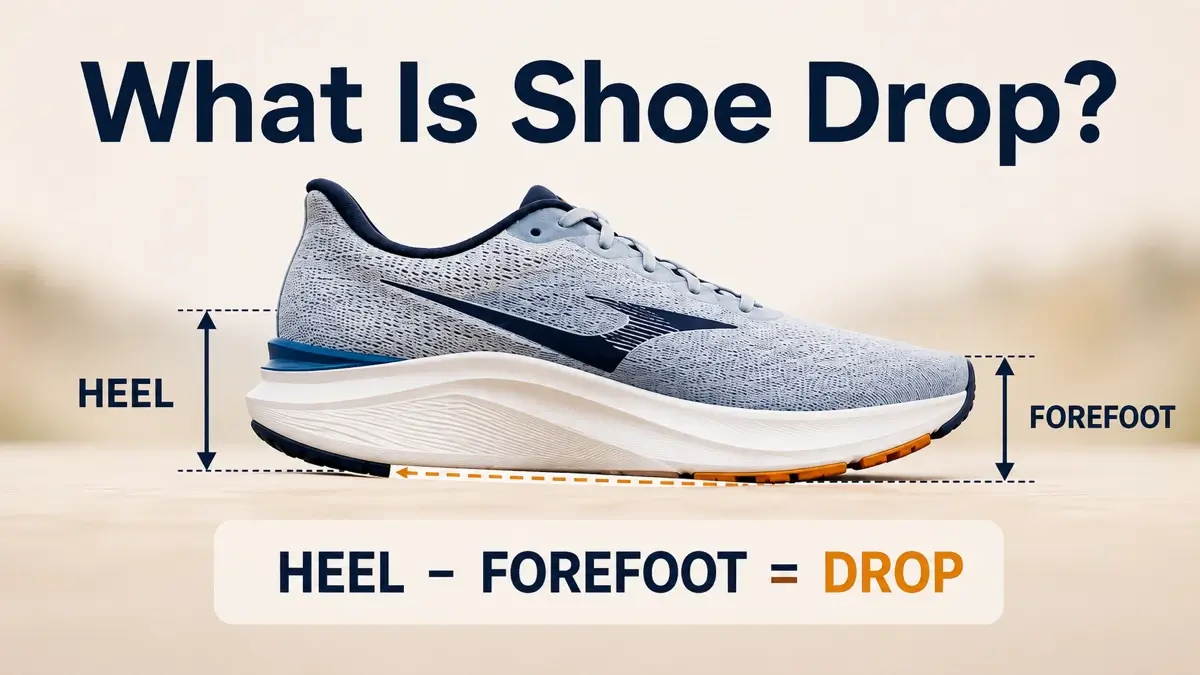
| Quick answer: What is shoe drop? Shoe drop, or heel-to-toe drop, is the difference between the height of the heel and the forefoot inside a shoe. It is measured in millimeters. Heel stack height – forefoot stack height = shoe drop. For example, if a shoe measures 32 mm under the heel and 24 mm under the forefoot, it has an 8 mm drop. A 0 mm drop means the heel and forefoot sit at the same relative height above the ground. |
Shoe drop, also called heel-to-toe drop, is the difference between the height of the heel and the height of the forefoot inside a shoe. It is measured in millimeters. One millimeter is about 1/25 of an inch, while 1 inch equals 25.4 mm. If you’re comparing zero-drop, low-drop and barefoot designs, see our Barefoot and Minimalist Shoes guide. For how drop works with foam, rockers, plates and stability systems, see our Running Shoe Technology guide.
For example, if a shoe measures 30 mm under the heel and 22 mm under the forefoot, the difference is 8 mm. That means the shoe has an 8 mm drop.
Although the measurement is small, it can noticeably affect how a shoe feels when you walk or run. Drop can influence ankle movement, how your foot moves through each step and where some of the load is placed on your feet and legs.
It is also useful when comparing walking and running shoes. Two shoes can look similar and have similar amounts of cushioning, yet feel quite different if their heel-to-toe drops are not the same.
What does shoe drop actually measure?
Shoe drop does not refer to the visible height of the outside edge of the shoe. Technically, stack height is measured from the surface supporting the foot inside the shoe down to the flat surface beneath the shoe. Heel-to-toe drop is the difference between those two measurements.
A note about stack height: Put simply, stack height refers to the measurement of the material between the bottom of your foot and the ground. That can include foam, rubber, outsole material and other cushioning or structural compounds.
Modern midsoles often curve upward around the sides of the foot. Looking at the exterior of a shoe or putting a ruler against the sidewall may not tell you how high the heel or forefoot actually sits above the ground.
A simple way to picture drop is to imagine standing barefoot on a flat floor. Your heel and forefoot are at roughly the same level. Now imagine placing a wedge beneath your heel. Your heel sits higher than your forefoot, creating a heel-to-toe difference. Athletic shoes can create the same effect within their midsoles.
What else is shoe drop called?
Manufacturers, shoe reviewers and researchers use several terms for the same basic measurement.
You may see it called:
- Heel-to-toe drop
- Heel drop
- Shoe drop
- Heel-to-toe offset
- Shoe offset
- Heel differential
- Toe drop
- Pitch
- Gradient
All of these terms can be used when discussing the difference between heel and forefoot height. When shopping, drop, offset and heel-to-toe drop are among the terms you are most likely to encounter.
How is shoe drop calculated?
The arithmetic is simple once you know the heel and forefoot stack heights: Heel stack height – forefoot stack height = shoe drop
Here are three hypothetical examples:
Shoe | Heel stack | Forefoot stack | Shoe drop |
|---|---|---|---|
Shoe A | 25 mm | 25 mm | 0 mm |
Shoe B | 30 mm | 24 mm | 6 mm |
Shoe C | 35 mm | 23 mm | 12 mm |
Shoe A is a zero-drop shoe because the heel and forefoot are at the same height.
Shoe B raises the heel 6 mm above the forefoot.
Shoe C has a 12 mm difference and would generally be considered a high-drop shoe.
The important point is that drop measures a difference in height. It does not tell you how thick or cushioned the shoe is.
What shoe-drop measurements are common?
Running shoes are commonly described as having heel-to-toe drops between 0 and 15 mm, but that is not an absolute physical limit.
RunRepeat reports that laboratory testing of hundreds of shoes has found actual drops ranging from slightly negative at about -0.8 mm to as high as 16.1 mm.
There is also no universal industry standard for labels such as “low,” “moderate” or “high” drop.
Asics, for example, groups its shoes into these categories:
| Drop | Asics classification |
|---|---|
| 0 mm | Zero drop |
| 1-5 mm | Low drop |
| 6-10 mm | Mid drop |
| 10 mm or more | High drop |
Asics’ categories overlap at 10 mm, which illustrates why the actual measurement is more useful than the category name.

For comparisons, a practical way to think about drop is:
| Heel-to-toe drop | Useful description |
|---|---|
| Below 0 mm | Negative drop |
| 0 mm | Zero drop |
| 1-4 mm | Low drop |
| 5-7 mm | Low-to-moderate drop |
| 8-10 mm | Moderate drop |
| 11-15 mm | High drop |
| Above 15 mm | Unusually high drop |
These descriptions are comparison tools, not medical classifications or universal footwear standards.
Can a shoe have negative drop?
Yes, although it is uncommon in conventional running shoes. Negative drop means the measured forefoot stack height is slightly greater than the heel stack height.
For example:
- Heel: 29.2 mm
- Forefoot: 30 mm
- Drop: -0.8 mm
Some shoe review sites have discovered negative drops, although this is usually on shoes that manufacturer’s call zero drop. It is usually minuscule and a result of manufacturing variances.
Stated drop vs. measured drop
The drop listed by a shoe manufacturer is not necessarily identical to the measurement obtained from a production shoe in an independent laboratory. A manufacturer might list a shoe at 8 mm, for example, while laboratory testing could produce a somewhat different result.
Manufacturing tolerances, shoe size, measurement methodology and differences between the design specification and finished shoe can all contribute to variation.
This does not necessarily mean the manufacturer specification is wrong. It means consumers should understand what the number represents.
When comparing shoes, distinguish between:
- Advertised drop: The specification published by the manufacturer.
- Measured drop: The result obtained by physically measuring a finished shoe using a defined testing method.
If both numbers are available, make sure you are comparing like with like.
What does zero drop mean?
A zero-drop shoe has no intended height difference between the heel and forefoot. If the heel stack is 25 mm and the forefoot stack is also 25 mm:
25 mm – 25 mm = 0 mm drop
Zero drop does not mean zero cushioning.
A zero-drop shoe could have:
- 10 mm under the heel and 10 mm under the forefoot.
- 20 mm under the heel and 20 mm under the forefoot.
- 30 mm under the heel and 30 mm under the forefoot.
All three have a 0 mm drop. The difference is their stack height. This is why a thick, highly cushioned Altra and a thin minimalist shoe can both technically be zero drop. Asics similarly notes that shoes with very different amounts of cushioning can have the same heel-to-toe drop.
Shoe drop vs. stack height
Drop and stack height are related measurements, but they tell you different things about a shoe.
Stack height tells you how high your foot sits above the ground at a particular point.
Shoe drop tells you the difference between heel and forefoot stack height.
Consider these two shoes:
Measurement | Shoe A | Shoe B |
|---|---|---|
Heel stack | 40 mm | 24 mm |
Forefoot stack | 32 mm | 16 mm |
Drop | 8 mm | 8 mm |
Both have an 8 mm drop. However, Shoe A has 16 mm more material beneath both measurement points. It could therefore feel substantially different despite having exactly the same drop. An 8 mm drop alone does not tell you whether a shoe is:
- Highly cushioned
- Minimalist
- Soft
- Firm
- Flexible
- Stable
Drop tells you only how much higher the heel sits relative to the forefoot.
What does a low-drop shoe feel like?
A low-drop shoe positions the heel relatively close to the height of the forefoot.
That generally creates a flatter sensation underfoot than you would experience in a 10 or 12 mm shoe.
When running, lower-drop footwear can facilitate a more midfoot-oriented landing and can increase demands on the feet, ankles, calves and Achilles tendon compared with higher-drop shoes. (Asics)
For walking, the difference may be less dramatic, but someone moving from a 12 mm shoe to a 4 mm shoe could notice several changes.
These may include:
- A flatter feeling underfoot.
- More movement at the ankle.
- Greater loading of the calf and Achilles area.
- Less sensation of the heel being elevated.
- A different heel-to-toe transition.
That does not make low drop inherently better or worse. The shoe simply places your foot and lower leg in a different relationship to the ground.
Examples of low-drop walking and running shoes
Low-drop shoes generally place the heel only slightly higher than the forefoot. For comparison here, we are using 0 to 6 mm, while recognizing that manufacturers classify these ranges differently.
Current examples include:
Shoe | Advertised drop | Type | Useful for | Price |
|---|---|---|---|---|
Altra Torin 8 | 0 mm | Cushioned neutral | Walking, daily running, roomy toe box | |
Altra Experience Flow 2 | 4 mm | Lightweight neutral | Walking, running, lower-drop transition | |
New Balance Fresh Foam X More v6 | Approx. 4 mm | Maximum cushion | Walking, longer distances, daily wear | |
Hoka Bondi 9 | 5 mm | Maximum cushion | Walking, standing, longer distances | |
Brooks Ghost Max 3 | 6 mm | High-cushion neutral | Walking, orthotics, everyday running |
The Altra Torin 8 is a useful example of why zero drop should not be confused with minimal cushioning. Altra lists the Torin 8 at a 30 mm stack height with a 0 mm heel-to-toe drop and classifies its cushioning level as high.
The Altra Experience Flow 2 provides some heel elevation while remaining low drop. The men’s model is listed with a 32 mm heel, 28 mm forefoot and 4 mm difference.
The Hoka Bondi 9 combines maximum cushioning with a 5 mm drop. Hoka increased the Bondi’s drop from 4 mm in the previous generation to 5 mm in the Bondi 9
At 6 mm, the Brooks Ghost Max 3 sits near the upper end of the low-to-moderate range used here. Brooks specifically lists walking and orthotic use among its intended applications and combines the 6 mm drop with high-stack cushioning, a rocker shape and a broad base.
Specifications can change between generations, so check the current model rather than assuming a new version has the same drop as the shoe it replaces.
What does a high-drop shoe feel like?
A high-drop shoe positions the heel noticeably higher than the forefoot.
For someone accustomed to conventional running shoes, that may feel completely normal. Someone who regularly wears zero-drop footwear may notice the elevated heel immediately.
A higher drop can reduce the amount of ankle dorsiflexion required and shift some demand away from the ankle and Achilles region. Lower and higher drops can also change how forces are distributed farther up the kinetic chain.
Higher drop is not the same as more cushioning. A shoe can have substantial cushioning with either a low or high drop.
Examples of higher-drop walking and running shoes
Several current athletic shoes provide useful examples of moderate-to-high and high heel-to-toe drops.
Shoe | Advertised drop | Type | Useful for | Price |
|---|---|---|---|---|
Brooks Beast GTS 26 | 12 mm | Maximum-support stability | Walking, orthotics, everyday wear | |
Brooks Ghost 18 | 10 mm | Neutral cushioned | Walking, daily running | |
Brooks Adrenaline GTS 25 | 10 mm | Stability | Walking, running, structured support | |
Nike Pegasus 42 | 10 mm | Neutral responsive | Walking, running, everyday athletic use | |
Saucony Triumph 24 | 10 mm | High-cushion neutral | Longer walks and runs | |
Mizuno Wave Rider 29 | 10 mm | Neutral daily trainer | Walking, running, heel-first transitions |
The Brooks Beast GTS 26 is the clearest high-drop example in this group at 12 mm. Brooks specifically lists walking, everyday wear and orthotic use among its intended applications.
The Brooks Ghost 18 and Adrenaline GTS 25 are both listed with 10 mm drops, and Brooks includes walking among the intended uses for both.
Nike lists the Pegasus 42 at a 10 mm heel-to-toe drop.
The Mizuno Wave Rider 29 is also now a 10 mm model. Mizuno reduced the drop from 12 mm in the previous generation, another reminder that the geometry of a long-running shoe model can change.
How does shoe drop affect walking?
Most people contact the ground with the heel first when walking, then move their weight toward the forefoot before pushing off.
The geometry of the shoe can affect how that movement feels.
A higher-drop shoe may feel familiar to someone who has spent years in conventional walking or running shoes. A lower-drop shoe may feel flatter and allow or require more ankle movement.
For walking shoes, however, drop should never be considered by itself.
Other characteristics that matter include:
- Cushioning
- Stability
- Rocker geometry
- Flexibility
- Heel fit
- Toe-box width
- Midsole firmness
- Overall fit and comfort
A comfortable and stable 10 mm shoe may work far better for one walker than an uncomfortable 4 mm shoe. Another walker may strongly prefer the flatter platform of the 4 mm model.
How does shoe drop affect running?
Drop tends to become more noticeable during running because the forces involved are greater and foot-strike patterns vary more.
Lower-drop shoes can facilitate midfoot running, while higher-drop shoes can facilitate rearfoot running. Asics notes that even relatively small differences in drop can affect movement through the feet and lower body.
That does not mean shoe drop alone determines how you land.
Foot strike is also affected by:
- Running speed
- Technique
- Shoe geometry
- Terrain
- Fatigue
- Individual biomechanics
Putting a habitual heel striker in a 4 mm shoe does not automatically turn that person into a forefoot runner.
Similarly, wearing a 12 mm shoe does not guarantee a heel strike.
Is there an ideal shoe drop?
There is no single heel-to-toe drop that is best for everyone.
Your preferred drop may depend on your footwear history, ankle mobility, running or walking mechanics, comfort and the activity for which you are using the shoe.
Someone who has comfortably worn 10 to 12 mm shoes for years may have no reason to switch simply because lower-drop footwear has become popular.
Someone accustomed to zero-drop shoes may find a 12 mm shoe awkwardly elevated.
A useful place to start is with a shoe you already find comfortable.
Find its drop and use that as a baseline when considering alternatives.
How to compare shoe drop between shoes
Drop becomes especially useful when you use it as a comparison measurement rather than trying to find a universally “correct” number.
Suppose your current walking shoe has an 8 mm drop.
You are considering these replacements:
Shoe | Drop | Difference from current shoe |
|---|---|---|
Current shoe | 8 mm | Reference |
Shoe A | 10 mm | 2 mm higher |
Shoe B | 6 mm | 2 mm lower |
Shoe C | 0 mm | 8 mm lower |
Shoe A and Shoe B represent relatively modest changes in heel-to-toe geometry.
Shoe C is dramatically different.
That does not mean the zero-drop shoe is unsuitable. It means you should expect a substantially different underfoot geometry and may need time to adapt.
Start with the drop of your current shoe
If your existing shoes work well, find their manufacturer-listed drop.
Look for specifications using terms such as:
- Heel-to-toe drop
- Midsole drop
- Offset
- Heel differential
Use that number as your starting point.
Compare millimeters, not category names
“Low drop” and “high drop” are not standardized labels.
One manufacturer may describe 6 mm as low drop while another considers it mid drop. The actual number is more informative.
An 8 mm shoe remains an 8 mm shoe regardless of whether its manufacturer describes it as moderate, standard or traditional.
Look at the size of the change
A change from 10 mm to 8 mm is 2 mm.
A change from 10 mm to 0 mm is 10 mm.
Those are very different transitions.
For many people, a couple of millimeters may feel fairly subtle. Moving from conventional high-drop footwear to zero drop can be much more noticeable because it changes the relationship between the heel, ankle and lower leg.
Compare stack height at the same time
Drop cannot tell you how much shoe is beneath your foot. Consider:
Shoe A: 38 mm heel / 30 mm forefoot = 8 mm drop
Shoe B: 24 mm heel / 16 mm forefoot = 8 mm drop
Both have an 8 mm drop.
But Shoe A places your entire foot 14 mm higher above the ground.
If you want to understand how two shoes may differ, look at both stack height and drop.
Compare the rest of the shoe
Even identical stack and drop measurements do not guarantee identical rides. Other differences can include:
- Foam softness
- Rocker design
- Midsole width
- Heel geometry
- Forefoot flexibility
- Stability features
- Shoe weight
- Outsole construction
Two shoes with 6 mm drops can feel completely different.
How much difference does 2 mm of drop make?
There is no universal threshold at which a change in drop suddenly becomes noticeable. For many walkers, the difference between an 8 and 10 mm shoe may be fairly subtle.
Others may notice it. Research cited by Asics indicates that even changes of a few millimeters can affect lower-body movement during running. Your existing footwear matters too.
Moving from: 10 mm to 8 mm is a relatively modest change.
Moving from: 10 mm to 0 mm is a much larger change.
When comparing shoes, the size of the change from what you already wear can be more useful than asking whether a particular number is inherently good or bad.
Can you calculate shoe drop yourself?
Yes, if you already have reliable heel and forefoot stack measurements.
The calculation is: Heel stack – forefoot stack = drop
For example:
Heel stack: 37 mm
Forefoot stack: 29 mm
37 mm – 29 mm = 8 mm drop
The arithmetic is easy. Obtaining accurate stack-height measurements from an intact shoe at home is not.
The measurement needs to represent the height from the surface supporting the foot inside the shoe down to the ground. Exterior sidewalls, upward-curving foam and other design elements can make a ruler measurement from the outside inaccurate.
World Athletics defines specific internal-length positions for measuring heel and forefoot stack height, while Asics notes that accurate DIY measurement may require cutting a shoe open.
For most shoppers, the manufacturer’s specification is therefore the easiest reference point.
Why might two websites give different drop measurements?
You may occasionally find one website saying a shoe has an 8 mm drop and another reporting 6.7 mm or 9 mm. There are several possible explanations.
These include:
- One figure is manufacturer-listed and another is independently measured.
- The shoe generation has changed.
- A retailer is displaying old specifications.
- Men’s and women’s versions differ.
- Different shoe sizes were measured.
- Manufacturing tolerances produced small variations.
- Different testing methods were used.
Before comparing numbers, check whether they are advertised specifications or physical laboratory measurements.
Can shoe drop change when a model is redesigned?
Yes, and sometimes the difference is substantial enough to change how the shoe feels.
A familiar shoe name does not guarantee identical geometry from one generation to the next.
The Hoka Clifton, for example, changed from a 5 mm drop in the Clifton 9 to 8 mm in the Clifton 10. The Bondi moved from 4 mm to 5 mm with the Bondi 9. Mizuno also reduced the Wave Rider from 12 mm to 10 mm with the Wave Rider 29.
If you love a particular shoe, check the specifications before automatically buying the next version.
Should you switch suddenly from high drop to zero drop?
A gradual transition is generally more sensible than making an abrupt change.
Moving directly from a 10 or 12 mm shoe to zero drop changes the position of the heel relative to the forefoot and can increase demands on the feet, calves and Achilles tendon.
Altra recommends gradually increasing the amount of time spent in zero-to-low-drop footwear, particularly for people accustomed to higher-drop shoes.
One approach is to alternate the new shoes with your existing pair and gradually increase the amount of walking or running you do in the lower-drop shoes.
Pain that persists or worsens is a reason to stop the transition and seek professional advice rather than trying to push through it.
Is lower shoe drop better?
Not automatically. A lower drop may appeal to people who prefer a flatter platform and less heel elevation. A higher drop may feel better to people who prefer a traditional running-shoe geometry or want less demand placed on the ankle and calf-Achilles complex. There is no compelling reason to choose a shoe purely because its drop is lower. Comfort, fit and how the entire shoe works with your walking or running mechanics matter more.
Is higher drop better for walking?
Not necessarily. Many walkers are comfortable in shoes with moderate-to-high drops, particularly if they are accustomed to that geometry. Others prefer zero-to-low-drop footwear. Most walking begins with heel contact, but shoe drop is only one of many characteristics affecting the transition through the stride.
A stable, comfortable 6 mm shoe can be a better walking shoe for one person than an unstable 10 mm model. For someone else, the 10 mm shoe may feel considerably better.
Does shoe drop affect plantar fasciitis?
It can influence how forces are distributed through the foot and lower leg, but there is no single drop measurement that treats plantar fasciitis. Heel elevation may feel more comfortable for some people because it changes loading through the foot and calf-Achilles complex. However, persistent plantar heel pain should not be managed simply by choosing a particular shoe-drop number.
Fit, cushioning, support, foot mechanics, activity level and the cause of the pain all matter. If heel pain persists, seek advice from an appropriate health professional.
Does shoe drop affect the Achilles tendon?
Yes. Lowering the heel relative to the forefoot can increase ankle dorsiflexion and place greater demands on the calf-Achilles complex.
This is one reason someone who abruptly switches from a 10 or 12 mm shoe to zero drop may initially experience calf or Achilles soreness.
Altra similarly advises a gradual transition when moving into zero-to-low-drop footwear.
People with an existing Achilles injury or persistent pain should seek individualized professional guidance before making a major change in footwear.
Does shoe drop matter if you stand all day?
It can, but it is rarely the only specification worth considering. For prolonged standing, cushioning, stability, fit and underfoot comfort may be more immediately noticeable than a difference of a few millimeters in drop.
A highly cushioned 8 mm shoe and a thin 8 mm shoe have the same heel-to-toe geometry but can feel dramatically different over an eight-hour shift. Treat drop as one part of the shoe rather than the main buying criterion.
Common questions about shoe drop
An 8 mm drop means the heel sits 8 mm higher than the forefoot. For example: 36 mm heel – 28 mm forefoot = 8 mm drop
A 10 mm drop means there is a 10 mm difference between heel and forefoot stack height. For example: 32 mm heel – 22 mm forefoot = 10 mm drop
A 4 mm drop places the heel only slightly above the forefoot and is generally considered low drop.
Zero drop means the heel and forefoot are at the same relative height above the ground. It does not mean the sole is thin. A zero-drop shoe can have a thick, highly cushioned midsole.
It depends on the classification system. Asics places 6 mm at the beginning of its mid-drop category, while other footwear sources and manufacturers may describe it as low or low-to-moderate. Compare the actual millimeter measurement rather than relying on the category name.
Usually not. Asics classifies 6 to 10 mm as mid drop. An 8 mm shoe generally sits between very flat low-drop footwear and traditional high-drop models.
Yes. A 12 mm difference between the heel and forefoot is generally considered high drop.
No. Heel height or heel stack tells you how high the heel sits above the ground. Shoe drop compares that measurement with the height of the forefoot. A shoe can have a 40 mm heel stack but only a 5 mm drop if its forefoot stack is 35 mm.
No. A highly cushioned shoe can have a 0 mm drop, while a much thinner shoe can have a relatively large heel-to-toe difference. Stack height and drop are separate measurements.
Yes. Independent laboratory measurements sometimes differ from advertised specifications. RunRepeat has documented differences between stated and measured heel-to-toe drops across numerous running shoes.
Compare the millimeter specifications directly. If your current shoe has a 10 mm drop and the new shoe has an 8 mm drop, the difference is 2 mm. If the new shoe has a 0 mm drop, the difference is 10 mm, representing a much larger change in shoe geometry.
Not accurately in most cases. The external sidewall does not necessarily correspond to the height of the foot inside the shoe. Proper stack-height measurements are taken from the internal surface supporting the foot down to a flat surface beneath the shoe at defined heel and forefoot positions.
Start with what already works. If your current walking shoes are comfortable, find their heel-to-toe drop and use that measurement as a baseline. You can then compare prospective shoes with that number while also considering cushioning, stability, width, rocker design and overall fit.
There is no required beginner drop. If you are comfortable in your current athletic shoes, choosing a new shoe with a similar drop can reduce the number of variables you are changing at once. A major move from high-drop to zero-drop footwear may require more adaptation than switching between shoes with similar heel-to-toe geometry.
Yes, but it should be treated as one specification among several. Drop can help explain why two otherwise similar shoes feel different and can be particularly useful when comparing a new shoe with one you already know is comfortable. It should be considered alongside cushioning, stack height, stability, fit and the overall shape of the shoe.