Last Updated on October 10, 2026
Versatile, durable speed, but no soft comfort
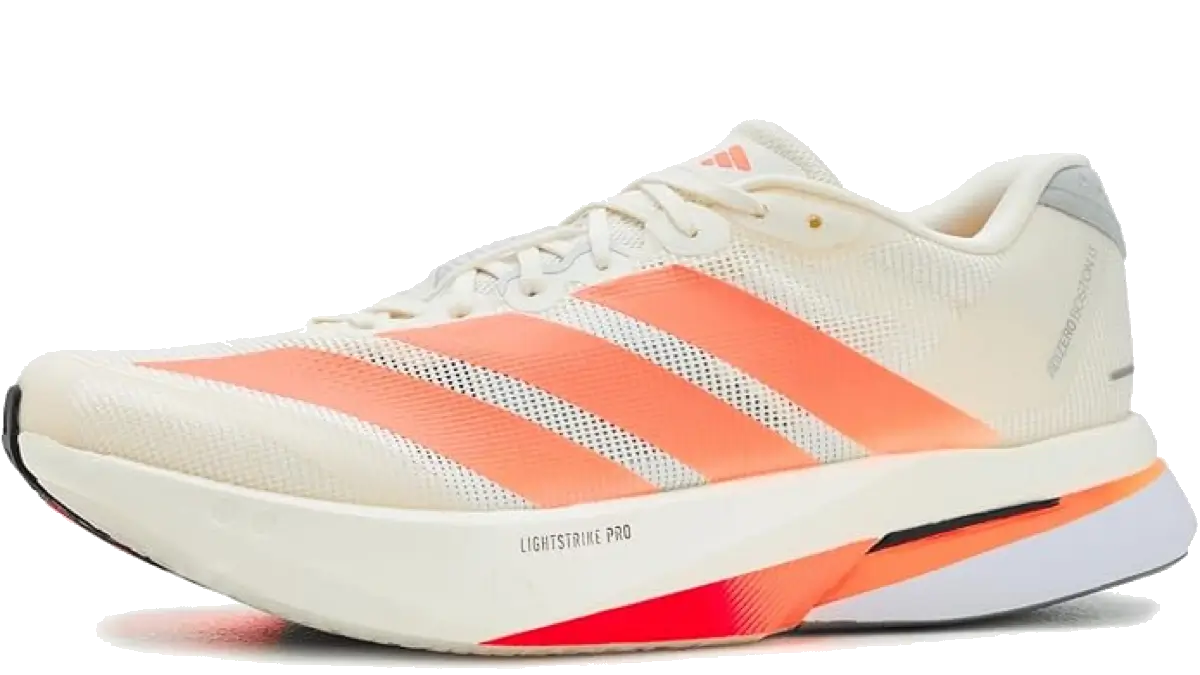
Quick Answer: Adidas Adizero Boston 13 Review: The Boston 13 is a plated super trainer for neutral runners who want one shoe for tempo work, long runs and race-pace efforts. Glass-fiber Energyrods sit between a Lightstrike Pro top layer and a firmer Lightstrike carrier, which gives a stiff, snappy ride that rewards a strong push rather than a gentle one. Continental rubber grips well and the shoe holds up to hard mileage. The catch is comfort: it is firm underfoot and unforgiving on easy days. Check latest price.
The Adidas Adizero Boston 13 is the thirteenth version of a shoe that has spent two decades as the sensible sibling to Adidas’s racers. It sits directly below the Adizero Adios Pro in the range, and it is built to do the job a carbon racer cannot: take a beating, cover long miles and still feel fast when you ask it to. Adidas calls this category a super trainer, meaning a shoe with racing-style foam and some form of stiffening element, built to survive daily use rather than a handful of races.
The stiffening element here is not a plate but Energyrods, five glass-fiber rods shaped roughly like the bones of the foot and embedded in the midsole. Because they are separate pieces rather than one flat sheet, they let the forefoot twist and bend along its natural lines while still resisting the collapse of the toes at push-off. In practice that means the Boston 13 feels stiff when you drive off the front of the foot and more accommodating than a full carbon plate when you are just jogging.
Around the rods, Adidas layers Lightstrike Pro, its bouncy racing foam, over a firmer Lightstrike carrier that provides the structure. The 13 carries slightly more Lightstrike Pro than the Boston 12 did, in a slightly lower stack. The ride is recognizably the same shoe, just a touch smoother.
Specs
Here are the specifications for the Adidas Adizero Boston 13:
| Type | Road super trainer, neutral |
| Best for | Tempo runs, intervals, long runs at effort, marathon racing on a budget |
| Midsole | Lightstrike Pro over a firmer Lightstrike carrier |
| Plate or rods | Energyrods, glass-fiber infused, five separate rods |
| Stack height | 36 mm heel / 30 mm forefoot, approximate |
| Heel-to-toe drop | 6 mm |
| Weight | About 9.0 oz (255 g) men’s US 9, about 8.0 oz (227 g) women’s US 8 |
| Upper | Lightweight engineered mesh with a minimal, unpadded heel |
| Outsole | Continental rubber with Lighttraxion cutouts |
| Widths | Standard width only |
| Price | Launched at $160 in May 2025. Check latest price |
Pros
These are the strengths that justify the price:
- Genuinely versatile, since one pair covers workouts, long runs and race day
- Energyrods stiffen the toe-off without the locked-in feel of a full carbon plate
- Continental rubber grips confidently on wet roads, which is rare in a shoe this light
- Durable enough to take the weekly mileage most super trainers cannot
- Light for a plated shoe at around 9 ounces in a men’s US 9
- Secure, low-profile upper that stays put through fast turns
Cons
These are the reasons it will not suit every runner:
- Firm underfoot, so slow recovery miles feel harsher than in a soft daily trainer
- Needs a strong push to activate the rods, which means slower runners get less out of it
- Minimal heel padding and a snug fit, so the upper is unforgiving on wider or sensitive feet
- The 6 mm drop loads the calves and Achilles more than a high-drop trainer
- At $160 it costs super trainer money and asks you to accept a firm ride for it
What is new versus the Adizero Boston 12
This is an evolution rather than a rebuild. Adidas increased the proportion of Lightstrike Pro in the midsole, which is the softer and more resilient of the two foams, while trimming the overall stack by roughly 2 mm. The drop came down from 7 mm to 6 mm. Read together, those changes lower the shoe slightly and put more of the good foam where the foot lands.
The practical effect is a marginally smoother ride, particularly through the midfoot, where the Boston 12 could feel abrupt. The Energyrods carry over, so the fundamental character has not changed: this is still a shoe that feels stiff and slightly dead at a shuffle and comes alive once the pace picks up.
The upper is the most visible difference. Adidas restyled it with a cleaner mesh and reworked the fit around the midfoot. Runners who found the 12 too tight over the instep generally get on better with the 13, though the heel remains lightly padded and the overall shape is narrow. Anyone upgrading from the 12 should expect the same shoe with the rough edges sanded down, not a new experience.
Who should buy the Adizero Boston 13
Buy the Boston 13 if you run workouts and you want one shoe that can handle them all. It is quick enough for intervals, stable enough for a long run at marathon effort and tough enough that you do not have to ration its use the way you ration a carbon racer. Runners training for a half or full marathon who want a single pair for every quality session will find it hard to beat at this price.
It also suits runners who dislike the sensation of a full carbon plate. Because the rods are separate and shaped to follow the foot, the forefoot still bends and twists, so the shoe feels less like it is dictating your stride. Neutral runners with a strong forefoot push get the most from that design, and midfoot strikers tend to prefer it to heel strikers.
Finally, buy it if durability matters to you. Continental rubber and a firm carrier foam mean the Boston is one of the few plated shoes that will absorb genuine weekly mileage without going flat, which changes the value calculation considerably against a racer you can only use a handful of times.
Who should avoid the Adizero Boston 13
Avoid it if you want a comfortable easy-day shoe. The Boston 13 is firm, and at a slow jog the rods do not flex enough to reward you, so the ride feels stiff and a little lifeless. Runners looking for plush cushioning for recovery miles are better served by a soft neutral trainer.
Slower runners in general get less from this shoe than the price suggests. The rods and the firm carrier need force to compress, and if you are not generating that force you are carrying the stiffness without the payback. A plateless super trainer with a resilient foam will feel far better across a wider range of paces.
Two fit groups should also look elsewhere. Runners with wide feet have no wide fitting available, and the last is narrow to begin with. Runners with a history of Achilles or calf trouble should be cautious about the 6 mm drop, which asks more of the lower leg than a 10 mm trainer does. If pain persists or worsens, a professional assessment is worth more than a change of shoe.
How does the Adizero Boston 13 fit?
Here is the fit info you’ll find helpful.
Fit and sizing
The Boston 13 fits true to size in length for most runners, with a performance shape: narrow through the midfoot, moderately snug at the toes and locked down at the heel. It is cut to be worn tight, which is what you want in a workout shoe but not what everyone wants in a long-run shoe.
There is no wide fitting, so runners who need volume should try before buying. Anyone between sizes will usually be happier going up a half, since the mesh has little stretch and the toe box does not accommodate spread as the foot swells over a long effort.
Upper and step-in comfort
Step-in comfort is functional rather than luxurious. The mesh is thin and breathable, the tongue is minimal and the heel carries very little padding, all of which keeps weight down and holds the foot still. Runners used to a plush daily trainer will notice the difference immediately, and some will find the heel collar sits close to the Achilles.
What the upper does well is security. There is almost no internal movement when you change direction or drive hard off the forefoot, which is exactly the point in a shoe built for workouts. It also breathes well enough for summer training, though there is little insulation for cold mornings.
How does the Adizero Boston 13 perform?
Here is how the shoe performs.
Midsole and cushioning
The two foams do different jobs. Lightstrike Pro, the softer and more resilient layer, sits where the foot contacts the shoe and supplies most of the bounce. The firmer Lightstrike carrier underneath holds the shape of the platform and keeps the Energyrods working. The blend reads as firm overall, and cushioning depth is moderate rather than generous, so this is protection for fast miles rather than plushness for slow ones.
Energy return, the share of impact energy the midsole gives back at push-off, is good when the foam is loaded hard. That is the whole design premise: run fast and the shoe pays you back, run slow and it mostly just sits there.
Ride and running performance
At tempo and faster the Boston 13 is excellent. The rods resist the toes bending back at the end of the step, so instead of the forefoot collapsing you get a firm lever to push against, and the shoe rolls off the front quickly. It holds a rhythm well over long repeats and it does not lose composure late in a session the way softer super trainers can.
At easy paces it is a different shoe. The stiffness that helps at speed becomes something you notice, and the firm carrier transmits more road feel than most runners want on a recovery day. Treat it as a two or three days a week shoe and pair it with something soft for the rest.
Stability and support
The Boston 13 is a neutral shoe, though a fairly stable one for its category. It gets that stability from a moderate stack height, a firm carrier foam that does not let the foot sink and rods that spread load across the width of the platform. There is no medial post and nothing designed to limit inward roll, so runners who need support features should not choose it for that reason.
What it does offer is composure at speed. Because the platform is lower and firmer than a max-stack racer, it feels planted through turns and on uneven road camber, which is one of the practical advantages of a super trainer over a carbon racer for everyday use.
Outsole, grip and durability
Continental rubber is the standout feature. Grip on wet asphalt is dependable rather than nervous, which matters more in a workout shoe than in a trainer because you are cornering and pushing harder. Adidas uses a cutout pattern to save weight while keeping rubber where the wear happens.
Durability is the Boston’s calling card. The outsole compound is hard-wearing and the firmer carrier foam resists packing out, so the shoe outlasts most plated models. The usual 300 to 500 mile figure is only a broad guideline, and many runners report the Boston sitting at the upper end of it rather than the lower.
Is the Adizero Boston 13 good for walking?
Not particularly. The Boston 13 is built around a stiffening structure that only makes sense when you are running hard, and walking never generates the force needed to compress the foam and load the rods. What you feel instead is a firm, stiff shoe that resists the natural bend of the toes, and that is the opposite of what a walking stride wants.
The fit works against it too. The upper is cut tight for security at speed, the heel is thinly padded and there is no wide fitting, so it is a poor choice for standing all day or for anyone whose feet swell. Grip and durability are genuinely good, so it will not let you down on a walk, but there is no reason to choose it over a cushioned walking shoe. If you want one pair for running and walking, a softer neutral trainer is the better buy.
Adizero Boston 13 vs. Adizero Boston 12
Here is how the two versions compare on the details that change the run:
Boston 13 | Boston 12 | |
Drop | 6 mm | 7 mm |
Stack | Slightly lower, about 2 mm less | Slightly taller |
Lightstrike Pro | More of it in the midsole | Less of it |
Ride | Slightly smoother through the midfoot | More abrupt in transition |
Upper | Restyled mesh, easier over the instep | Tighter for some runners |
Price | Check the current price | Check the current price |
Buy the 13 if you are new to the line or if the 12 pinched over the midfoot. Buy the 12 while it is discounted if you already know it fits you, since the ride difference is small and the price gap usually is not. Check the price link for current cost on Amazon.
Adidas Adizero Boston 13 Alternatives
Firmness is the Boston’s most common complaint, and the Saucony Endorphin Azura answers it directly. It uses a soft PEBA-based foam with no plate at all, so it stays comfortable at easy paces while still rolling forward when you push. Runners who want super trainer bounce without the stiff toe-off should start there (check price | read review).
Runners who want the same weight and speed but a friendlier ride across all paces might prefer the Hoka Mach 7. It is light and quick without any stiffening structure, which makes it a more natural everyday shoe, though it gives up the firm lever the Energyrods provide at the end of a hard interval (check price | read review).
For a shoe that adds bounce rather than stiffness, the Asics Novablast 6 is the contrast worth considering. Its tall, lively midsole makes easy running genuinely enjoyable and still handles a steady effort, so it works as the soft counterpart in a rotation where the Boston covers the hard days (check price | read review).
When race day is the actual goal and durability matters less, a carbon racer is the honest upgrade. The Nike Vaporfly 4 is far lighter and far more aggressive, and it will produce a faster time over a half or full marathon, but it will not survive being your workout shoe as well (check price | read review).
Price and value
The Boston 13 launched at $160 in May 2025, which is standard for a plated super trainer and well below what a carbon racer costs. The value argument rests on how many jobs it does. One pair covers workouts, long runs and racing, and because the Continental outsole and firm carrier foam resist wear, it lasts long enough to be a genuine training shoe rather than a shoe you save for special occasions. Runners who only jog easy miles will not see that value, since the parts they are paying for are the parts they never use.
Final verdict
Best for: tempo runs, intervals, long runs at effort and budget marathon racing, for neutral runners with a strong forefoot push.
Avoid if: you want a soft recovery shoe, you run mostly at easy paces, you need a wide fitting or your calves dislike a low drop.
Fit: true to size in length, narrow and performance-oriented in shape, standard width only.
Verdict: The Boston 13 remains one of the most useful shoes in running, provided you actually run workouts. It is firm, it demands effort and it repays it. You can check size availability before you order.
Frequently Asked Questions for Adidas Adizero Boston 13
Yes in length for most runners, but the shape is narrow through the midfoot and toe box. There is no wide fitting, so runners with high-volume feet often go up a half size or try the shoe on first.
Energyrods are five glass-fiber infused rods laid out roughly like the bones of the foot. Because they are separate pieces rather than a single sheet, the forefoot can still twist and bend along natural lines while the rods resist the toes collapsing at push-off. The result is stiff at speed but less rigid than a full plate.
Plenty of runners do. It is heavier and less aggressive than a carbon racer, so it will not produce the same times, but it is stable, grippy and durable, which suits runners who want one shoe for the training block and race day.
The Continental rubber outsole and firm carrier foam make it one of the more durable plated shoes on sale. The common 300 to 500 mile range is only a guideline, and the Boston tends to sit toward the upper end of it depending on body weight and surface.
It is not the easiest first shoe. The 6 mm drop asks more of the calves and Achilles, the ride is firm and the rods only pay off at faster paces. New runners are usually better served by a cushioned neutral trainer.
Buy the Boston if you want one shoe for workouts and racing that will survive regular use. Buy the Adios Pro if you want maximum race-day performance and you are willing to keep it for races and key sessions only.