Last Updated on October 22, 2026
| Quick Answer: Best Sandals for Bunions in 2026. The most bunion-friendly sandals are the ones that avoid squeezing the big-toe joint. Look for a wide forefoot, adjustable or soft straps, minimal pressure over the bunion and a stable footbed. Our current picks are the Orthofeet Maui, Ecco Offroad Yucatan, Teva Hurricane XLT2, Birkenstock Arizona Soft Footbed, Vionic Tide 2.0 and Oofos OOahh Slide. Sandals can reduce rubbing and pressure, but they do not correct the underlying bunion. |
A bunion is a deformity at the base of the big toe that can make ordinary footwear painful. The problem is often less about cushioning and more about space: a narrow forefoot or stiff strap can press directly on the enlarged joint.
That is why sandals can work well for some people with bunions. Open designs give the forefoot more room, while adjustable straps let you fine-tune the fit. The trade-off is that not every sandal has enough support for long walks, and some toe-post or cross-strap designs can irritate sensitive feet.
If you also need closed footwear, compare our Best Shoes for Bunions guide, which covers current sneakers with roomy toe boxes, soft uppers and wider size options.
Best Sandals for Bunions at a Glance
The options below cover different needs: extra-depth fit, walking support, adjustable outdoor straps, contoured cork footbeds, arch support and soft recovery cushioning.
| Sandal | Best for | Bunion-friendly feature | Price |
|---|---|---|---|
| Orthofeet Maui | Most adjustable | Extra depth, multiple adjustable straps, roomy forefoot | Check latest price |
| Ecco Offroad Yucatan | Walking and travel | Three-point adjustment and supportive footbed | Check latest price |
| Teva Hurricane XLT2 | Outdoor walking | Adjustable straps and open forefoot | Check latest price |
| Birkenstock Arizona Soft Footbed | Contoured support | Two adjustable straps and broad footbed | Check latest price |
| Vionic Tide 2.0 | Arch support | Contoured footbed and soft toe post | Check latest price |
| Oofos OOahh Slide | Soft recovery feel | Open toe and soft OOfoam platform | Check latest price |
What Makes a Sandal Bunion-Friendly?
The main goal is to reduce pressure on the enlarged big-toe joint. Mayo Clinic recommends roomy shoes with plenty of space for the toes, while the American Academy of Orthopaedic Surgeons advises avoiding tight, narrow shoes.
For sandals, that usually means an open or broad forefoot, straps that can be adjusted around the bunion rather than pulled tightly across it, and a footbed that keeps the foot from sliding forward. Soft materials can also help reduce rubbing.
No sandal can reverse a bunion. If the joint is persistently painful, inflamed or increasingly difficult to fit, a podiatrist or orthopedic specialist can help determine whether pads, orthotics, activity changes or other treatment makes sense. Our home remedies for bunions guide covers conservative comfort measures in more detail.
Best Sandals for Bunions in 2026
Orthofeet Maui
Best for: Maximum adjustability and people who need extra depth.

The Orthofeet Maui is the most accommodating option in this lineup. Its appeal is adjustability: the sandal is designed for feet that need more room, and the strap system lets you change tension around sensitive areas instead of forcing the foot into a fixed shape.
That matters with bunions because the swollen joint may tolerate one strap position but not another. Orthofeet also builds its comfort footwear around extra depth and removable or adjustable support components, making the Maui a strong choice if you already use an orthotic or need more internal space.
The styling is more orthopedic than minimalist. If appearance matters more than maximum adjustability, the Ecco or Birkenstock options are easier to dress up.
Ecco Offroad Yucatan
Best for: Travel, everyday walking and people who want a secure sandal without a cramped forefoot.

The Ecco Offroad Yucatan remains one of the most practical walking sandals because it gives you three points of adjustment: forefoot, instep and heel. That allows you to loosen the front strap when pressure over the bunion is the main problem while still keeping the heel secure.
The supportive footbed and substantial outsole make it better suited to longer walking than a simple fashion sandal. The trade-off is that the forefoot strap still crosses the bunion area, so the fit must be adjusted carefully. If even light strap pressure is painful, choose a more open slide.
Teva Hurricane XLT2
Best for: Outdoor walking and people who want simple, highly adjustable straps.

The Hurricane XLT2 is a straightforward outdoor sandal with hook-and-loop straps across the forefoot, instep and ankle. That makes it easy to change the fit as your foot swells during the day.
For bunions, the key is whether the front strap sits comfortably. Because it can be loosened, it is usually easier to accommodate than a fixed leather strap. The outsole is also more rugged than most casual sandals, making the Hurricane a better choice for travel, parks and uneven paths.
It is less contoured than the Birkenstock and less plush than the Oofos, so choose it when adjustability and outdoor durability matter most.
Birkenstock Arizona Soft Footbed
Best for: People who like a firm, contoured footbed and want adjustable forefoot straps.

The Arizona Soft Footbed gives you Birkenstock’s broad, anatomically shaped platform with two adjustable straps. The footbed is firmer and more structured than most foam sandals, while the added soft-footbed layer makes it less stark than the standard cork version.
The width through the forefoot can work well for bunions, but the lower strap crosses close to the big-toe joint. That means correct sizing and strap adjustment are essential. If the buckle or strap edge lands directly on the bunion, this is not the right sandal for your foot.
For more Birkenstock options, see our Birkenstock sandal guide.
Vionic Tide 2.0
Best for: A lightweight flip-flop feel with more built-in arch support than a basic sandal.
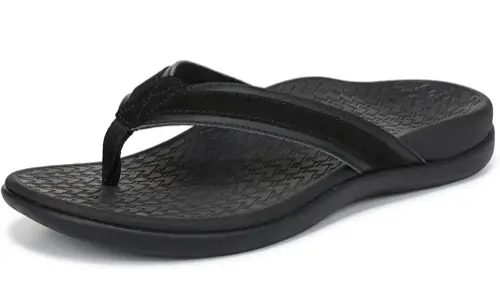
The Vionic Tide 2.0 pairs a contoured footbed with a soft woven toe post and foam-lined strap. Vionic lists built-in arch support, a deep heel cup and shock-absorbing EVA cushioning, and the model carries the APMA Seal of Acceptance.
The open sides give a bunion plenty of room, but toe-post sandals are not comfortable for everyone. If your bunion changes the angle of the big toe enough that the post feels irritating, choose a slide or strap sandal instead.
Oofos OOahh Slide
Best for: Soft cushioning and an open-toe recovery slide.
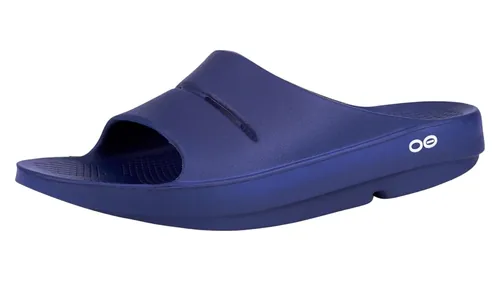
The OOahh is the softest option here. Oofos uses its OOfoam material throughout the footbed and strap, and the design leaves the toes completely open. That makes it useful after exercise, around the house or for short casual walks when a stiff upper feels uncomfortable.
The limitation is fit. The single strap is not adjustable, so a prominent bunion or high-volume forefoot can still feel squeezed. Try it only if the strap clears the painful area comfortably.
Read our Oofos OOahh Slide review for more detail.
How to Choose Sandals for Bunions
Start with the shape of the forefoot. Your big-toe joint should sit on the footbed rather than hanging over the edge, and no strap should dig into the bunion. If you can see the skin bulging around a strap, the sandal is too narrow or too tight.
Adjustability matters because bunions can become more irritated or swollen during long days. Hook-and-loop straps, buckles or multiple adjustment points let you loosen the fit without losing all heel security.
A stable footbed can reduce sliding, which matters because a foot that constantly moves forward can create friction over the bunion. Arch support can improve comfort for some people, but it should never force the foot into a painful position.
If you also need closed shoes, see our best shoes for bunions guide.
Frequently Asked Questions About Sandals and Bunions
The most important rule is simple: the sandal should reduce pressure rather than create a new pressure point over the bunion.
They can be. Open sandals often give the forefoot more space than closed shoes, but straps can still irritate a bunion if they cross directly over the joint. Adjustable designs are usually easier to fit.
No. Sandals may reduce pressure and rubbing, but they cannot reverse the structural deformity of a bunion.
Look for a broad footbed, plenty of forefoot room and straps that can be loosened or positioned away from the bunion. Avoid narrow footbeds and rigid straps that press directly on the big-toe joint.
They can work well when the footbed is wide enough and the straps do not press on the bunion. The Arizona’s adjustable straps are useful, but the lower strap can still irritate some feet.
Not automatically. A flip-flop can leave the bunion completely open, but a toe post may be uncomfortable if the big toe is angled or sensitive. Support and fit vary widely between models.
Only if the wider size improves fit without making the foot slide around. The key is enough space at the forefoot while still keeping the heel secure.
See a clinician if bunion pain is persistent, worsening, limiting activity or making shoes increasingly difficult to wear. Seek care sooner if the joint becomes very red, swollen or unusually painful.