Quick Answer: Crocs Specialist II Work Clog Review: The Specialist II is a simple, roomy work clog for people who want more toe coverage, more arch shape and easier cleaning than a Classic Clog. Its fully molded Croslite construction handles spills well and the higher heel gives the back of the foot more coverage. The big caution is traction: Crocs does not currently list Crocs Lock slip-resistant tread or ASTM slip-resistance certification for this model, so we would not choose it for greasy restaurant floors. See who should buy it.
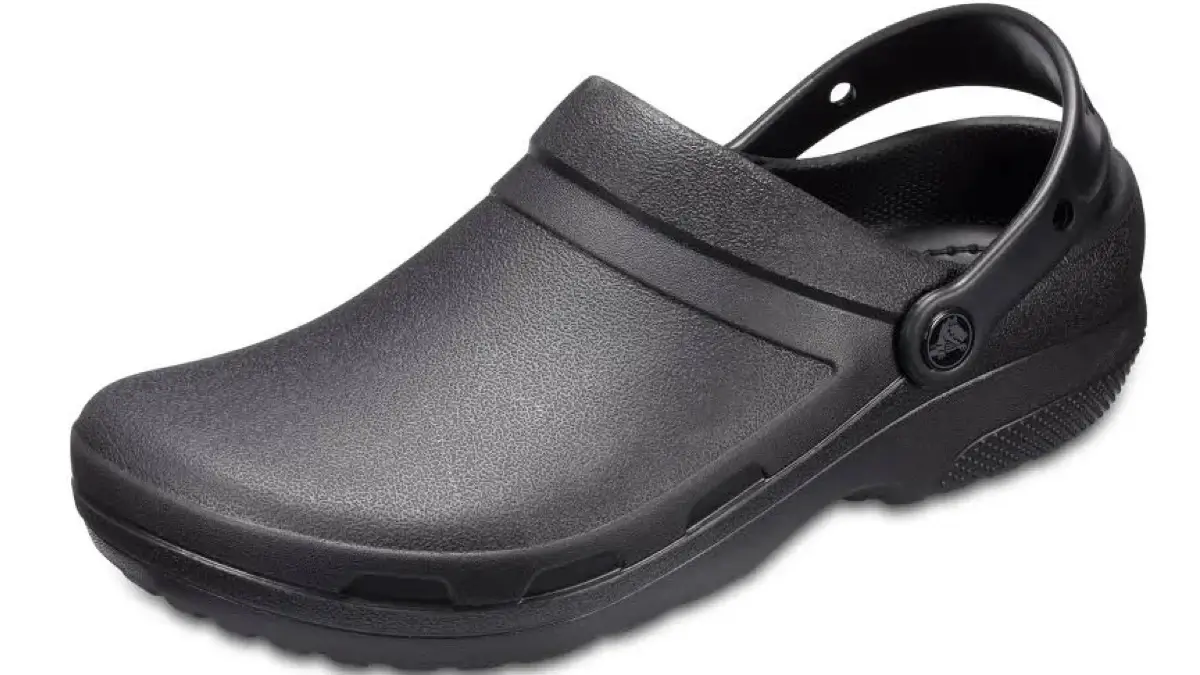
The Crocs Specialist II Work Clog looks like a tougher, more enclosed version of the Classic Clog, and that is essentially what it is. Crocs gives it a thicker toe and metatarsal area, a higher heel, more arch contour and a fully molded upper that can be washed with soap and water. It is designed for people who want Crocs-style comfort in a work setting without the ventilation holes of the Classic.
That makes it useful for jobs where splashes, dust and everyday mess are common, but where certified slip resistance is not the main requirement. This distinction matters. Crocs currently lists explicit ASTM slip-resistance testing on models such as the Bistro Pro LiteRide and On The Clock Work Slip-On. The current Specialist II product page does not make those same claims.

More coverage than a Classic Clog
The main appeal of the Specialist II is coverage. The toe is enclosed, the material over the forefoot is thicker and the heel rises higher than it does on a Classic Clog. That helps keep ordinary workplace splashes and debris away from your foot and makes the shoe feel more appropriate in a work setting.
It is still a clog, though. The heel is not locked down the way it is in a lace-up work shoe or the On The Clock Slip-On. If your job involves constant fast walking, ladders, carrying heavy loads or lots of direction changes, a more secure shoe may be a better match.
For standing, short walks and jobs where you are frequently stepping in and out of footwear, the Specialist II is easier to live with. It is light, simple and roomy, and there are no laces or fabric panels to deal with.
The footbed has more shape than the Classic
Crocs builds more arch contour into the Specialist II than it does into the Classic Clog. The molded Croslite footbed is also textured with small nubs. The result feels more shaped under the foot without becoming a firm orthotic-style shoe.
That extra contour can help if the Classic feels too flat to you. It still will not suit everyone who needs strong arch control or a removable insole. The footbed is part of the molded shoe, so there is much less room for customization than there is in a conventional walking or work shoe.
If support is your main priority rather than easy cleaning, compare the Specialist II with our best arch-support shoes and best shoes for standing all day.
The traction question matters
This is the biggest thing to understand before buying the Specialist II. Crocs currently describes it as part of the Crocs At Work collection, but the product page does not list Crocs Lock slip-resistant tread, ASTM F2913 testing or ASTM F3445 certification. That is different from the Bistro Pro LiteRide and On The Clock Work Slip-On, where Crocs publishes those slip-resistance details.
Recent customer reviews on Crocs.com also include repeated complaints that newer Specialist II pairs do not have the slip-resistant sole some buyers remember from older versions. Customer reviews are anecdotal, but they reinforce the safer reading of Crocs’ current specifications: do not buy the Specialist II assuming it is a certified non-slip kitchen shoe.
If you work around grease, wet tile or restaurant spills, start instead with our best slip-resistant work shoes, the Bistro Pro LiteRide or the On The Clock.
Specs
| Type | Fully molded work clog |
| Best for | Standing, easy-clean workplaces, light-duty service work and casual work use |
| Material | Croslite foam |
| Toe | Enclosed with thicker construction |
| Heel | Higher than the Classic Clog for added coverage |
| Footbed | Contoured Croslite with nubbed texture |
| Arch support | More pronounced than the Classic Clog |
| Slip resistance | Crocs does not currently publish Crocs Lock or ASTM slip-resistance certification for this model |
| Care | Soap and water; air dry away from high heat |
| Original launch price | Crocs does not publish an original launch price for this long-running model. Check latest price |
Who should buy the Specialist II?
The Specialist II makes sense for people who already like the feel of Crocs but want more coverage and a little more support than the Classic provides. It works well for indoor standing, clinics, salons, labs, workshops, light-duty service jobs and other places where washable footwear is useful.
It can also be a practical around-the-house or garage shoe if you want something more enclosed than a Classic. The roomy shape gives feet space to spread, and many people will appreciate that after several hours of standing.
If you are comparing several Crocs for work, see our best Crocs shoes guide. That page explains where the Specialist II, Bistro Pro LiteRide, Neria Pro II and On The Clock fit.
Who should skip it?
Skip the Specialist II if your job specifically requires a certified slip-resistant shoe. Crocs currently publishes stronger traction credentials for other work models, so there is no reason to choose the less clearly specified option for greasy restaurant or kitchen floors.
It is also a poor fit if your feet run hot. The enclosed molded upper has very little airflow compared with a Classic Clog or mesh sneaker. Recent Crocs customer reviews frequently mention heat and sweaty feet as a downside.
If you need a removable insole, a tightly secured heel or conventional width choices such as 2E or 4E, look elsewhere. The Specialist II is simple by design, and that simplicity limits adjustment.
Specialist II vs. Bistro Pro LiteRide
The Bistro Pro LiteRide is the better choice for restaurants, kitchens and other slippery workplaces because Crocs publishes ASTM slip-resistance testing for it. It also adds the softer LiteRide footbed. The Specialist II is simpler and more basic, with extra arch shape and protective coverage but without the same published traction credentials.
If your main goal is standing comfort in a relatively dry workplace, the Specialist II can still make sense. If traction is part of the job requirement, the Bistro is the safer comparison.
Specialist II vs. On The Clock
The On The Clock Work Slip-On holds the heel more securely and carries published slip-resistance testing. It is the better Crocs choice for workers who move quickly or spend more of the shift walking.
The Specialist II is easier to step into and feels more like a traditional Crocs clog. Choose it when convenience and roomy comfort matter more than heel security.
Specialist II vs. Classic Clog
The Classic Clog is lighter, more ventilated and better for casual wear. The Specialist II adds an enclosed toe, thicker forefoot protection, a higher heel and more arch contour. For work around spills or debris, the Specialist II is the more sensible design.
Neither should be treated as the default answer for a slippery commercial kitchen. For that use, choose a Crocs model with explicit slip-resistance testing.
Verdict
The Crocs Specialist II is a useful middle ground between a casual Classic Clog and Crocs’ more specialized slip-resistant work models. It gives you more coverage, more arch shape and the same washable molded construction that makes Crocs easy to live with. The limitation is important: the current product page does not give it the same published slip-resistance credentials as Bistro or On The Clock. Buy it for coverage and easy-clean comfort, not because you assume every Crocs work clog is non-slip.
Check the Crocs Specialist II Work Clog on Amazon.
FAQ
Is the Crocs Specialist II slip resistant?
Crocs currently does not list Crocs Lock tread or ASTM slip-resistance certification on the Specialist II product page. If certified slip resistance matters for your job, choose a model where Crocs publishes those specifications.
Is the Specialist II good for standing all day?
It can work well for standing because it is roomy, light and more contoured under the arch than a Classic Clog. People who need firmer support may prefer a structured work shoe.
Is it good for nurses?
It can suit some nurses in dry clinical settings, especially when easy cleaning matters. For hospital floors where verified slip resistance is important, compare the Neria Pro II, Bistro Pro LiteRide or On The Clock instead.
Does the Specialist II have arch support?
Yes. Crocs specifically lists enhanced arch support and a contoured footbed, and it feels more shaped than the Classic Clog.
Is it good for wide feet?
The roomy clog shape works well for many wide feet, but Crocs does not sell it in standard measured widths such as 2E, 4E or 6E.
Can you wash the Specialist II?
Yes. Crocs says the fully molded shoe can be cleaned with soap and water. Let it air dry and keep molded Crocs footwear away from high heat.
What is the difference between Specialist II and Classic Crocs?
The Specialist II has an enclosed toe, thicker forefoot construction, a higher heel and more arch contour. The Classic is more ventilated and better suited to casual wear.