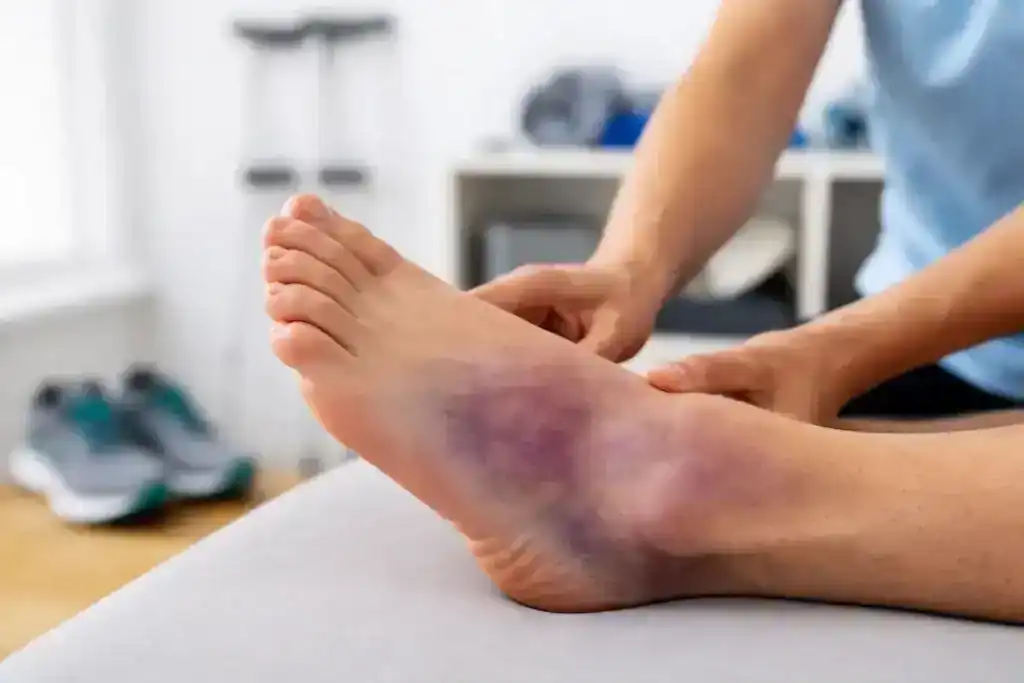
Midfoot pain can be confusing — especially when it doesn’t go away quickly. Many people assume a “sprain” in the midfoot is like a typical ankle sprain that heals in a few weeks. But if you’ve injured your Lisfranc complex (the set of joints and ligaments in the middle of your foot), you’re dealing with a significantly different injury that often takes months to heal — and sometimes longer than people expect.
Understanding Lisfranc or midfoot sprain recovery time — and what truly helps tissue heal — can prevent frustration, failed rehab, and long-term complications. Below, we break down what a Lisfranc sprain really is, how long recovery takes at each stage, and exactly what you can do to heal safely and effectively.
What Is a Midfoot (Lisfranc) Sprain?
Your foot isn’t just bones and muscles — it’s a system of joints and ligaments that support your arch and help you walk.
The Lisfranc joint complex is located in the midfoot. It connects the long metatarsal bones (the long bones leading to your toes) to the tarsal bones (closer to your heel). The strong ligaments here keep the bones stable so your foot can support weight and push off during walking and running.
A midfoot or Lisfranc sprain occurs when these ligaments are stretched or partially torn — often due to:
- Twisting or rolling your foot awkwardly
- Dropping something heavy on your foot
- Sudden stops or pivoting forces (common in sports)
- Falls or accidents
A Lisfranc sprain can be milder (just ligament injury) or severe (with associated bone fractures, dislocations, or significant instability). In everyday language, a Lisfranc sprain is often called a midfoot sprain, but it’s much more serious than a typical ankle sprain.
Why Healing Takes So Long
Unlike an ankle sprain, which usually affects one joint with good blood flow and healing potential, the Lisfranc complex sustains heavy loads every time you stand or walk. Because of that:
- Even mild injuries take time to heal because the foot is almost always under pressure.
- Severe sprains with bone involvement heal even more slowly and may need surgery to realign bones and stabilize the joint.
- Delays or improper care can lead to chronic pain, instability, deformity, or arthritis in the midfoot.
Put simply: the midfoot doesn’t “turn off” while healing, so your recovery plan must respect tissue healing timelines.
Lisfranc Sprain Recovery Timeline: Week-by-Week and Month-by-Month
First 1–2 Weeks: Acute Phase — Rest, Protection, and Pain Control
After the injury:
- Swelling and bruising are usually still present.
- Weight-bearing is typically limited or avoided so the ligament healing response can start.
- A doctor may prescribe:
- A protective boot or cast
- Crutches or non-weight-bearing instructions
- Ice, elevation, and anti-inflammatory care
For these first few weeks, your goal is to calm inflammation and protect the structure. Walking too soon can delay healing or worsen instability.
Weeks 3–6: Continued Protection & Early Healing
During this stage:
- The ligament starts forming new scar tissue, but it’s still fragile.
- Weight-bearing usually remains limited — often non-weight-bearing for 6 weeks in moderate cases.
- Gentle range-of-motion exercises may be introduced by your therapist to maintain ankle flexibility (not midfoot mobility yet).
- You may start low-impact cardio like swimming or cycling (non-weight-bearing) if cleared by your clinician.
This early phase is crucial — too much stress here can extend your recovery by weeks or months.
Weeks 6–12: Transition to Weight-Bearing (With Guidance)
Once X-rays show healing:
- Your clinician may allow partial weight-bearing in a boot.
- Gradual walking begins again when bone and ligament stability are adequate.
- Physical therapy shifts toward:
- Balance training
- Arch strengthening
- Controlled gait training
This phase builds structural resilience so your foot tolerates normal walking forces again.
Note: Without proper guidance, people often “push through pain” and restart full activity too early. Pain is not a safe sign of healing — it’s a warning sign that the tissue is still stressed.
3–6 Months: Rehab, Strength, and Gradual Return to Activity
If your sprain didn’t require surgery:
- Most people start meaningful rehabilitation at around 3 months.
- Pain continues to decrease.
- Mobility improves.
- Many can return to walking normally and low-impact fitness.
If you did need surgery, this phase generally starts later and is more gradual because your foot was structurally realigned.
6–12+ Months: Full Healing & Return to Pre-Injury Levels
Even after pain goes away, internal healing continues for months. Most experts agree:
- Complete recovery often takes 6–12 months depending on severity and treatment approach.
- Some people with complex injuries (multiple fractures or displacement) may take a year or more before they feel fully confident walking or returning to sports.
This timeline reflects how long ligaments and supporting structures need to remodel properly under appropriate, graduated load.
What Helps Healing — What Actually Works
Recovering from a Lisfranc sprain is not about “toughing it out.” It’s about managing stress on the joint while promoting tissue repair and strength. Here’s what helps — based on medical guidance and clinical best practices:
1. Early Protection & Medical Care
The absolute first step is a professional assessment. Lisfranc injuries are often misdiagnosed as simple sprains. But an untreated Lisfranc injury can lead to chronic problems.
Your clinician will likely order X-rays, and possibly MRI or CT, to confirm the diagnosis. You want the right diagnosis early — waiting weeks can allow instability and poor healing.
2. Immobilization and Non-Weight-Bearing
For the first 6–8 weeks, your foot will usually be:
- In a cast or rigid boot
- Non-weight-bearing (with crutches or walker support)
This removes excessive stress from healing ligaments so your body can create new, strong tissue.
3. Gradual Physical Therapy Guided by Pain Thresholds
Eventually your clinician will prescribe:
- Strength-building exercises for the arch and ankle muscles
- Balance training to help foot stability
- Range-of-motion work to prevent stiffness
Therapy should be pain-controlled and gradual — not aggressive. If you feel sharp midfoot pain, you’ve progressed too fast.
4. Low-Impact Cardio for Conditioning
While your foot heals, swimming, cycling, and upper-body strength work can help maintain fitness without stressing the injured area.
5. Supportive Footwear After Cast/Boot Removal
When you start walking normally again:
- Choose supportive shoes with firm midsoles
- Avoid minimalist sneakers and unsupportive flats
- Consider orthotics if recommended by your clinician
Your shoe choices significantly influence how the midfoot absorbs force. Better support equals less risk of re-injury.
Best Shoes to Support Midfoot or Lisfranc Sprain Recovery
Footwear plays a meaningful role in midfoot and Lisfranc sprain recovery because every step places forces through the arch and midfoot joints. While shoes can’t cure the injury itself, choosing models that emphasize stability, cushioning, and smooth transitions can reduce day-to-day irritation and make walking feel less painful as tissues settle.
Proper recovery shoes should provide:
- Good cushioning to absorb impact
- Supportive midsoles that limit excessive midfoot bending
- Stability in the arch and heel area
- A smooth heel-to-toe roll that reduces ligament strain
Experts highlight brands known for comfort and walking support, especially those with designs that promote foot health and reduce strain on the midfoot.
Recommended Supportive Footwear
Here are some well-reviewed options that balance cushioning, support, and daily comfort — helpful while healing from a midfoot or Lisfranc sprain:
Supportive Everyday and Walking Shoes:
- Brooks Adrenaline GTS 25 (Stability Shoe) – Excellent support with GuideRails for moderate control and cushioning during walks.
- Brooks Ghost 17 (Neutral Cushioning Shoe) – Plush cushioning and smooth gait transitions make this a versatile choice for longer walks.
- New Balance 515 V3 (Comfort-Focused Sneaker) – Lightweight yet supportive everyday shoe with arch-friendly cushioning.
- Vionic Walk Max Sneakers (Podiatrist-Approved Design) – Extra arch support and deep heel cup designed for all-day comfort.
Budget-Friendly and Comfort-Focused Options:
- Zove Wide Walking Sneakers – Affordable walking shoes with a wide toe box and cushioned midsole for reduced pressure.
- Whitin Wide Running Shoes – A wide toe box and soft cushioning make these a comfortable daily walking choice.
Note: Shoes aren’t a cure for a midfoot or Lisfranc sprain, but by reducing impact and improving midfoot support and gait mechanics, they can meaningfully decrease daily discomfort and help prevent setbacks while healing.
Walking Shoes vs. Running Shoes for Lisfranc Sprain Recovery
When you’re recovering from a midfoot or Lisfranc sprain, walking shoes are often the more comfortable and predictable choice,especially early in your rehab, because:
- They tend to offer stable platforms
- Many emphasize softer cushioning
- They encourage a smoother, controlled stride
- They reduce aggressive midfoot push-off that can strain healing ligaments
However, that doesn’t mean running shoes are off-limits. Certain running shoes with excellent cushioning and stability can also feel good during recovery — as long as you use them primarily for walking and low-impact activity and not yet for running or high-impact training.
Why Walking Shoes Often Work Well
Walking shoes typically:
- Have a stable base that limits excessive motion
- Feature rocker soles or smooth transitions that lessen stress through the midfoot
- Provide cushioning without over-flexing the foot
This combination helps reduce repetitive strain while you regain strength and confidence in the foot.
When Running Shoes Are Suitable During Recovery
Running shoes built around shock absorption and smooth gait transitions can work well for walking during Lisfranc recovery. Many models balance plush cushioning with enough structure to help your foot deal with regular steps without jarring impact — and do so while feeling lightweight and comfortable.
Examples of running-inspired shoes that can be comfortable choices while walking include:
- Brooks Ghost 17 — excellent cushioning and neutral support for daily steps.
- Brooks Adrenaline GTS 25 — stability-focused ride that supports a controlled gait.
- Vionic Walk Max Sneakers — known for strong arch support and everyday comfort.
What to Avoid Until Pain Is Fully Resolved
Certain shoes tend to exacerbate pain or slow healing if worn too soon:
- Minimalist / thin-soled shoes — these offer little shock absorption or midfoot support.
- Highly flexible or lightweight casual footwear with minimal structure — these allow excessive midfoot bending.
- High-heel or unstable footwear — places undue stress on midfoot ligaments.
Bottom Line: Your goal isn’t to cure the injury with footwear — it’s to create an environment where walking feels less irritating, and your midfoot stays supported throughout daily activity. The right supportive sneaker can help reduce load, soften impact, and make each step safer as you heal.
What Doesn’t Help Healing
Avoid the following common mistakes, such as:
- Walking on the foot too soon
- Jumping back into running or high-impact activity before cleared
- Ignoring persistent pain
- Skipping rehab or therapy sessions
All of those behaviors can delay healing or make the injury permanent.
Signs Your Recovery Is On Track
Progress isn’t always linear — but these are good milestones:
- Reduced swelling and bruising
- Ability to stand without pain
- Longer walking tolerance without discomfort
- Better balance and foot strength
- Pain-free jogging and low-impact workouts
Remember: It’s okay if full activity returns gradually over many months. Fast doesn’t mean healthy when it comes to tissue healing.
When to Seek Further Help
It is important to contact your foot and ankle specialist if at any point you notice:
- Increasing pain
- Persistent swelling after weeks
- Instability or “giving way” in your arch
- Difficulty bearing weight
Ongoing symptoms after appropriate rehab can be a sign of incomplete healing or a more complex injury than initially diagnosed.
How This Page Fits the Bigger Recovery Picture
Midfoot and Lisfranc sprains don’t exist in isolation — and for many people, foot pain isn’t always clearly diagnosed at first. Understanding how Lisfranc injuries compare to other common foot conditions can help you make sense of why recovery timelines vary so widely.
Some foot injuries heal in weeks, while others — especially those involving the midfoot, ligaments, or joint stability — require months of careful protection and gradual rehabilitation. Seeing these patterns side by side can make prolonged recovery feel less confusing and more expected.
If you’re dealing with ongoing foot pain, overlapping symptoms, or uncertainty about your diagnosis, it can be helpful to look at broader foot injury recovery timelines to understand how different structures heal and why some injuries demand more patience than others. Learn more: Foot injury recovery time and healing timelines.
Final Takeaway
A midfoot or Lisfranc sprain is not a “minor strain.” It’s a serious injury involving key stabilizing ligaments that take time to heal — typically many months, and sometimes up to a year or more.
But the good news?
With early diagnosis, proper immobilization, pain-controlled rehab, and the right footwear and therapy plan, most people can fully recover and return to normal walking and even sports.
Healing doesn’t happen overnight, but with the right approach, you can get back on your feet and keep your midfoot stable and pain-free.