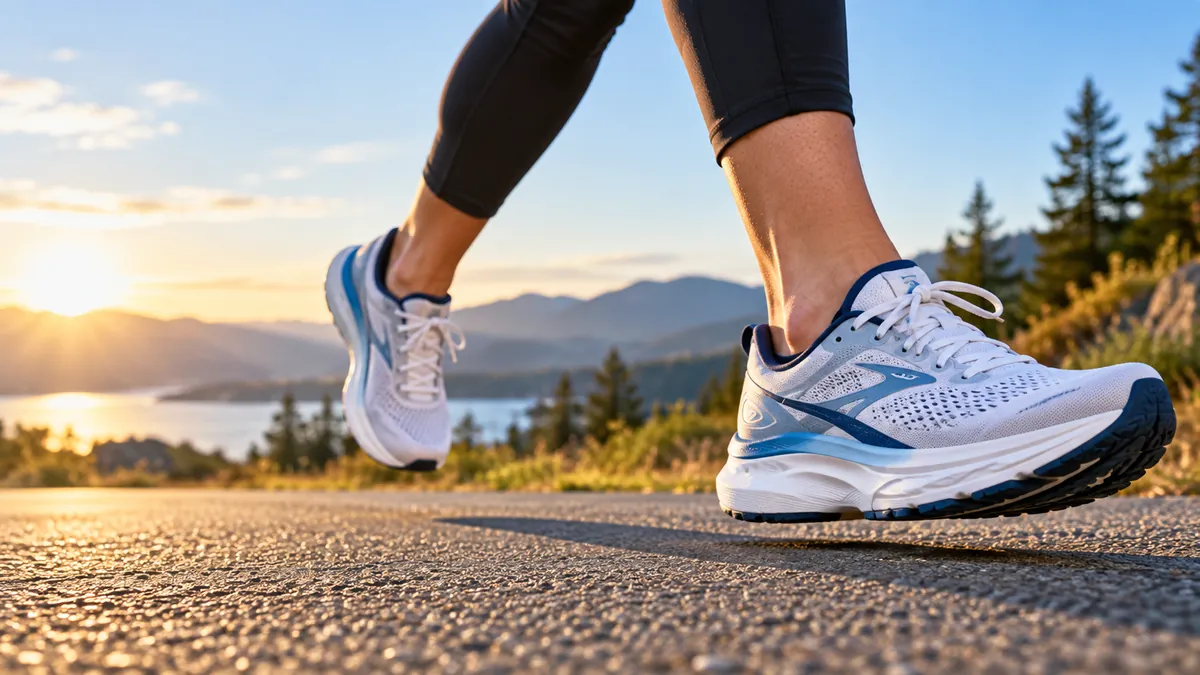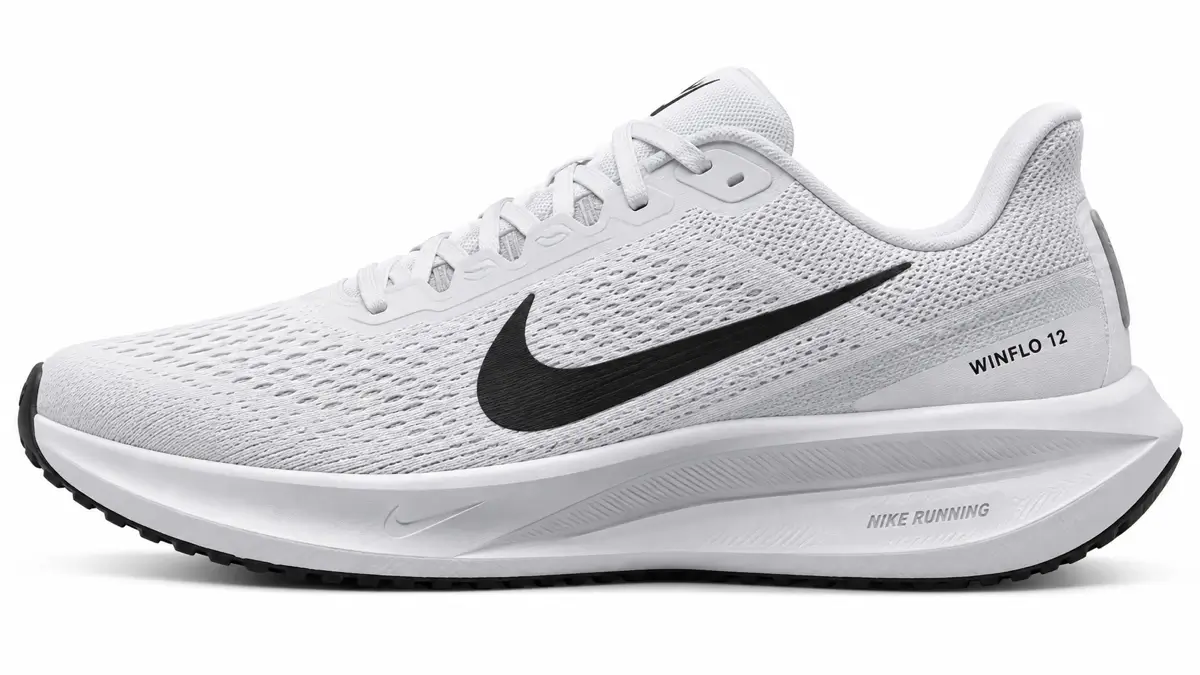
Deep, soft comfort and three widths in a genuinely heavy shoe
Quick Answer: Nike Winflo 12 Review: The Winflo 12 is Nike’s affordable cushioned trainer, and this version is a much softer and more protective shoe than the Winflo has been before. A thick slab of Cushlon foam sits over an air unit in the heel, which gives it plenty of shock absorption for daily running, walking and standing. It also comes in regular, wide and extra-wide, which is rare at this money. The problem is weight: it is one of the heaviest trainers you can buy, and it feels sluggish whenever you try to run quickly. Check latest price.
Gender-specific buy links: Men’s version | Women’s version
The Winflo has always been the shoe Nike sells to people who want a real running shoe without paying flagship prices. For years that meant a fairly ordinary trainer with a firm ride, positioned a step below the Pegasus and rarely discussed much. The Winflo 12 changes that. Nike has rebuilt it around the thing buyers currently want most, which is soft, deep cushioning, and the result is a considerably more interesting shoe than the ones it follows.
It arrived in March 2026 at $110. Underneath is a thick layer of Cushlon 3.0, Nike’s cushioning foam, working with an air unit in the heel that absorbs impact as you land. The part that will matter most to a lot of readers is less glamorous: Nike sells it in regular, wide and extra-wide, which is unusual in a shoe at this price and rules it into consideration for a great many feet that are shut out elsewhere.

Specs
Here are the specifications for the Nike Winflo 12:
| Shoe type | Cushioned neutral road trainer, everyday running and walking |
| Gait type | Neutral, with no correction built in |
| Heel-to-toe drop | 10 mm per Nike’s spec sheet, a traditional heel-striker-friendly setup |
| Stack height | Listed at about 34 mm heel and 24 mm forefoot in independent catalogues; Nike does not publish a figure |
| Weight | About 11.4 oz (322 g) in a men’s US 10, which is heavy for a trainer |
| Midsole | Cushlon 3.0 foam with a Nike Air unit in the heel |
| Outsole | Rubber across the high-wear areas |
| Upper | Engineered mesh with a padded collar and tongue |
| Widths | Regular, wide and extra-wide on Nike’s US site |
| Best use | Easy daily running, long walks, standing, travel |
| Price | Launched at $110 in March 2026. Check latest price |
Pros
- Shock absorption is excellent for the price, which is what most people actually want from a trainer.
- Regular, wide and extra-wide widths make it available to feet that most cheap running shoes exclude.
- The air unit under the heel takes a real edge off landing, which suits heel strikers and walkers.
- The taller, softer build is a genuine improvement rather than a cosmetic update.
- Generous padding around the collar and tongue makes it comfortable straight out of the box.
Cons
- At roughly 11.4 oz it is one of the heaviest trainers on sale, and your legs will notice on longer runs.
- It is slow to turn over, so faster running feels like hard work rather than fun.
- The soft foam is comfortable but not springy, so there is little energy returned as you push off.
- There are no stability features at all, so it does nothing for runners who need support.
- Nike does not publish a stack height, which makes it harder to compare against rivals on paper.
What is new compared with the Winflo 11
This is a rebuild rather than a tidy-up. Earlier Winflos were comparatively modest shoes, with enough foam to get the job done and a firm, workmanlike ride that reflected their position at the bottom of Nike’s running range. The Winflo 12 takes the shoe in the direction the whole market has moved, piling on a considerably thicker layer of Cushlon 3.0 so that impact is absorbed rather than passed up your legs. If you own an older pair, the difference in softness is obvious within the first few steps.
What has not changed is the geometry. Nike’s spec sheet keeps the 10 mm heel-to-toe drop that the Winflo has always had, which means the heel sits a full centimetre higher than the forefoot. That is a traditional setup and it suits runners who land on their heels, which is most people. The air unit in the heel also carries over, and it does the same job as always, compressing on impact to soften the landing. The cost of all the extra foam is weight, and this is where the update is less flattering, because the shoe is now heavy even by the standards of cushioned trainers.
Who should buy the Nike Winflo 12
The clearest case is anyone who needs a wide shoe and does not want to spend a fortune. Most running brands treat width as a premium feature, offering it on their flagship models and nowhere else, which leaves people with broad feet choosing between an expensive shoe and an uncomfortable one. Nike offering regular, wide and extra-wide on a $110 trainer solves a real problem, and it is the single strongest reason to look at this shoe.
Beyond that, it suits runners who prioritise comfort over pace. If your running is three or four easy outings a week, and what you want is for your knees and shins to feel fine afterward, the deep soft cushioning here does exactly that job. It is also a strong choice if the same pair has to cover walking, standing at work or a day of travel, because those uses reward absorption rather than responsiveness. Heel strikers in particular get good value from the air unit, which is placed precisely where they land.
Not sure this is the right shoe? Use our free Shoe Finder to narrow your choices by fit, cushioning, support and how you plan to use the shoe.
Who should probably skip it
Weight is the main reason to walk away. This is one of the heaviest running shoes currently sold, and while a few extra ounces sound trivial written down, over an hour of running they translate into legs that tire sooner and a stride that feels laboured. Anyone doing intervals, tempo work or racing should buy something else entirely. Runners who already find soft shoes vague underfoot will not enjoy it either, because there is little rebound to push against and the ride is absorbent rather than lively. If you need stability features for a gait issue, this shoe offers none. And anyone chasing a personal best at any distance is simply shopping in the wrong part of the range.
Here are three shoes that suit those runners better:
- Asics Hyper Speed 6: a light, cheap shoe built for the fast sessions this one cannot handle (check price)
- Brooks Ghost AMP: lighter and livelier, so one pair can cover both easy days and faster ones (check price | read review)
- Asics Gel-Cumulus 26: a cushioned daily trainer that weighs considerably less and also comes in letter widths (check price | read review)
How does the Nike Winflo 12 fit?
Nike has a reputation for narrow shoes, and this is one of the places where the brand makes an exception. Three widths are offered, the padding is generous and the shape is accommodating rather than racy. Most people can order their usual size.
Fit and sizing
Length runs true to size. The standard width is closer to average than Nike’s performance shoes, which tend to be snug, and beyond that there are wide and extra-wide options on Nike’s own site. That range is the most useful thing about the fit and it is worth restating, because it means people with genuinely broad feet, bunions or swelling can buy the same shoe as everyone else rather than hunting for a specialist brand. Through the midfoot and heel the shoe holds well without pressure. The one group who may find it awkward is narrow-footed runners, who will want to try the regular width rather than assume it is snug.
Upper and step-in comfort
Step-in comfort is one of the shoe’s strengths. The collar and tongue are well padded, the engineered mesh is soft rather than stiff, and there is no break-in period. That padding adds to the weight, which is the recurring trade in this shoe, but it also makes it pleasant to wear for long periods, which matters if you are on your feet all day rather than running. Breathability is adequate rather than excellent, as a consequence of the thicker materials. Nothing about the upper is clever, and in a shoe at this price that is a reasonable outcome: it fits, it holds and it does not rub.
How does the Nike Winflo 12 perform?
This shoe is built around absorbing impact, and it does that very well. What it does not do is give anything back, so the faster you try to run, the less you will enjoy it. The sections below explain how those two things play out underfoot.
Cushioning and ride
Cushioning is the reason to buy this shoe. The thick Cushlon 3.0 midsole is soft, and the air unit sitting under the heel compresses on landing to take out a further chunk of the impact. If you are a heel striker running on pavement, that combination is noticeably kinder to your joints than a firm budget trainer. The ride is absorbent rather than bouncy: the foam swallows the shock and then more or less stays where it is, which feels plush at easy paces and dull at quick ones. For walking and for easy running, plush is exactly right.
Ride and running performance
There is no plate and no springy racing foam, so all the forward motion comes from you. That is fine at conversational pace, where the shoe is smooth and predictable from landing through to push-off. It becomes a problem as soon as you want to move. The weight is the dominant factor: swinging a shoe this heavy through each stride takes real effort, and repeated over thousands of steps that effort adds up into legs that feel tired earlier than they should. The soft foam compounds it, because instead of rebounding it simply compresses. Treat this as a shoe for easy running only and it makes sense. Ask it to do a session and it will frustrate you.
Stability and support
The Winflo 12 is a neutral shoe. There is no medial post, no guide rails and nothing designed to change how your foot rolls inward, and it will not correct overpronation. Stability comes from its proportions, and here they are reasonably favourable. Although the foam is soft, the shoe is not especially tall by current standards, so there is less platform to wobble on than in a 45 mm trainer, and the base is broad. Heavier runners may still find the soft midsole compresses more than they would like on one side. Anyone who needs real support for a gait issue should look at a dedicated stability shoe, and if pain is involved, a podiatrist is a better first step than a new pair of trainers.
Outsole, grip and durability
Rubber coverage is generous across the areas that take the wear, which is typical of a shoe built for durability rather than for low weight, and it contributes to the heft. Grip on dry and damp pavement is dependable, and the usual caution applies on painted road markings, wet metal and polished indoor floors. On the plus side, all that rubber means the outsole should outlast the midsole comfortably, and a firm-wearing budget shoe used mostly for easy running and walking has a decent chance of lasting well. The common 300 to 500 mile figure is a broad guideline rather than a promise, and soft foams do tend to lose their cushioning before they look worn out.
Is the Nike Winflo 12 good for walking?
It is very good for walking, and for many buyers that will be the main reason to own it. Everything that holds it back as a running shoe stops mattering when you slow down. Weight is much less of an issue at walking pace, where you are not swinging the shoe through a fast stride, and the soft foam and heel air unit are exactly what you want against concrete for a long shopping trip, a day of sightseeing or a shift on your feet. The padded collar keeps it comfortable over hours. The width options matter more here than anywhere else, because feet swell over the course of a day and wide or extra-wide gives them room to do that. It also takes an aftermarket insole or orthotic without a struggle. For hard floors and long days, this is a better use of the shoe than running is.
Nike Winflo 12 vs. Winflo 11
Feature | Winflo 12 | Winflo 11 |
Drop | 10 mm per Nike’s spec sheet | 10 mm, carried over unchanged |
Midsole | A thicker stack of Cushlon 3.0 with a heel Air unit | A thinner stack of Cushlon with a heel Air unit |
Ride | Soft and absorbent | Firmer and more workmanlike |
Weight (men’s) | About 11.4 oz (322 g) in a US 10 | Lighter, though we could not confirm a figure |
Widths | Regular, wide and extra-wide | Regular and wide |
Launch price | $110, March 2026 | $110, March 2026 |
Buy the new model if cushioning is what you are after. The extra foam genuinely changes what the shoe is for, turning a fairly plain budget trainer into a comfortable one, and the addition of an extra-wide option widens who can wear it.
Buy the previous model if you preferred a firmer shoe or you find one heavily discounted. Some runners genuinely dislike soft foam, finding it unstable and draining over distance, and for them the older Winflo is the better ride as well as the cheaper one. It is also the lighter of the two.
Nike Winflo 12 Alternatives
The most direct rival sits on the next shelf along. Asics Dynablast 6 costs almost the same and offers a similar amount of cushioning with a livelier foam, and it weighs a good deal less. It is the better run of the two. Where it loses out is fit, because it has a notably low toe box and does not offer anything like this range of widths (check price).
Staying with Nike, the Pegasus 42 is the natural step up. It is lighter, firmer and far more versatile, with enough response to handle a faster run as well as an easy one, and it is also sold in extra widths. You pay more for it, and it gives up some of the pure softness that makes this shoe comfortable for walking (check price | read review).
Runners who want this shoe’s plushness done properly should consider the Nike Vomero 18. It is the brand’s premium cushioned trainer, softer and deeper underfoot than the Winflo while carrying less weight, and it is the right answer for long slow miles. The price difference is substantial (check price | read review).
At the other end, the Nike Downshifter 14 is the cheaper option in the same family. It is firmer, simpler and has less foam, so it makes sense for shorter runs and casual wear rather than for anyone covering real mileage, but it costs meaningfully less and it also comes in a wide fitting (check price).

Price and value
Launching at $110 in March 2026 puts the Winflo 12 among the better value cushioned trainers around, and the value case is stronger than the shoe’s running performance alone would suggest. You are getting deep cushioning, a hard-wearing outsole and, crucially, three width options, on a shoe most people will use for a mix of easy running and everyday wear. Judged purely as a running shoe it is beaten on weight and responsiveness by rivals at the same money. Judged as a comfortable shoe you will spend a lot of hours in, it earns its price easily.

Final verdict
Best for: runners and walkers who want soft cushioning at a modest price, especially anyone who needs a wide or extra-wide fitting.
Avoid if: you want a light shoe, you do speed sessions, you dislike soft foam, or you need stability features.
Fit: true to size, accommodating rather than snug, with regular, wide and extra-wide available.
Verdict: a much better shoe than the Winflo used to be, and a genuinely sensible buy if comfort is your priority and speed is not. The softer midsole and the heel air unit do real work on hard pavement, and the width options open it up to people the running market usually ignores. Just go in knowing that this is a heavy shoe, and that weight is the price you pay for everything else it does well.
Frequently Asked Questions for Nike Winflo 12
Yes. Nike’s US site lists it in regular, wide and extra-wide, which is unusual for a shoe at this price. That range is one of the strongest reasons to consider it if broad feet, bunions or swelling have made other cheap running shoes uncomfortable.
The Pegasus is Nike’s flagship daily trainer and the Winflo sits below it. The Pegasus is lighter, firmer and more responsive, so it handles faster running as well as easy running. The Winflo is softer, heavier and cheaper, and it is aimed squarely at comfort.
It is one of the better options at this price. The thick soft midsole and the air unit under the heel absorb a lot of what hard floors throw at you, the collar is well padded and the wide and extra-wide options give feet room to swell through a shift.
It is one of the heaviest trainers on sale, and whether that matters depends on what you do in it. For walking and easy running it is a minor issue. For any kind of fast running it is a significant one, because a heavy shoe takes more effort to swing through each stride and tires your legs sooner.
No. It is a neutral shoe with no medial post, no guide rails and nothing designed to change the way your foot rolls. If you have been told you need support, or if you get pain when you run, a dedicated stability model and a professional assessment are better starting points.
It is a sealed pocket of pressurised air set into the midsole under the heel. When you land it compresses and then returns to shape, absorbing part of the impact before it reaches your leg. Because most runners and walkers land heel first, that is where it does the most good.