A max-cushion trainer built for easy and long miles
Quick Answer: The Saucony Paramount Max is a max-cushion neutral trainer built for easy runs, long runs, walking and long days on hard surfaces. Its 43/37 mm IncrediRUN platform gives it a soft, bouncy ride, while the broad base makes it steadier than many shoes this tall. It is best for comfort-first runners, not speedwork: the 10.6 oz men’s weight and soft forefoot make faster efforts feel cumbersome. The fit is roomy, especially in the forefoot, but it is sold in standard width only. See the specs below or try the Free Shoe Finder.
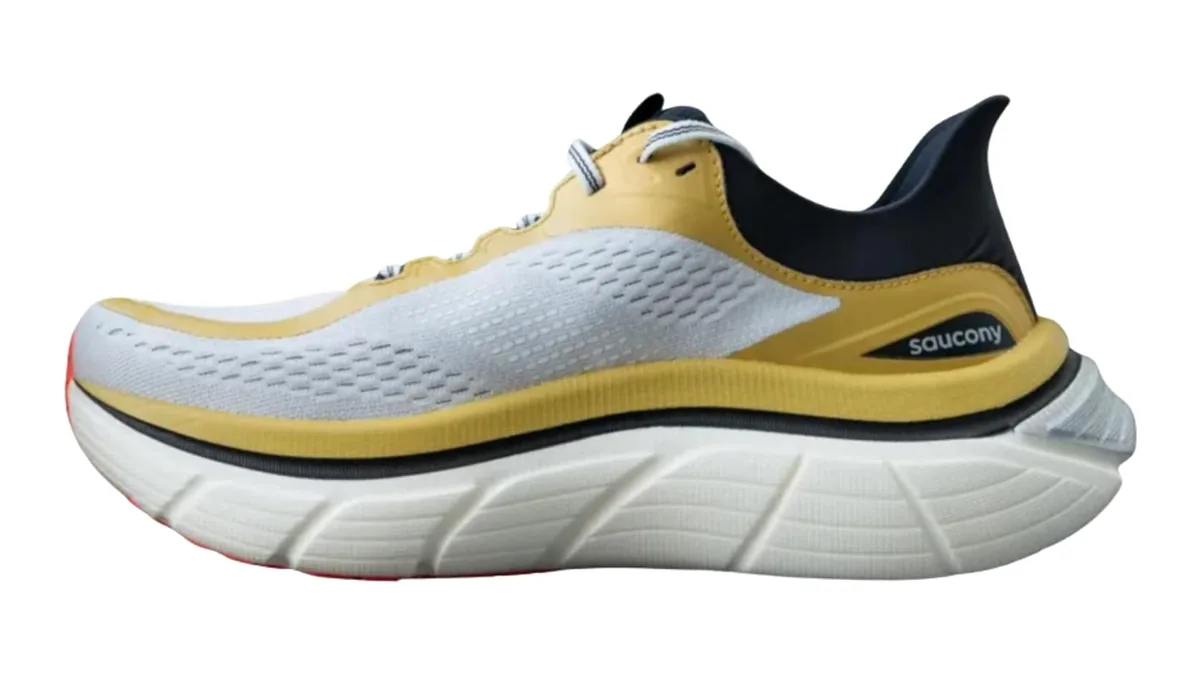
The Saucony Paramount Max is a max-cushion neutral running shoe, which means a very tall stack of foam underneath and no built-in features aimed at controlling how your foot rolls. Stack height is simply how much material sits between your foot and the ground, and at 43 mm under the heel this is about as much as anyone puts in a shoe you are supposed to train in every day.
What makes it interesting is the foam. IncrediRUN is the bouncy, lightweight material Saucony developed for its race shoes, and this is the brand putting it to work in a shoe for slow miles instead. Runners call this kind of shoe a super trainer: race-shoe materials, everyday purpose. Unlike most super trainers, the Paramount Max has no carbon plate, so nothing is stiffening the sole or forcing you forward.
In the Saucony range it sits above the Triumph as the plushest, tallest option, and alongside the plateless Endorphin Azura as the comfort-first choice rather than the quick one. It launched on July 1, 2026 at $200. If you want one shoe for easy running, long runs and general life, this is squarely aimed at you.
Specs
Here are the specifications for the Saucony Paramount Max:
| Category | Max-cushion road trainer, plateless super trainer |
| Best for | Easy runs, long runs, recovery days and long periods on your feet |
| Support type | Neutral, with steadiness coming from the width of the base rather than from support features |
| Midsole foam | Full-length IncrediRUN, the light and springy foam Saucony uses in its racing shoes |
| Plate | None |
| Stack height | 43 mm at the heel, 37 mm at the forefoot |
| Heel-to-toe drop | 6 mm, so your heel sits only slightly higher than your toes, a flatter setup than a traditional trainer |
| Weight, men’s | 10.6 oz, 302 g, in a size 9 |
| Weight, women’s | 8.8 oz, 250 g, in a size 7.5 |
| Upper | Engineered mesh with a padded heel collar and a roomier forefoot than most Saucony trainers |
| Outsole | Rubber coverage at the main wear points over a wide base |
| Widths | Standard only |
| Surface | Road, sidewalk and treadmill |
| Price | $200 at its July 1, 2026 launch. Check latest price |
Pros
These are the reasons to consider the Paramount Max:
- The cushioning is exceptional. Forty-three millimeters of IncrediRUN takes the sting out of pavement in a way very few trainers manage, which matters if your knees or shins complain after hard-surface running.
- It is soft and bouncy at the same time, so it does not feel like sinking into a mattress. The foam pushes back as you come off it.
- The base is wide, which makes a very soft shoe far steadier underfoot than the numbers suggest.
- The forefoot is roomier than Saucony’s usual last, so it suits runners whose feet spread out on landing.
- There is enough depth inside to take a custom insole or an over-the-counter orthotic, which most max-stack shoes cannot manage.
Cons
These are the reasons it will not suit everyone:
- At 10.6 oz in a men’s size 9 it is a heavy shoe, and you notice that the moment you try to pick up the pace.
- The forefoot is soft enough to feel vague when you push off hard, so faster sessions feel like work rather than fun.
- It is bulky. Independent reviewers have described the shape as unwieldy, and it does look and feel like a lot of shoe.
- Some reviewers have reported the heel collar rubbing when worn with low socks, which is worth knowing before a long run.
- There is no wide width, so broad-footed runners depend entirely on the roomier standard last being enough.
What is new versus the rest of the Saucony range
The Paramount Max is a new model rather than an update, so there is no previous version to compare against. What is new is the idea: Saucony taking IncrediRUN, the foam it developed to make race shoes fast, and using the whole midsole of a daily trainer to make one as soft as possible.
That is a departure from how the brand has built its cushioned shoes before. The Triumph uses PWRRUN+, a durable and comfortable foam, but a heavier and less lively one. The Hurricane adds a guidance system for runners who need their feet steadied. The Paramount Max does neither. It just goes as tall and as bouncy as it can and relies on the width of the platform to keep things honest.
It also differs from the Endorphin Azura, Saucony’s other plateless shoe built on race foam. The Azura is lighter and quicker and can handle a tempo run. The Paramount Max is taller, softer and slower, and it is a better shoe for recovery days and for anyone whose main complaint about running is that the ground is hard.
Who should buy the Paramount Max
Buy it if you run mostly at easy or steady pace and you want the softest, most protective shoe you can get while still having something that rolls forward properly. That covers a lot of weekend runners: a few runs a week, one longer one, mostly on pavement, no interest in a stopwatch.
It also suits runners who feel beaten up by hard surfaces. If hard pavement leaves your feet or legs feeling beaten up, a max-cushion shoe like this may make the surface feel less harsh. That does not mean it will treat knee, shin or foot pain, and persistent pain should be assessed rather than managed only by changing shoes.
Runners who use orthotics or custom insoles may want to compare this one. Independent reviewers have described the fit as roomy with good interior volume, but an orthotic changes heel height and midfoot space, so bring your insert when trying the shoe rather than assuming it will fit.
And buy it if you like a shoe that works after the run too. It is also a strong crossover option for walking after a run or for long days on your feet. Compare it with our Best Running Shoes and Best Walking Shoes hubs if you are deciding between a running-first and walking-first shoe.
Who should probably skip it
Skip it if you care about pace. The weight and the soft forefoot both work against you when you try to run fast, and the shoe never stops reminding you how much of it there is. Runners doing regular tempo sessions or intervals will find it a chore.
Skip it too if you prefer to feel the ground. Some runners genuinely dislike a tall, soft platform because it leaves them uncertain where their foot is, and no amount of base width fixes that preference. And if your feet roll inward a long way and you need actual support rather than just stability from a wide base, this is not the shoe for that job.
If any of that is you, these suit you better:
- Hoka Mach 7: a light, plateless, low-fuss trainer that can handle easy runs and quick ones without feeling like hard work (check price | read review)
- Asics Novablast 6: bouncy and well cushioned but a couple of ounces lighter, so it stays fun when you speed up (check price | read review)
- Saucony Hurricane 26: the same brand’s max-cushion shoe with an added guidance system, for runners who need their feet held steady rather than just cradled (check price | read review)
How does the Saucony Paramount Max fit?
The fit is the friendliest part of this shoe. Saucony trainers have a reputation for being cut narrow, and the Paramount Max is a clear exception, with a forefoot that gives your toes room to move. The heel and midfoot are secure without being tight. It is a comfortable, forgiving fit rather than a precise one, which is exactly right for the shoe’s purpose.
Fit and sizing
Take your usual running size. The length is accurate and there is no need to size up for room, because the width is already there. Runners with medium to slightly wide feet should find the standard last works, and it has been noted by independent reviewers as one of the roomier shoes in this category. Genuinely wide feet are a harder call, since Saucony has not made a wide version, so try a pair on if you normally need a 2E.
If you wear an orthotic or aftermarket insole, test the shoe with it in place. The Paramount Max has a relatively accommodating fit, but added insoles can change heel hold and instep pressure even in a roomy shoe.
Upper and step-in comfort
Step-in comfort is excellent. The mesh is soft, the tongue is padded and the heel collar is generously filled, so the shoe feels welcoming before you have taken a step. Combined with the deep foam underneath, it is the kind of shoe you can put on tired legs and feel better immediately.
The one caution comes from independent reviewers who found the heel collar could rub against bare skin when worn with very low socks. It is not a universal complaint and crew socks solve it, but if you always run in ankle socks it is worth a careful first outing rather than a first marathon.
How does the Saucony Paramount Max perform?
This shoe is built for one speed, and it is a comfortable one. Run easy and it feels like a luxury. Try to run hard and it feels like a shoe fighting you. The sections below cover what the foam does, how the shoe holds together underfoot and how the bottom stands up to miles.
Cushioning and ride
This is the reason to buy the shoe. IncrediRUN is soft on impact and then rebounds quickly, so landings are absorbed but you are not left sinking. With 43 mm of it at the heel, hard pavement stops registering as hard pavement. Independent reviewers have been consistent that the impact protection is among the best available in a trainer.
The ride is a slow, smooth roll rather than a snappy one. Without a plate the sole flexes naturally, and the gentle curve of the sole helps you move from heel to toe without having to work at it. Over a long run that adds up to less fatigue in the feet and lower legs.
Ride and running performance
Easy and steady running is where it belongs, and long runs are where it shines. The foam does not pack down or go flat over two hours, which is the failing of many cushioned trainers, so the last mile feels much like the first.
Faster running exposes the limits. The soft forefoot compresses too far when you drive off your toes, so the push-off feels mushy rather than firm, and the weight means you are lifting more shoe with every stride. It will get through a mild pace change on a long run, but a session of sharp intervals is asking the wrong thing of it.
Stability and support
This is a neutral shoe with no medial post, no firmer inside wedge and no guidance rails. The only thing keeping you steady is the shape of the platform, and Saucony went wide with it. That works better than expected: independent reviewers have repeatedly called it more stable than a shoe this soft ought to be, and the broad base stops the foam collapsing sideways under a normal landing.
The broad platform may feel steady enough for many neutral runners, but pronation alone does not determine whether someone needs a stability shoe. This model has no dedicated guidance system. If you consistently prefer structured support, compare it with the Saucony Hurricane 26 or read our neutral vs. stability guide. If you have ongoing pain, get it assessed rather than shopping for a cure.
Outsole, grip and durability
Rubber covers the areas that wear fastest, spread across a platform wide enough that the load is shared. Grip on dry and damp pavement is dependable, and the flat, broad footprint is reassuring on wet crossings. This is a road shoe, so gravel and trail are outside its remit.
Durability looks reasonable for a shoe using race-derived foam. The common 300 to 500 mile guideline is only a rough guide, and much depends on your weight and your surfaces, but the outsole coverage here is proper rather than token, so this is a shoe you can put real mileage through.
Is the Saucony Paramount Max good for walking?
Yes, and it is one of the better running shoes for it. Because there is no plate stiffening the sole, the shoe bends as your foot rolls through a walking step instead of fighting it, and the deep IncrediRUN takes the edge off concrete and tile. For a long day of walking, a city trip or a shift spent mostly upright, that combination works.
The wide base helps here too, because walking is slower and steadier than running and a broad platform feels planted rather than tippy. The roomy forefoot suits feet that swell over a long day, and the depth inside means you can keep wearing your own insoles. The drawbacks are practical rather than performance ones: it is heavy on your feet by the end of a very long day, and it is a bulky-looking shoe that will not pass as casual footwear. If you want a dedicated walking shoe it is worth comparing against one, but as a do-everything pair it earns its place.
Paramount Max versus the Saucony Triumph
Because the Paramount Max is a new model, the useful comparison is with the Triumph, the cushioned Saucony trainer most buyers will be choosing between.
| Paramount Max | Triumph | |
| Midsole foam | Full-length IncrediRUN, race-derived | PWRRUN+, comfort-focused |
| Stack height | 43 mm / 37 mm | Lower |
| Feel | Softer and bouncier, more roll | Firmer and more conventional |
| Weight | Heavier | Lighter |
| Price at launch | $200 | Lower |
Buy the Paramount Max when maximum softness and impact protection are the whole point, when you run long and slow, or when hard surfaces are your problem.
Buy the Triumph when you want a cushioned shoe that is lighter on the foot, less bulky and considerably cheaper, and when you occasionally want to run quickly without the shoe complaining.
Saucony Paramount Max Alternatives
Runners who want the tall, protected feel with a plate adding some snap should look at the Hoka Skyward X 2. It offers similar deep cushioning for easy days and long runs, but the carbon plate gives it a firmer, more directed roll than the Saucony’s free-flexing sole. Our Skyward X 2 review covers who benefits from that plate and who is better off without one.
A lighter high-stack option is the Asics Superblast 2. It has plenty of foam and a wide platform like the Paramount Max, but it weighs less and is far happier when you speed up, which makes it the better single shoe if your easy runs sometimes turn into fast ones. See the Superblast 2 review for the detail.
If the roomy fit is what appeals and the price is not, the Brooks Ghost Max 3 gives you a wide, stable, tall trainer with a generous toe box for considerably less money. It is firmer and less bouncy, so you trade the IncrediRUN feel for value and a shoe that walks as well as it runs. The Ghost Max 3 review explains where that trade lands.
Staying with Saucony, the Endorphin Azura is the shoe to pick if you liked the sound of IncrediRUN but not the weight. It uses the brand’s race foam in a lighter, quicker plateless shoe that can handle a tempo run, which is precisely what the Paramount Max cannot do. Our Endorphin Azura review sets out that difference.
Price and value
At $200 this is priced as a premium trainer rather than a race shoe, and it is in line with other max-stack super trainers. What you are paying for is a full midsole of foam that normally appears in shoes costing $250 or more, plus a level of impact protection that cheaper trainers cannot match.
The value case is stronger than it looks, because unlike a racer this is a shoe you can use constantly. The outsole has real rubber on it, the foam holds its character over long runs, and it doubles as a walking and standing shoe. Spread across daily mileage plus everyday wear, the cost per mile is fair. What you are not getting for $200 is versatility of pace, and that is the honest limit: if you need one shoe that covers both easy days and fast days, something $50 cheaper will serve you better.
Final verdict
Best for: easy runs, long runs and recovery days, runners who feel beaten up by hard surfaces, orthotic wearers, and anyone who wants a running shoe that is also good for walking and standing.
Avoid if: you do regular fast sessions, you like to feel the ground, you need real support for feet that roll inward a long way, or you want a light shoe.
Fit: true to size, roomier through the forefoot than most Saucony shoes, deep enough for insoles, standard width only.
Verdict: The Paramount Max is a comfort-first max-cushion trainer with a broad base, roomy fit and enough bounce to keep easy and long miles from feeling flat. Its weight and soft forefoot make it a poor choice for speedwork, but it makes much more sense for runners and walkers who value protection and a steady ride over pace.
Check the latest price on the Saucony Paramount Max.
See where the Paramount Max fits in our best Saucony running shoes guide.
Frequently Asked Questions for Saucony Paramount Max
It can be a good first serious running shoe, because the cushioning is forgiving and the wide base keeps it steady. The weight is the only real drawback for someone still building fitness.
Yes. The soft foam and smooth roll suit treadmill running well, and the belt is gentle on the outsole. Some runners find a heavy shoe warm indoors, so expect a little more heat than usual.
No. Saucony sells it in the standard width only, though the standard forefoot is roomier than the brand’s usual shape, so many people who normally need a wide will still get on with it.
The rubber coverage is proper rather than token, so it should behave like a normal trainer. The usual 300 to 500 mile figure is a broad guideline, and your weight and running surfaces will move it in either direction.
No. It has no plate, it is heavy and the soft forefoot gives way when you push hard. It can carry you round a slow marathon in comfort, but it will not help you run a fast one.
IncrediRUN is Saucony’s lightweight, high-rebound midsole material, originally developed for its racing shoes. It is soft on landing and springs back quickly, which is why it feels bouncy rather than dead underfoot.
Is the Paramount Max good for walking and standing?
Yes. Its broad base, deep cushioning and roomy forefoot make it a strong running-to-walking crossover shoe for long days on hard surfaces. It is bulky and heavier than a dedicated walking shoe, so compare it with lighter walking-first options if all-day walking is your main use.