Serious deep-cold warmth in a boot that is heavy and clumsy to walk in
Quick Answer: Sorel 1964 Pac Nylon Review: The Sorel 1964 Pac Nylon is a classic pac boot for genuinely cold winters. A waterproof rubber shell keeps slush out, a thick removable felt liner keeps heat in, and Sorel rates the pair to minus 25 F. It suits snow clearing, dog walks in deep cold, ice fishing and standing around outdoors in winter. It is heavy and stiff, though, so it is a poor choice for long walks or any kind of hiking. Check latest price.
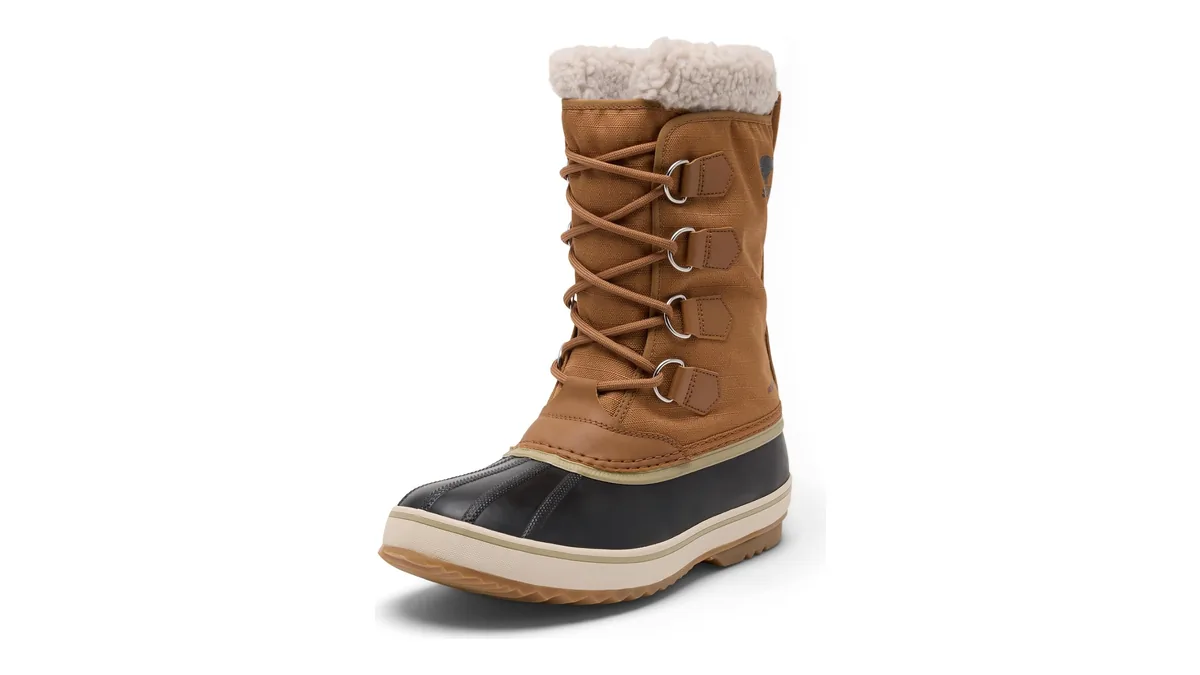
The Sorel 1964 Pac Nylon is one of the oldest designs still on sale in winter footwear. A pac boot is a specific thing: a waterproof rubber lower shell with a separate insulating liner that lifts out, rather than one sealed boot with insulation built in. Sorel has been making that design since the 1960s, and the name refers to exactly that.
Within Sorel’s range it sits right next to the better-known Caribou. The two share the same basic idea and the same rubber shell approach. The Caribou uses a leather upper above the rubber, while the 1964 Pac Nylon uses a waterproof nylon upper, which is lighter, cheaper and needs no leather care.
Understand the category and the boot makes sense immediately. This is not a winter hiking boot and it is not a walking boot that happens to be warm. It is cold-weather equipment, built for standing, shoveling, waiting and short trips through snow, and it is very good at that narrow job.
Specs
Here are the specifications for the Sorel 1964 Pac Nylon:
| Type | Insulated pac-style winter snow boot with a removable liner |
| Best for | Snow clearing, deep-cold dog walks, ice fishing, yard work, standing outdoors in winter |
| Temperature rating | Rated by Sorel to keep feet warm and dry down to minus 25 F |
| Upper | Waterproof nylon with seam-sealed construction |
| Shell | Handcrafted waterproof vulcanized rubber, meaning the rubber is heat-cured into one piece |
| Liner | Removable 9 mm washable recycled felt inner boot with a Sherpa pile snow cuff |
| Midsole | 2.5 mm bonded felt frost plug, a layer that blocks cold coming up from the ground |
| Outsole | Herringbone rubber tread |
| Measurements | About 10.25 in. shaft height, 1.5 in. heel, 0.75 in. platform |
| Widths | One width, which Sorel does not name, though the toe box is generous |
| Price | Around $180 at retail (checked September 2026). Check latest price |
Pros
- Genuinely warm, with a rating to minus 25 F that few winter boots at any price match
- The felt liner lifts out, so it can be dried overnight or washed, which is the main reason pac boots outlast sealed winter boots
- The vulcanized rubber shell is properly waterproof, so slush, puddles and wet snow are a non-issue
- A roomy toe box leaves space for thick socks and for toes to move, which helps keep them warm
- Nylon needs no care, unlike the leather upper on the Caribou
Cons
- Heavy and stiff, so walking any distance is tiring and awkward
- Too warm for mild winter days, and your feet will sweat above freezing
- The herringbone tread is built for snow, not ice, and it is not a substitute for traction devices
- One width only, so narrow feet have to rely on thick socks and lacing
- Nylon looks and feels less substantial than the Caribou’s leather, which matters to some buyers
What is new versus the Sorel Caribou
The 1964 Pac Nylon is a long-running design rather than a boot that gets refreshed each season, and Sorel does not publish a change history for it. The comparison that actually helps you is with the Caribou, because the two sit side by side in stores and most buyers are choosing between them.
Both use the same pac construction: a waterproof rubber lower, a removable felt liner and a seam-sealed upper. The difference is the material above the rubber. The Caribou uses leather, which is tougher against scrapes, holds its shape better over years and looks more traditional. It also needs occasional conditioning and it costs more.
The nylon upper on this boot is lighter, dries faster and needs nothing from you beyond a wipe. It is less resistant to abrasion, so if you are dragging boots across gravel or catching them on machinery the leather will hold up better. For most people, buying snow boots for a driveway and a dog, the nylon is the sensible choice and the saving is real.
Who should buy the Sorel 1964 Pac Nylon
Buy it if your winters get seriously cold. Below about 10 F, ordinary insulated boots start to struggle and a thick felt liner in a sealed rubber shell does not. If you live somewhere that sees real subzero cold, this is equipment rather than a luxury.
It suits standing and slow work best: clearing a driveway, feeding animals, ice fishing, watching a game outdoors, waiting at a bus stop in January. The warmth is at its most valuable when you are not generating much heat yourself.
It is also a good pick if you have had winter boots fail on you by never drying out. Because the liner comes out, you can pull it overnight and start the next day with a dry boot, which no sealed insulated boot lets you do.
Who should probably skip it
Skip it if you want to walk in it. This is a heavy, stiff boot with a tall shaft, and a two-mile walk in it feels much longer than two miles. Anyone hiking, snowshoeing or covering real distance wants an insulated boot built to flex.
Skip it as well if your winters are mild or wet rather than cold. In anything above freezing it is too warm, and sweaty feet in a sealed boot end up colder than dry feet in a lighter one. And if ice rather than snow is your problem, the tread here will not solve it.
- Merrell Thermo Chill 2 Mid Waterproof: an insulated winter boot built on a hiking shape, so you can actually walk distances in it (check price)
- The North Face Chilkat V: a lighter insulated winter boot that is warm enough for most conditions and far less clumsy on the move (check price)
- Columbia Newton Ridge Plus II Waterproof Omni-Heat: an insulated leather hiking boot for cold but not extreme conditions, at a much lower price (check price)
How does the Sorel 1964 Pac Nylon fit?
Pac boots fit differently from anything else you own, and expecting them to fit like a shoe is the most common mistake buyers make. There is meant to be air and sock volume in here, because trapped air is a large part of what keeps your feet warm.
Fit and sizing
Take your usual size and try it with the thick socks you will actually wear. The boot is roomy through the toes by design, and that room is functional: toes that can move stay warmer than toes clamped in place, and squeezing a thick sock into a tight boot compresses the air that was doing the insulating.
Sorel offers one width, which it does not name, so there is no narrow or wide option to fall back on. If your foot is slim, expect to lace firmly and use a thicker sock. If your foot is wide, the generous toe box usually copes.
Upper, liner and step-in comfort
The upper is waterproof nylon above a vulcanized rubber shell, with sealed seams. Vulcanized means the rubber is heat-cured into a single piece rather than glued together, which is why the lower half of this boot simply does not leak.
Inside sits a 9 mm recycled felt liner with a Sherpa pile snow cuff at the top, which seals around your calf and stops snow dropping in. Step-in comfort is soft and slipper-like rather than supportive, because a felt liner has no arch structure at all. Underneath, a 2.5 mm bonded felt frost plug blocks cold rising through the sole, which is the direction most heat is actually lost when you are standing still.
How does the Sorel 1964 Pac Nylon perform?
Judged as a cold-weather tool, this boot is excellent and largely unchanged for good reason. Judged as footwear you move around in, it is agricultural. Both things are true at once.
Warmth and insulation
Sorel rates the boot to minus 25 F, and the three things delivering that are the felt liner, the frost plug under your foot and the sealed rubber shell that keeps everything dry. Wet insulation stops insulating, so the waterproofing is as much a warmth feature as a comfort one.
Treat any temperature rating as a guide rather than a promise. It assumes you are reasonably active, wearing appropriate socks and not standing on frozen steel. Circulation, sock choice and how long you are out all change the real-world answer more than the number does.
Ride and walking performance
This is where the boot gives ground. The rubber shell barely flexes, the shaft is tall and the whole thing is heavy, so your stride shortens and your ankle does most of the adapting. Over a driveway and back that is nothing. Over a couple of miles it is genuinely tiring.
The felt liner also means no arch support and very little structure, so your foot moves inside the boot more than it would in a hiking boot. That is comfortable when you are standing and less reassuring on uneven frozen ground.
Stability and support
There is no guidance or stability structure in this boot at all, and it is not designed to influence how your foot moves. What you get is a tall, stiff shell that holds your ankle simply by surrounding it, which is protective in deep snow and vague on rough ground.
If you need arch support you can usually fit a thin insole under the liner, though space is limited and anything bulky will compress the insulation. Do not expect the boot itself to support your foot the way a walking shoe does.
Outsole, grip and durability
The herringbone tread is a classic snow pattern, with angled bars that bite into packed snow and clear it rather than holding it. On snow it works well. On wet ice, like almost every rubber outsole, it is much less convincing, and if ice is a regular hazard where you live, a set of slip-on traction cleats is a better answer than any boot tread.
Durability is a real strength. Vulcanized rubber is hard to damage, nylon does not need conditioning the way leather does, and the liner is replaceable, which means the part that wears out first can be renewed without buying a new boot. These are boots people keep for many winters, though no boot carries a lifespan guarantee and how long yours lasts depends on how hard you use it.
Is the Sorel 1964 Pac Nylon good for walking?
For short winter walks, yes, and that is how most owners use it. Clearing snow, walking the dog around the block, crossing a parking lot in a storm and tramping through deep snow are all well within what it does happily, and the warmth means you can take your time rather than rushing back inside.
For anything longer it is the wrong tool. The weight, the stiffness and the lack of arch support add up quickly, and by two or three miles most people are uncomfortable. It is also poor for standing all day indoors, because it is far too warm. If you want one boot for deep cold and for walking distances, you are asking for two different boots. As always, comfort depends on your arch, your gait and your history, so persistent foot pain is worth having assessed rather than solving with footwear alone.
Sorel 1964 Pac Nylon versus the Sorel Caribou
1964 Pac Nylon | Caribou | |
Upper material | Waterproof nylon, seam-sealed | Leather over the rubber shell |
Care needed | Wipe clean, nothing else | Occasional leather conditioning |
Abrasion resistance | Lower | Higher |
Price | Lower | Higher |
Shell, liner and construction | Vulcanized rubber shell, removable felt liner | The same pac construction |
Buy the 1964 Pac Nylon when you want the warmth and the removable liner without paying for leather or looking after it. For driveway and dog-walk duty it is the practical choice.
Buy the Caribou when your boots take abuse, or you simply prefer the leather look and are willing to condition it. It is the more hard-wearing of the two above the rubber line. Check Caribou price
Sorel 1964 Pac Nylon alternatives
Most people weighing this boot want a bit less of something: less weight, less money or less lacing.
Sorel Caribou: the leather-uppered sibling on the same rubber shell, for anyone who wants a tougher outside and does not mind the care or the cost (check price).
Columbia’s Bugaboot is the sensible middle ground for anyone who found the Sorel more boot than they need. It is lighter, cheaper and easier to walk in, and it is warm enough for most winters that do not involve serious subzero cold (check price).
Where mud and slush matter more than deep cold, a pull-on rubber boot such as the Bogs Classic Mid makes more sense. There is no lacing, the whole boot is waterproof rather than just the lower half, and it is far quicker to get on and off for short trips outside (check price).
Price and value
Around $180 buys a boot that solves one problem completely rather than several problems partly. The vulcanized rubber shell, the thick felt liner and the frost plug are the expensive parts, and they are the parts that keep your feet warm and dry when it is genuinely cold. Because the liner can be replaced and nylon needs no care, this is also a boot that can last many winters, which spreads the cost. It is poor value if you only see a few frosty weeks a year, when a lighter insulated boot would serve you better for less.
Final verdict
Best for: people in genuinely cold winters who need warm, waterproof boots for snow clearing, yard work, short dog walks and standing around outdoors.
Avoid if: you want to walk distances, you live somewhere with mild or wet rather than cold winters, or ice rather than snow is your main hazard.
Fit: true to size, roomy through the toes, one width only. Try it with the thick socks you will actually wear.
Verdict: We rate the Sorel 1964 Pac Nylon as one of the most dependable cold-weather boots you can buy, and the removable liner is the feature that keeps it useful for years rather than seasons. It has not changed much in decades because it did not need to. Just do not mistake it for a boot you can hike in.
Frequently Asked Questions for Sorel 1964 Pac Nylon
A pac boot has a waterproof rubber lower shell with a separate insulating liner that lifts out, rather than insulation built permanently into the boot. The removable liner is the point: it can be dried or washed overnight and replaced when it packs down.
They use the same pac construction and the same rubber shell. The Caribou has a leather upper above the rubber, which is tougher and needs conditioning, while the 1964 Pac Nylon uses waterproof nylon, which is lighter, cheaper and maintenance free.
Yes, and it is one of the main advantages of the design. Replacement felt liners are sold separately, so when the original packs down and stops insulating well you can renew the warm part of the boot instead of buying a new pair.
Treat it as a guide rather than a guarantee. Temperature ratings assume reasonable activity, dry feet and suitable socks. Standing still on frozen ground, poor circulation or a damp liner will all make the real-world limit warmer than the number suggests.
One thick wool or wool-blend sock, not two pairs. Doubling up compresses the air that does the insulating and restricts circulation, which makes feet colder rather than warmer. Avoid cotton, which holds sweat against your skin.
Pull the felt liner out and stand both parts somewhere warm but not hot, away from radiators and heaters, which crack rubber and shrink felt. Drying the liner separately is far faster than trying to dry the assembled boot, and it is the reason the liner is removable.
Not especially. The herringbone tread is designed to grip and shed packed snow, and like most rubber outsoles it offers limited hold on wet ice. If ice is a regular hazard, slip-on traction cleats over the boot are a more effective answer than any tread pattern.