An orthopedic walking shoe built around fit
Quick Answer: Propet Stability Walker Review: The Stability Walker is a leather orthopedic walking shoe for people who need a wide, steady platform and room for an orthotic. Propet builds it on a broad unitsole base with internal and external heel counters and a contoured heel stabilizer, and offers it in five widths from narrow to 4E. It is coded A5500, which makes it eligible under the Medicare therapeutic shoe benefit for people with diabetes. The drawbacks are weight and a firm, dated ride. Check latest price.
Propet Stability Walker: Exceptional fit options with a firm, old-fashioned ride
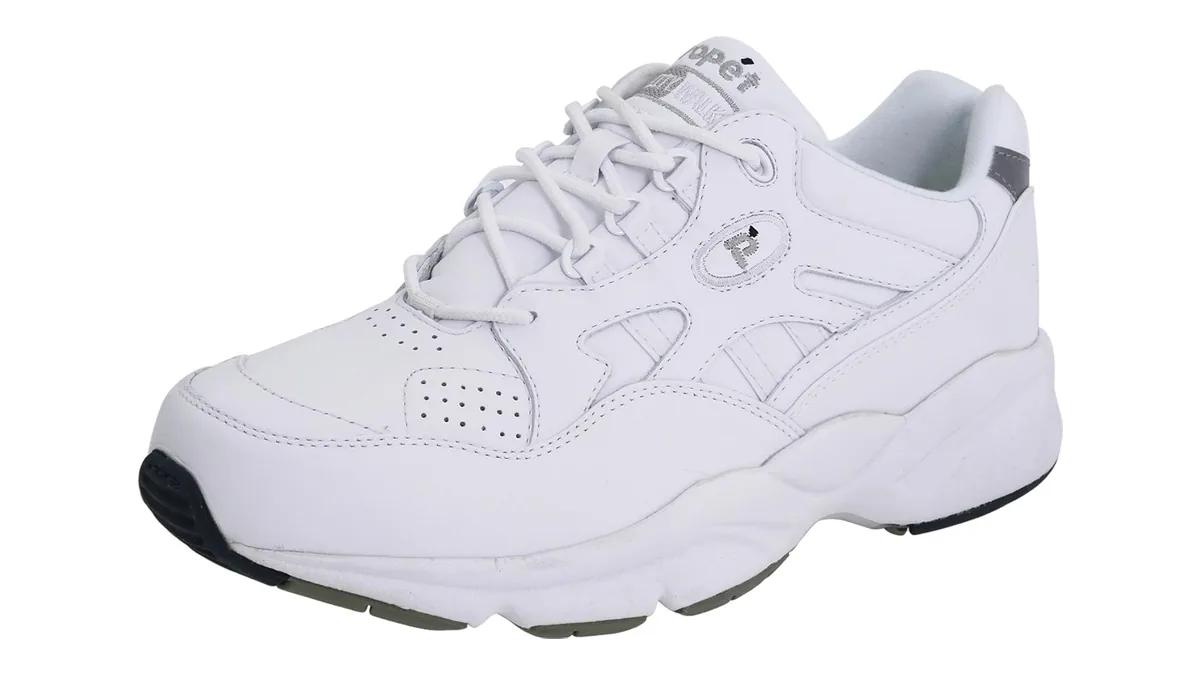
The Propet Stability Walker is not trying to compete with modern cushioned walking shoes, and judging it on that basis misses the point. It is an orthopedic shoe, built to solve fit and stability problems that a conventional sneaker cannot, and it has been in production largely unchanged for years because the people who need it keep buying it. For the current brand lineup, see our Propet shoes guide.
The defining feature is width. Propet offers this shoe in narrow, medium, wide, extra wide and 4E, which is a range almost nobody else matches. Combined with a genuinely roomy toe box and extra depth, that makes it one of the few options for feet that are swollen, misshapen or simply very broad, and for people who need to fit a custom orthotic without cramping the foot.
Stability comes from structure rather than from foam. Propet uses a wide unitsole base, internal and external heel counters and a contoured heel stabilizer, all of which work to stop the rearfoot moving. On a shoe intended for people who may be unsteady on their feet, that matters more than cushioning depth.
Specs
Here are the specifications for the Propet Stability Walker:
| Type | Leather orthopedic walking shoe |
| Best for | Walking, standing, orthotic users, wide or swollen feet, people needing a steady platform |
| Upper | Perforated genuine leather or nubuck with a brushed nylon moisture-wicking lining |
| Midsole | Lightweight molded EVA |
| Insole | Removable padded PU footbed with a heel pad and cushioning ridges |
| Stability features | Wide unitsole base, internal and external heel counters, contoured heel stabilizer |
| Closure | Speed lacing system with a padded collar and tongue |
| Widths | Narrow (2A/B), Medium (B/D), Wide (D/E), Extra Wide (2E/3E) and 2X (4E) |
| Medicare coding | Coded A5500, so it is eligible under the Medicare therapeutic shoe benefit for people with diabetes, subject to the usual qualification requirements |
| Model numbers | M2034 men’s, W2034 women’s |
| Price | A long-running model with no single launch date; list prices commonly run about $103 to $125, approximate. Check latest price |
Pros
These are the reasons it is prescribed and recommended so often:
- Five width fittings, from narrow to 4E, which very few shoes match
- Extra depth and a removable footbed, so a custom orthotic fits without cramping the foot
- Wide unitsole base and twin heel counters make the shoe feel very steady at slow speeds
- Coded A5500, so it may be covered under the Medicare therapeutic shoe benefit for eligible people with diabetes
- Perforated leather with a wicking lining, which suits feet that get hot or sweaty
- Speed lacing makes it easier to fasten for anyone with limited hand strength or reach
Cons
These are the compromises of an orthopedic design:
- Firm underfoot, with far less cushioning than a modern walking shoe
- Heavy compared with a foam-based walking shoe
- Dated styling, which some people mind and others do not
- Stiff through the forefoot, so it rolls rather than flexes as you walk
- At roughly $103 to $125 it costs more than many cushioned walking shoes that feel softer
What the Stability Walker is designed to do
This is not a shoe updated on an annual cycle, so there is no new version to compare against. Propet keeps it in the range because it addresses problems that do not change: feet that are too wide or too swollen for ordinary shoes, feet that need to accommodate a prescribed orthotic, and people who need a shoe that will not let the ankle wander.
The extra depth is the feature that does the most work. A custom orthotic takes up vertical space, and putting one into a normal shoe usually pushes the foot up until the toes press against the top. A shoe built with extra depth from the start avoids that, which is why podiatrists and pedorthists keep recommending this category.
The A5500 coding is the other practical point. That code identifies footwear that meets the requirements of the Medicare therapeutic shoe benefit for people with diabetes, which means eligible patients may be able to obtain it with coverage rather than paying out of pocket. Eligibility rules are set by Medicare and a supplier or clinician will confirm whether they apply to you.
Who should buy the Propet Stability Walker
Buy the Stability Walker if fit is your problem rather than cushioning. Five widths up to 4E, extra depth and a roomy toe box solve difficulties that no amount of foam addresses, and for feet that swell during the day or that no longer fit a standard last, this is one of the few practical answers.
It is a strong choice for orthotic users. The footbed lifts out cleanly and there is genuine vertical space for a device, so a prescribed orthotic can sit where it is meant to rather than pushing the foot upward.
People with diabetes should note the A5500 coding, since it may make the shoe obtainable under the Medicare therapeutic shoe benefit if they qualify. A clinician or approved supplier will confirm eligibility, and footwear choices for diabetic feet are worth discussing with them rather than deciding alone.
Who should avoid the Propet Stability Walker
Avoid it if you want cushioning. This is a firm shoe with a modest EVA midsole, and anyone whose main complaint is sore feet on concrete will get far more relief from a modern max-cushion walking shoe. Comfort here comes from fit rather than from softness.
Avoid it if you walk long distances for fitness. It is heavy, stiff through the forefoot and not designed for pace, so brisk walking or covering serious mileage will be harder work than in a purpose-built walking shoe.
It is also not a running shoe in any sense. And if styling matters to you, the Stability Walker looks like what it is, so anyone wanting something that passes as a normal sneaker should look elsewhere.
How does the Propet Stability Walker fit?
Fit and sizing
The Stability Walker fits true to size in length, and the width range is where it stands apart. Narrow, medium, wide, extra wide and 4E are all offered, which means most people can find a fitting that actually matches their foot rather than settling for the nearest available.
The toe box is deliberately roomy, giving the toes space to spread, which Propet argues improves stability and which certainly helps anyone with bunions, hammertoes or swelling. The extra depth is designed for orthotics, so if you are not using one the shoe may feel a little voluminous, and a thicker sock or the supplied footbed will take up the space.
Upper and step-in comfort
The upper is perforated leather or nubuck over a brushed nylon lining that wicks moisture. Leather moulds to the foot over time and the perforations help with heat, which matters for people whose feet sweat or who are managing skin sensitivity.
The speed lacing system is a practical touch that is easy to overlook. Laces that run through hooks rather than eyelets are considerably easier to tighten and loosen for anyone with arthritic hands or limited reach, which is a real consideration for the people this shoe serves.
How does the Propet Stability Walker perform?
Cushioning and standing comfort
The midsole is a molded EVA, and there is a moderate amount of it. The removable PU footbed adds a heel pad and cushioning ridges, which softens heel strike, but the overall impression is firm rather than plush.
That firmness is not accidental. A soft midsole compresses unevenly under a foot that is unstable, and for a shoe aimed at people who need a steady platform, a firmer base is the safer choice. Anyone whose priority is pure cushioning should recognise that this is a deliberate design decision they may not want.
Stability and support
This is the shoe’s purpose and it does it well. A wide unitsole base gives the foot a broad platform to land on, which is the single most effective way to feel steady at walking speed. Internal and external heel counters and a contoured heel stabilizer then hold the rearfoot in place so it cannot tip.
What this is not is motion control in the running sense, and it does not correct gait. It provides a steady base and holds the heel. Anyone with balance problems, neuropathy or persistent foot pain should be guided by a clinician on footwear, since fit and medical need interact in ways a shoe review cannot assess.
Outsole, grip and durability
The unitsole is broad and flat with a moderate tread, which grips indoor floors, pavement and packed surfaces dependably. The wide base contributes as much to sure footing as the tread pattern does, since more contact area means a more predictable footprint.
Durability is good. Leather uppers outlast mesh by a wide margin, a firm EVA midsole does not flatten as quickly as a soft one and the construction is straightforward. Running mileage guidelines are not a useful measure here, and for a walker this is footwear measured in years rather than months.
Is the Propet Stability Walker good for walking?
For everyday walking and standing, yes, and that is exactly the job it was built for. The wide unitsole base and the twin heel counters make it feel steady at slow speeds, which is when most people feel unsure on their feet, and the leather upper with a roomy toe box accommodates feet that swell over the course of a day. For errands, walking around a home or a workplace, and anyone using an orthotic, it is a genuinely good shoe.
For fitness walking it is less suitable. It is heavy, the forefoot is stiff so the foot does not flex naturally through the step, and the cushioning is modest by current standards, so several miles on concrete will be felt. If you are walking for exercise rather than for daily life, a cushioned walking shoe in a wide fitting will serve you better.
Stability Walker vs. a modern cushioned walking shoe
These two approaches solve different problems:
Propet Stability Walker | Cushioned walking shoe | |
Fit range | Five widths, narrow to 4E, extra depth | Usually standard and wide only |
Cushioning | Firm and modest | Deep and soft |
Orthotic space | Designed for it | Often tight once a device is fitted |
Weight | Heavy | Lighter |
Medicare A5500 coding | Yes | Usually not |
Buy the Stability Walker if fit, orthotics or coverage eligibility are what you need. Buy a cushioned walking shoe if your feet fit standard lasts and your problem is soreness from hard surfaces.
Propet Stability Walker Alternatives
Walkers who need support and leather durability but want a more modern shoe should compare the Brooks Addiction Walker 2. It is a motion-control leather walking shoe with a slip-resistant outsole, available in multiple widths, and it cushions noticeably better (check price | read review).
Where cushioning matters more than fit range, the Brooks Ghost Max 3 offers a wide, flat and very soft platform that suits standing on hard floors, and it comes in wide fittings with a removable insole for orthotics (check price | read review).
Walkers who want both deep cushioning and genuine stability should look at the Hoka Gaviota 6, which pairs a max-cushion platform with a support frame and is available in wide fittings (check price | read review).
For commuting and travel where the Stability Walker’s styling is a drawback, the Hoka Transport 2 combines deep cushioning and a grippy Vibram outsole in a shoe that looks like everyday footwear (check price).
See more Propet shoes.
Price and value
List prices commonly run about $103 to $125, which is more than many cushioned walking shoes and less than premium ones. The value is not in the materials, which are conventional, but in the fitting range and the extra depth: for someone who cannot wear a standard shoe, a shoe that fits is worth more than one that is softer. The A5500 coding also changes the arithmetic for people with diabetes who qualify under the Medicare therapeutic shoe benefit, since the out-of-pocket cost may be considerably lower. For everyone else, cheaper shoes offer more comfort per dollar.
Final verdict
Best for: everyday walking and standing for people with wide, swollen or hard-to-fit feet, orthotic users, and those qualifying under the Medicare therapeutic shoe benefit.
Avoid if: you want soft cushioning, you walk long distances for fitness, or you want a shoe that looks like a normal sneaker.
Fit: true to size, roomy toe box, extra depth for orthotics, and five widths from narrow to 4E.
Verdict: The Stability Walker solves fit and stability problems that modern cushioned shoes largely ignore, and the width range alone justifies its place. It is firm, heavy and plain, so buy it for what it does rather than for how it feels underfoot. You can check size availability before ordering.
Frequently Asked Questions for Propet Stability Walker
Five: narrow (2A/B), medium (B/D), wide (D/E), extra wide (2E/3E) and 2X (4E). That range is far broader than almost any mainstream walking shoe, and it is the main reason the shoe is recommended for hard-to-fit feet.
A5500 identifies footwear that meets the requirements of the Medicare therapeutic shoe benefit for people with diabetes. It means eligible patients may be able to obtain the shoe with coverage rather than paying out of pocket. Eligibility rules are set by Medicare, and a clinician or approved supplier will confirm whether they apply to you.
Yes. The footbed lifts out and the shoe is built with extra depth, so there is genuine vertical space for a device. That is the difference between an orthopedic shoe and a normal one, where an orthotic often pushes the foot up until the toes press against the top.
Not by modern standards. It uses a molded EVA midsole and a padded PU footbed, which softens heel strike, but the overall feel is firm. That is deliberate, since a soft midsole compresses unevenly under an unsteady foot and would undermine the shoe’s stability.
Three things: a wide unitsole base that gives the foot a broad platform, internal and external heel counters that hold the rearfoot, and a contoured heel stabilizer. It provides a steady base rather than correcting gait, and it is not motion control in the running sense.
Less so. It is heavy and stiff through the forefoot, and the cushioning is modest, so several miles on concrete will be felt. It is built for everyday walking and standing rather than for covering distance at pace.