Last Updated on September 22, 2026
Quick Answer: The Hoka Speedgoat 7 is the best all-around men’s trail running shoe in this guide because it combines responsive cushioning with Vibram Megagrip and 5 mm lugs for mixed technical terrain. Choose the Brooks Cascadia 20 if you want a more stable, protective platform; the Salomon Speedcross 6 for deep mud and soft ground; the Altra Lone Peak 9 for zero-drop geometry and a roomy toe box; and the New Balance Fresh Foam X Hierro v9 for plush cushioning and wide-width options. Match the shoe to terrain, fit and distance rather than buying on brand alone.
For this September 2026 update, we checked the current versions of every shoe in the guide and compared traction, cushioning, drop, fit, protection and intended terrain. The result is a five-shoe shortlist that covers the main trail-running needs without pretending one model is best for every runner or every surface.
Best Men’s Trail Running Shoes at a Glance
| Shoe | Best for | Key trail feature | Drop | Price |
|---|---|---|---|---|
| Hoka Speedgoat 7 | Best overall / mixed technical terrain | Vibram Megagrip, 5 mm lugs, responsive cushioning | 5 mm | Check current price |
| Brooks Cascadia 20 | Stable all-terrain running and hiking | Vibram Megagrip, TrailAdapt, broad stable platform | 6 mm | Check current price |
| Salomon Speedcross 6 | Mud, soft ground and steep loose trails | Mud Contagrip, 5 mm lugs, secure Quicklace fit | 10 mm | Check current price |
| Altra Lone Peak 9 | Zero-drop runners and roomy toe-box fit | 0 mm drop, Original FootShape fit, MaxTrac outsole | 0 mm | Check current price |
| New Balance Fresh Foam X Hierro v9 | Plush cushioning and wide-width options | Dual-density Fresh Foam X, Vibram Megagrip, deep lugs | 4 mm | Check current price |
How We Picked These Trail Running Shoes
Trail shoes work best when their design matches the ground beneath them, so we evaluated this list by use case rather than treating every model as interchangeable. We checked current 2026 model availability and manufacturer specifications, then compared outsole compound and lug depth, cushioning and heel-to-toe drop, toe-box and width options, underfoot protection, upper durability and the terrain each shoe is built to handle. We also looked for clear trade-offs: deep mud traction can feel awkward on pavement, high cushioning can reduce ground feel, and zero-drop geometry can require a gradual transition for runners accustomed to a higher heel.
In-depth Reviews for the Best Men’s Trail Running Shoes
Below are detailed reviews of each current model, including the terrain, fit and running style each shoe suits best.
Brooks Cascadia 20
Best for: Stable all-terrain running and hiking

The Brooks Cascadia 20 is the stability-focused choice in this group. Its Vibram Megagrip outsole and TrailAdapt system create a broad, predictable platform for rocky, root-filled and mixed-surface trails. The current model uses a 6 mm drop and is built for runners who value protection and control over a minimal feel.
Brooks increased the cushioning from the Cascadia 19 and paired the shoe with a more capable outsole, creating a livelier ride without turning it into a soft, unstable cruiser. The air-mesh upper uses overlays in high-wear areas, while the toe cap and mudguard help protect the foot and upper from trail debris.
Choose the Cascadia 20 for varied trails, technical hiking or longer runs where a secure platform matters more than outright speed. Runners who want a softer, more energetic feel may prefer the Speedgoat 7, while runners who mostly encounter deep mud should look at the Speedcross 6. Read our full Brooks Cascadia 20 review.
Specs
- Drop: 6 mm
- Outsole: Vibram Megagrip
- Platform: TrailAdapt system
- Best use: varied surfaces, technical terrain and hiking
Pros
- Stable, protective platform
- Strong mixed-terrain grip
- Wide version available
Cons
- Heavier than more agile trail shoes
- More structured than runners seeking maximum ground feel may want
Hoka Speedgoat 7
Best for: Mixed technical terrain and long trail runs
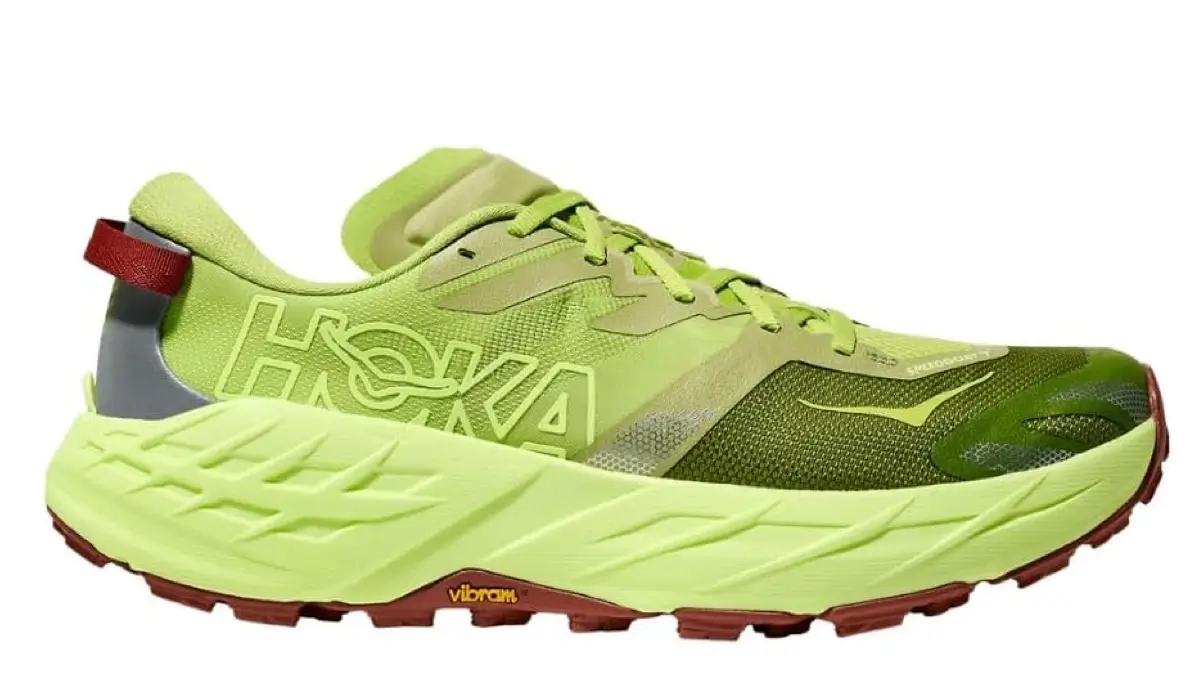
The Hoka Speedgoat 7 is our best all-around pick because it balances cushioning, traction and responsiveness without becoming overly specialized. Hoka updated the midsole for a livelier ride while keeping the protective cushioning that made the Speedgoat popular for long trail days. The men’s model uses a 5 mm heel-to-toe drop.
Underfoot, Vibram Megagrip with Traction Lug and 5 mm lugs provides dependable grip on rock, dirt and mixed technical terrain. Hoka also revised the lug orientation, refined the heel collar and added gaiter integration for better debris management.
The Speedgoat 7 makes the most sense for runners who want one shoe for technical singletrack, mountain trails and longer distances. It is less mud-specific than the Speedcross 6 and less low-to-the-ground than the Lone Peak 9, but its mix of grip and cushion gives it the broadest range here. Read our full Hoka Speedgoat 7 review.
Specs
- Drop: 5 mm
- Outsole: Vibram Megagrip with Traction Lug
- Lugs: 5 mm
- Best use: mixed technical terrain and longer trail runs
Pros
- Excellent all-around traction
- Responsive cushioning for long runs
- Wide option available
Cons
- High cushioning reduces ground feel
- Not as aggressive in deep mud as the Speedcross 6
Salomon Speedcross 6
Best for: Mud, soft ground and steep loose trails
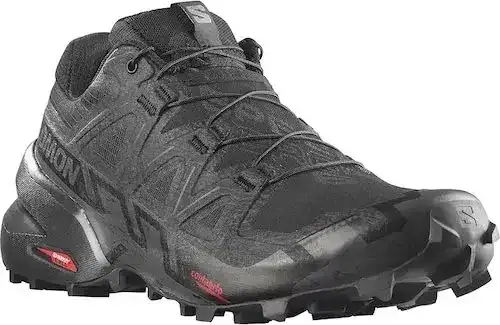
The Salomon Speedcross 6 remains current in 2026 and is the most specialized shoe in this guide. Its Mud Contagrip outsole uses deep 5 mm lugs designed to bite into loose, soft and uneven ground, making it a strong choice for wet forest trails, steep dirt, snow and sloppy race conditions.
Salomon’s SensiFit construction and Quicklace system create a close, secure hold, while anti-debris mesh, a protective toe cap and mudguard help keep trail grit away from the foot. The men’s shoe uses a 10 mm drop. A Gore-Tex version and a wide version are also sold separately for runners who need waterproofing or more room.
The trade-off is versatility. Those aggressive lugs feel less natural on pavement, hard-packed paths and long rocky stretches, and runners who prefer a broad toe box may find the standard fit snug. Buy the Speedcross 6 when mud traction is the priority; choose the Speedgoat 7 or Cascadia 20 if your routes mix rock, dirt and firmer surfaces.
Pros
- Excellent traction in mud and soft terrain
- Secure Quicklace fit
- Wide and Gore-Tex versions available
Cons
- Less comfortable on pavement and hard-packed surfaces
- Standard fit can feel snug through the forefoot
Altra Lone Peak 9
Best for: Zero-drop runners and a roomy toe-box fit
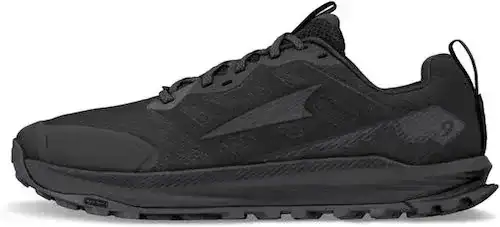
The Altra Lone Peak 9 stands apart because of its 0 mm heel-to-toe drop and Original FootShape fit. That geometry places the heel and forefoot at the same height and gives the toes substantially more room than a conventional tapered trail shoe. It is a strong option for runners who already prefer zero-drop footwear or who want a broad, natural-feeling forefoot.
The current Lone Peak 9 uses an Altra EGO midsole, a MaxTrac outsole and a StoneGuard layer for flexible protection from rocks and debris. Altra also sells related Lone Peak variants with additional outsole, waterproofing and width choices.
Zero drop is not automatically better for joints or alignment. Runners accustomed to a higher-drop shoe should transition gradually because the change can increase load on the calf and Achilles. If you already run comfortably in low- or zero-drop footwear, the Lone Peak 9 offers excellent toe room, flexibility and trail feel.
Pros
- Roomy toe box
- Flexible, natural-feeling platform
- Wide version available
Cons
- Zero drop requires a gradual transition for many runners
- Less cushioned than the Speedgoat 7 or Hierro v9
New Balance Fresh Foam X Hierro v9
Best for: Plush cushioning and wide-width options
The New Balance Fresh Foam X Hierro v9 is the comfort-first option in this guide. Its dual-density Fresh Foam X midsole uses a softer top layer over a firmer lower layer, giving the shoe a plush feel without leaving the foot unsupported on uneven ground. The men’s model uses a 4 mm drop, making it a good match for long trail outings, hiking and runners who want more cushioning than the Lone Peak 9 provides.
Traction comes from a Vibram Megagrip outsole with deep trail lugs. The upper combines breathable mesh, a gusseted tongue and Toe Protect reinforcement to help keep debris out and protect high-wear areas. New Balance offers the men’s shoe in standard, wide and extra-wide widths, which is a major advantage for runners who struggle to fit conventional trail shoes.
The standard Hierro v9 is not a waterproof shoe, so do not choose it specifically for keeping water out. Its strength is cushioned comfort, traction and width choice. The high, soft platform can also feel less precise on very technical terrain than a lower, firmer shoe.
Pros
- Plush cushioning with a stable lower layer
- Excellent width range
- Strong Vibram trail traction
Cons
- Standard version is not waterproof
- High cushioning can reduce precision on technical ground
How to Choose Men’s Trail Running Shoes
The best trail running shoe is the one that matches your terrain, foot shape and running style. Start with the surface you encounter most often, then narrow the choice by cushioning, drop, fit and weather protection. A shoe built for deep mud can feel clumsy on hard-packed paths, while a highly cushioned shoe may feel less precise when the trail becomes steep and technical.
Match Lug Depth to the Terrain
Deep, widely spaced lugs work best in mud and soft ground because they can bite into the surface and shed debris. The Speedcross 6 is the clearest example here. For mixed terrain, outsole compound and lug shape matter as much as depth: the Speedgoat 7 and Cascadia 20 use Vibram Megagrip for confidence on rock, dirt and wet surfaces.
Choose Cushioning for Distance and Ground Feel
More cushioning can reduce how sharp rocks and repeated impacts feel over long distances, but a taller, softer platform can also reduce ground feel. The Hierro v9 and Speedgoat 7 lean toward comfort and protection, while the Lone Peak 9 keeps the foot closer to the trail. There is no universal amount of cushioning that prevents injury, so use comfort, stability and your normal training history as the deciding factors.
Pay Attention to Toe Room, Width and Drop
Your toes should have room to spread and should not hit the front of the shoe on descents. The Hierro v9 offers standard, wide and extra-wide versions, while the Cascadia 20 and Speedgoat 7 offer wide options. The Lone Peak 9 has Altra’s roomiest FootShape geometry. Runners moving to its 0 mm platform from a conventional higher-drop shoe should transition gradually.
Waterproofing Is a Trade-Off
A waterproof membrane can help in cold rain, snow and prolonged wet conditions, but it usually reduces ventilation and can hold water if it enters over the collar. The standard shoes in this guide should not be assumed to be waterproof. Separate waterproof variants are available for several models. For warm weather and stream crossings, a breathable shoe that drains and dries quickly can be the better choice.
A Trail Shoe Should Feel Good Before the First Long Run
Do not buy a trail shoe that feels painful or badly fitted and assume it will break in. Minor upper stiffness may soften with use, but the basic length, width and shape will not change enough to rescue the wrong size. Try shoes with the socks you actually run in, check heel hold on an incline if possible and leave enough toe room for downhill running and normal foot swelling.
Which Men’s Trail Running Shoe Should You Buy?
Choose the Hoka Speedgoat 7 if you want the broadest mix of traction, cushioning and technical-trail versatility. Pick the Brooks Cascadia 20 for a more stable, protective platform; the Salomon Speedcross 6 for deep mud and soft ground; the Altra Lone Peak 9 for zero-drop geometry and a roomy toe box; or the New Balance Fresh Foam X Hierro v9 for plush cushioning and the widest range of width options.
FAQ About Men’s Trail Running Shoes
For a versatile all-around option, the Hoka Speedgoat 7 is our top pick. The Brooks Cascadia 20 is better for runners who want a stable, protective platform, while the Salomon Speedcross 6 excels in mud. The Altra Lone Peak 9 suits zero-drop runners, and the New Balance Fresh Foam X Hierro v9 is the most accommodating choice for plush cushioning and wider feet.
Trail running shoes should hold the heel and midfoot securely while leaving enough room for the toes to spread and for the foot to swell on longer runs. Your toes should not hit the front of the shoe when running downhill.
Most standard trail running shoes are not waterproof. Waterproof versions usually add a Gore-Tex or similar membrane. Several shoes in this guide are available in separate waterproof variants.
There is no single ideal lug depth. Around 4 to 5 mm works well for many mixed trails, while deep, widely spaced lugs are better for mud and soft ground. Outsole rubber and lug shape also matter.
Yes, occasionally, but aggressive trail outsoles can feel stiff or awkward on pavement and may wear faster. For regular road-to-trail use, choose a moderate-lug shoe rather than a mud-specific model.
Not universally. Zero-drop shoes such as the Altra Lone Peak 9 can suit runners who already use that geometry, but switching suddenly from a higher-drop shoe can increase stress on the calves and Achilles. Transition gradually if zero drop is new to you.
Do not rely on mileage alone. Replace trail shoes when the outsole lugs are badly worn, traction has noticeably declined, the midsole feels compressed or uneven, the upper no longer holds the foot securely, or the shoe has become consistently uncomfortable.