Last Updated on October 16, 2026
Outstanding warmth and waterproofing in a heavy, clumsy boot
Quick Answer: Sorel Caribou Winter Boot Review: The Caribou is a heavy-duty winter boot for deep snow, slush and genuinely cold weather. A vulcanized waterproof rubber shell keeps water out completely, a removable 9 mm felt inner boot supplies the warmth and can be pulled out to dry, and a 10-inch shaft with a snow cuff keeps snow from getting in. It is the reference point for cold-weather footwear. The drawbacks are considerable weight, a clumsy feel and poor grip on ice without added traction. Check latest price.
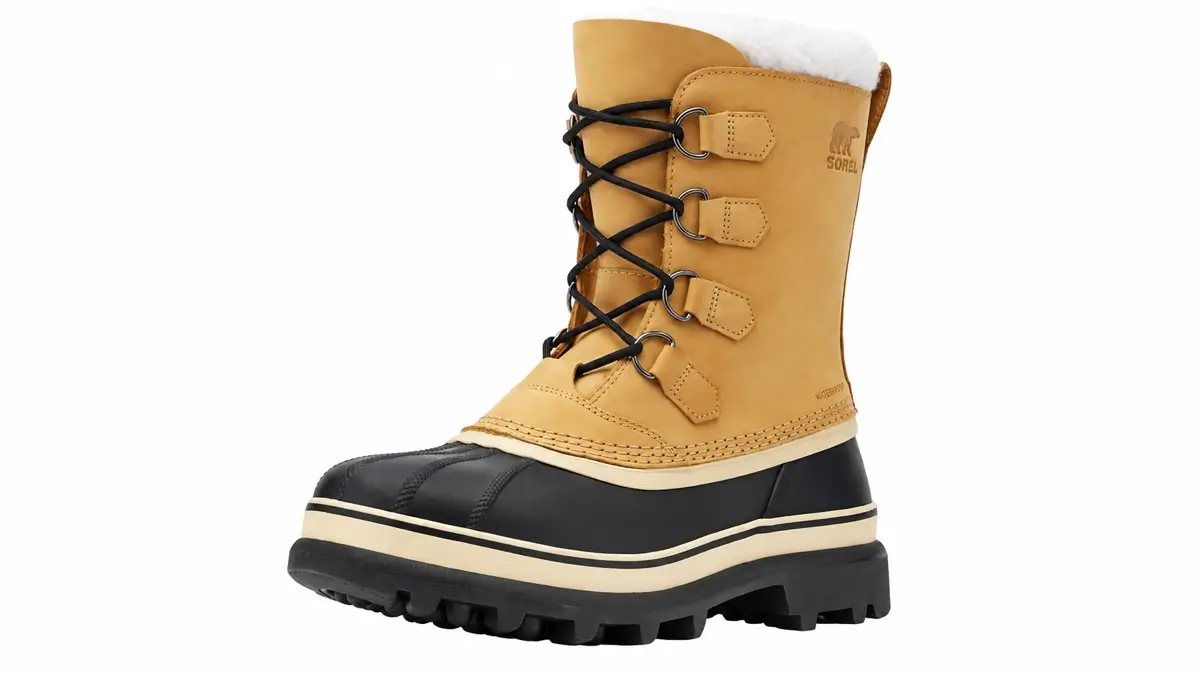
The Sorel Caribou has been in production for decades and has barely changed, which in footwear is unusual. It is built around a simple idea that modern insulated boots have mostly abandoned: instead of building insulation into the boot, put a waterproof rubber shell on the outside and a thick removable felt liner on the inside.
That construction has two practical advantages. The vulcanized rubber shell, meaning the rubber is bonded under heat into a single sealed piece rather than stitched, does not leak, ever. And the 9 mm felt inner boot can be pulled out at the end of the day and dried separately, which matters enormously because a boot that gets damp inside and cannot dry is a cold boot the next morning.
Above the rubber sits a waterproof nubuck leather upper with a seam-sealed construction, a 10-inch shaft and a Sherpa pile snow cuff at the top. Sorel rates the boot to minus 40 degrees Fahrenheit, though it is worth knowing that boot temperature ratings are not produced by any standardized test and should be treated as marketing guidance rather than measurement.
Specs
Here are the specifications for the Sorel Caribou:
| Type | Heavy-duty waterproof winter boot |
| Best for | Deep snow, slush, extreme cold, snow clearing, standing outdoors in winter |
| Shell | Handcrafted waterproof vulcanized rubber |
| Upper | Waterproof nubuck leather with seam-sealed construction |
| Liner | Removable 9 mm washable recycled felt inner boot with a Sherpa pile snow cuff |
| Temperature rating | Rated by Sorel to minus 40 degrees Fahrenheit; no standardized test exists, so treat this as approximate |
| Shaft height | About 10 inches |
| Weight | About 2 lb 4 oz to 2 lb 8 oz per boot in men’s size 9; sources differ, so treat as approximate |
| Outsole | Sorel Aero-Trac non-loading rubber |
| Price | A long-running model with no single launch date; retailer list prices commonly run about $225 to $250, approximate. Check latest price |
Pros
These are the reasons it has lasted this long unchanged:
- The vulcanized rubber shell is genuinely waterproof, with no seams to leak
- The felt liner pulls out to dry, so the boot is warm again the next morning
- Replacement liners are available, which effectively resets the boot’s warmth years later
- A 10-inch shaft and snow cuff keep deep snow out where a low boot fills immediately
- Very warm, and the liner can be swapped for a thicker aftermarket one in extreme cold
- Built to survive salt, slush and years of winters
Cons
These are the realities of a shell-and-liner boot:
- Very heavy at well over two pounds per boot, which makes walking tiring
- Clumsy and stiff, since the rubber shell does not flex with the foot
- The outsole is designed for snow rather than ice, so it slips on wet ice without added traction
- Far too warm for anything above freezing, so it is a specialist winter boot only
- Expensive at roughly $225 to $250
What has changed, and how the versions differ
The Caribou is not updated on a seasonal cycle. Sorel has kept the shell, the liner and the silhouette essentially intact for decades, and the changes that have happened are material rather than structural. The felt liner now uses recycled content, and the leather and finishes have been updated over time, but a pair bought today works the same way as a pair bought twenty years ago.
What does vary is the family around it. Sorel builds a Caribou WP, a Caribou Horizon with a Gore-Tex membrane and a more modern silhouette, and various lighter Caribou-branded models aimed at city winter rather than deep snow. Those share a name but not the shell-and-liner construction that defines the original, so check what you are buying.
The most useful thing to know is that the liner is a consumable. Felt compresses over years of use and loses some of its insulating value, and replacement liners are sold separately. Fitting a new liner to an old shell is far cheaper than buying a new boot, and it is the single best thing you can do to extend the life of a pair.
Who should buy the Sorel Caribou
Buy the Caribou if you deal with real winter. Deep snow, slush, sub-freezing days spent outdoors, clearing driveways, walking dogs in a snowstorm, working outside in the cold: these are the conditions it was built for and where nothing lighter comes close.
It is particularly good for standing rather than walking. If your winter involves waiting at bus stops, watching children’s sports, ice fishing or working outdoors in one place, the combination of a thick felt liner and a sealed rubber shell keeps feet warm far longer than an insulated hiking boot.
Finally, buy it if you want something repairable. The shell lasts decades, the liner is replaceable and the whole design is deliberately simple. In a market full of boots that are finished when their built-in insulation packs down, that is genuinely unusual.
Who should avoid the Sorel Caribou
Avoid it if you walk any distance. At well over two pounds per boot, with a rubber shell that does not flex, the Caribou is exhausting over a few miles. Winter hikers should buy an insulated hiking boot instead, which will be lighter, more flexible and far more comfortable to move in.
Avoid it for mild winters. This boot is built for serious cold, and above freezing it becomes a sweaty, oversized burden. Anyone whose winter is wet rather than frozen would be better served by a lighter waterproof boot or shoe.
The most important warning is about ice. The Aero-Trac outsole is designed to grip snow and shed it rather than to hold on wet ice, and no rubber compound grips ice reliably. Anyone regularly on icy sidewalks should add slip-on traction devices, and older adults in particular should treat ice grip as a separate problem this boot does not solve.
How does the Sorel Caribou fit?
Here is how the fit and comfort rate on this boot.
Fit and sizing
The Caribou is generally sized to be worn with thick socks, and buyers who wear thin socks often find it roomy. Many people order their usual size and use a heavy wool sock, which is what the boot was designed around. Trying it with the socks you actually wear in winter is the only reliable approach.
Because the liner is removable, fit can be adjusted more than in a conventional boot. A compressed old liner leaves the boot loose, and a new or thicker aftermarket liner tightens it considerably. That flexibility is part of why the boot suits such a wide range of feet.
Liner, shell and warmth
The 9 mm felt inner boot is the warmth. Felt traps a great deal of air and stays reasonably insulating even when slightly damp, which is why it has remained the material of choice for cold-weather liners despite decades of synthetic alternatives. The Sherpa pile snow cuff seals around the calf so snow does not fall in from above.
The rubber shell handles everything below. Vulcanized rubber has no stitching, so there is nothing to leak, and it does not care about salt, slush or standing water. The trade is that rubber does not breathe at all, so feet will sweat, which is precisely why being able to remove and dry the liner overnight matters so much.
How does the Sorel Caribou perform?
Here is how the boot performs.
Warmth and cold-weather performance
Sorel rates the Caribou to minus 40 degrees Fahrenheit. There is no standardized industry test behind boot temperature ratings, so that figure should be read as a claim rather than a measurement, and real-world warmth depends heavily on activity level, sock choice and how dry the liner is. What can be said plainly is that the Caribou is among the warmest mainstream winter boots available, and that most people will find it more than sufficient for typical North American winters.
The practical advantage is recovery. A boot with built-in insulation that gets damp inside stays damp, and a damp boot is a cold boot. Pulling the felt liner out to dry by a radiator overnight resets it completely, which is why this design still wins for multi-day cold exposure.
Stability and comfort underfoot
The Caribou is stiff and stable rather than cushioned. The rubber shell forms a rigid base, the felt liner provides some padding underfoot and the wide sole gives a broad platform in snow. On soft snow that stiffness is helpful, because it stops the foot rolling as the surface gives way.
On hard ground it is much less pleasant. There is no meaningful cushioning system, so pavement is felt directly, and the sole does not flex with the foot. There are no support features, and anyone with persistent foot or ankle pain should seek a professional assessment rather than expect a winter boot to help.
Outsole, grip and durability
Sorel’s Aero-Trac outsole is described as non-loading, meaning the lug pattern is designed to shed snow instead of packing it into a smooth base. On snow that works well and the boot bites confidently. On wet ice it does not, and it is important to be clear that this is a limitation of rubber generally rather than of this boot specifically. Slip-on traction devices are the answer where ice is common.
Durability is exceptional. Vulcanized rubber shells routinely last decades, salt does not attack them and the leather upper survives repeated wetting. The liner is the wear item, and replacing it is far cheaper than replacing the boot. Mileage guidelines are meaningless here; this is footwear measured in winters.
Is the Sorel Caribou good for walking?
For short winter walks in snow, yes, and it is far better than a regular boot at that job. The 10-inch shaft and snow cuff stop snow entering, the sealed rubber shell means slush and puddles are irrelevant, and the felt liner keeps feet warm while you are moving slowly or standing still. Around a neighborhood, a driveway or a snowy yard it is exactly right.
For longer walks it is poor. Over two pounds per boot means lifting more than four pounds with each pair of steps, the rubber shell will not flex so the foot cannot roll through the stride, and there is no cushioning against hard ground. On ice the grip is a genuine safety limitation and traction devices should be added. Treat it as a boot for surviving winter rather than for walking in it, and use a cushioned winter walking shoe for distance.
Caribou vs. an insulated hiking boot
These are the two ways to approach winter, and they suit different people:
| Sorel Caribou | Insulated hiking boot | |
| Warmth | Much warmer, thick removable felt liner | Moderate, built-in insulation |
| Drying | Liner pulls out to dry overnight | Cannot be dried out properly |
| Weight | Very heavy | Much lighter |
| Walking comfort | Stiff and clumsy | Flexes with the foot |
| Deep snow | 10-inch shaft keeps snow out | Fills over the collar |
Buy the Caribou if you stand around in deep snow and severe cold. Buy an insulated hiking boot if you walk or hike in winter and warmth matters less than being able to move comfortably.
Sorel Caribou Alternatives
Anyone who wants Caribou-level warmth in something they can actually walk in should look at a modern insulated hiking boot rather than another shell boot. The Merrell Thermo range is built for exactly that compromise, trading some warmth for far better flexibility and a fraction of the weight (check price).
For hiking in cold conditions rather than standing in them, a waterproof hiking shoe with warm socks is often the better system. The Keen Targhee IV is waterproof, durable and roomy enough to take a thick sock, and it walks far better than any winter boot (check price).
Where winter means wet and slushy rather than frozen, the Merrell Moab 3 waterproof is enough boot for most people and costs considerably less. It handles rain, puddles and cold rain without the bulk of a snow boot (check price).
For workers who need warmth plus a safety toe rather than snow-boot bulk, an insulated work boot such as the Timberland PRO Boondock covers both, since it is offered with 400 g of insulation and a composite toe (check price).
Price and value
Retailer list prices for the Caribou commonly run about $225 to $250, which is a lot for a boot you may only wear a few months a year. The value case is unusual though, because this is one of very few pieces of footwear that can genuinely last decades. The vulcanized shell does not degrade, the leather survives repeated wetting and salt, and the one part that does wear, the felt liner, can be replaced for a small fraction of the boot’s price. Amortized over fifteen or twenty winters, it is inexpensive. Judged as a purchase for one season, it is not.
Final verdict
Best for: deep snow, severe cold, slush, snow clearing and standing outdoors in winter.
Avoid if: you walk long distances, your winters are mild or wet rather than frozen, or you need reliable grip on ice without adding traction devices.
Fit: designed around thick socks, so it feels roomy with thin ones; fit can be adjusted by replacing the removable felt liner.
Verdict: The Caribou is still the reference point for cold-weather footwear because the shell-and-liner design solves a problem built-in insulation cannot. It is heavy and clumsy, and if your winter is severe enough you will not care. You can check size availability before ordering.
Frequently Asked Questions for Sorel Caribou
The boot is designed around a thick wool sock, so most people order their usual size and wear heavy socks. If you wear thin socks it will feel roomy. Because the liner is removable, fit can also be adjusted later by fitting a new or thicker liner.
Treat it as guidance rather than measurement. There is no standardized industry test for boot temperature ratings, and real warmth depends on how active you are, what socks you wear and whether the liner is dry. The Caribou is genuinely among the warmest mainstream winter boots, but the number itself is not a tested figure.
Yes, and it is the best way to extend the boot’s life. Felt compresses over years and loses insulating value, and replacement liners cost a small fraction of a new pair. Fitting a fresh liner to an old shell effectively restores the warmth.
No, and this is its most important limitation. The Aero-Trac outsole is designed to grip and shed snow, not to hold on ice, and no rubber compound grips wet ice reliably. If you regularly walk on icy sidewalks, add slip-on traction devices.
Feet sweat inside a rubber shell because rubber does not breathe. A boot with built-in insulation stays damp once that happens, and a damp boot is a cold boot. Pulling the felt liner out to dry overnight resets the boot completely, which is the whole advantage of this design.
Short distances in snow, yes. Real hiking, no. At over two pounds per boot with a rigid rubber shell that will not flex, it is exhausting over distance. An insulated hiking boot is the right choice for covering ground in winter.