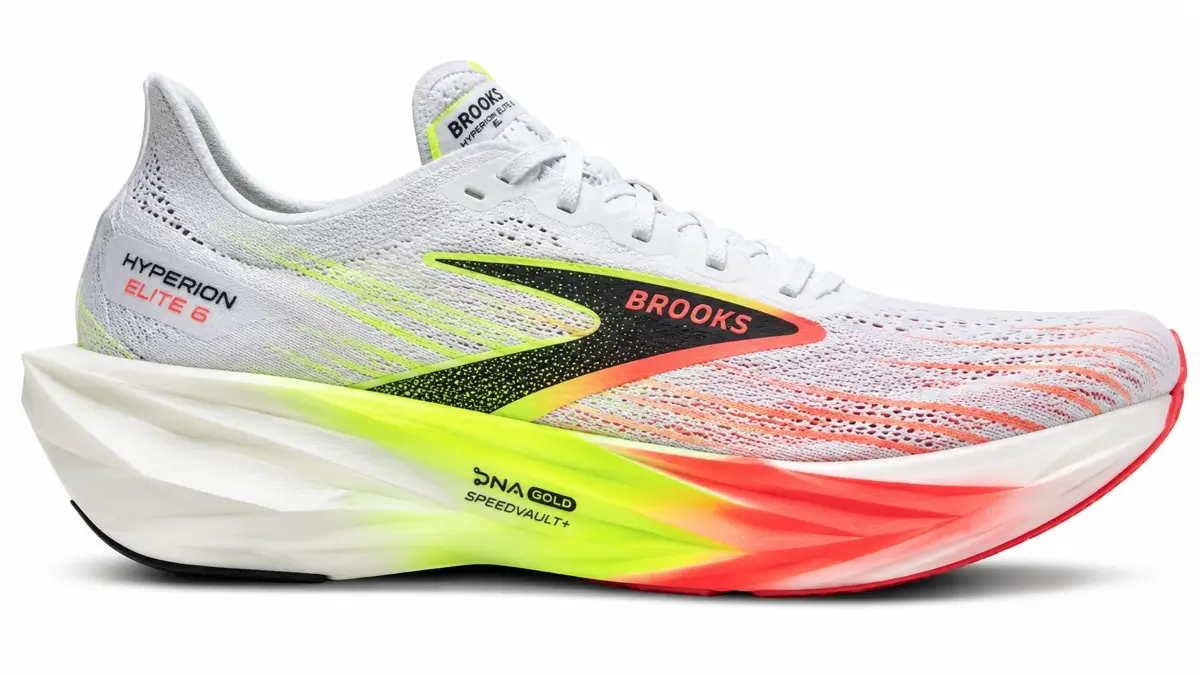
A genuinely front-rank marathon racer at a genuinely painful price
Quick Answer: Brooks Hyperion Elite 6 Review: The Hyperion Elite 6 is Brooks’ carbon-plated marathon racing shoe, and it is the first one in the line we would happily race in. A reworked DNA Gold foam and a much more aggressive carbon plate give it a rolling, springy feel that keeps working late in a long race, and a wider midfoot makes it steadier than the version before it when your form starts to slip. It is very expensive and the fit runs snug, so try before you commit. Check latest price.
The Brooks Hyperion Elite 6 is a road racing shoe designed for one thing: going as fast as you can over a long distance. It is what runners call a super shoe, which means a very tall stack of springy foam with a stiff carbon fiber plate buried inside it. Stack simply means how much foam sits between your foot and the road, and the plate is a curved sheet that stops the shoe bending so it rolls you forward instead.
In the Brooks range this is the top of the pyramid. The Hyperion 3 is the light, low, plateless option for shorter and faster work, the Hyperion Max is the plated shoe for workouts and longer efforts, and the Elite is the one reserved for race day. It launched on Aug. 1, 2026 at $274.95 after being unveiled at London Marathon weekend in the spring.
The interesting part of this release is who it is for. Earlier Hyperion Elites felt like shoes for fast, light, efficient runners, and everyone else was carrying a stiff board around. This one is broader in its appeal, and that is the main reason we think it is worth your attention.
Specs
Here are the specifications for the Brooks Hyperion Elite 6:
| Category | Road racing shoe, carbon-plated |
| Best for | Half marathon and marathon race days, and hard race-pace sessions |
| Support type | Neutral, meaning it has no built-in features aimed at controlling how much your foot rolls inward |
| Midsole foam | DNA Gold, reformulated in more than one density for this version |
| Plate | SpeedVault+ carbon fiber plate, set further back at the heel and curved harder under the toes |
| Stack height | 40 mm at the heel, 33 mm at the forefoot, which is the ceiling allowed for World Athletics road racing |
| Heel-to-toe drop | 7 mm, so your heel sits slightly higher than your toes, a middle-of-the-road figure most runners adapt to easily |
| Weight, men’s | 6.97 oz, 198 g, in a size 9 |
| Weight, women’s | 6.07 oz, 172 g, in a size 8 |
| Midfoot platform width | About 60 mm, up from about 55 mm on the previous version |
| Upper | Thin engineered mesh with minimal padding, noted by independent reviewers as unusually comfortable for a racer |
| Outsole | Small rubber pads at the high-wear points, with exposed foam elsewhere |
| Widths | Standard only |
| Surface | Road and smooth pavement |
| Price | $274.95 at its Aug. 1, 2026 launch. Check latest price |
Pros
These are the reasons the Hyperion Elite 6 deserves a place on your shortlist:
- The reworked DNA Gold foam gives back more energy than the old formula did, so the shoe feels like it is helping rather than simply cushioning.
- The redesigned plate and stronger toe curve make each step finish quickly, which is the feeling runners describe as being rolled onto your toes.
- A 5 mm wider platform through the middle of the shoe makes it noticeably steadier once your stride gets sloppy late in a race.
- The upper is unusually pleasant for a shoe in this category, so you can get through a marathon without hot spots.
- Just under 7 oz in a men’s size 9 puts it among the lighter marathon racers, and weight matters more the longer you run.
Cons
These are the reasons to hesitate:
- At $274.95 it is one of the most expensive running shoes on sale, and the useful life of a racer is short.
- It comes in one width only, so runners with broad feet may struggle with the snug race last.
- The aggressive plate and curve want you moving quickly, and the shoe feels clumsy and stiff at easy speeds.
- There is very little rubber on the bottom, which keeps the weight down but means the tread smooths off sooner than on a training shoe.
- It does nothing useful for walking, standing or daily wear, so it cannot be the only pair in your closet.
What is new versus the Hyperion Elite 5
Brooks changed the two things that mattered. The first is the foam. DNA Gold was already the brand’s liveliest material, but for the Elite 6 it was reformulated and used in more than one density, which means firmer in some places and softer in others. The result is bouncier without being harsh, and independent reviewers have been consistent in saying the energy return took a real step up rather than a marketing step up.
The second is the plate. The new SpeedVault+ carbon plate starts further back under the heel and curves much harder towards the toes than the Elite 5’s did. Paired with a more pronounced curve in the sole itself, that gives a stronger sense of being tipped forward through the second half of each step. Forefoot pop, the sharp sensation as you leave the ground, is noticeably more definite than before.
Two smaller changes matter more than they sound. The midfoot platform grew from about 55 mm to about 60 mm, and you feel that as steadiness when fatigue arrives. And the forefoot gained a millimeter of foam, which brought the drop down from 8 mm to 7 mm. Weight came down slightly too, by roughly 7 g in a men’s 9. Taken together the Elite 6 is a better shoe than its predecessor in every area that decides a race.
Who should buy the Hyperion Elite 6
Buy it if you are a committed Brooks runner who has been eyeing other brands on race day. That describes a lot of people, because the earlier Hyperion Elites were never quite competitive, and this one is. You no longer have to leave the brand to get a proper marathon shoe.
It also suits the runner who wants an energetic race shoe without a punishing one. The foam is springy but not skittish, and the wider base keeps things predictable, so the Elite 6 does not demand perfect form in the way a very narrow, very soft racer does. Runners targeting anything from a fast half marathon to a marathon will get the most out of it.
Heel strikers should pay attention here too. Because the plate now reaches further back under the heel, the shoe starts working earlier in your step than it used to, so you do not have to land on your midfoot to feel the benefit.
And buy it if you value a comfortable upper. Plenty of racing shoes are miserable to wear for two hours or more. This one is not, and over a marathon that is worth as much as any foam.
Who should probably skip it
Skip it if you are looking for one shoe to cover everything you do. The sparse outsole and the specialized ride make it a bad daily trainer, and nearly $275 buys a lot of shoe elsewhere. Skip it too if your feet are wide, because there is no wide option and the race last is cut close.
It is also the wrong shoe if your racing tops out at a 5K. Over that distance the tall foam is weight you are lugging rather than help you are receiving, and a lower, leaner shoe will feel faster. Runners who need real support to keep their feet steady should look at a stability trainer instead, since there is nothing in this shoe doing that job.
If that is you, these three make more sense:
- Brooks Hyperion 3: a light, low, plateless Brooks shoe for 5K and 10K racing and short fast sessions, at a fraction of the price (check price | read review)
- Adidas Adizero Boston 13: a firm, fast shoe you can actually train in every week, so the money buys miles rather than just races (check price | read review)
- Brooks Ghost 18: the sensible cushioned Brooks trainer for anyone who reads all this and decides they just want a comfortable shoe to run in (check price | read review)
How does the Brooks Hyperion Elite 6 fit?
It fits like a racing shoe should, which means close to the foot with very little slack, but the materials are kinder than most. The wider midfoot changes the feel from the last version, and the standard width will work for most people with average or narrow feet. There is no wide option, and that is the one fit question worth settling in a store.
Fit and sizing
Take your usual running size. The length is accurate and the toe box has enough height that your toes are not pressed down, though it is not generous side to side. The wider platform underneath does not translate into a wider upper, so a broad forefoot will still feel contained. If you are between sizes, go up rather than down, because a racing shoe that pinches at mile 20 ruins the day.
Upper and step-in comfort
This is the pleasant surprise. Racing uppers are usually a thin screen stretched over your foot, and comfort is an afterthought. Brooks got this one right, with a soft mesh that holds without digging in and just enough structure around the heel to stop your foot lifting. Independent reviewers have singled it out, and it is the reason the Elite 6 is easier to spend two or three hours in than most of its rivals. Padding is still minimal, so it is a firm step-in, not a plush one.
How does the Brooks Hyperion Elite 6 perform?
The short version is that it behaves like a proper race shoe now. It wants speed, it gives energy back, and it stays composed as you tire. The sections below break down what it feels like underfoot, how steady it is and how much wear the bottom will take.
Cushioning and ride
There is 40 mm of DNA Gold under the heel, and it is firmer and springier than the Elite 5’s version rather than softer. That combination is deliberate. A soft racer feels lovely for ten minutes and then swallows your energy, while a firm and bouncy one keeps returning force to you mile after mile. Landings are protected without feeling vague, and the foam does not flatten out the way cheaper materials do late in a long effort.
Using more than one density lets Brooks put softer material where you land and firmer material where you push, which is why the shoe manages to feel forgiving and purposeful at the same time.
Ride and running performance
Forward motion here comes from the plate and the curved sole rather than from the foam alone. Because the carbon now starts further back and curves harder at the front, the shoe picks you up early in the step and tips you off the toes quickly. It is a strong, rolling sensation, and it is more assertive than the previous version.
The useful range is broad for a racer. It makes sense from a hard half marathon effort through to a marathon, and it handles long tempo work well. At jogging pace it feels stiff and tall, because nothing is compressing the foam or engaging the plate, so judge it on a fast session rather than a warm-up.
Stability and support
This is a neutral shoe. There is no firmer wedge along the inside edge, no raised walls and nothing that guides your foot, so any steadiness comes purely from the shape of the base. That is where the 5 mm of extra midfoot width earns its keep: the platform is less of a tightrope than the Elite 5’s, and the difference shows up exactly when it matters, in the closing miles when your form frays.
It is still a 40 mm stack of race foam, though, and that is inherently tippy. If your ankles feel unsteady in tall shoes, or your feet roll inward a long way, this will not hold you. No shoe of this type corrects how you run, and we would not recommend one as a remedy for a foot problem. Persistent or worsening pain is worth taking to a physical therapist or podiatrist.
Outsole, grip and durability
Rubber is applied in small pads at the spots that take the most wear, with foam left bare in between. Grip on dry road is reliable and it is acceptable in light rain, which is all a road racer needs. Cornering on wet paint or metal covers calls for the same care any race shoe demands.
Durability is the usual racing compromise. The common 300 to 500 mile guideline is only a broad rule of thumb, and a shoe built this light will not reach the top of that range. Keep these for races and key workouts, run your easy miles in something else, and they will last through several race cycles.
Is the Brooks Hyperion Elite 6 good for walking?
No. Walking never generates enough force to compress race foam or activate a carbon plate, so all you experience is the awkward half of the design: a tall, stiff sole that refuses to bend as your foot rolls through a step, sitting on a narrow base that feels unsteady on hard floors.
For standing all day it is worse still, because the plate transmits pressure rather than absorbing it and the sparse padding gives your foot nothing to rest on. It is a poor travel shoe too: the thin mesh offers no protection, and every mile of sightseeing wears down an outsole you are saving for race day. It will not take a custom insole either, since the low-volume race fit leaves no spare depth. For walking, standing or all-day comfort, buy a cushioned daily trainer or a purpose-built walking shoe instead.
Hyperion Elite 6 versus Hyperion Elite 5
Hyperion Elite 6 | Hyperion Elite 5 | |
Midsole foam | Reformulated DNA Gold, multiple densities | Earlier DNA Gold, single formulation |
Plate | SpeedVault+, set further back, curved harder under the toes | SpeedVault, less aggressive geometry |
Stack and drop | 40 mm / 33 mm, 7 mm | 40 mm / 32 mm, 8 mm |
Midfoot width | About 60 mm | About 55 mm |
Weight, men’s size 9 | About 6.97 oz | About 7.2 oz |
Feel | Bouncier, more strongly rockered, steadier when tired | Flatter, less energetic, narrower underfoot |
Buy the Elite 6 if you are choosing between them at full price. It is better in every way that decides a race result, and the wider base alone makes it the safer choice for a long event.
Buy the Elite 5 if you find it heavily discounted and you prefer a calmer, flatter ride. Some runners genuinely dislike a strong rocker, and the older shoe asks less of your calves for that reason. It is also the cheaper way into the line if you are curious about plated shoes but not ready to spend $275.
Brooks Hyperion Elite 6 Alternatives
The closest comparison for most buyers is the New Balance FuelCell SuperComp Elite v6. It costs about the same and is softer underfoot than the firm and bouncy Brooks, so it suits runners who want landings cushioned more than they want the shoe snapping them forward. It is also sold in a wide, which settles the question for anyone the Brooks last does not fit.
Shorter races point somewhere else. The Nike Vaporfly 4 is lower and lighter, which makes it feel quicker over 5K and 10K where the Brooks is carrying foam you cannot use. Our Vaporfly 4 review sets out where that lower stack helps and where it costs you.
Runners who want the lightest possible shoe should weigh the Asics Metaspeed Sky Tokyo, which undercuts the Elite 6 on the scales and is built for a runner who lengthens their stride at speed rather than quickening it. It is firmer again than the Brooks, so this is a choice about feel as much as grams. The Metaspeed Sky Tokyo review explains that stride distinction.
Finally, the Saucony Endorphin Pro 5 is the gentler marathon racer of the group. Its slotted plate produces a smoother, less insistent roll, which is the right answer if the Brooks rocker feels like too much shoe telling you what to do. See the Endorphin Pro 5 review for how that plays out over a marathon.
Price and value
$274.95 is at the top of the market, and Brooks has priced this as a statement that the shoe belongs there. What the money buys is real: a foam that returns more energy than the old one, a plate that does more work, a steadier platform and an upper you can wear for hours without thinking about it.
Whether that is good value depends entirely on how you use it. Ration these to races and a few key sessions and the cost spreads across two or three race cycles, which is defensible for a shoe that genuinely helps you run faster. Wear them for everyday mileage and the thin outsole will turn $275 into a very expensive few months. There is no discount for being a loyal Brooks customer here, so judge it against the other racers at this price rather than against the rest of the Brooks range.
Final verdict
Best for: half marathon and marathon racing, Brooks loyalists who have been racing in other brands, and heel strikers who want a plate that engages early.
Avoid if: you have wide feet, you want one shoe for everything, your races are 5K, or you need genuine support features.
Fit: true to size, snug race cut, comfortable upper, standard width only.
Verdict: After five versions of polite, unremarkable race shoes, Brooks has built one that can stand next to the best in the category. The foam and the plate are both doing real work, the wider base makes it dependable when you are hurting, and the upper is better than anything else at this price. We rate it as the first Hyperion Elite worth choosing on merit rather than brand loyalty, provided the narrow fit suits you and you keep it for race day.
Check the latest price on the Brooks Hyperion Elite 6.
Frequently Asked Questions for Brooks Hyperion Elite 6
Yes. Its 40 mm heel stack matches the maximum height allowed for road racing and it uses a single plate, so it complies with the current rules for road events.
Most runners who keep it for races and a few key sessions will get two or three race cycles from a pair. Using it for everyday mileage will wear the thin outsole down much sooner.
No. Brooks sells it in the standard width only, so runners who normally need a 2E should try a pair on before buying or look at a racer that offers a wide option.
It is well suited to longer intervals at race pace. For short, sharp repetitions the height and stiffness get in the way, and a lighter, lower shoe will feel more responsive.
A strong rocker and a stiff plate do shift load towards the calves and Achilles, so introduce the shoe gradually over a few faster sessions rather than debuting it on race day.
DNA Gold is the name Brooks gives its highest-performance midsole foam. For this version it was reformulated in several densities, which makes it firmer and springier than the previous mix without feeling harsh.