Last Updated on October 22, 2026
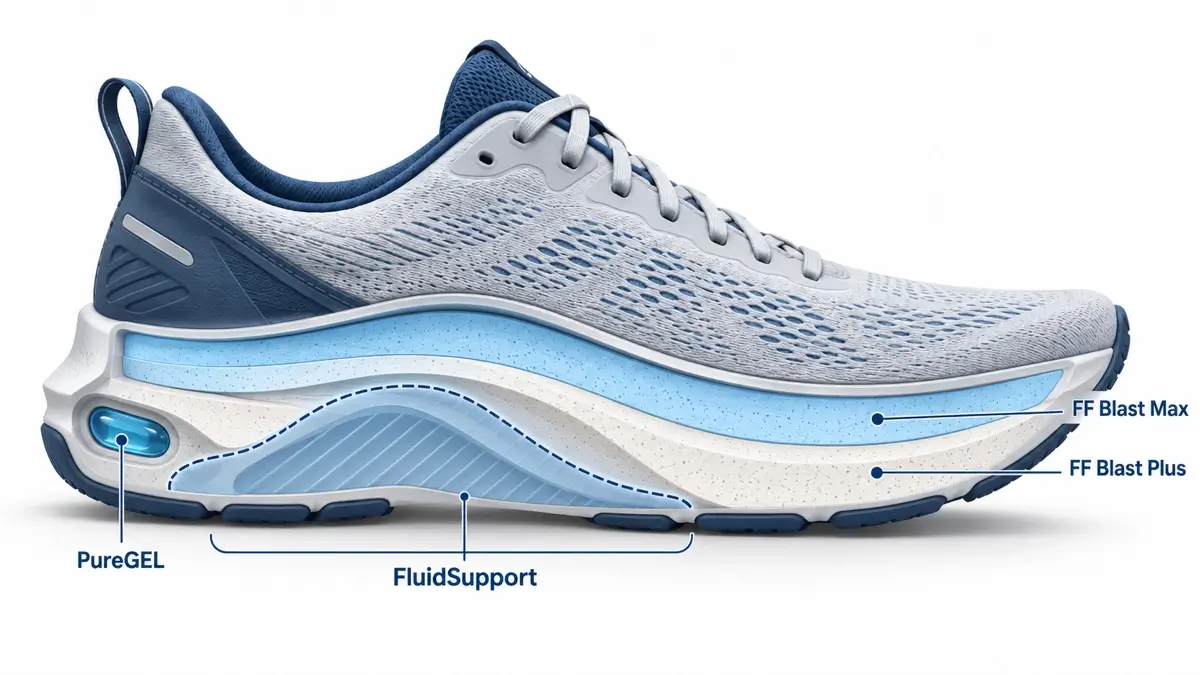
| Quick Answer: What is Asics FluidSupport? Asics FluidSupport is a stability system introduced in the Gel-Kayano 33 in 2026. It is not a type of midsole foam. Instead, FluidSupport combines two cushioning layers with specially designed midsole geometry to provide support as your foot moves from landing through toe-off. The softer FF Blast Max foam sits above a firmer layer of FF Blast Plus cushioning. FluidSupport replaces Asics’ previous 4D Guidance System and is designed to provide stability without relying on a traditional firm medial post. |
Running shoe companies are changing how they build stability shoes. Older designs often relied on a firm piece of foam called a medial post along the inside edge of the shoe. That post was meant to reduce excessive inward movement of the foot. Newer systems use foam geometry and platform design in different ways. For the broader technology context, see our Running Shoe Technology guide.
Newer stability shoes tend to be more subtle. Brands now use wider platforms, different foam densities, sidewalls and carefully shaped midsoles to guide the foot instead of trying to force it into one position.
Asics FluidSupport is part of that shift. The company introduced FluidSupport in the Gel-Kayano 33 (read review), released in the U.S. on June 1, 2026. The technology replaces the 4D Guidance System used in the previous Gel-Kayano 32 (read review). Asics describes the new system as combining dual-layer cushioning with advanced geometry to create smooth, adaptive stability.
The important point is that FluidSupport is not the cushioning material itself. It is the support system created partly by how those cushioning materials and the midsole are designed.
Is FluidSupport a Midsole Technology?
Yes, but there is an important distinction. FluidSupport is a midsole-based stability technology, not a midsole foam. That difference can get confusing because shoe companies often use the word “technology” for cushioning compounds, stability structures and other features.
In the Gel-Kayano 33, several different technologies work together:
| Technology | What it is | Main job |
|---|---|---|
| FluidSupport | Stability system | Guides and stabilizes the foot |
| FF Blast Max | Midsole cushioning foam | Softer cushioning and energy return |
| FF Blast Plus | Midsole cushioning foam | Cushioning with a firmer, more stable base |
| PureGEL | Heel cushioning technology | Helps absorb impact |
| 4D Guidance System | Previous stability system | Provided adaptive guidance in earlier Kayano models |
Asics says the Gel-Kayano 33 uses FF Blast Max as the upper cushioning layer, while FF Blast Plus sits underneath and adds stability. FluidSupport combines these cushioning layers with the shape and geometry of the midsole.
PureGEL is another separate technology. It is positioned under the heel to improve shock absorption and soften landings. It should not be described as part of the FluidSupport foam system itself.
A simple way to think about it is: FF Blast Max and FF Blast Plus are materials. FluidSupport is the support architecture built around them.
See more about FF Blast Max and releated Asics foam technologies.
How Does Asics FluidSupport Work?
FluidSupport is designed to provide different amounts of guidance as your foot moves through a step.
Asics says the technology responds to changing biomechanical needs during the stride while allowing the foot to move naturally. Instead of putting one hard support element under the arch, the system combines cushioning firmness and midsole shape to influence how the shoe behaves from heel strike to toe-off.
The first major part is the dual-layer midsole.
A softer layer of FF Blast Max sits closer to the foot. It provides cushioning and energy return. Below it is FF Blast Plus, which Asics describes as firmer and more supportive.
The second part is the geometry of the midsole.
Rather than relying entirely on a traditional medial post, the shape and construction of the platform help control how the foot moves across the shoe.
That approach provides support without making the shoe feel as if a hard piece of foam is pushing against the inside of your arch.
The result is what is sometimes called adaptive stability or guidance-based stability. The shoe is designed to support movement rather than simply block it.
FluidSupport vs. the 4D Guidance System
FluidSupport replaces the 4D Guidance System found in the Gel-Kayano 32.
That does not mean Asics abandoned the ideas behind 4D Guidance. The company says FluidSupport follows the same broader concept of providing stability that adapts as a runner’s movement changes, particularly as fatigue affects running form.
The two systems achieve that goal differently.
The 4D Guidance System used several elements working together. Asics described those as including a wider midsole shape, a supportive foam component around the arch, heel geometry and a larger outsole contact area.
FluidSupport simplifies and changes that construction by placing more emphasis on the relationship between its two cushioning layers and the overall midsole geometry.
| FluidSupport | 4D Guidance System | |
|---|---|---|
| Current model | Gel-Kayano 33 | Gel-Kayano 32 |
| Main concept | Dual-layer cushioning plus geometry | Multiple stability elements working together |
| Upper foam | FF Blast Max | FF Blast Plus |
| Lower/support layer | FF Blast Plus | 4D Guidance components and geometry |
| Stability style | Adaptive guidance | Adaptive guidance |
| Traditional medial post | No | No |
| Current Asics system | Yes | Replaced in Kayano 33 |
Both technologies represent a move away from the rigid medial posts traditionally associated with stability running shoes.
FluidSupport is best viewed as an evolution of Asics’ adaptive stability approach, rather than simply a new name for 4D Guidance.
Is FluidSupport the Same as Dual-Density Foam?
Not exactly. FluidSupport does use two different cushioning materials with different characteristics, so it shares some ideas with dual-density stability midsoles. But calling FluidSupport simply “dual-density foam” misses an important part of the design.
Asics specifically describes the technology as a combination of dual-layer cushioning and advanced geometry.
The shape of the shoe matters.
A modern stability shoe can become more supportive by using a broad platform, raised sidewalls, strategically shaped foam or different stiffness levels across the midsole. Shoe designers can therefore influence movement without inserting one obvious hard post under the arch.
This also explains why two shoes using similar cushioning compounds can feel very different.
The foam determines characteristics such as softness, resilience and compression. The midsole geometry determines how much of that foam is placed in different locations and how the foot interacts with it.
FluidSupport combines both ideas.
What Other Brands Have Technology Similar to FluidSupport?
Asics is not the only company moving toward stability systems that use foam construction and geometry rather than traditional medial posts.
The systems are not identical, but several major brands now take a similar approach.
| Brand | Stability technology | Basic approach |
|---|---|---|
| Asics | FluidSupport | Layered cushioning plus midsole geometry |
| Puma | RunGuide | Cushioned core, firmer rim and heel support |
| New Balance | Stability Plane | Support structure integrated with cushioned platform |
| Saucony | CenterPath | Platform geometry and guided transitions |
| Brooks | GuideRails | Firmer foam structures around the heel |
| Hoka | H-Frame | Firmer supporting structure integrated into the midsole |
These technologies all try to add stability while allowing the shoe to retain a relatively natural ride. The way each company does that is different.
Puma RunGuide
Puma’s RunGuide system may be one of the closest comparisons. The ForeverRun Nitro 3 (read more about Puma shoes) uses a dual-density Nitrofoam midsole with a cushioned core surrounded by a firmer rim. Puma says RunGuide combines that construction with heel support to guide running motion.
That makes the basic concept similar to FluidSupport: use different cushioning characteristics and the structure of the midsole to produce stability.
New Balance Stability Plane
New Balance makes the distinction between cushioning and stability particularly clear.
The Fresh Foam X 860v15 uses Fresh Foam X for cushioning and a separate Stability Plane system for support. New Balance says Stability Plane adds stability without compromising the cushioning of the underfoot platform. That is useful when comparing terminology.
Fresh Foam X is the cushioning technology. Stability Plane is the support technology. In the same way, FF Blast Max and FF Blast Plus are cushioning materials, while FluidSupport describes the stability system.
Saucony CenterPath
Saucony’s CenterPath Technology also relies heavily on geometry.
In the Hurricane 25, Saucony combines PWRRUN PB cushioning with a PWRRUN support frame and redesigned geometry. The company says CenterPath works with that geometry to help keep the runner aligned and provide smoother transitions.
The implementation differs from FluidSupport, but the philosophy is similar. Stability comes from the entire platform rather than one hard corrective component.
Brooks GuideRails
Brooks takes a somewhat different approach with its GuideRails Technology System.
GuideRails uses two firmer foam components positioned around the heel. The medial component helps control inward movement, while a raised lateral component limits excessive outward heel movement.
GuideRails is therefore more localized than FluidSupport, but it belongs in the same broad category of modern support technologies designed to guide motion without relying on an old-style medial post.
Hoka H-Frame
Hoka’s H-Frame is another midsole-based stability system.
The design uses a firmer H-shaped structure integrated into the midsole. Hoka describes it as cradling the foot and providing stability without overcorrecting the gait. It is used in shoes including the Arahi 8.
This makes H-Frame another useful comparison with FluidSupport because support is created by the way different parts of the midsole are arranged.
What Shoes Use Asics FluidSupport?
As of September 2026, the Asics Gel-Kayano 33 is the main shoe built around the new FluidSupport technology.
The Gel-Kayano 33 is a maximum-cushion stability running shoe with an 8 mm heel-to-toe drop. Asics lists the men’s version at about 10.5 ounces and the women’s version at about 9.1 ounces. Wide and extra-wide versions are also available in some men’s configurations, while women’s wide versions are available as well.
The U.S. launch price was $170. (Check current price.)
Because FluidSupport debuted in the Gel-Kayano 33, it is too early to assume that Asics will use the technology across every stability model. Other Asics stability shoes may continue to use different support designs.
For current availability, check the latest Asics Gel-Kayano 33 price on Amazon.
Is Asics FluidSupport Good for Walking?
FluidSupport can also make sense for walking, even though the Gel-Kayano 33 is primarily marketed as a running shoe.
Walkers who like stability shoes often benefit from the same basic design features runners do: a broad platform, controlled transitions, secure heel support and cushioning that does not feel unstable underfoot.
The Gel-Kayano has also long crossed over from running into walking because of its combination of cushioning and structured support.
FluidSupport may be particularly appealing to walkers who want support but dislike the sensation of a hard medial post pressing against the inside of the foot.
The Gel-Kayano 33 also has an 8 mm drop and maximum cushioning, which gives it a more traditional heel elevation than many lower-drop max-cushion shoes.
However, more support is not automatically better. A neutral walker who already feels comfortable and stable in neutral shoes does not necessarily need FluidSupport.
Fit and comfort should still come first.
See more in our guide about best walking shoes.
Is FluidSupport Good for Overpronation?
FluidSupport was designed for the type of runner who wants additional stability or guidance, including people who overpronate.
Overpronation means the foot rolls inward more as weight moves through it during walking or running. Some inward movement is normal. The issue is whether your movement pattern, comfort or shoe wear suggests you would benefit from additional support. (See our overpronation resource guide.)
Asics positions the Gel-Kayano 33 as a stability trainer and specifically discusses stability technology in connection with runners who overpronate.
FluidSupport does not attempt to lock the foot into a rigid position. Asics says it is intended to provide guidance during important phases of the gait cycle while still allowing natural foot movement.
That makes it part of the modern trend toward guidance rather than aggressive correction.
If you have ongoing foot, ankle, knee or lower-leg pain, however, choosing a stability shoe should not replace an assessment by a qualified health professional.
Frequently Asked Questions
Asics FluidSupport is a stability system that combines dual-layer midsole cushioning with specially designed geometry. It debuted in the Gel-Kayano 33 in 2026 and replaced the previous 4D Guidance System.
No. FluidSupport is not a foam compound. The Gel-Kayano 33 uses FF Blast Max and FF Blast Plus foams. FluidSupport describes how the cushioning and midsole structure work together to provide stability.
The Gel-Kayano 33 combines softer FF Blast Max cushioning on top with firmer FF Blast Plus cushioning underneath. The two layers are part of the FluidSupport design.
FF Blast Max is a cushioning foam. FluidSupport is a stability system. FF Blast Max contributes to the feel of the system, but the two names do not describe the same type of technology. More on the Asics foam technologies.
FluidSupport replaced the 4D Guidance System in the Gel-Kayano line when Asics introduced the Gel-Kayano 33 in 2026.
Both are stability technologies, but they work differently. Brooks GuideRails uses firmer foam components around the heel to limit excessive motion. FluidSupport uses dual-layer cushioning and midsole geometry to provide guidance through the stride.
Puma RunGuide, New Balance Stability Plane, Saucony CenterPath and Hoka H-Frame are useful comparisons. All use some combination of foam construction, structure or geometry to provide support without depending entirely on a traditional medial post.
Yes. The Gel-Kayano 33 can be used for walking as well as running. Its cushioning, broad platform and stability system may be useful for walkers who prefer additional guidance and support.