Last Updated on September 27, 2026
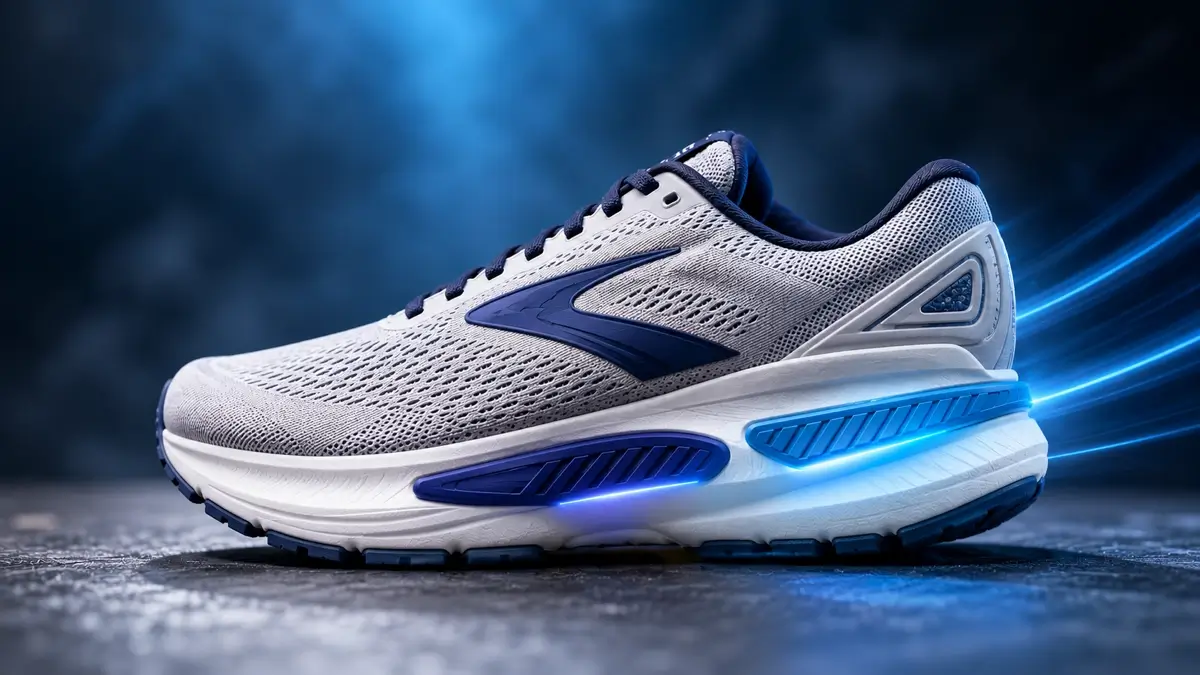
| Quick Answer: Brooks GuideRails. This shoe support technology is a stability system designed to limit excessive movement without forcing every runner or walker into the same foot position. Two firmer foam structures around the heel act somewhat like bumpers, becoming more noticeable when the foot and lower leg move beyond their preferred path. Brooks uses GuideRails in GTS versions of shoes such as the Adrenaline GTS 25 and Glycerin GTS 23. |
Stability running shoes used to be relatively easy to spot. Many had a noticeably firm piece of foam along the inside of the midsole designed to resist excessive inward rolling of the foot. Modern systems often use geometry, sidewalls and guidance features instead. For the broader technology context, see our Running Shoe Technology guide.
Brooks has taken a different approach with its GuideRails support system. Rather than concentrating solely on pronation, GuideRails is designed around the movement of the foot, ankle, shin and knee as parts of the same system. The goal is not to hold the foot rigidly in one position. Instead, GuideRails allows normal movement while adding resistance when movement becomes excessive.
That distinction matters for runners and walkers who want some stability without the intrusive feeling associated with older motion-control shoes.
What Is Brooks GuideRails?
GuideRails is Brooks’ structured support technology for stability shoes. It uses two pieces of firmer foam positioned around the heel. Brooks says the system is intended to reduce excessive ankle and knee rotation while allowing the body to follow its natural movement pattern.
The two components have slightly different jobs.
The firmer foam along the inside of the heel helps resist excessive inward rolling. On the outside, a higher section of foam helps limit excessive outward movement of the heel. Together, they create boundaries around the rear of the foot rather than relying on one large stability structure underneath the arch.
An easy way to think about GuideRails is as a set of bumpers. If your stride remains within a comfortable range, the system may not feel particularly intrusive. If your heel begins moving farther inward or outward, the firmer structures provide additional resistance.
This is fundamentally different from trying to make every runner’s foot move in exactly the same way.
How Does GuideRails Work?
To understand GuideRails, it helps to look beyond pronation.
Pronation is the natural inward movement of the foot that occurs as it absorbs impact. Some pronation is normal and necessary. What shoe companies traditionally tried to control was excessive pronation or “overpronation” (overpronation explained.) , often using a firmer piece of foam called a medial post on the inside of the midsole. GuideRails approaches stability more broadly.
Brooks describes the relationship between ankle and knee movement as “coupling.” Movement at the foot and ankle can influence movement farther up the leg, including rotation of the shin and knee. Instead of focusing only on foot eversion, which is the outward tilting motion associated with the foot rolling inward, GuideRails is designed to limit several forms of excessive movement. The system therefore works mainly around the heel rather than directly underneath the arch.
During a relatively neutral stride, the GuideRails structures may have limited influence. As movement increases, the foot encounters the firmer foam and receives additional resistance.
This gives GuideRails what might be described as an adaptive quality. The rails themselves do not mechanically adjust, but how much a wearer interacts with them depends partly on how that person’s foot moves.
GuideRails vs. a Traditional Medial Post
The biggest difference between GuideRails and traditional stability technology is where and how support is delivered.
A medial post is normally a firmer section of midsole foam placed underneath the inside edge of the foot. Its primary purpose is to resist excessive inward movement. GuideRails surrounds the heel with firmer structures instead. That can make the support feel less like something pushing upward underneath the arch and more like boundaries around the foot. Brooks also designed the system with movement farther up the leg in mind rather than treating pronation as an isolated foot problem.
This does not automatically make GuideRails better than every medial-post system. Stability shoes have evolved considerably, and modern brands use sidewalls, wider platforms, geometry, heel structures and different foam densities to create stability.
For the wearer, the more useful question is usually whether the shoe provides enough guidance without making the stride feel forced.
Benefits of GuideRails Shoes
The main attraction of GuideRails is that it can add stability without making a shoe feel like a traditional motion-control shoe.
Brooks positions the technology as a way of allowing a person’s natural movement while limiting motion that moves too far beyond that range. Current Brooks shoes using GuideRails are classified as providing structured support.
For the right wearer, potential advantages include more control around the rearfoot, less intrusive stability than some older medial-post designs and support that considers movement of the foot and leg together.
There is another practical benefit: Brooks uses the technology across shoes with very different cushioning levels and purposes. You do not have to choose one specific type of ride simply because you want GuideRails.
The Adrenaline GTS (latest review) offers balanced everyday cushioning, for example, while the Glycerin GTS (latest review)combines GuideRails with a softer, more plush platform. The Beast GTS and Ariel GTS provide a broader, more substantial stability platform.
Is GuideRails Good for Overpronation?
GuideRails can be appropriate for some people who overpronate, but it should not be understood simply as an “anti-pronation” device.
Overpronation generally refers to the foot rolling inward more than expected during the gait cycle. GuideRails’ inside component helps resist excessive inward movement, so runners or walkers who want more control on the medial side of the shoe may find the system useful.
However, pronation itself is not automatically a problem. It is a normal part of walking and running. Shoe choice should therefore not be based only on whether someone’s foot pronates. Comfort, previous injury history, the amount of support a person prefers, foot shape and how the shoe feels while moving are also important considerations.
Is GuideRails Good for Walking?
Yes. GuideRails is not limited to running. Brooks specifically lists walking among the intended uses for several GuideRails shoes. The Adrenaline GTS 25 is positioned for both road running and walking, while the Ariel GTS 26 and Addiction GTS 15 are also specifically listed for walking and everyday use.
That can make GuideRails particularly interesting for people who spend long periods on their feet.
Walking also involves repeated movement through the ankle, shin and knee. Someone who feels more comfortable in a stable platform may therefore benefit from GuideRails even if they never run.
The amount of support still matters. A walker looking for moderate guidance may prefer an Adrenaline GTS, while someone wanting a broad platform and more substantial structured support may be better served by the Beast GTS or Ariel GTS.
Which Shoes Use GuideRails?
Brooks generally identifies GuideRails models by adding “GTS” to the shoe name. As of August 2026, important current models include the following.
Brooks shoe (review is linked when available) | GuideRails role | Best suited to | Check price |
|---|---|---|---|
Everyday structured support | Walking, daily running and general use | ||
Support with plush cushioning | Long runs, everyday running and people wanting a softer ride | ||
Beast GTS 26 | Maximum structured support | Walking, running, orthotics and people wanting a broad platform | |
Ariel GTS 26 | Maximum structured support | Women’s walking, running, orthotics and everyday wear | |
Addiction GTS 15 | Stable, roomy platform | Walking, everyday running and orthotic use |
Brooks describes the current Adrenaline GTS 25 as a structured-support shoe suitable for both road running and walking. The Glycerin GTS 23 combines GuideRails with Brooks’ plush DNA TUNED cushioning.
At the more supportive end of the range, the Beast GTS 26 uses GuideRails with a broad base and is specifically intended for runners wanting maximum support. Its women’s counterpart, the Ariel GTS 26, combines GuideRails with a broad platform and a roomy upper that can accommodate orthotics.
The Addiction GTS 15 provides another option for walking and orthotic users, with a roomy forefoot and structured GuideRails support.
More about GTS vs non-GTS Brooks shoes.
GuideRails and Orthotics
Wearing an orthotic does not necessarily mean you should avoid GuideRails.
In fact, Brooks specifically lists orthotic use among the intended applications for shoes including the Beast GTS 26, Ariel GTS 26 and Addiction GTS 15. The Ariel and Addiction also use roomier upper constructions designed to accommodate different foot shapes and inserts.
However, an orthotic already changes how forces are distributed underneath the foot. Adding a stability shoe introduces another variable.
People using prescription orthotics should therefore choose shoes based on how the orthotic and shoe work together rather than assuming that more support is always preferable.
Learn more about orthotics.
What Does the Research Say About Stability Systems Like GuideRails?
There is a reasonable biomechanical basis for the idea that footwear can influence how the foot and lower leg move, but that should not be confused with proof that GuideRails prevents injuries.
A 2025 systematic review and meta-analysis examined 18 studies involving motion-control footwear. The researchers found that footwear with motion-control features could reduce peak rearfoot eversion compared with standard shoes and could also affect movement farther up the leg, including knee rotation. That supports the general idea that stability features can influence lower-limb biomechanics.
It does not prove that Brooks GuideRails specifically prevents knee pain, plantar fasciitis, running injuries or other medical conditions. The research included different motion-control designs rather than being a clinical trial of GuideRails itself.
Research into the “habitual motion path” theory has also examined the idea that runners may perform better when footwear allows them to stay closer to their preferred movement pattern. One study involving Brooks Sports researchers found greater knee cartilage-volume reductions when runners deviated farther from their habitual motion path, although this research does not establish GuideRails as an injury-prevention treatment.
For consumers, the sensible takeaway is simpler: a stability shoe should feel comfortable and supportive without fighting the way your body naturally wants to move.
Who Should Consider GuideRails?
GuideRails may be worth trying if neutral running or walking shoes feel unstable, your feet seem to collapse excessively inward as you tire, or you consistently prefer the secure feeling of stability footwear.
It can also make sense for someone moving away from older, heavily posted stability shoes who still wants some guidance.
GuideRails may be less appealing to runners who strongly prefer flexible neutral shoes or who feel pressure against the sides of the heel when wearing structured footwear.
The best test is not whether a shoe has a particular stability label. It is whether you can walk or run comfortably in it without feeling that the shoe is forcing your feet into an unnatural position.
GuideRails Frequently Asked Questions
Brooks’ latest 2026 GuideRails documentation describes GTS as GuideRails Technology System. Some older Brooks material used “Go-To Support,” so shoppers may still see both explanations online. Brooks currently uses the GTS designation to identify shoes equipped with GuideRails support.
Brooks uses the GTS designation on shoes equipped with GuideRails structured support, so a GTS model is the supportive version of that shoe or part of Brooks’ dedicated support range.
Yes. The current Adrenaline GTS 25 is classified by Brooks as a structured-support shoe and uses the GuideRails Technology System. Learn more about stability shoes.
No. GuideRails primarily uses firmer structures around the heel to control excessive movement. It is not simply an elevated arch or a traditional medial post underneath the foot.
No. Pronation is a normal part of gait. GuideRails is intended to keep excessive movement in check rather than eliminate normal foot motion.
Possibly. Stability shoes are not restricted to people with a particular pronation pattern, but a neutral runner who does not need or enjoy additional guidance may prefer the neutral version of a Brooks shoe. For example, Brooks offers the plush Glycerin alongside the structured-support Glycerin GTS, allowing shoppers to choose a similar overall cushioning experience with or without GuideRails. Learn more about what a neutral shoe is.
They can be. Several GuideRails models are designed for walking and everyday use as well as running. The Addiction GTS 15, Ariel GTS 26 and Adrenaline GTS 25 are particularly relevant to people who spend significant time walking or standing. See best shoes for standing all day.
The Beast GTS 26 for men and Ariel GTS 26 for women sit at the more substantial end of Brooks’ current support lineup. Brooks describes them as shoes for runners who need maximum support, and both combine GuideRails with broad, stable platforms.
There is evidence that motion-control footwear can alter rearfoot and lower-limb biomechanics, but that is not the same as proving that GuideRails prevents injuries. Current evidence does not justify treating the technology as a guaranteed way to prevent knee, foot or running injuries.