Last Updated on September 23, 2026
Quick Answer: What are the best shoes for tempo runs? The best tempo shoes feel light and responsive when you increase your pace without being as aggressive as a dedicated racing shoe. The Saucony Endorphin Speed 5 is our best overall choice because its PEBA cushioning and flexible nylon plate work well for tempo runs, intervals and faster long runs. The New Balance Rebel v5 is a great plateless alternative, while the Hoka Mach X 3 provides more cushioning for longer workouts. Check the latest Endorphin Speed 5 price on Amazon.
Tempo runs occupy an awkward spot in your training week. You are not jogging, but you are not racing either. You want to settle into a strong pace, hold it and finish feeling as though you could have continued a little longer. Your shoes should match that goal.
A very soft daily trainer can feel sluggish when you increase the pace. A lightweight carbon racing shoe can go too far in the other direction, giving you more stiffness and race-day technology than you need for a weekly workout.
The sweet spot is a shoe that feels quick without becoming demanding. For some runners, that means a lightweight plateless trainer. For others, it means one of the newer super trainers that combines high-energy foam with a nylon, Pebax or carbon plate.
Below are the models that make the most sense in 2026. Skip down to see best tempo run shoes.
What is a tempo run?
There is no single pace that defines a tempo run for every runner. You will often hear tempo pace described as “comfortably hard.” That is useful as long as you remember that the comfortable part is relative. You are working. Your breathing is elevated. Holding a long conversation would be difficult, but you should still feel in control.
A good way to think about the effort is around 7 to 8 out of 10. You are running considerably faster than your easy pace, but you are not sprinting or hanging on desperately until the workout ends.
Tempo and threshold runs are also sometimes treated as the same workout, although the terms are not always used identically. A true threshold workout targets a more specific physiological intensity, while “tempo” is commonly used for a broader range of sustained faster running. That is why telling every runner to use 10K pace can be misleading. Your correct pace depends on your fitness, race times, workout length and training goal.
The real test is control. You should be able to settle into the pace rather than repeatedly accelerating, slowing down and fighting the workout.
What makes a good tempo running shoe?
Tempo shoes need to feel different from your recovery shoes, but they do not have to feel like racing shoes.
The best choices usually combine relatively low weight with a midsole that responds when you increase your effort. You want enough cushioning to protect your legs through a longer workout, but not so much softness that the shoe feels slow or unstable when your turnover increases.
There are two particularly useful types.
Lightweight trainers keep things simple. Shoes such as the New Balance FuelCell Rebel v5 use responsive foam without a plate. Your foot can move more naturally, and there is less shoe underneath you.
Super trainers add premium foams and often a plate. The plate may be nylon, Pebax or carbon depending on the shoe. These models usually provide more cushioning and structure, which can make them especially useful for long tempo runs and marathon training.
Neither approach is automatically better. The right choice depends on whether you prefer a natural, flexible ride or more cushioning and assistance. You can learn more about the materials used in these shoes in our running shoe foam guide.
Best tempo running shoes in 2026
Shoe | Best for | Why it works for tempo runs | Price |
|---|---|---|---|
Best overall | PEBA foam, nylon plate, versatile ride | ||
Best plateless | Very light, flexible PEBA/EVA midsole | ||
Best for long tempo runs | PEBA top layer, Pebax plate, high cushioning | ||
Best carbon-plated trainer | ZoomX foam, full carbon Flyplate | ||
Best firm option | Stable, responsive ride for sustained pace | ||
Best cushioned tempo shoe | | DNA GOLD + DNA FLASH v2, nylon plate, 45 mm stack | ||
Best race-like feel | Carbon plate, FF TURBO cushioning |
Saucony Endorphin Speed 5: Best overall
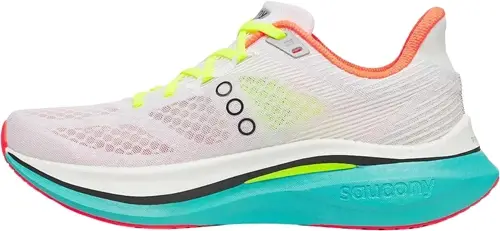
The Endorphin Speed 5 hits the middle ground that makes a great tempo shoe. It feels noticeably quicker than a conventional daily trainer, but it does not feel as rigid or specialized as many carbon racing shoes.
Saucony sandwiches a semi-rigid nylon plate between layers of PWRRUN PB foam. That combination gives you some extra snap as you increase your pace while allowing more flex than you typically get from a carbon plate. Saucony lists it specifically for speed days and race days, but it has enough cushioning to handle longer training sessions as well.
That versatility is why it gets our top spot. It makes sense for a runner doing a weekly tempo workout, intervals and occasional faster long runs who does not want separate shoes for every session.
It is less compelling if you prefer a very flexible shoe or do almost all of your running at an easy pace.
Check the latest Endorphin Speed 5 price on Amazon.
New Balance FuelCell Rebel v5: Best plateless tempo shoe
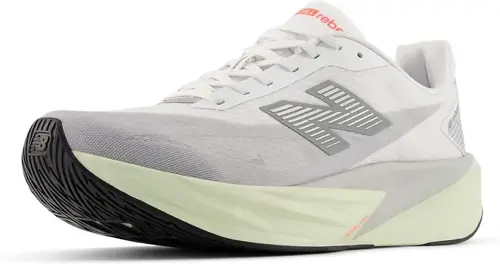
Not every fast training shoe needs a plate. The New Balance FuelCell Rebel v5 is for runners who want their shoe to disappear underfoot rather than push them through each stride. New Balance uses a PEBA and EVA foam blend that keeps the shoe light and responsive while retaining the flexibility missing from many plated trainers.
The Rebel v5 has a 6 mm drop and is designed for everyday and quicker runs. New Balance also added more foam than the previous version, so it has enough protection for longer efforts without turning it into a bulky max-cushion trainer.
This is the model I would look at if you like running by feel. It works particularly well for runners who want to control their own turnover rather than having a stiff plate or aggressive rocker dictate the ride.
The trade-off is that you get less structure and propulsion than you would from a super trainer.
Check the latest FuelCell Rebel v5 price on Amazon.
Hoka Mach X 3: Best for long tempo runs
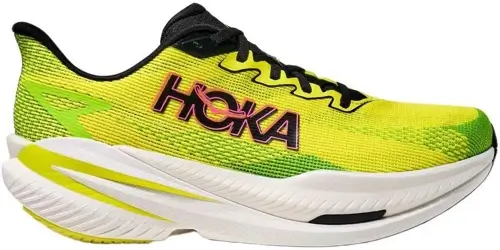
The Hoka Mach X 3 takes the super-trainer approach. It gives you plenty of cushioning for longer efforts while still being built to move when you increase the pace.
Its dual-density midsole places PEBA foam near the foot for a livelier feel, with a Pebax plate running through the shoe. Hoka also uses its speed-focused rocker geometry to help move you through toe-off. The result is a shoe designed specifically around up-tempo training rather than easy jogging.
This makes the Mach X 3 particularly appealing to runners doing longer tempo sessions, progression runs or marathon-pace workouts. You get more protection underfoot than you would from a stripped-down speed shoe, which can be welcome when the workout stretches beyond an hour.
It is not the lightest or simplest option here. If you want a low-profile tempo shoe that lets you feel the road, the Rebel v5 makes more sense.
Check the latest Hoka Mach X 3 price on Amazon.
Nike Zoom Fly 6: Best carbon-plated tempo trainer
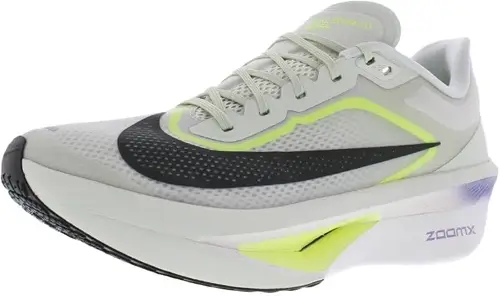
The Zoom Fly 6 is the choice for runners who want some of Nike’s racing-shoe feel in something they can train in regularly.
Nike combines ZoomX foam with a full-length carbon-fibre Flyplate. The shoe has an 8 mm drop and weighs about 265 grams in a men’s size 9. Nike positions it for race training and speed runs rather than as a race-day-only shoe.
That makes it well suited to tempo workouts where you want to practise running efficiently at faster paces without putting every training mile on a more expensive racing shoe.
The carbon plate does give the Zoom Fly 6 a more structured feel than the Endorphin Speed 5 or Rebel v5. Some runners will love that. Others will find it more shoe than they need for a controlled Tuesday tempo run.
If you already enjoy carbon-plated shoes and want a training companion with a similar feel, the Zoom Fly 6 makes a lot of sense.
Check the latest Nike Zoom Fly 6 price on Amazon.
Adidas Adizero Boston 13: Best for runners who prefer a firmer ride
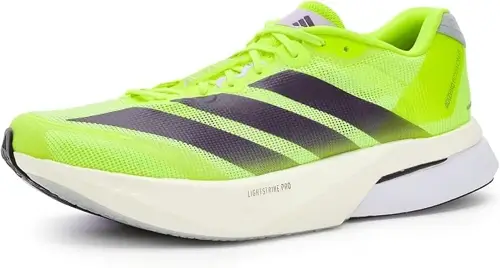
The Boston has long occupied the space between an everyday Adidas trainer and an all-out Adizero racing shoe, and the Boston 13 continues in that role.
This is a good option if you dislike very soft speed shoes. The ride is more controlled and planted, which can make it easier to lock into a pace and keep it there rather than feeling as though the shoe is bouncing underneath you.
Adidas currently lists the Boston 13 at a $160 U.S. retail price, although individual colors are already being discounted. Adidas also categorizes the Boston line for training and tempo running.
That combination of speed, structure and durability makes it particularly useful for runners who want to put plenty of training miles on their tempo shoe.
It would not be my first choice for someone who wants a soft, highly cushioned ride. For that runner, the Mach X 3 or Hyperion Max 3 will probably feel better.
Check the latest Adidas Boston 13 price on Amazon.
Brooks Hyperion Max 4: Best for cushioned speedwork
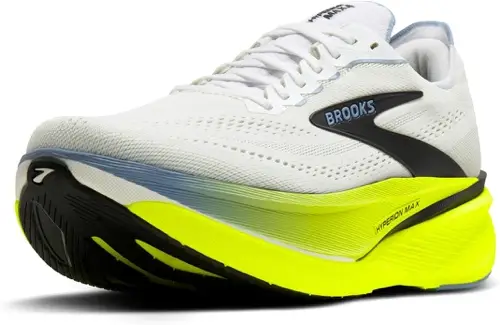
The Brooks Hyperion Max 4 is built for runners who want plenty of cushioning underfoot without giving up the quicker feel needed for tempo runs.
Brooks gives it a tall 45 mm stack and combines its springy DNA GOLD foam with DNA FLASH v2 cushioning. A nylon SpeedVault plate adds structure through the midsole, while the curved RapidRoll rocker helps move you smoothly from landing through toe-off. Brooks specifically recommends the Hyperion Max 4 for fast workouts, training runs and long runs.
That makes it a particularly good option for runners whose tempo workout is part of a longer session. You get enough cushioning to keep the legs comfortable as the miles build, but the plate and responsive foams help the shoe come alive when you increase the pace.
The 6 mm drop also keeps the geometry relatively performance-focused without pushing the shoe into an extreme low-drop setup.
The trade-off is weight. At about 10.1 ounces for the men’s version, the Hyperion Max 4 is not the lightest tempo shoe on this list. If you want something minimal and nimble, the New Balance Rebel v5 will feel quicker underfoot.
But if your priority is a cushioned, protective shoe that can handle tempo runs, progression runs and faster long runs, the Hyperion Max 4 is one of the more versatile options here.
Check the latest Brooks Hyperion Max 4 price on Amazon.
Asics Magic Speed 5: Best for a race-like tempo workout
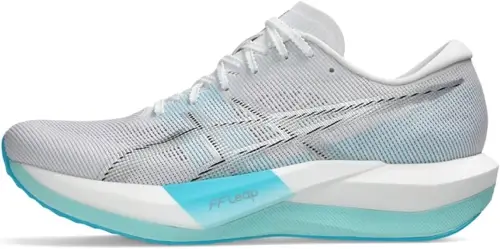
The Asics Magic Speed 5 is one of the more race-focused tempo shoes on this list. It is light, carbon-plated and designed for runners who want their faster training sessions to feel a little more like race day.
Asics made some significant changes from the Magic Speed 4. The Magic Speed 5 is about 50 grams lighter and uses FF LEAP cushioning over a layer of FF Blast Plus foam. It also has a redesigned carbon plate and a lower 7 mm drop. The result is a quicker, more direct shoe that feels better suited to tempo runs and intervals than the taller, more cushioned previous version.
This is a good choice if your tempo sessions are genuinely fast or if you use them to practise 5K, 10K or race-pace running. The carbon plate adds stiffness and snap through toe-off, while the lower weight makes it easier to turn over as your pace increases.
The trade-off is versatility. The Magic Speed 5 is less relaxed than something like the New Balance Rebel v5 or Saucony Endorphin Speed 5, so it would not be my first choice if you want the same shoe for easy running as well.
For runners who specifically want a fast, plated training shoe without stepping up to one of Asics’ more expensive Metaspeed racers, however, the Magic Speed 5 makes a lot of sense.
Check the latest Asics Magic Speed 5 price on Amazon.
Should you use your daily trainers for tempo runs?
You can. You do not need a separate tempo shoe just because your training plan includes faster running.
For a newer runner, your regular daily trainer may be all you need. The difference becomes more noticeable as your workouts get longer, your pace improves or you start training for a specific race goal.
Daily trainers are usually designed first around comfort, protection and durability. Those qualities are excellent during easy runs, but some shoes can feel heavy or overly soft when you try to hold a faster pace for 20, 30 or 40 minutes.
A tempo shoe shifts that balance toward responsiveness. That does not necessarily mean less cushioning. Modern shoes such as the Mach X 3 and Hyperion Max 3 have plenty of foam. The difference is that the cushioning is paired with geometry, responsive foam or a plate designed to work better as your pace increases.
If your current trainer already feels smooth during faster workouts, however, there is no urgent reason to replace it.
Do you need a plated shoe for tempo runs?
No. The New Balance Rebel v5 is probably the clearest example on this list. It gets its fast feel from low weight, responsive foam and flexibility rather than a plate.
Plates can still be useful. A nylon or Pebax plate can add structure and a little extra snap without making a shoe feel as rigid as many carbon racers. That is one reason shoes such as the Endorphin Speed 5 and Mach X 3 work so well as training shoes.
Carbon takes the idea further. The Zoom Fly 6 and Magic Speed 4 provide a more structured, race-like ride that some runners prefer when practising faster paces. Think of the plate as a preference rather than a requirement.
If you enjoy a flexible shoe and want your foot to do more of the work, go plateless. If you like a rocker, a stiffer forefoot and a little more assistance through toe-off, a plated trainer may suit you better.
How to choose the right tempo shoe
Start with the type of ride you already enjoy. If soft shoes tend to make you feel unstable, do not buy the softest super trainer because it has the most advanced foam. Look at a more controlled shoe such as the Boston 13.
If stiff carbon shoes leave your feet or calves feeling beat up, consider the nylon-plated Endorphin Speed 5 or skip the plate entirely with the Rebel v5.
Longer-distance runners may appreciate the additional cushioning of the Mach X 3 or Hyperion Max 3. Runners doing shorter, quicker tempo sessions may prefer something lighter.
Fit matters just as much. Your tempo shoe should hold your heel and midfoot securely when you increase your pace, while still giving your toes enough room to spread as the workout progresses. And remember that the most technically impressive shoe is not automatically the best one for you. A good tempo shoe should help you settle into pace and then largely disappear from your thoughts.
If you are not sure which type of running shoe suits your stride, try our free shoe finder calculator.
How many tempo shoes do you need?
For most recreational runners, one is plenty. A simple two-shoe rotation can cover most training. Use a comfortable daily trainer for easy and recovery miles, then switch to a lighter or more responsive shoe for tempo runs, intervals and other faster workouts. If you race regularly, you can add a third shoe specifically for race day.
There is also nothing wrong with using a versatile shoe such as the Endorphin Speed 5 for several types of running. The point of a rotation is not to collect shoes. It is to have footwear that makes sense for the workout.
The more important distinction is between your genuinely easy running and your quality sessions. If every run is done in an aggressive plated shoe, you may be spending extra money and giving up some of the comfort and flexibility that make an ordinary daily trainer useful.
FAQ: Tempo runs and running shoes
A tempo run should feel controlled but challenging. Your breathing will be noticeably harder than during an easy run, and conversation will usually be limited, but you should not feel as though you are sprinting or barely hanging onto the pace.
Not necessarily. Tempo pace depends on your fitness and how long the workout lasts. For some runners it may be near 10K pace, while for others it will be slower. Effort and workout purpose are more useful than applying one race pace to everyone.
Yes, but start conservatively. A newer runner might begin with shorter blocks of controlled faster running rather than trying to hold a hard pace continuously for a long period.
No. A regular running shoe can handle tempo workouts. A dedicated tempo shoe becomes more useful when you want something lighter or more responsive for regular faster training.
They can be, but carbon is not required. Some runners enjoy the structure and propulsion of a carbon plate, while others prefer a nylon plate, Pebax plate or no plate at all.
The New Balance FuelCell Rebel v5 (check price) is one of the strongest current options. Its PEBA/EVA midsole is light and responsive, but the shoe remains flexible because there is no plate running through it.
Yes. Many modern tempo shoes can double as race shoes, particularly for runners who do not want to buy a separate premium racing model. Shoes such as the Endorphin Speed 5, Mach X 3 and Zoom Fly 6 are designed to handle both faster training and race efforts.