Last Updated on October 10, 2026
Plenty of cushioning with almost no bounce
Quick Answer: Brooks Glycerin Max 2 Review: The Brooks Glycerin Max 2 is a maximum-cushion neutral trainer for runners and walkers who want as much foam underfoot as possible on easy days. Its DNA Tuned midsole measures 45.4 mm at the heel and a huge 37.3 mm at the forefoot, and the GlideRoll rocker keeps a stack that tall rolling forward smoothly. Upper comfort and stability are both better than the size suggests. The problems are weight, at over 11 ounces, and energy return well below average for a $200 shoe. Check latest price.
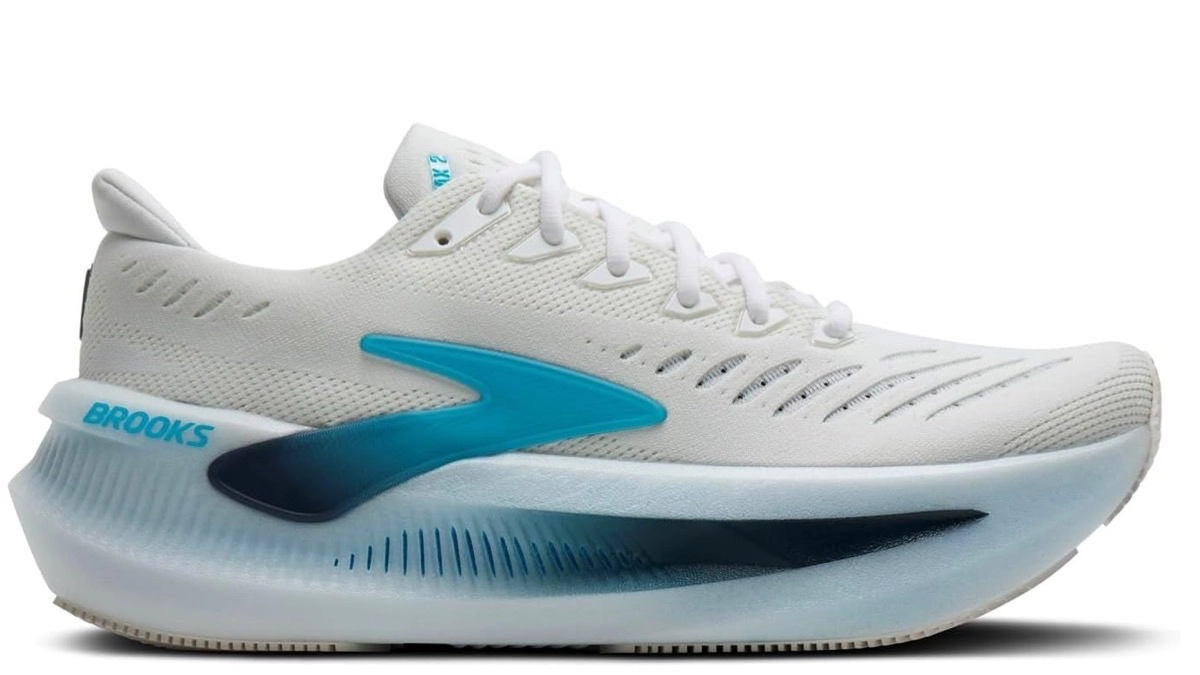
The Glycerin Max sits above the standard Glycerin at the top of the Brooks cushioning range, and it exists for one purpose: to put the maximum amount of foam between you and the road. Version 2 measures 45.4 mm at the heel and 37.3 mm at the forefoot in independent testing, and that forefoot figure is higher than the average shoe’s heel stack.
What holds it together is geometry. Brooks calls the shape GlideRoll, and it is an aggressively curved sole at both ends, which is what stops a stack this tall feeling like stilts. The DNA Tuned midsole, a nitrogen-infused foam with different cell structures in the heel and forefoot, is also softened for this version to 30.9 on the Asker C durometer.
The gap between what the shoe costs and what the foam does is the issue. DNA Tuned remains EVA-based, and energy return measured 49.1 percent at the heel and 51.3 percent at the forefoot, both well under the 58.6 percent average. Combine that with a measured 11.2 ounces and you have a shoe that protects superbly and gives back very little.

Specs
Here are the specifications for the Brooks Glycerin Max 2:
| Type | Road maximum-cushion neutral trainer |
| Foot and gait type | Neutral, works for all footstrikes, particularly suits heel strikers and heavier runners |
| Midsole foam | DNA Tuned, nitrogen-infused, 30.9 durometer main section with a firmer 36.5 heel piece |
| Stability system | None. A firmer heel foam section and a broad platform provide guidance |
| Weight (men’s 9) | 11.3 oz / 320 g listed, 11.2 oz / 318 g independently measured |
| Heel-to-toe drop | 6 mm listed, 8.1 mm independently measured |
| Stack height | About 45 mm heel listed, 45.4 mm heel / 37.3 mm forefoot independently measured |
| Upper | Triple-jacquard engineered air mesh with a plush collar and a non-gusseted tongue |
| Outsole | Mostly exposed foam with rubber at the main impact and toe-off zones |
| Widths | Standard only |
| Surface | Road, treadmill, paved path |
| Price | $200 at launch, January 2026. Check latest price |
Pros and Cons for the Brooks Glycerin Max 2
Here are the pros and cons for this shoe.
Pros
- A 37.3 mm forefoot is higher than most shoes’ heel stack, so forefoot protection on long easy runs is exceptional.
- Forefoot shock absorption jumped to 128, a large improvement on the first Glycerin Max and the biggest gain in this update.
- The aggressive GlideRoll rocker at both ends keeps transitions smooth despite a stack height that would otherwise feel awkward.
- Upper comfort is genuinely excellent and breathability measured 74 against a 72 average, which is unusual for a shoe this substantial.
- Despite the height it rates as very stable, thanks to a firmer foam section in the heel and a broad platform.
Cons
- Energy return of 49.1 percent at the heel is among the lower figures recorded and poor for a $200 shoe.
- At a measured 11.2 ounces it is heavier than the first version and heavy in absolute terms, which rules out anything beyond easy pace.
- Toe box height measured 24.0 mm against a 27.1 mm average, so there is limited room above the toes.
- The tongue is not gusseted, meaning it is unattached at the sides and can slide out of position.
- Rubber coverage is sparse for such a heavy shoe, leaving a lot of exposed foam on the ground.
What is new versus the Brooks Glycerin Max
Brooks left the DNA Tuned formulation broadly alone and changed how the shoe distributes its cushioning. The first Glycerin Max concentrated protection at the heel; this version shifts it forward. Forefoot shock absorption rose to 128, a substantial gain, while the heel figure eased slightly to 137. For a shoe most often used on long easy runs, that is the right direction.
The GlideRoll rocker was sharpened, with more curvature at both the forefoot and the heel. Given that measured stiffness is 21.9N, far above the 15.5N average, that curvature is doing essential work: the shoe cannot bend, so it has to roll instead.
The upper is new, a triple-jacquard engineered air mesh that measures well on breathability and feels plusher than the previous version. The one clear step backwards is weight, which went up rather than down and now measures 11.2 ounces. Anyone hoping the second generation would trim the bulk will be disappointed.
Pros
- Deep cushioning isolates the foot from hard pavement
- Strong choice for recovery runs and easy mileage
- Broad platform and firmer heel foam stay controlled under heavier runners
- GlideRoll rocker creates a smooth forward transition
Cons
- Heavy at about 11.2 ounces
- Not well suited to faster running or one-shoe-for-everything use
- Low toe-box height can press on the top of the toes
- Standard width only, with no wider fit option
Who should buy the Brooks Glycerin Max 2
Buy the Glycerin Max 2 if your priority is isolation from the road. Nothing in the Brooks range puts more foam underfoot, and the forefoot stack in particular is deeper than almost anything else on sale. For recovery runs the day after a hard session, this is exactly the kind of shoe that job calls for.
Heavier runners get a strong case. A tall stack only helps if it does not collapse, and the firmer DNA Tuned section in the heel plus the broad platform keep this one controlled under load. Independent stability assessment rates it highly despite the height, which is not true of every maximum-cushion shoe.
It also suits runners who like a strongly rockered ride. The GlideRoll shape produces a definite forward roll rather than the flat, deliberate transition many cushioned trainers give, and if that sensation appeals then the stiffness stops being a drawback and starts being the point.
Check prices and sizes on Amazon.
Who should avoid the Brooks Glycerin Max 2
Avoid it if you want one shoe for everything. At 11.2 ounces with energy return in the high forties, this shoe simply cannot do faster running. Effort goes into the foam and does not come back, and the weight is felt on every stride once the pace lifts.
Skip it if you need room above your toes. Toe box height measured 24.0 mm, notably under the average, and Brooks offers this model in standard width only, so there is no alternative fit to move to. Interior width itself is fine at 96.5 mm, so the pressure comes from above rather than the sides.
Finally, think carefully if $200 is a stretch. The upper and the geometry justify a premium, but the foam does not. Several maximum-cushion shoes cost less and return more energy, and a couple weigh nearly two ounces less while cushioning almost as well.
How does the Brooks Glycerin Max 2 fit?
Here is how it fits and feels.
Fit and sizing
Order your usual size. Owner feedback points to true to size, and measured internal length of 269 mm is within a fraction of the 269.3 mm lab average, so the length is entirely conventional.
Width is comfortable rather than tight. The interior measured 96.5 mm, slightly above average, and toe box width of 73.4 mm is average too. The restriction is vertical: at 24.0 mm the toe box is low, so runners who like to wiggle their toes freely, or who have high-volume feet, will feel the upper pressing down. Brooks normally offers several widths across its range but not on this model, so there is no way around it if the shape does not suit you.
Upper and step-in comfort
The triple-jacquard engineered air mesh is the highlight. It wraps the foot closely, has a plush collar and feels expensive in a way the Glycerin range has not always managed. Airflow testing returned 74 against a 72 average and drying potential matched the average at 53 percent, which is a strong result for a shoe carrying this much material.
The one design misstep is the tongue, which is not gusseted, meaning it is not stitched to the sides of the shoe and can slide off centre during a run. On a $200 shoe that is a strange saving, and it is the kind of thing you notice every time it happens.
How does the Brooks Glycerin Max 2 perform?
Here is how it performs.
Midsole and cushioning
DNA Tuned is nitrogen-infused foam, meaning gas is blown into the compound to make it lighter and softer, with different cell sizes tuned for the heel and the forefoot. In this version the main section measures 30.9 on the Asker C scale, comfortably on the soft side, while a smaller, firmer piece at 36.5 sits in the heel to keep the landing controlled.
Protection is where the money goes. Heel shock absorption measured 137 and the forefoot 128, both above the 131 average, and the forefoot figure is the standout improvement in this generation. Energy return is the opposite story: 49.1 percent at the heel and 51.3 percent at the forefoot against a 58.6 percent average. DNA Tuned is still EVA-based, and EVA cushions well but does not spring, which is the whole explanation.
Ride and running performance
The Glycerin Max 2 rolls rather than flexes. Measured stiffness of 21.9N is among the higher figures recorded and comes from the sheer height of the stack rather than from any plate, so the shoe barely bends underfoot. Brooks compensates with the aggressive GlideRoll curvature at both ends, which tips you forward from heel contact through to toe-off.
At easy pace that combination works well and the miles pass comfortably. Above that it falls apart quickly. There is no rebound to draw on, the shoe weighs 11.2 ounces, and the rocker sets a rhythm that does not speed up with you. Treat this as a recovery and long-run shoe and it does its job. Ask anything else of it and it will refuse.
Stability and support
This is a neutral shoe with no support system, and yet it rates as very stable for its size. The reasons are the firmer 36.5-durometer foam section placed in the heel, which resists collapsing sideways where the softer main foam would give way, and a wide platform that gives the foot a broad base to land on. The extreme stiffness helps too, since a shoe that will not twist will not roll.
None of this makes it a stability shoe or lets it limit pronation. What it means is that runners with mild support needs, who would normally be wary of a 45 mm stack, can usually wear this one comfortably. Anyone with a pronounced inward roll should still choose a shoe built to guide it.
Outsole, grip and durability
The outsole leaves most of the DNA Tuned foam exposed, with rubber placed only at the main impact zone and the toe-off area. That is a familiar weight-saving approach, though it is a strange one on a shoe that still weighs 11.2 ounces, and it leaves a lot of soft foam in contact with the road.
Wet-concrete grip measured 0.51 against a 0.52 average, adequate rather than impressive but reliable enough in the rain. Overall durability rates as good, helped by the fact that a stack this deep takes a long time to pack down. The usual 300 to 500 mile guideline is a fair expectation, with the exposed foam sections being the place to watch for wear.
Is the Brooks Glycerin Max 2 good for walking?
Yes, and walking may be where it makes the most sense. Everything that limits it as a running shoe matters less on foot. The absent energy return is irrelevant when you are not trying to run fast. The 11.2-ounce weight is far less noticeable at walking speed than at running speed. And the two things it does best, deep cushioning and a strong forward roll, are exactly what long hours on hard floors reward.
The rocker deserves particular mention. Because the shoe is too stiff to bend at 21.9N, a walker would normally fight the forefoot on every step. GlideRoll’s curvature means you roll over it instead, which keeps the stride natural. Two things to watch: the low 24.0 mm toe box gets less comfortable as feet swell over a day, and there is only one width available. If those suit you, this is one of the better max-cushion shoes for standing and walking.
Brooks Glycerin Max 2 vs. Brooks Glycerin Max
Here is how the two versions compare on the points that changed:
Feature | Glycerin Max 2 | Glycerin Max |
Forefoot shock absorption | 128 | Lower |
Heel shock absorption | 137 | Slightly higher |
Rocker | Enhanced GlideRoll, more curvature | Less aggressive |
Upper | Triple-jacquard engineered air mesh | Previous mesh |
Weight (measured) | 11.2 oz / 318 g | Slightly lighter |
Price | $200 at launch in January 2026. Check latest price | $180, Check latest price |
Buy the new model when you want the extra forefoot protection and the stronger roll, both of which make long easy runs more comfortable. Buy the previous model when you can find it discounted and you would rather have the slightly lighter build, since the midsole formulation and the price are otherwise unchanged and the differences are refinements rather than a rethink.
Brooks Glycerin Max 2 Alternatives
Runners who want this much cushioning with actual bounce should look at the Hoka Skyward X 2 (check price | read review). It is similarly tall and similarly rockered, but the midsole gives back more of what you put in, which makes long runs feel less like hard work.
A cheaper and considerably lighter route to a soft ride is the Asics Gel-Nimbus 28 (check price | read review). It gives up some stack height and some of the rolling sensation, but it fits more feet and costs less while cushioning nearly as well.
Anyone who likes the Brooks fit but finds this shoe too much can step down to the Brooks Glycerin 23 (check price | read review). It is a conventional cushioned trainer rather than a maximalist one, it comes in multiple widths, and it costs substantially less.
For a lighter, livelier shoe that still has plenty of foam, the Asics Novablast 6 (check price | read review) is the obvious contrast. It weighs far less, returns more energy and can handle a faster effort, at the cost of less absolute protection on very long runs.

Price and value
The Glycerin Max 2 launched at $200 in January 2026, matching the first version. That buys the deepest cushioning Brooks makes, a well-judged rocker that keeps a 45 mm stack usable, an excellent upper and better-than-expected stability. What it does not buy is a modern high-rebound foam, and at this price that omission is hard to defend when rivals at $180 or less return meaningfully more energy and weigh nearly two ounces less. The value case works if the shoe will be used for recovery days, long easy miles and time on your feet. It does not work if you expect a $200 shoe to be versatile.

Final verdict
Best for: recovery runs, long easy miles, heavier runners who want maximum protection, and walkers who want a strong rocker underfoot.
Avoid if: you want one versatile shoe, you need vertical room in the toe box, or you expect bounce for your $200.
Fit: true to size with average length and width but a low toe box, standard width only.
Verdict: as a comfort machine for easy days the Glycerin Max 2 is very good, and the way Brooks made a 45 mm stack feel stable and roll smoothly is genuinely impressive engineering. The EVA-based foam and the weight are what keep it from justifying its price, and until Brooks addresses both this stays a specialist purchase. Check online prices.
Frequently Asked Questions for Brooks Glycerin Max 2
The Max is the taller, more cushioned model. It carries roughly 45 mm of foam at the heel against a conventional stack on the standard Glycerin, uses a stronger rocker and costs considerably more. The standard Glycerin is lighter, more flexible and available in multiple widths.
No. Unlike most of the Brooks range, this model is produced in standard width only. Interior width measures slightly above average, so many feet will be fine, but the low toe box height of 24.0 mm is the measurement to watch and there is no alternative fit available.
In this shoe, yes for most neutral runners. Brooks placed a firmer foam section in the heel to stop the softer main foam collapsing sideways, and paired it with a wide platform and a very stiff build. Independent assessment rates its stability highly for a shoe this tall.
It is Brooks’ name for the curved sole shape used on this shoe, aggressive at both the heel and the forefoot. Because a 45 mm stack is too stiff to bend, the curvature does the work instead, tipping the foot from landing through to toe-off so the stride still feels smooth.
DNA Tuned is nitrogen-infused but still EVA-based, and EVA absorbs impact well without returning much of it. Measured energy return of 49.1 percent at the heel confirms that. The foam is genuinely soft at 30.9 on the durometer, so landings feel plush while toe-off feels flat.
It is a poor choice for it. The combination of a measured 11.2 ounces, below-average energy return and a rocker tuned for easy pace makes faster running feel laboured. Keep it for recovery runs and long easy miles and use a lighter shoe for workouts.