Last Updated on September 27, 2026
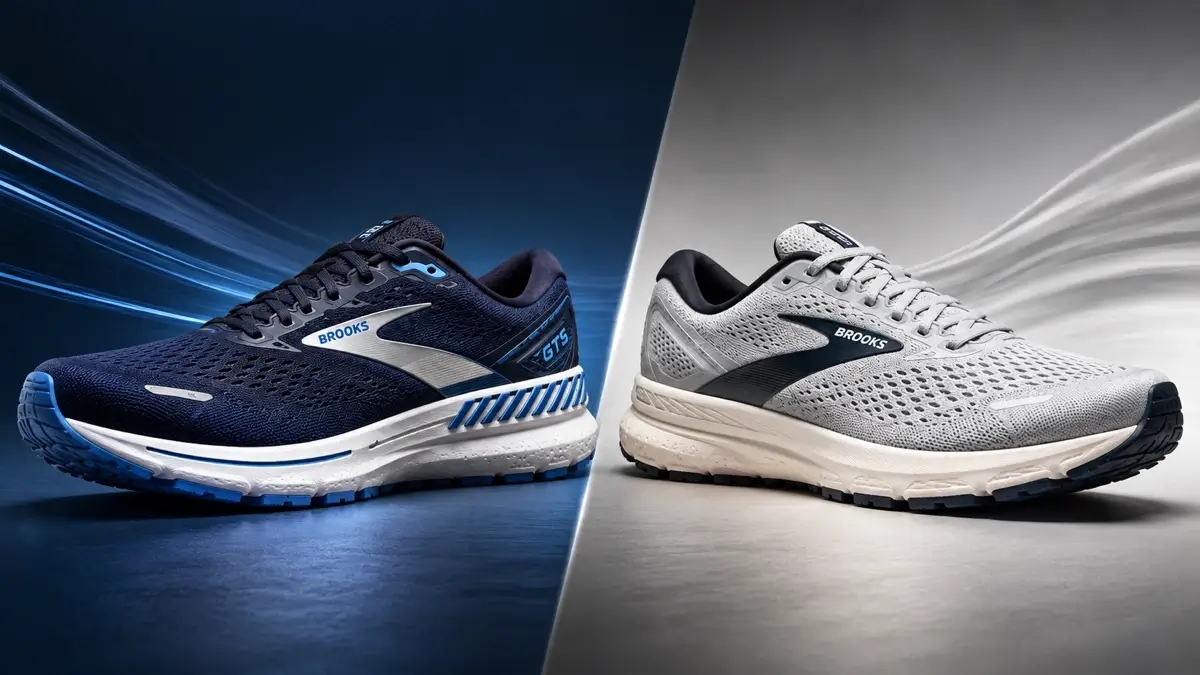
| Quick answer: Brooks GTS vs. non-GTS: Brooks GTS shoes are structured-support shoes. They use GuideRails, a foam structure, to help reduce excessive movement at the heel, ankle, shin, and knee. Non-GTS Brooks shoes are neutral. They still have cushioning, heel structure, and a shaped midsole, but they do not include the GuideRails system. |
Brooks sells several running and walking shoes in GTS and non-GTS versions. At first glance, the difference may appear minor. The shoes often have similar names, cushioning systems, and designs, but the letters GTS indicate an important change in how the shoe supports the body.
A Brooks GTS shoe includes the brand’s GuideRails support system. A non-GTS Brooks shoe is generally a neutral model without GuideRails.
More Brooks running shoe comparisons.
What are GuideRails?
Brooks GuideRails are two sections of firmer foam positioned on either side of the heel to provide structured support. Rather than forcing the foot into a fixed position, the system is designed to help limit excessive inward or outward movement while allowing the feet, ankles, knees, and hips to follow their natural motion path. GuideRails are included in Brooks shoes with “GTS” in the model name and may be helpful for runners and walkers who feel unstable in neutral footwear.
Who are the GTS versions for?
The GTS version is intended for runners and walkers who benefit from additional stability. The non-GTS version allows the foot and lower leg to move without the extra guidance built into the GTS shoe. Neither version is automatically better. The right choice depends on your movement, comfort, activity, orthotics, and how stable you feel while wearing the shoe.
GTS vs non-GTS features
Feature | Brooks GTS shoes | Non-GTS Brooks shoes |
|---|---|---|
Shoe category | Structured support or stability | Neutral |
GuideRails | Included | Not included |
Overall feel | More stable and controlled | Less structured and more natural |
Best for | People who benefit from added movement control | People comfortable in neutral shoes |
Arch support | Varies by model | Varies by model |
Weight | May be slightly heavier | May be slightly lighter |
Examples | Adrenaline GTS, Glycerin GTS, Beast GTS | Ghost, Glycerin, Ghost Max |
The most important distinction is movement support, not cushioning. A GTS shoe can be soft and highly cushioned, while a neutral shoe can still have a broad and stable platform.
What does GTS mean in Brooks shoes?
GTS stands for Go-To Support. Brooks adds the designation to shoes equipped with its GuideRails support technology. According to Brooks, the system is designed to support a person’s natural movement path while helping keep excessive movement under control. Also see this explainer from Brooks Running.
GuideRails consist of supportive components placed around the heel. They function somewhat like bumpers, becoming more noticeable when the foot and lower leg move toward the edges of the shoe’s intended range.
This approach differs from traditional stability shoes that relied heavily on a firm medial post under the inside of the foot. A medial post primarily resisted inward rolling. GuideRails are designed to address excessive movement more broadly rather than simply pressing against the arch.
What is a non-GTS Brooks shoe?
A non-GTS Brooks shoe is generally considered neutral, meaning it does not include a built-in stability system designed to control excessive inward or outward movement.
Neutral shoes still provide cushioning, heel support, and structure, but they allow the foot to move through its natural gait without added guidance from features such as GuideRails. They are typically best suited to runners and walkers who feel stable in standard footwear, do not need motion-control support, or prefer a less structured feel underfoot.
Neutral does not mean completely unstructured. These shoes still have heel counters, midsoles, outsoles, shaped footbeds, and varying levels of cushioning. Some neutral Brooks shoes also have wide bases or rocker-shaped soles that can make them feel inherently stable.
The difference is that they do not include GuideRails.
The Brooks Ghost 18, Ghost Max 4, Glycerin 23, and Glycerin Max 2 are examples of current neutral models. Brooks positions the Ghost family as cushioned neutral footwear for road running and walking, while the standard Glycerin provides a softer, more highly cushioned experience.
Current Brooks GTS models compared
The current Brooks GTS lineup ranges from an everyday support shoe to models intended for maximum support, orthotics, or a roomier fit.
Amazon prices and available versions change frequently. Each link below searches Amazon.com for the specified model and includes the affiliate tracking tag bestwalking-20.
Brooks GTS model | Best for | Support and cushioning | Availability | Latest price |
|---|---|---|---|---|
Brooks Adrenaline GTS 25 | Everyday running, walking, work, and moderate support | Balanced cushioning with GuideRails | Men and women | |
Brooks Glycerin GTS 23 | Plush cushioning with structured support | Soft, high cushioning with GuideRails | Men and women | |
Brooks Beast GTS 26 | Maximum support, wider feet, orthotics, and walking | Durable cushioning, broad base, and maximum support | Men | |
Brooks Ariel GTS 26 | Maximum-support women’s shoe for walking, running, and orthotics | Durable cushioning, broad base, and maximum support | Women | |
Brooks Addiction GTS 15 | Roomy fit, orthotics, walking, and everyday running | Balanced cushioning with a wider forefoot and full-body support | Men and women |
The Adrenaline GTS 25 is Brooks’ primary everyday support shoe. Brooks recommends it for road running, walking, structured support, and reliable daily comfort.
The Glycerin GTS 23 adds GuideRails to Brooks’ highly cushioned Glycerin platform. It is the better starting point for someone who wants a softer underfoot feel than the Adrenaline provides.
The Beast GTS 26 and Ariel GTS 26 are the men’s and women’s maximum-support options. Both have broad platforms, roomy uppers, and removable insoles that can accommodate many orthotics.
The Addiction GTS 15 combines structured support with a roomy forefoot. Brooks specifically identifies walking, everyday running, added support, and use with orthotics among its intended purposes.
If you are deciding between specific models, our Brooks running shoes comparison guide compares the current Ghost, Glycerin, Adrenaline, Hyperion and Ghost Max families.
Brooks Glycerin vs. Glycerin GTS
The Brooks Glycerin is the clearest example of a model available in neutral and GTS versions.
The standard Glycerin 23 is neutral. It is designed for runners and walkers who want soft, highly cushioned footwear without a dedicated support system.
The Glycerin GTS 23 uses a similar cushioning platform but adds GuideRails. Brooks describes the GTS version as providing supreme softness with structured support.
Someone who likes a soft shoe but feels unstable in the standard Glycerin may prefer the GTS version. Someone who does not need movement control may find the neutral version smoother and less intrusive.
Feature | Brooks Glycerin 23 | Brooks Glycerin GTS 23 |
|---|---|---|
Category | Neutral | Structured support |
GuideRails | No | Yes |
Cushioning | Soft and highly cushioned | Soft and highly cushioned |
Best for | Neutral runners and walkers | Runners and walkers wanting cushioning with support |
Latest price |
The GTS version is not necessarily more cushioned. Its primary difference is the addition of structured support.
Brooks Ghost vs. Adrenaline GTS
The Brooks Ghost and Adrenaline GTS serve similar everyday purposes, but they belong to different support categories.
The Ghost 18 is a neutral daily trainer intended for road running and walking. The Adrenaline GTS 25 is a structured-support daily trainer that includes GuideRails. Brooks does not currently sell a directly paired Ghost GTS model.
Someone who enjoys a balanced everyday shoe and does not need GuideRails may prefer the Ghost. Someone looking for a comparable daily shoe with additional movement control may prefer the Adrenaline GTS.
Feature | Brooks Ghost 18 | Brooks Adrenaline GTS 25 |
|---|---|---|
Category | Neutral | Structured support |
GuideRails | No | Yes |
Best for | Everyday neutral running and walking | Everyday running and walking with added support |
Cushioning | Balanced | Balanced |
Latest price |
The Adrenaline is not simply a Ghost with GuideRails added. They are separate shoe families with differences in geometry, fit, cushioning, and ride. However, they are often compared because both are designed as versatile everyday shoes.
How Brooks GuideRails work
GuideRails are positioned around the heel rather than directly underneath the arch. The system is intended to help the foot, ankle, shin, and knee remain within a comfortable movement path.
When the wearer moves relatively neutrally, the rails may have little noticeable effect. As movement becomes more excessive, the firmer components along the sides of the heel provide resistance.
This is why some neutral runners can comfortably wear GTS shoes. The system is not designed to force every foot into exactly the same position. However, runners who do not need the added structure may still find a GTS shoe heavier, firmer, or more restrictive than its neutral alternative.
Is GTS the same as arch support?
GTS does not simply mean extra arch support.
The GuideRails system is primarily built around the heel. Although a GTS shoe may feel more supportive through the midfoot, it does not necessarily have a higher or more prominent arch than a neutral Brooks shoe.
Arch height also does not determine support needs on its own. A person can have flat feet and walk comfortably in neutral shoes. Another person may have average or high arches but still benefit from a more stable platform.
Fit, comfort, foot shape, lower-leg movement, activity, and injury history are usually more useful considerations than arch height alone.
Are GTS shoes made for overpronation?
Brooks GTS shoes are frequently recommended to people who overpronate, but GuideRails are not limited to conventional overpronation control.
Pronation is the natural inward movement of the foot as it absorbs impact. Everyone pronates to some degree. The potential concern is excessive movement that contributes to instability, discomfort, or problems farther up the leg.
Traditional stability shoes often attempted to stop this movement using a firm piece of foam under the inside edge of the foot. Brooks instead presents GuideRails as a system that helps control excessive movement through the foot and knee while allowing the body to follow its natural path.
A GTS shoe may therefore suit someone whose ankles roll inward, whose knees move excessively toward each other, or who simply feels unstable in neutral shoes.
See also: Best overpronation running shoes
Who should consider a Brooks GTS shoe?
A Brooks GTS shoe may be worth considering when neutral shoes feel unstable or when unwanted movement becomes more noticeable during long runs, walks, or work shifts.
People who have successfully worn stability shoes in the past may also find the transition to GuideRails comfortable. The system can be particularly useful for walkers or runners whose form changes as they become tired.
A recommendation from a podiatrist, physical therapist, or other qualified professional is another reason to try a structured-support shoe. Even then, comfort should remain part of the decision. A shoe that causes pressure, rubbing, numbness, or new pain is not a good match simply because it belongs to the recommended category.
Who may prefer a non-GTS Brooks shoe?
A non-GTS shoe may be more appropriate when you have worn neutral footwear comfortably and do not feel that your feet or ankles need additional guidance.
Neutral shoes often feel less restrictive. They may also provide a smoother transition from heel to toe because there are no GuideRails resisting movement at the sides of the heel.
People who use custom orthotics sometimes prefer neutral shoes because the orthotic already provides the prescribed control. Combining a highly corrective orthotic with a structured-support shoe could create more intervention than intended. The appropriate combination depends on the orthotic and why it was prescribed.
Are Brooks GTS shoes good for walking?
Brooks GTS shoes can be used for walking as well as running. Brooks lists walking as an intended use for the Adrenaline GTS 25, Glycerin GTS 23, Beast GTS 26, Ariel GTS 26, and Addiction GTS 15. (Brooks Running)
The added stability may be helpful during long walks, work shifts, travel, or other situations in which fatigue causes a person’s movement to become less controlled.
Not every walker needs GuideRails. A neutral shoe with a broad base, secure heel, and comfortable cushioning may provide sufficient stability.
See also: Best shoes for walking
Are GTS shoes better for plantar fasciitis?
A GTS shoe may feel helpful for some people with plantar fasciitis, but it is not a treatment for the condition.
Plantar fasciitis can be influenced by activity changes, calf tightness, foot strength, body weight, work surfaces, footwear, and other factors. Some people feel better in structured-support shoes, while others prefer neutral shoes with soft cushioning and an appropriate heel-to-toe drop.
The shoe should hold the heel securely and feel comfortable through the arch and forefoot. Persistent, severe, or worsening heel pain should be assessed by a qualified health professional.
See also: Best shoes for plantar fasciitis.
Are GTS shoes better for knee pain?
GuideRails were developed with lower-limb movement in mind, including movement at the knee. Brooks says the system helps keep excessive motion in check rather than focusing only on the position of the foot.
That does not mean a GTS shoe will resolve knee pain. Knee discomfort can result from arthritis, training errors, muscle weakness, previous injuries, mobility limitations, or several other causes.
A stability shoe may help when excessive foot and lower-leg movement contributes to the problem. It may have little effect when the pain has an unrelated cause.
See also: Best shoes for knee pain
Can neutral runners wear Brooks GTS shoes?
Neutral runners can wear GTS shoes when the shoes feel comfortable.
GuideRails are designed to provide more resistance as movement becomes excessive. A neutral runner may therefore experience the shoe mainly as a secure platform.
There is no clear reason to switch from a comfortable neutral shoe solely because GTS sounds more supportive. Additional support is not automatically beneficial, and some neutral runners find the rails noticeable.
Trying comparable GTS and non-GTS shoes is more useful than choosing entirely according to a gait label.
See also: Best neutral running shoes
Can you wear orthotics in Brooks GTS shoes?
Several Brooks GTS shoes have removable insoles and enough internal space for orthotics. The Beast GTS 26, Ariel GTS 26, and Addiction GTS 15 are specifically positioned as accommodating options for orthotic users.
Take the orthotics with you when trying on shoes. Once inserted, the heel should remain secure, the toes should have sufficient room, and the top of the foot should not press uncomfortably against the upper.
Because orthotics differ substantially, the professional who prescribed or fitted them may be able to advise whether they should be used in neutral or structured-support shoes.
How to choose between GTS and non-GTS Brooks shoes
The best shoe is usually the one that feels comfortable while you are moving, not merely while you are standing in a store.
Try the shoes with your usual socks and orthotics. Walk or run long enough to notice heel security, arch pressure, toe room, and whether the shoe feels stable during turns.
A GTS shoe should feel supportive without pushing harshly against either side of the foot. A neutral shoe should feel natural without leaving you unsteady.
When comparing two versions, use similar models whenever possible. The Glycerin and Glycerin GTS offer the most direct comparison because they are designed around closely related cushioning and fit experiences.
GTS vs. GTX
GTS and GTX describe completely different shoe features.
GTS means the shoe includes Brooks’ GuideRails support system.
GTX indicates that the shoe uses Gore-Tex waterproofing. A GTX model is designed to help keep water out while remaining breathable.
A shoe name may contain both designations when it combines structured support with waterproofing.
Frequently asked questions
GTS stands for Go-To Support. Brooks uses the designation for shoes containing its GuideRails support system.
Yes. Brooks classifies GTS models as structured-support or stability shoes.
Generally, yes. When Brooks sells a standard model and a GTS version, the non-GTS shoe is normally the neutral option.
Not necessarily. Both are highly cushioned. The primary difference is the GuideRails support added to the GTS version.
Brooks does not currently sell a directly paired Ghost GTS. The Adrenaline GTS is the closest everyday structured-support alternative.
The current performance version is sold as the Adrenaline GTS 25. The Adrenaline line is positioned as a structured-support shoe.
They can be, but flat feet do not automatically require stability shoes. Comfort, movement, foot shape, and professional advice are more useful than arch height alone.
Any shoe can cause pain when its shape, cushioning, support, or fit does not suit the wearer. Stop wearing a shoe that causes persistent pain, numbness, or rubbing.
A GTS model may be slightly heavier because of its additional support components. The difference varies by shoe and size.
No. Brooks markets its main GTS models for both running and walking.
No. Pronation is a normal part of walking and running. GuideRails are intended to resist excessive movement rather than eliminate pronation.
They can be a good option for people who want cushioning and a stable platform during long work shifts. Fit and personal comfort remain the deciding factors.
The Glycerin GTS 23 is the primary highly cushioned GTS option. The Beast GTS 26 and Ariel GTS 26 combine durable cushioning with maximum support.
The Beast GTS 26 for men and Ariel GTS 26 for women are Brooks’ maximum-support models.
The Adrenaline GTS 25 is the most versatile everyday option for many runners and walkers. The Glycerin GTS 23 may be preferable for someone who wants a softer and more cushioned feel.