Last Updated on September 23, 2026
Quick answer: Do Orthotic Insoles Work for Plantar Fasciitis?
Orthotic insoles may help you manage plantar fasciitis pain, but they are not a cure. The most reliable research points to modest relief over the medium term, roughly 7 to 12 weeks. Expensive custom orthotics have not consistently beaten good over-the-counter insoles in head-to-head studies, and not everyone feels a clear difference. For most people the practical first step is a firm, supportive store-bought insole with realistic expectations, such as the Powerstep Pinnacle insole.
If you have stubborn heel pain, orthotic insoles are one of the first things people suggest. They are also one of the most confusing things to shop for, because prices run from under $20 to several hundred dollars. So, do orthotic insoles work for plantar fasciitis, and are the costly ones worth it? This guide walks through what the research actually shows, who insoles help most, which store-bought options are worth a look, and how to give a pair a fair trial.
The short version is that orthotic insoles for plantar fasciitis are worth trying as a low-cost part of a bigger plan, not as a stand-alone fix. A firm, store-bought arch support such as the Powerstep Pinnacle is a sensible place to start for most people, and there is little proof that pricey custom orthotics do better. If you are new to the condition, our guide to what plantar fasciitis is explains the basics.
What Are Orthotic Insoles?
Orthotic insoles are removable inserts that sit inside your shoes to support the arch, cushion the heel, and change how weight passes through your foot. Some people call them shoe inserts, arch supports, or orthotics. They come in two broad types.
Store-bought insoles, also called over-the-counter or prefabricated insoles, are ready-made arch supports you buy off the shelf in a range of sizes. Custom orthotics are molded or scanned to match your individual foot, usually through a podiatrist, and they cost far more. Both aim to do the same basic job: give the foot more support than a bare shoe.
How Orthotic Insoles May Ease Plantar Fasciitis Pain
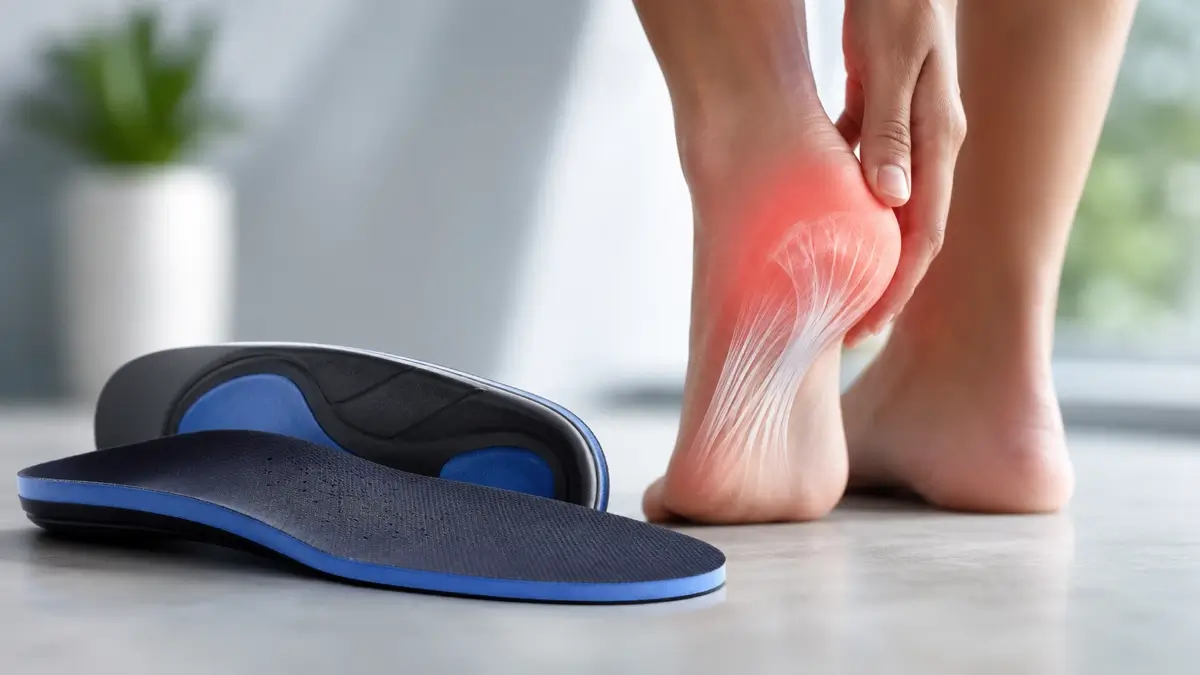
An orthotic insole works in a mechanical way, not a medicinal one. Plantar fasciitis is an irritation of the plantar fascia, a band of tissue along the bottom of the foot that can get sore where it attaches at the heel. By supporting the arch and cradling the heel, an insole can spread pressure away from that sore spot and limit how far the arch flattens under load. In plain terms, it reduces stress on the sore tissue under the foot.
That is a sensible idea, and the research broadly supports a modest benefit. But how much it helps depends a lot on when you measure. A 2018 review combined the results of 19 studies involving about 1,660 people and mapped the effect by time frame.
What the Research Shows Over Time
This table shows how orthotic insoles may affect plantar fasciitis pain across three time frames, and how reliable the current research is for each one.
Time frame | Effect on pain | How strong the evidence is |
|---|---|---|
Short term (about 0 to 6 weeks) | No clear drop in pain or gain in day-to-day function | Very low |
Medium term (about 7 to 12 weeks) | Small drop in pain vs. a comparison insole with no real support; function did not improve | Moderate |
Long term (about 12 months or more) | No clear drop in pain or gain in function | Very low |
In that review, the comparison group wore an insole designed not to provide meaningful support, so the medium-term result reflects the insole doing more than a placebo. Even then, the average pain reduction was small, and everyday function did not improve. The practical read is that insoles are most useful as a medium-term tool that takes the edge off over a few weeks to a couple of months while the fascia settles and you address the causes.
What the Evidence Says: Do Orthotic Insoles Work for Plantar Fasciitis?
Put simply, the evidence is mixed and fairly modest. The strongest finding, that insoles reduce pain more than a non-supportive insole over about 7 to 12 weeks, rests on moderate-quality studies. The short-term and long-term evidence is weak, and a separate 2018 review found that insoles were not clearly better than a non-supportive insole or other simple care overall. So insoles are not a proven cure, and not everyone who tries them will notice a meaningful improvement.
It also helps to be clear about what an insole does. It does not heal plantar fasciitis directly. At best it may improve comfort and change how pressure is spread across the foot while the tissue recovers. That is why most guidance treats orthotic insoles as one part of a broader plan that also includes supportive shoes, gentle stretching, sensible activity levels, and a professional assessment when the pain is severe or stubborn. An insole also cannot make up for a worn-out or badly fitting shoe.
Who May Benefit From Orthotic Insoles
Insoles make the most sense for a specific set of people. You are more likely to benefit if you fit one of the descriptions below.
- Your shoes give little or no arch support, so an insole adds support you are missing.
- You want to upgrade a pair of shoes you already like rather than buy new ones.
- You have flexible flat feet or notice your arch collapsing, a group also covered in our guide to the best insoles for flat feet.
- You want a low-cost first step before spending money on anything custom.
Who May Not Benefit
Insoles are not for everyone. They are less likely to help, or may not be the right first move, in these cases.
- You expect overnight relief, since the evidence favors slow, medium-term improvement.
- You already wear a well-fitted, supportive shoe with a firm arch, so extra support adds little.
- Your pain is severe, getting worse, or not improving, which is a reason to see a professional rather than keep buying inserts.
Custom Orthotics vs. Store-Bought Insoles
This is the question that saves people the most money. When researchers compare custom-made orthotics with store-bought insoles for ordinary plantar fasciitis, they usually find no meaningful difference in pain or function. Both tend to reduce pain by a similar amount, and the custom versions cost far more. In short, custom orthotics for plantar fasciitis have not shown a consistent advantage for typical cases.
Custom devices still have a place. They can help with complex foot shapes or when a podiatrist recommends them for a specific reason. But for typical plantar fasciitis, a well-chosen store-bought insole is a reasonable, and much cheaper, place to start.
Recommended Orthotic Insoles for Plantar Fasciitis
A quick note on how we picked these. We did not wear-test these insoles ourselves. The verdict above rests on the cited clinical research for the category, and the picks below are based on each brand’s established availability on Amazon, its arch-support design, its arch-height options, and its price, matched to different feet and budgets. Confirm the right size and arch height for your foot before you buy, because fit matters more than price.
Insole Comparison
This table matches five widely sold orthotic insoles to the foot type, support feel and budget each one suits best, so you can shortlist a sensible starting pair.
Insole | Best for | Support feel |
|---|---|---|
Most people starting out | Firm arch, cushioned heel | |
Higher arches wanting structure | Rigid, structured heel cup | |
Matching arch height to your foot | Firm shell, replaceable top cover | |
Budget buyers wanting cushioning | Softer, lower cost | |
More active walkers and runners | Flexible, dynamic support |
Powerstep Pinnacle
The Powerstep Pinnacle pairs a firm, supportive arch with a cushioned heel, which makes it a balanced starting point for many people with plantar fasciitis. Powerstep was founded by a podiatrist in 1991, and the Pinnacle is its most popular everyday model. It is a good default if you are not sure where to begin.
Superfeet Green
The Superfeet Green uses a rigid, structured heel cup and high arch support. It suits people with higher arches who want maximum structure rather than soft cushioning. The support is aggressive, so it can take a few days to get used to.
Tread Labs Pace 2
The Tread Labs Pace 2 comes in four arch heights, so you can match the shell to your own foot. Its top cover is replaceable, which extends the life of the insole. It is a good pick if you know your arch height or have struggled to find a fit.
Dr. Scholl’s Plantar Fasciitis Pain Relief Orthotics
Dr. Scholl’s Plantar Fasciitis Pain Relief Orthotics are softer and cheaper than the firm arch supports above. They lean toward cushioning and everyday comfort rather than rigid structure, which some tender heels prefer. They are a low-cost way to see whether an insole helps at all.
Currex RunPro
The Currex RunPro offers flexible, dynamic support in low, medium and high arch profiles. It is aimed at more active walkers and runners who want support that moves with the foot rather than a stiff shell. Choose the arch profile that matches your foot.
How to Choose the Right Orthotic Insole
The correct fit, arch height and comfort matter more than price alone. A firm, structured arch support is the most common choice for arch-driven plantar fasciitis, because a stiffer insole limits how far the arch flattens. But the research does not prove that firm is best for everyone. Some people, especially those with a bruised, tender heel on hard floors, do better with softer cushioning, and an insole that feels unstable or painful is the wrong one no matter how highly it is rated.
A few simple checks help. Match the arch height to your foot rather than guessing. If your pain is mainly under the heel, a heel cup or heel pad may serve you better than a full-length arch support. And make sure the insole fits your shoe, so it does not crowd your toes or lift your heel out of the back.
Insoles or New Shoes First?
Insoles and shoes solve overlapping problems, so it is rarely one or the other. A supportive shoe with a cushioned heel may be enough on its own, while an insole adds targeted arch support to shoes you already own. A reasonable order for most people is to start with a supportive, cushioned shoe, then add a store-bought insole if you need more arch support. Our picks for the best walking shoes for plantar fasciitis and the best men’s shoes for plantar fasciitis are a good starting point, and our guide to heel-to-toe drop for plantar fasciitis explains one detail worth checking on any shoe.
How to Give Orthotic Insoles a Fair Trial
Because the evidence favors medium-term relief, judging a pair too quickly is the most common mistake. These steps give any insole a fair chance.
- Give it weeks, not days. The research favors relief over 7 to 12 weeks, so do not write off a pair after a couple of walks.
- Break them in slowly. Wear firm insoles for part of the day at first if they feel aggressive.
- Pair them with the basics. Calf and foot stretching, sensible activity levels, and avoiding long barefoot walks on hard floors are part of the standard approach.
- Re-check the fit. Take out the shoe’s own insole first, and pick a shoe with enough room so the new insole does not crowd your toes or raise your heel.
When to See a Professional
Insoles are self-care, and self-care has limits. See a podiatrist, physical therapist, or doctor if any of the following apply.
- Your pain is severe, or it is getting worse instead of better.
- Heel pain has not improved after several weeks of supportive shoes, stretching and insoles.
- You feel numbness, tingling, or burning in the foot.
- The pain started after a fall or injury, or comes with swelling.
- You have diabetes, poor circulation, or known nerve problems in your feet, in which case it is best to get advice before self-treating.
Final Recommendation
For most people asking whether orthotic insoles work for plantar fasciitis, the honest answer is: they may help modestly, mainly as a medium-term way to manage pain, and it makes sense to start with an affordable store-bought pair rather than a custom one. A firm arch support such as the Powerstep Pinnacle is a low-risk first step, and higher arches may prefer the more rigid Superfeet Green. Whatever you choose, treat it as one part of a plan that includes supportive shoes, stretching and patience, and reassess after several weeks.
This article is educational and is not a substitute for individual medical care. If your heel pain is severe, lasting, or not improving, see a podiatrist or physical therapist.
Frequently Asked Questions
No. Insoles may help manage pain, most reliably over the medium term, but they do not cure the condition. Most plantar fasciitis improves with a mix of supportive shoes, gentle stretching, and sensible activity over weeks to months.
The strongest evidence is for medium-term relief, around 7 to 12 weeks. Some people feel a difference sooner, but the short-term evidence is weak, so give any insole several weeks before you decide.
For typical plantar fasciitis, the research shows no consistent advantage for custom orthotics over good store-bought insoles. Start with an affordable store-bought option unless a clinician advises otherwise for your specific foot.
Firm, structured arch support is the most common choice, because it limits how far the arch flattens. But research has not proven one firmness is best for everyone. A tender heel may prefer softer cushioning, and comfort and fit matter most.
They can. An insole that does not fit, or that is too aggressive, may create new pressure points or discomfort. If an insole increases your pain, stop using it and try a different shape or arch height, or ask a professional for guidance.