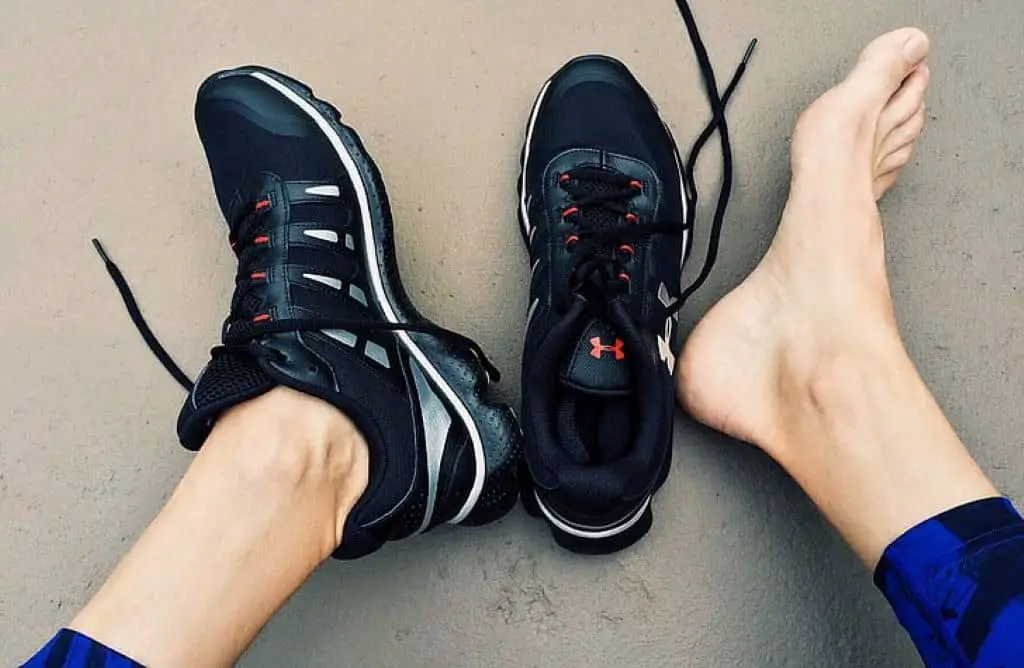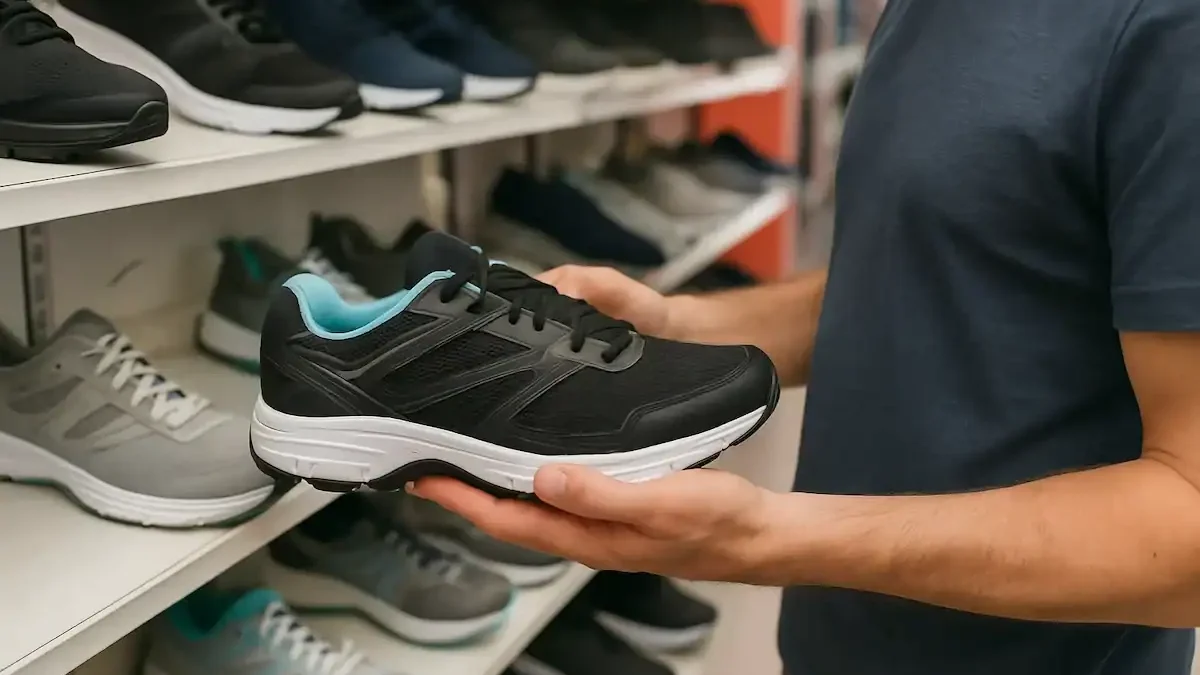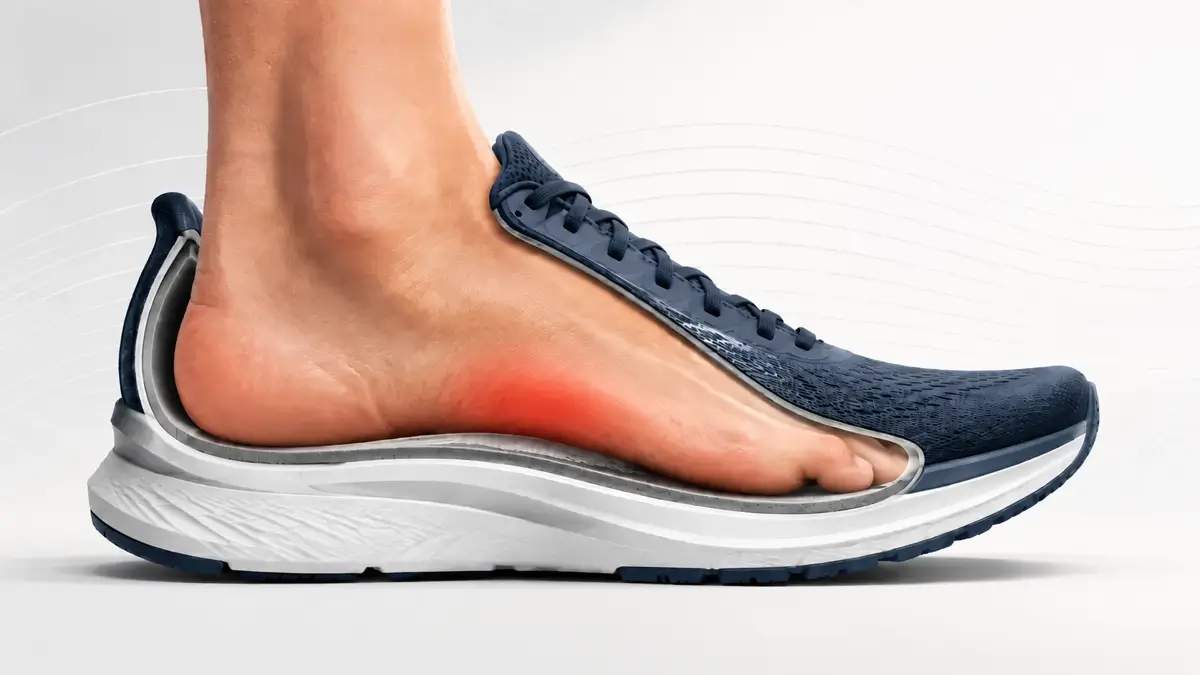
| Quick Answer: What Heel Drop is Best for Plantar Fasciitis? There is no scientifically proven “best” heel drop for plantar fasciitis. A moderate heel-to-toe drop of about 8-12 mm can be a sensible starting point, especially if you also have tight calves or Achilles tendons. However, lower-drop shoes can work well when they combine good cushioning, stability and rocker geometry. The important point is not to judge a shoe by heel drop alone. Fit, cushioning, support, sole shape and how your heel responds when walking all matter. Avoid making a sudden switch to zero-drop footwear during a painful flare if your feet and calves are not already adapted to it. |
Heel drop gets a lot of attention when people shop for the best walking shoes for plantar fasciitis, but the number on the spec sheet tells only part of the story.
An 8-12 mm drop is a useful range to try if you have tight calves or prefer a more traditional walking shoe. But a 5 mm Hoka can also feel excellent for plantar fasciitis because its thick cushioning, broad base and rocker change how the shoe behaves underfoot.
This guide explains what heel-to-toe drop actually means, what the research can and cannot tell us, and how to choose a practical range based on your feet rather than chasing one supposedly perfect number.
How we approached this: This guide summarizes footwear biomechanics and plantar fasciitis research. It is not medical advice, and there is no clinical guideline establishing one ideal heel-to-toe drop for plantar fasciitis. Persistent or severe heel pain should be assessed by a podiatrist, physical therapist or other qualified health professional.
What is heel-to-toe drop?
Heel-to-toe drop, sometimes called shoe offset, is the difference in height between the heel and forefoot inside a shoe. A shoe with a 10 mm drop positions your heel about 10 mm higher than the front of your foot.
Many traditional running and walking shoes use a drop of roughly 8-12 mm. Lower-drop shoes are often around 4-6 mm, while zero-drop shoes place the heel and forefoot at roughly the same height.
Do not confuse heel drop with overall stack height, which is the total amount of material between your foot and the ground, usually measured at the heel and forefoot.
A Hoka Bondi 9, for example, has a very thick midsole but only a 5 mm heel-to-toe drop. A shoe can therefore be both highly cushioned and relatively low-drop.
Drop can matter because the foot, plantar fascia, calf and Achilles tendon work together as you walk. Changing the heel position changes ankle geometry and can alter how forces move through that system. That does not mean a higher drop automatically reduces stress on the plantar fascia.
What heel drop is usually suggested for plantar fasciitis?
You will often see 8-12 mm suggested as a starting range for people with plantar fasciitis, particularly when heel pain occurs alongside tight calf muscles or an irritated Achilles tendon.
There is a practical reason for that advice. Raising the heel changes the amount of ankle dorsiflexion, or upward ankle bend, required as your body moves over the foot. Some people with tight calves find a moderate or higher-drop shoe noticeably more comfortable. But this should be treated as a starting point rather than a medical rule.
The 2023 clinical practice guideline for plantar fasciitis from the Academy of Orthopaedic Physical Therapy and American Academy of Sports Physical Therapy recommends treatments including plantar fascia and calf stretching, taping, strengthening and, in some situations, supportive shoe inserts (the medical profession calls these “orthoses”). It does not establish a specific heel-to-toe drop that people with plantar fasciitis should wear. That distinction matters.
What does the research actually say about heel drop and plantar fasciitis?
The research is much less definite than shoe advice online sometimes suggests. One problem is that much of the biomechanics research studies heel elevation, heel lifts or high-heeled shoes rather than the small differences in heel-to-toe drop found in modern athletic footwear.
For example, a 2021 biomechanics study examined shoes with heel heights of 3, 5 and 7 centimetres. Researchers found progressively greater plantar fascia strain as heel height increased during walking.
Those are heel heights of 30-70 mm, however. They should not be treated as direct evidence that a 10 mm running shoe creates more plantar fascia strain than a 5 mm shoe.
An earlier review of heel elevation and plantar heel pain found similarly complicated results. The effect depended partly on whether elevation came from the entire shoe geometry or simply from placing a heel lift under the rear of the foot. The practical conclusion is simpler than the biomechanics.
Research does not currently give us enough evidence to say that 5 mm, 8 mm, 10 mm or 12 mm is universally best for plantar fasciitis. That makes the design and comfort of the entire shoe more important than one specification.
How to choose a heel drop for plantar fasciitis
Your current footwear, calf flexibility, Achilles comfort and symptoms should guide where you start.
Your situation | Drop worth trying | Why |
|---|---|---|
Tight calves or Achilles | 8-12 mm | May feel more comfortable because less ankle dorsiflexion is required |
Plantar fasciitis with no strong shoe preference | 6-10 mm | Gives you a large selection of cushioned walking and running shoes |
Already comfortable in lower-drop shoes | 4-6 mm | No need to abandon a comfortable shoe simply because its drop is lower |
Already adapted to zero-drop shoes | 0 mm may still work | Plantar fasciitis alone does not automatically make zero-drop unsuitable |
Painful flare plus no experience with low-drop shoes | Avoid a sudden switch | Changing footwear can alter loads on the calf, Achilles and foot |
The key word is try.
If you normally wear 10 mm shoes comfortably, developing plantar fasciitis is not a reason to suddenly move to zero-drop footwear. The reverse is also true. Someone who has comfortably walked in lower-drop shoes for years does not necessarily need to jump to a 12 mm shoe. Large changes in footwear are usually better made gradually.
Heel drop is only one part of the shoe
Two shoes with the same 10 mm drop can feel completely different. When choosing footwear for plantar fasciitis, also consider:
- Heel cushioning: Helps reduce the harsh feeling of repeated heel strikes on hard surfaces.
- Stable platform: A broad base can make a tall, cushioned shoe feel more secure.
- Heel counter: The structured area around the back of the shoe helps hold the heel in place.
- Arch and midfoot support: This may make the shoe more comfortable, particularly for people who overpronate.
- Rocker geometry: A curved sole can help the foot roll forward and reduce the amount of bending required through the forefoot.
- Fit: Heel slipping, pressure points or a shoe that is too narrow can outweigh the theoretical advantage of a particular drop.
This helps explain why several lower-drop Hoka shoes remain popular with people looking for comfortable plantar fasciitis footwear.
Current plantar fasciitis shoe options and their heel drops
Here are current 2026 models that illustrate how different shoe designs approach cushioning and support.
Shoe (links to Amazon listing) | Heel drop | Why consider it | Review |
|---|---|---|---|
10 mm | Stability shoe with GuideRails and DNA Loft v3 cushioning | ||
10 mm | Neutral shoe with balanced cushioning and a traditional ride | ||
5 mm | Maximum cushioning, broad platform and Smooth MetaRocker | ||
6 mm | Maximum cushioning plus enhanced H-Frame stability | ||
8 mm | Maximum cushioning with FLUIDSUPPORT stability technology |
The table shows why heel drop should not be used by itself to rank plantar fasciitis shoes.
The Bondi 9 has only a 5 mm drop, yet it combines that geometry with a very thick supercritical EVA midsole, a wide platform and a rocker. The Brooks Ghost 18 has a higher 10 mm drop but a more traditional ride.
Neither approach is automatically better. If you are deciding specifically between these brands, see our guide to Hoka vs. Brooks for plantar fasciitis.
You can also compare more options in our guides to the best walking shoes for plantar fasciitis and best men’s shoes for plantar fasciitis.
Are zero-drop shoes bad for plantar fasciitis?
No. Zero-drop shoes are not automatically bad for plantar fasciitis. The bigger concern is transition.
Moving abruptly from a shoe with a 10-12 mm drop to a zero-drop shoe changes the demands placed on your feet, calves and Achilles tendon. That can be uncomfortable even if you do not have plantar fasciitis.
If you already wear zero-drop shoes comfortably, plantar fasciitis does not necessarily mean you must stop.
If you have never worn them and your heel is currently painful, however, the middle of a flare is probably not the best time to make a dramatic change in shoe geometry.
Make the transition gradually and use symptoms as your guide.
What else helps plantar fasciitis besides choosing the right drop?
Footwear can make walking more comfortable, but plantar fasciitis treatment should not revolve around shoes alone.
The 2023 clinical practice guideline gives strong support to plantar fascia-specific stretching and calf stretching. It also recommends strengthening the muscles of the foot and ankle and supports taping for short-term improvements in pain and function.
Orthoses can also be useful as part of a broader treatment program, although current evidence does not support relying on an orthotic alone as a short-term treatment.
We take a closer look at that evidence in our guide to whether orthotic insoles work for plantar fasciitis.
If heel pain continues despite footwear changes and basic self-care, getting a proper diagnosis matters. Heel pain can have causes other than plantar fasciitis.
Frequently asked questions
There is no proven ideal heel drop. An 8-12 mm drop is a reasonable starting range if you have tight calves or prefer traditional shoes, but lower-drop shoes can also work well when their cushioning, stability and rocker suit your feet.
It can be. A 10 mm drop is common in cushioned walking and running shoes and may feel comfortable for people with tight calves or Achilles tendons. The Brooks Ghost 18 and Adrenaline GTS 25 both use a 10 mm drop.
Not necessarily. The Hoka Bondi 9 has a 5 mm drop but combines it with maximum cushioning, a broad platform and a rocker. Some people with plantar fasciitis may prefer this type of geometry over a higher-drop shoe.
Not inherently. The main concern is making a sudden transition to zero-drop footwear, especially when your heel is already painful or your calves and Achilles tendons are tight.
A moderate or higher-drop shoe may feel more comfortable because it reduces the amount of ankle dorsiflexion required during each step. An 8-12 mm shoe is a reasonable range to test.
Usually not. Heel drop, cushioning, stability, fit and rocker geometry all affect how a shoe feels. Choosing a shoe based on drop alone ignores most of its design.
Start with the range you already tolerate comfortably. If you have tight calves or are unsure, a cushioned shoe around 8-10 mm is a reasonable place to begin. Lower-drop max-cushion shoes can also work if their rocker and platform feel comfortable.
This article is informational and is not a substitute for professional medical care. Persistent, severe or worsening heel pain should be evaluated by a qualified health professional.
Sources and further reading
For readers who want to explore the evidence behind these recommendations:
- Heel Pain – Plantar Fasciitis: Revision 2023, Journal of Orthopaedic & Sports Physical Therapy.
- The Influence of Heel Height on Strain Variation of Plantar Fascia During High Heel Shoes Walking
- Heel Elevation in the Shoe: What the Literature Reveals
- Comprehensive Review and Evidence-Based Treatment Framework for Optimizing Plantar Fasciitis Diagnosis and Management