Last Updated on September 23, 2026
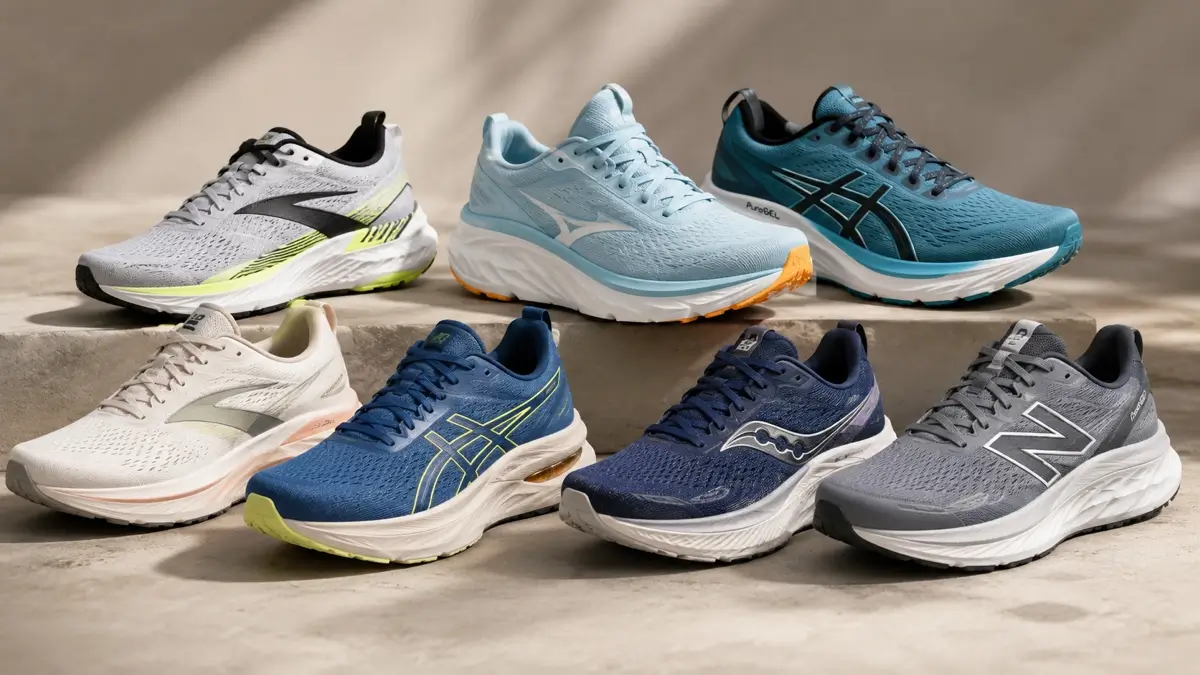
| Quick Answer: Best Shoes for Plantar Fasciitis. The best running shoe for plantar fasciitis in 2026 is the Brooks Adrenaline GTS 25 for runners who benefit from added stability, while the Hoka Bondi 9 is our top choice for maximum cushioning. The Asics Gel-Kayano 33 is a strong option for overpronators, and neutral runners should consider the Brooks Ghost Max 4 or Asics Gel-Nimbus 28. Look for cushioning that reduces impact, a secure heel, appropriate arch support and a shoe that matches your gait rather than choosing based on softness alone. Check the Brooks Adrenaline GTS 25’s latest price. |
Plantar fasciitis can make running uncomfortable because every stride places repeated stress through the heel and arch. The right shoe cannot cure plantar fasciitis, but it can make running more manageable by reducing impact, improving stability and helping your foot move more efficiently.
There is no single shoe that works for everyone with plantar fasciitis. A runner with flat feet and overpronation may need more guidance than someone with high arches and a neutral gait. Some runners also respond better to a higher heel-to-toe drop, while others prefer a rocker-shaped sole that helps the foot roll forward with less bending through the forefoot.
The shoes below are current models available in 2026 and include both neutral and stability options.
Best Running Shoes for Plantar Fasciitis Compared
Running shoe (full reviews linked) | Best for | Support type | Heel-to-toe drop (?) | Cushioning | Price check |
|---|---|---|---|---|---|
Best overall | Stability | 10 mm | Balanced | ||
Maximum cushioning | Neutral | 5 mm | Maximum | ||
Overpronation | Stability | 8 mm | Maximum | ||
Orthotics | Neutral | 6 mm | Maximum | ||
Neutral runners | Neutral | 8 mm | Maximum | ||
Stable daily running | Stability | 6 mm | Maximum | ||
Wide feet | Stability | 6 mm | Maximum |
See also: What is a stability shoe? and What is a neutral shoe?
Brooks Adrenaline GTS 25: Best Overall
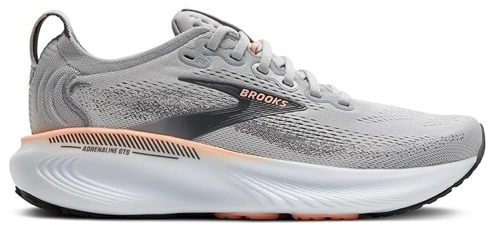
The Brooks Adrenaline GTS 25 is our best overall running shoe for plantar fasciitis because it combines cushioning, stability and a traditional running-shoe feel without becoming excessively rigid.
Brooks uses its GuideRails support system instead of a firm medial post. The system is designed to limit excessive movement when needed rather than forcing the foot into one fixed position. That makes the Adrenaline especially useful for runners who overpronate or whose ankles tend to roll inward as they become tired.
The 10 mm heel-to-toe drop is another reason it may work well for runners dealing with heel pain. A higher drop does not automatically make a shoe better for plantar fasciitis, but some runners find it reduces tension through the calf, Achilles tendon and plantar fascia compared with very low-drop footwear.
The Adrenaline GTS 25 also uses Brooks’ DNA LOFT v3 cushioning, which gives the shoe a protective feel without making it unstable. That balance is important because a shoe that is extremely soft can sometimes allow more foot movement than a runner with plantar fasciitis wants.
Multiple width options are available, which also makes it easier to get a secure fit without squeezing the forefoot.
Best for: Runners who want stability, heel cushioning and a dependable everyday training shoe.
Note: Neutral runners who do not need stability may prefer the Ghost Max 4 or GEL-NIMBUS 28.
Hoka Bondi 9: Best Maximum Cushioning
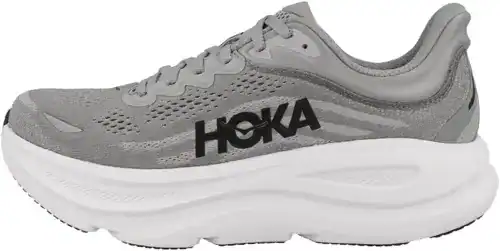
Best for: Heel strikers, heavier runners, recovery runs and runners who prioritize maximum cushioning.
The Hoka Bondi 9 is one of the most cushioned road-running shoes available and is a strong choice for runners whose plantar fasciitis is aggravated by hard landings.
Hoka increased the cushioning underfoot compared with earlier Bondi models and uses a supercritical EVA midsole designed to provide a softer, more responsive ride.
The Bondi also uses Hoka’s rocker-shaped geometry. Rather than requiring the foot to bend sharply through the forefoot, the shoe encourages the body to roll forward during the stride. Some runners with plantar fascia irritation find that motion more comfortable, particularly when the fascia feels tight during toe-off.
Despite the thick sole, the Bondi 9 has a broad platform that helps prevent the shoe from feeling excessively unstable.
It is not, however, a traditional stability shoe. Runners with significant overpronation may be better served by the Asics GEL-KAYANO 33, Brooks Adrenaline GTS 25 or New Balance 860v15.
The Bondi’s 5 mm drop is also lower than the Adrenaline’s. If you normally run in shoes with a higher drop, transition gradually rather than immediately putting long mileage into the Bondi.
Note: The high stack and substantial construction may feel bulky to runners who prefer a lighter, more flexible shoe.
Asics Gel-Kayano 33: Best for Overpronation
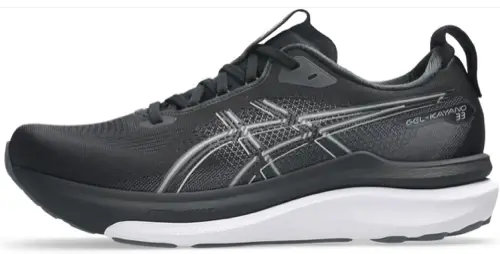
Best for: Runners with overpronation, low arches or a preference for substantial stability and cushioning.
The Asics Gel-Kayano 33 is one of the strongest options in 2026 for runners who have plantar fasciitis along with flat feet or excessive inward rolling of the foot.
The biggest change in this generation is Asics’ FLUIDSUPPORT system, which replaces the support approach used in the previous Kayano. The system is designed to provide adaptive guidance while allowing the foot to move more naturally through the stride.
Asics combines FF Blast Plus and FF Blast Max cushioning in the midsole, giving the shoe a plush feel while maintaining enough structure for stability. Rearfoot PureGEL adds additional impact protection at the heel, which is particularly relevant for runners whose plantar fasciitis pain is concentrated near the heel bone.
The Kayano 33 retains an 8 mm drop, placing it between lower-drop shoes such as the Bondi 9 and higher-drop models such as the Adrenaline GTS 25.
This is still a substantial shoe, but modern Kayano models feel very different from the rigid motion-control shoes that once defined the stability category.
Note: Neutral runners may find the support system more than they need.
Brooks Ghost Max 4: Best for Orthotics

Best for: Neutral runners, runners using orthotics and anyone who wants maximum cushioning on a broad platform.
The Brooks Ghost Max 4 is a strong option for runners who want substantial cushioning without traditional stability control.
That makes it particularly useful for runners who already use custom or over-the-counter orthotics. Combining a corrective orthotic with a strongly guided stability shoe can sometimes produce more intervention than a runner actually needs.
The Ghost Max 4 uses Brooks’ DNA LOFT v3 cushioning beneath a broad platform. That wide base is important because it helps provide inherent stability even though the shoe is technically neutral.
Brooks also uses GlideRoll Rocker geometry, which helps move the foot from landing toward toe-off with less effort. This type of rocker can be useful for runners who find that bending through the forefoot aggravates plantar fascia discomfort.
The 6 mm heel-to-toe drop is moderate rather than extreme. Runners moving from a 10 mm or 12 mm shoe should still allow time for their calves and Achilles tendons to adjust.
The shoe also provides enough internal space to accommodate many orthotics without making the upper feel excessively tight.
Note: The high stack can feel less nimble during faster workouts.
Asics GEL-NIMBUS 28: Best Neutral Cushioned Option
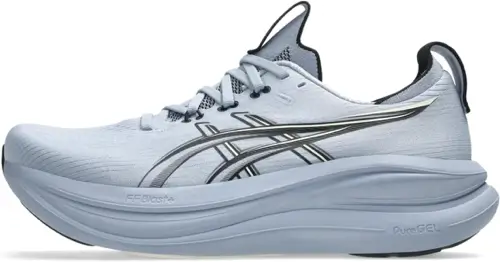
Best for: Neutral runners, runners with high arches and runners who prioritize soft heel cushioning.
Not everyone with plantar fasciitis needs a stability shoe. If your gait is neutral or you have high arches, cushioning and shock absorption may matter more than pronation control. The Asics GEL-NIMBUS 28 is one of the strongest choices for that type of runner.
The Nimbus uses FF Blast Plus cushioning and rearfoot PureGEL to soften landings. Asics also reduced the weight compared with the previous generation, helping the shoe feel less cumbersome despite its high level of cushioning.
The 8 mm heel-to-toe drop gives the Nimbus a fairly conventional running geometry. That can make it easier to adapt to than very low-drop shoes for runners whose plantar fascia, calves or Achilles tendons are already irritated.
The upper is designed to hold the foot securely without relying on rigid overlays, while the broad midsole gives the shoe a stable feel despite its neutral classification.
This is also a good option for long runs because the cushioning helps maintain comfort as the feet become fatigued.
Note: Runners with significant overpronation should consider the Gel-Kayano 33 instead.
Saucony Guide 19: Best Stable Daily Trainer
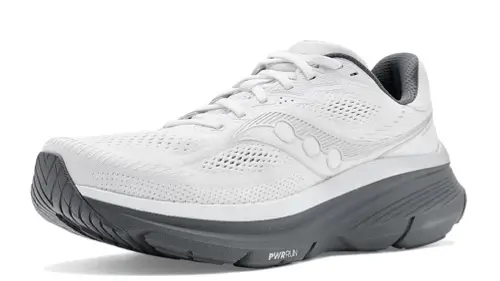
Best for: Mild to moderate overpronators who want a stable everyday trainer.
The Saucony Guide 19 provides stability without feeling like an old-fashioned motion-control shoe.
Saucony uses its CenterPath approach, which combines broad geometry, sidewalls and platform design to guide the foot through the stride. Instead of placing a conspicuously firm section beneath the arch, the shoe creates stability through its overall shape.
That can work well for runners who need support but dislike feeling a hard stability feature beneath the foot.
The Guide 19 uses PWRRUN cushioning and has a 6 mm heel-to-toe drop. The cushioning is substantial enough for daily mileage while still providing enough responsiveness that the shoe does not feel overly soft.
Saucony has also made the forefoot more flexible than some highly structured stability shoes. Whether that feels better for plantar fasciitis depends on the runner. Some people prefer flexibility, while others feel more comfortable in a rocker-shaped or stiffer shoe.
Its greatest strength is versatility. The Guide 19 can handle everyday training, longer runs and walking without feeling excessively specialized.
Note: Runners who prefer a higher drop may feel more comfortable in the Adrenaline GTS 25.
New Balance Fresh Foam X 860v15: Best for Wide Feet
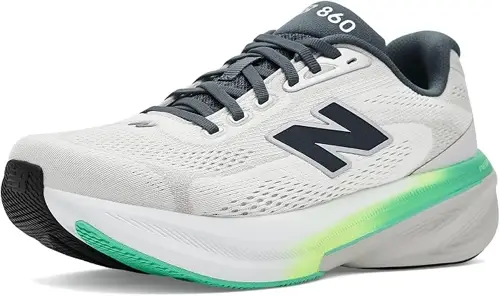
Best for: Runners with wide feet, overpronation or difficulty finding a stable shoe that fits properly.
Fit is particularly important when you are dealing with plantar fasciitis.
A shoe that is too narrow can change how your foot moves, while a loose heel can create unnecessary motion. The New Balance Fresh Foam X 860v15 stands out because it combines dedicated stability with a broad range of width options.
The 860v15 uses Fresh Foam X cushioning along with New Balance’s Stability Plane technology. Rather than relying on a traditional hard medial post, the shoe creates a controlled platform beneath the foot.
A rocker profile helps move the body forward during the stride, while the cushioning provides substantial protection for the heel.
The 860 is not a lightweight performance shoe. Its focus is support, comfort and durability, which may be exactly what runners with plantar fasciitis want for easy mileage.
New Balance typically offers the 860 in narrow, standard, wide and extra-wide fits, giving runners more flexibility than many competing models.
Note: It may feel heavier than the Saucony Guide 19.
What to Look for in Running Shoes for Plantar Fasciitis
There is no single footwear feature that fixes plantar fasciitis. The best shoe is the one that reduces irritation while matching your foot shape and gait.
Cushioning matters because running repeatedly loads the heel and forefoot, but more cushioning is not always better. A shoe should absorb impact without becoming so soft that your foot has to work harder to remain stable.
Arch support should also match your biomechanics. Runners with low arches and overpronation may benefit from stability features, while runners with high arches often prioritize cushioning and shock absorption.
Heel security is equally important. Your heel should feel secure without excessive pressure around the back of the foot.
Heel-to-toe drop also deserves attention. Switching suddenly from a 10 mm shoe to a zero-drop shoe significantly changes the load placed on the foot, Achilles tendon and calf. If you already have plantar fascia pain, major footwear changes should be gradual. See also: What is shoe drop?
Do You Need Stability Shoes for Plantar Fasciitis?
Not necessarily. Plantar fasciitis describes a painful condition, not a particular gait pattern.
Runners with low arches or excessive pronation may benefit from a stability shoe (what is it?) such as the Brooks Adrenaline GTS 25, Asics GEL-KAYANO 33, Saucony Guide 19 or New Balance 860v15.
Neutral runners may be better served by the Hoka Bondi 9, Brooks Ghost Max 4 or Asics Gel-Nimbus 28.
The important point is to match the shoe to your biomechanics rather than assuming everyone with plantar fasciitis needs the same amount of support.
Are Highly Cushioned Shoes Better for Plantar Fasciitis?
Highly cushioned shoes can make running more comfortable by reducing how harshly the ground feels beneath an irritated heel. However, softness and support are not the same thing.
A very soft shoe may feel comfortable when you first put it on but allow more motion than your foot tolerates during longer runs. That is why shoes such as the Hoka Bondi 9 and Brooks Ghost Max 4 use broad platforms to accompany their thick cushioning.
If you overpronate, a maximum-cushion stability shoe such as the Asics Gel-Kayano 33 may be more appropriate.
Should You Run With Plantar Fasciitis?
Whether you should continue running depends on how severe your symptoms are and whether running makes them worse.
Mild discomfort that remains stable may be managed differently from sharp pain that causes you to limp or change your gait. Continuing to run through substantial pain can also create compensations elsewhere in the body.
Plantar fasciitis is often most noticeable during the first few steps after getting out of bed or after sitting for a long time. If your pain is persistent, worsening or changing the way you walk or run, consider seeing a podiatrist, sports medicine physician or physical therapist.
Running shoes can help manage mechanical load, but they are not a substitute for diagnosis or treatment.
Can You Use Orthotics With Running Shoes for Plantar Fasciitis?
Yes. Many running shoes have removable factory insoles that can be replaced with over-the-counter or custom orthotics. See our orthotics guide for plantar fasciitis.
The Brooks Ghost Max 4 is particularly well suited to this because it combines a neutral platform with substantial cushioning and enough internal room for many inserts.
An orthotic changes the fit and geometry inside the shoe, however. After installing it, make sure your heel remains secure and that the upper does not become too tight.
If you use custom orthotics, bring them with you when trying on running shoes.
Best Alternatives
If the Brooks Adrenaline GTS 25 does not suit your foot, the Asics GEL-KAYANO 33 is the strongest alternative for runners who still want significant stability. The Kayano provides a softer, more substantial ride and may appeal to runners who want more cushioning under the heel.
The Hoka Arahi 9 is another option for runners who need support but prefer the geometry and rocker feel associated with Hoka. Its latest H-Frame system provides guidance without making the shoe feel like a traditional motion-control trainer.
For neutral runners, the Asics Gel-Nimbus 28 is the better choice if softness and long-distance comfort matter most. It provides generous cushioning without adding stability features that may be unnecessary for a neutral gait.
The Brooks Ghost Max 4 is the alternative to prioritize if you use orthotics or want a broad, stable platform without moving into a dedicated stability shoe.
More Plantar Fasciitis Resources
- Use our shoe finder to get a custom recommendation
- Best shoes for plantar fasciitis for men
- Best shoes for plantar fasciitis for women
- Best walking shoes for plantar fasciitis
- Ultimate plantar fasciitis guide
Frequently Asked Questions About Running Shoes for Plantar Fasciitis
The Brooks Adrenaline GTS 25 is our best overall choice because it combines cushioning, a 10 mm heel-to-toe drop and GuideRails stability. Neutral runners may prefer the Hoka Bondi 9 or Brooks Ghost Max 4.
Some Hoka models work well for runners with plantar fasciitis because they combine substantial cushioning with rocker-shaped soles. The Bondi 9 is our preferred maximum-cushion option, while the Arahi 9 is better suited to runners who want additional stability.
Brooks offers several shoes that may work well for runners with plantar fasciitis. The Adrenaline GTS 25 is the stronger option for runners who need stability, while the Ghost Max 4 is better suited to neutral runners or those using orthotics.
Some runners find a moderate or higher drop more comfortable because it alters loading through the heel, plantar fascia, Achilles tendon and calf. There is no single correct drop for everyone.
They should provide support appropriate to your foot. Runners with low arches may prefer a stability shoe, while runners with high arches often benefit more from cushioning and shock absorption.
They are not automatically good or bad, but switching suddenly to zero-drop footwear can increase loading through the foot and lower leg. Runners already dealing with plantar fascia pain should make major footwear changes gradually.
Replace running shoes when the cushioning or support noticeably deteriorates, even if the outsole still looks acceptable. A shoe that once felt comfortable but begins leaving your heel or arch sore after normal runs may be worn out.
No. Running shoes can help manage impact and mechanical load, but plantar fasciitis can also involve training volume, calf tightness, foot mechanics and tissue capacity. Persistent heel pain should be evaluated by a qualified health professional. See more about plantar faciitis healing time.