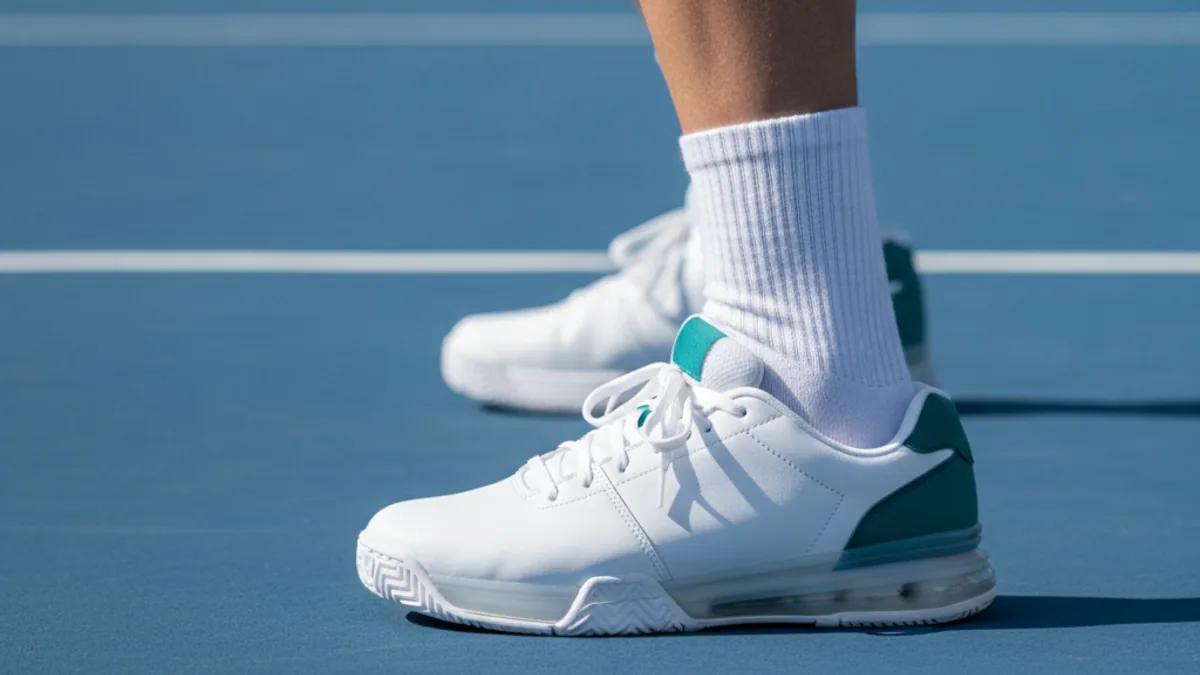
Quick Answer: K-Swiss Ultrashot 4 Review: The K-Swiss Ultrashot 4 is a sturdy, durability-first hard-court tennis shoe for players who wear through outsoles and want a planted feel on hard cuts. A new wraparound plastic support chassis and a graphite arch insert keep the shoe from twisting, while tough Aosta rubber with toe reinforcement is built for sliding and toe-dragging. It also works for pickleball. The trade-offs are weight, a stiff feel that takes a few sessions to soften and no wide option we could find. Check latest price.
The K-Swiss Ultrashot 4 is the brand’s performance flagship for tennis, and K-Swiss sells it to pickleball players too. K-Swiss pitches it as the newest version of the shoe its ATP and WTA players wear. It is built around one idea: a shoe that holds its shape and survives hard use.
That makes it a shoe for a specific player. If you slide on hard courts, drag your back foot on the serve or play several times a week, the Ultrashot 4 is aimed squarely at you. If you play socially once a week and want something light and comfortable straight from the box, a softer, lighter shoe will make you happier.
The fourth version adds a new support chassis and a more breathable upper, two changes aimed at the most common gripes with earlier Ultrashots: stability on wide balls and heat on summer days.

K-Swiss Ultrashot 4 men’s tennis shoe in white and blue, side view. Image: Amazon
Specs
Here are the specifications for the K-Swiss Ultrashot 4:
| Type | Durability-focused performance tennis shoe; also sold for pickleball |
| Best for | Frequent hard-court players, sliders and toe-draggers |
| Midsole | Surge 7.0 compression-molded EVA foam |
| Heel | ShockFrame molded TPU under the heel for shock absorption and support |
| Stability | 360-degree plastic support chassis plus a graphite winglet under the arch |
| Upper | DuraMesh with TPU yarn and DuraPrint overlays, more ventilated than earlier Ultrashots |
| Outsole | Aosta 7.0 rubber with DragGuard 7.0 in high-wear areas |
| Weight | About 16 oz in a men’s US 10.5 (retailer figure) |
| Width | Standard; no wide version found |
| Price | Check latest price |
Pros
- The plastic chassis keeps your foot on the platform when you push off hard for a wide ball.
- Tough Aosta rubber and DragGuard toe reinforcement are built for players who chew through outsoles.
- Specialist retailers sell it with a six-month outsole durability guarantee, which takes some of the risk out of the price.
- A more open, breathable upper than earlier Ultrashots helps on hot days.
- Works for both tennis and pickleball, so one pair can cover both sports.
Cons
- At about 16 oz in a men’s 10.5, it is one of the heavier court shoes, and you feel it late in a match.
- Stiff when new, so expect a few sessions before it feels settled.
- No wide version found, and the plastic chassis will not stretch for a broad foot.
- Firm underfoot rather than plush, and far too stiff for walking.
What K-Swiss changed from the Ultrashot 3
The biggest change is the new 360-degree support chassis. It is a molded thermal plastic frame that wraps the midfoot and heel, so the upper cannot slide off the sole when you load the outside edge of the shoe. Plastic does not stretch, which is exactly the point: on a hard cut, the platform under your foot stays put instead of rolling over. For the buyer, that means more confidence when you plant and push back toward the middle of the court.
The second change is ventilation. Earlier Ultrashots were not the most breathable shoes, and this version uses a more open DuraMesh upper woven with TPU yarn for strength. TPU is a tough, flexible plastic, so the mesh can be more open without tearing as easily. DuraPrint overlays reinforce the areas that take the most abuse.
Underneath, the ShockFrame, a molded TPU piece under the heel, adds shock absorption and guidance, and the graphite winglet under the arch stiffens the shoe so it does not twist along its length. The Surge 7.0 midsole and Aosta 7.0 outsole carry the Ultrashot’s durability-first approach forward.
Who should buy the K-Swiss Ultrashot 4
Buy it if you go through shoes quickly. Players who slide, drag a toe on the serve or play four or five times a week often spend more replacing worn-out shoes than they would on one tougher pair. The Ultrashot 4 is designed to last, and the retailer-backed outsole guarantee lowers the risk.
It suits aggressive, scrambling players. The chassis and graphite winglet are both there to stop the shoe from twisting, so if a lighter shoe has ever felt like it gave way under you on a wide ball, this one should feel planted by comparison.
Pickleball players are a good match too. K-Swiss sells the Ultrashot 4 for pickleball, and the quick, repeated stops and starts of that game wear outsoles in exactly the way this one is built to resist. The smaller court also means you cover less ground, so the extra weight matters less.
Who should probably skip it
Skip it if you want a light, quick shoe. At around 16 ounces, it is a lot to move around for two hours, and players whose game depends on first-step speed will feel slower in it than in a modern lightweight shoe.
Skip it too if you play once a week, because you will rarely reach the kind of wear that justifies such a heavily built shoe. And skip it if your feet are wide: we could not find a wide version, and the plastic frame does not give the way a soft fabric upper would. If you have ongoing foot or ankle pain, talk to a professional rather than expecting a shoe to solve it.
These are better fits for those players:
- Nike Vapor Pro 3: a lighter, speed-focused hard-court shoe for players who would rather be quick than armored (check price | read review)
- Adidas Gamecourt 2: an entry-level tennis shoe for once-a-week players who want comfort without a heavy build (check price)
- Nike GP Challenge Pro: a cushioned court shoe with a wider forefoot base and a padded upper, for broader feet (check price)
Not sure which court shoe suits your feet? Our Free Shoe Finder can help you narrow it down.
Fit: secure and structured, with no room to stretch
The Ultrashot 4 fits like a traditional performance court shoe: secure through the midfoot, firm at the sides and locked in at the heel. Because the chassis is plastic, what you feel in the store is close to what you get. The upper will soften a little with wear, but the frame around it will not stretch.
Start with your usual tennis shoe size, and make sure there is a little space in front of your toes, since every hard stop pushes your foot forward. Do not size up to make room for a wide foot. A longer shoe still has the same narrow structure, and the extra length lets your heel slip.
Expect the shoe to feel stiff for the first few sessions. That is normal for a heavily built court shoe and not a sign that you chose the wrong size. Wearing it for a couple of shorter hits before a long match is a sensible way to let it settle.

K-Swiss Ultrashot 4 side view showing the 360-degree support chassis, ShockFrame and Aosta 7.0 outsole. Image: Amazon
On court: planted on cuts, firm underfoot, heavier on sprints
Side-to-side movement is where the Ultrashot 4 earns its reputation. When you push off for a wide forehand, the chassis keeps the upper over the sole and the graphite winglet stops the shoe from twisting, so the base stays flat under your foot. That steadiness lets you commit to the shot instead of hedging.
Cushioning is firm. Surge 7.0 is a compression-molded EVA, meaning the foam is pressed into shape so it ends up denser and slower to flatten than cheaper foams. The ShockFrame under the heel takes some of the sting out of landings, but this is a protective shoe rather than a soft one. Players coming from a plush shoe will notice the firmer feel right away.
Forward speed is the trade-off. Sprinting in for a drop shot, you can feel the extra weight compared with a lighter speed shoe. It is not clumsy, but it is deliberate, and singles players who cover a lot of ground should weigh that against the durability.
Stability in a tennis shoe is about stopping the shoe from rolling over or twisting sideways, not about guiding your arch the way a running stability shoe does. The Ultrashot 4 does the tennis job well, but it does not correct how your foot moves and cannot prevent injuries.
Outsole and durability: built for players who wear shoes out
The Aosta 7.0 rubber is dense and heavily patterned for grip in every direction on hard courts. DragGuard 7.0 reinforcement sits in the high-wear zones, including the toe, which is the first place a serve-and-drag player wears through. Retailers note that the outsole is optimized for hard courts, so traction drops on clay, where K-Swiss sells a separate clay version.
Durability is the point of the shoe. Specialist retailers back the outsole with a six-month guarantee, though terms vary by store, so check the details where you buy. The upper and foam still age on their own schedule, and how long any tennis shoe lasts depends on how often you play, how much you slide and how rough your courts are.

K-Swiss Ultrashot 4 Aosta 7.0 outsole tread. Image: Amazon
Is the K-Swiss Ultrashot 4 good for walking?
Not really. Court shoes are built flat, stiff and heavy to resist sideways forces, and none of that helps when you walk in a straight line. The firm frame resists the natural heel-to-toe roll of a walking step, and at around 16 ounces per shoe you are lifting real weight with every stride.
It is fine for the walk from the parking lot to the court or for standing around between matches. For travel, errands or long days on your feet, a cushioned walking shoe will be lighter and much more comfortable. Our best walking shoes guide is a good place to start.
K-Swiss Ultrashot 4 vs. K-Swiss Ultrashot 3
Here is what changed, based on K-Swiss’ feature list and retailer descriptions:
Ultrashot 4 | Ultrashot 3 | |
Support chassis | New 360-degree plastic chassis | No full wraparound chassis |
Upper | More open DuraMesh with TPU yarn | Less breathable |
Heel | ShockFrame molded TPU | Earlier heel setup |
Status | Current model | Previous model |
Buy the Ultrashot 4 when you play in warm weather or want a more locked-in feel on hard cuts, since those are the two areas K-Swiss targeted. The Ultrashot 3 can still make sense if you already like its fit and mostly play indoors, where heat matters less.
To compare different court-shoe fits, read our K-Swiss Hypercourt Express 3 review and Wilson Rush Tour 5 review.
K-Swiss Ultrashot 4 Alternatives
If you like the idea of a tough, supportive hard-court shoe but want a different feel underfoot, the Asics Gel-Resolution X is the other long-standing choice for players who grind shoes down. It is similarly structured and substantial, with Asics’ gel cushioning in place of K-Swiss’ firm foam (check price).
The Adidas Barricade 14 takes a similar stability-first approach in a lighter, lower-to-the-ground package than earlier Barricades, which suits players who want support without quite as much bulk (check price).
Women who want more cushioning for long matches should consider the New Balance Coco CG2. Its thicker foam and carbon plate trade some of the Ultrashot’s ground feel for extra comfort over three sets (check price | read review).
Playing mostly pickleball? Our best pickleball shoes guide covers court shoes built for that game.
Price and value
The Ultrashot 4 is priced at the premium end of the tennis shoe market, and the value case rests on durability rather than comfort or speed. If you currently replace shoes every few months, a pair that lasts noticeably longer can cost less per month of play, and a retailer-backed outsole guarantee lowers the risk further. If you play once a week, you are paying for toughness you may never use, and a lighter, cheaper shoe will serve you better.
Final verdict
Best for: frequent hard-court tennis and pickleball players, sliders and toe-draggers who are tired of wearing through outsoles.
Avoid if: you want a light shoe, play once a week, have wide feet or need comfort from the very first session.
Fit: true to length for most, secure and structured, with no wide version found and sides that will not stretch.
Verdict: The K-Swiss Ultrashot 4 is a heavy, durable, planted court shoe that rewards players who play often and play hard. Give it a few sessions to settle, and it should outlast lighter rivals. Check the latest price.
Frequently Asked Questions for K-Swiss Ultrashot 4
Specialist retailers sell it with a six-month outsole durability guarantee. Terms vary by store, so check the details where you buy and keep your receipt.
Yes. K-Swiss sells it for pickleball as well as tennis, and its tough outsole suits the quick, repeated movements of pickleball.
We could not find a wide version. The plastic chassis makes the sides firm, so players with broad feet should try a court shoe with a wider forefoot.
Retailers list about 16 oz for a men’s US 10.5, which makes it one of the heavier tennis shoes. The weight comes from the tough outsole and support chassis.
The standard version is optimized for hard courts. K-Swiss also sells an Ultrashot 4 Clay with an outsole designed for clay, so buy that one if clay is your main surface.
Expect it to feel stiff at first. The structured upper and plastic chassis soften slightly over a few sessions, so try a couple of shorter hits before a long match.