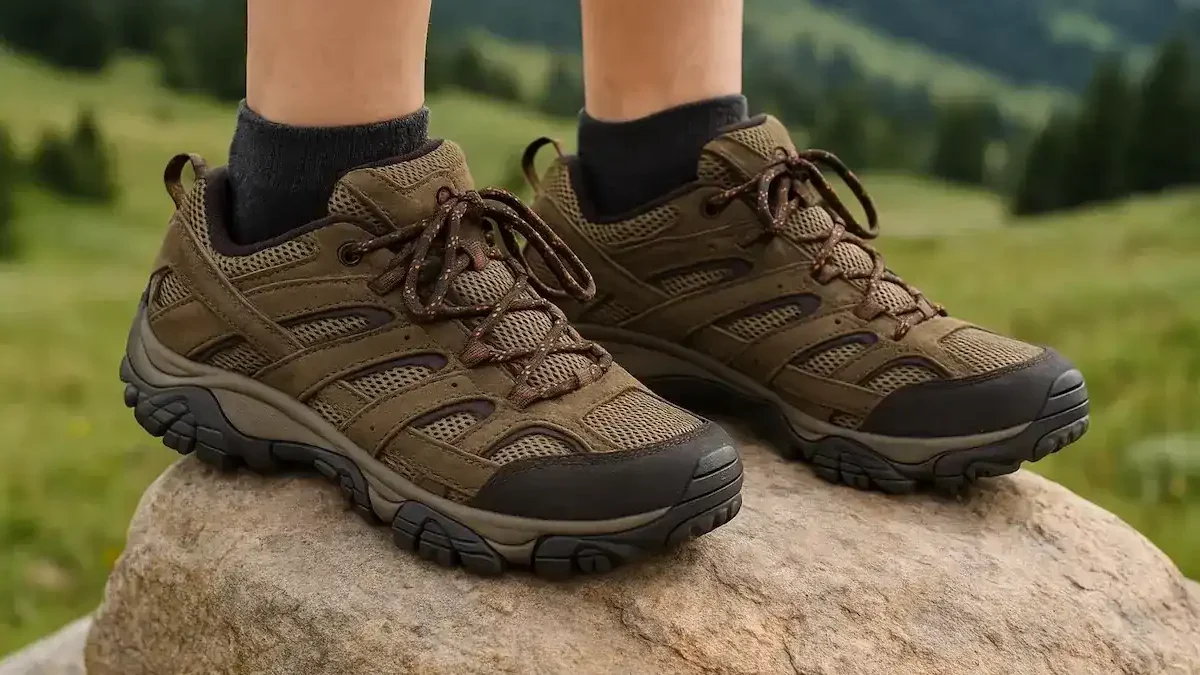
Out-of-the-box comfort with considerable weight
Quick Answer: Merrell Moab 3 review.The Merrell Moab 3 is a durable hiking shoe with a roomy fit, strong Vibram traction and very little break-in time. The standard low-cut model is the best choice for dry trails and warmer weather, while Merrell also offers low-cut waterproof, Mid Waterproof and Mid Gore-Tex versions for wetter conditions and more ankle coverage. All use a 11.5 mm drop and 5 mm lugs. The trade-off is weight. Even the standard Moab is heavy compared with modern trail shoes, and the waterproof boots add more weight and run warmer. Check latest price.
The Merrell Moab 3 is not just one shoe. It is a family of hiking shoes and boots built around the same basic platform. The standard Moab 3 reviewed here is the low-cut, non-waterproof version, but Merrell also sells a low-cut Waterproof model, a Mid Waterproof boot and a Mid Gore-Tex boot. That matters because the right Moab depends as much on weather and terrain as it does on fit. For help choosing between hiking shoes, boots and trail runners, see our complete hiking shoes and boots guide.
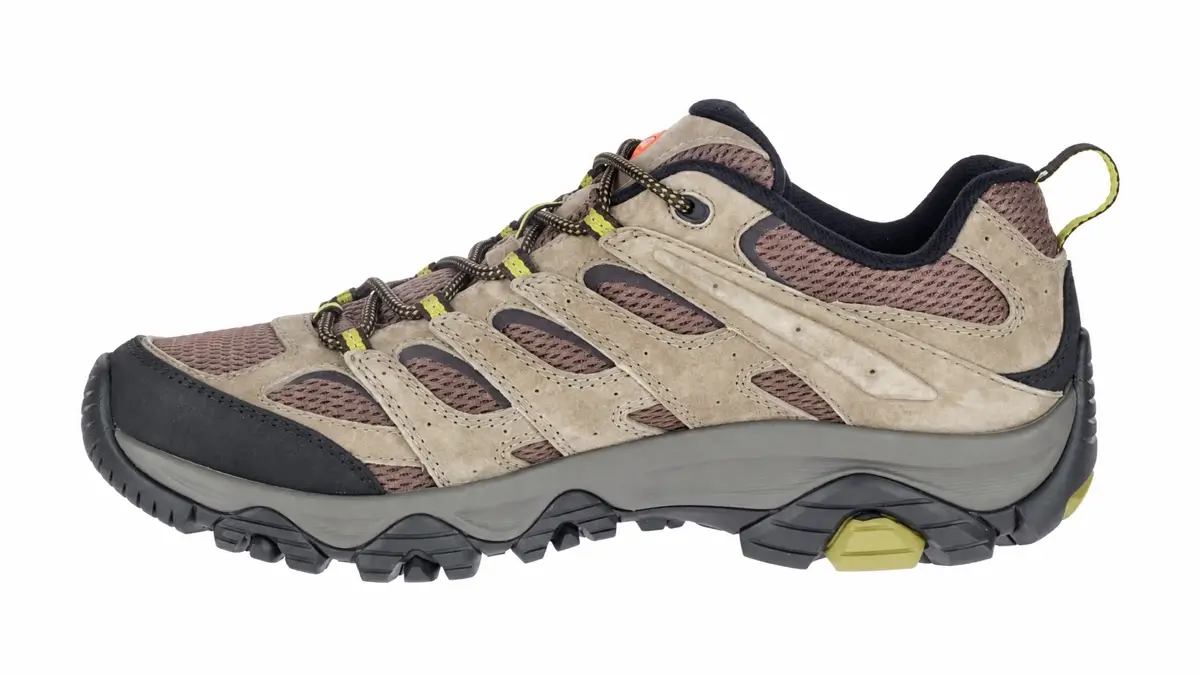
The basic formula stays remarkably consistent. You get a suede-and-mesh upper, a removable contoured footbed, Merrell Air Cushion in the heel, a Super Rebound Compound midsole and a Vibram TC5+ outsole with 5 mm lugs. The 11.5 mm heel-to-toe drop also remains the same across the main versions.
What changes is coverage, waterproofing and weight. The standard low shoe is the coolest and lightest choice. The Waterproof shoe adds a membrane without covering the ankle. The Mid Waterproof turns the Moab into a true hiking boot, while the Mid Gore-Tex uses a Gore-Tex membrane instead of Merrell’s standard waterproof system.
Specs
Here are the specifications for the Merrell Moab 3:
| Specification | Merrell Moab 3 |
|---|---|
| Type | Day-hiking shoe and boot family |
| Best for | Day hikes, mixed trails, travel, uneven ground and light outdoor work |
| Midsole | Super Rebound Compound with Merrell Air Cushion in the heel |
| Insole | Removable contoured Moab 3 footbed |
| Heel-to-toe drop | 11.5 mm |
| Lug depth | 5 mm |
| Men’s published weight | Moab 3: 460 g; Moab 3 Waterproof: 480 g; Mid Waterproof: 495 g; Mid Gore-Tex: 490 g per shoe |
| Upper | Pig suede leather and breathable mesh |
| Outsole | Vibram TC5+ |
| Versions | Low, low Waterproof, Mid Waterproof and Mid Gore-Tex; wide options are available on selected versions |
| Price | Launched at about $110 in September 2022, approximate. Check latest prices |
Which Merrell Moab 3 version should you buy?
The standard Moab 3 is the model to choose if you mostly hike in dry or warm conditions. It is the simplest version, lets more heat escape than the waterproof models and weighs about 460 g per shoe in the men’s version. You still get the Vibram TC5+ outsole, 5 mm lugs, protective toe cap and the same basic Moab fit. Check price & availability.
Choose the Moab 3 Waterproof if you want to keep the low-cut feel but regularly walk through wet grass, mud, puddles or rainy trails. Merrell adds a waterproof membrane that is designed to keep water out while allowing some moisture to escape. The men’s version weighs about 480 g per shoe. Check price & availability.
The Moab 3 Mid Waterproof is the more relevant choice if you are specifically shopping for a hiking boot. It extends the upper above the ankle, which provides more coverage from mud, water and trail debris. It uses Merrell’s waterproof membrane rather than Gore-Tex and weighs about 495 g per shoe in the men’s version. The extra height does not automatically prevent ankle injuries, but some walkers prefer the more enclosed and secure feeling of a mid-height boot. Check price & availability.
The Moab 3 Mid Gore-Tex is very similar in purpose but uses a Gore-Tex waterproof membrane. Merrell lists the men’s version at about 490 g per shoe. I would choose between the two waterproof mids based on fit, price and whether you specifically want Gore-Tex rather than assuming one will automatically perform better for every walker. Check price & availability.
Version | Best for | Men’s published weight |
|---|---|---|
Moab 3 | Dry trails, warm weather, general hiking | 460 g |
Moab 3 Waterproof | Wet trails without a boot-height upper | 480 g |
Moab 3 Mid Waterproof | Wet conditions, debris and buyers who want a hiking boot | 495 g |
Moab 3 Mid Gore-Tex | Same general use with a Gore-Tex membrane | 490 g |
For most walkers, the decision is straightforward. Stay with the regular Moab 3 if waterproofing is not important. Choose the low Waterproof if you want weather protection without a boot. Move to one of the Mid versions if you specifically want the additional coverage of a hiking boot.
Pros
These are the reasons it outsells everything else:
- Comfortable from the first wear, with no break-in period
- Vibram TC5+ outsole grips rock, gravel and packed dirt far better than the previous rubber
- Roomy fit and genuine wide widths, which is unusual in hiking footwear
- Removable contoured insole, so it works with a custom orthotic
- Offered as a low shoe, a waterproof version and a mid boot, so one fit works across conditions
- Cheaper than most technical hiking shoes, with a suede and mesh upper that lasts
Cons
These are the compromises:
- Heavy at roughly 16 ounces per shoe in men’s sizes, which is felt over a long day
- Firm and flat compared with modern cushioned hiking shoes
- Not especially breathable, particularly in the waterproof versions
- The high 11.5 mm drop suits walking but feels dated if you prefer a lower platform
- No rock plate, so sharp stones are noticeable on rough ground
What is new versus the Merrell Moab 2
The outsole is the significant upgrade. The Moab 2 used Merrell’s own rubber, which was adequate on dry dirt and unreliable on wet rock. Fitting a Vibram TC5+ raises the shoe’s grip to the standard of far more expensive hiking footwear, and it is the change most likely to keep you upright on a damp descent.
Merrell also softened the midsole and fitted the Kinetic Fit BASE insole, a contoured removable footbed that supports the arch better than the flat insert the Moab 2 used. Together they take some of the harshness out of a full day on gravel and hard-packed trail, which was the most consistent criticism of earlier versions.
Beyond that, Merrell increased the use of recycled materials in the upper and lining and tidied the construction. The fit, the shape and the general character are unchanged, which is deliberate: this is a shoe millions of people already know fits them, and Merrell was careful not to break that.
Who should buy the Merrell Moab 3
Buy the Moab 3 if you want a hiking shoe that feels comfortable and usable straight out of the box. Day hikers, travelers, dog walkers and anyone spending a few hours on mixed terrain are the core audience. Its roomy shape, stable platform and minimal break-in period help explain why the Moab has remained so popular.
It is an especially good option if fit has been a problem with other hiking shoes. The Moab is available in genuine wide widths, and the toe box is fairly generous even in the standard version. That gives feet more room to swell and spread during longer walks. The removable insole also makes the shoe relatively easy to use with a custom orthotic.
The range of Moab 3 versions makes the fit easier to stick with across different conditions. The standard low-cut model works well for warmer, drier weather. The low Waterproof version adds protection from rain and wet trails without the extra coverage of a boot. The Mid Waterproof and Mid Gore-Tex versions extend above the ankle for more protection from mud, water and trail debris.
The Mid Waterproof is not an insulated winter boot, so it should not be treated as a direct replacement for dedicated cold-weather footwear. But if you already know the Moab shape works for your feet, moving between the low, waterproof and mid-height versions lets you keep a familiar fit while adapting to different weather and trail conditions.
Who should avoid the Merrell Moab 3
Avoid it if you count grams. At roughly 16 ounces per shoe in men’s sizes this is heavy, and on a long day that adds up. Modern lightweight hiking shoes and trail running shoes weigh a third less and cover the same ground, so anyone walking serious distances should consider them.
Avoid it if you want cushioning. The Moab 3 is softer than the Moab 2 but it remains firm and flat by current standards, and there is no rock plate, so sharp stones are felt on rough ground. Walkers with sensitive feet will be more comfortable in a cushioned trail shoe.
Finally, this is a hiking shoe rather than a running shoe. It is too heavy and too stiff for running, and the waterproof versions in particular run warm, so anyone hiking in hot, dry conditions should stick to the ventilated model or look elsewhere entirely.
How does the Merrell Moab 3 fit?
Here is how this hiker fits.
Fit and sizing
The Moab 3 fits true to size with a generous toe box and a moderately secure midfoot. That shape is the shoe’s greatest asset, because feet swell over a day of hiking and a roomy front is what prevents black toenails on descents.
Wide widths are available across the range, which is unusual for hiking footwear and a genuine reason to choose the Moab. The Kinetic Fit BASE insole lifts out, so a custom orthotic fits without cramping the shoe, though the fit will tighten a little.
Upper and step-in comfort
Step-in comfort is the whole selling point. The suede leather and mesh upper is soft where it touches the foot, the collar is well padded and the bellows tongue, meaning it is stitched to the sides, keeps trail grit from working its way in. There is no break-in period at all, which cannot be said of most leather hiking footwear.
Breathability is moderate in the ventilated version and poor in the waterproof and Gore-Tex ones, which is the standard trade for keeping water out. The toe cap is substantial and does its job when you catch a rock.
How does the Merrell Moab 3 perform?
Here is how it performs.
Cushioning and underfoot feel
The midsole is EVA with an Air Cushion unit in the heel, a small pocket designed to absorb the impact of a heel-first landing. Softening the foam for this version helps, and the contoured insole adds arch support that the Moab 2 lacked, but the overall feel remains firm and grounded rather than plush.
That firmness has an upside. A hiking shoe that sinks under you is unstable on uneven ground, and the Moab’s platform stays predictable when you step across a rock or a root. The absence of a rock plate is the real gap, since sharp stones on rough trail are felt more than they would be in a shoe with one.
Stability and support on the trail
The Moab 3 is a neutral shoe. Stability comes from a wide, firm platform and a supportive heel counter rather than from anything designed to limit inward roll of the foot. In practice that combination is steady on uneven ground, which is what hiking asks for, and the mid-height boot version adds ankle coverage for anyone who wants it.
Hikers who overpronate significantly, meaning the ankle rolls inward and the arch flattens under load, will not find dedicated correction here, though the removable insole makes it easy to add an orthotic. Persistent foot or ankle pain deserves a professional assessment rather than a footwear fix.
Outsole, grip and durability
The Vibram TC5+ outsole is the reason to buy the 3 over the 2. The compound stays grippy on wet rock, and the 5 mm lugs are deep enough to bite into loose dirt and gravel without being so aggressive that pavement becomes uncomfortable. It is a well-judged pattern for mixed hiking rather than a specialist mud or rock design.
Durability is a long-standing Moab strength. Suede leather resists abrasion, the toe cap protects the most vulnerable area and Vibram rubber wears slowly. Mileage guidelines from running are not a useful measure here, but a Moab typically lasts seasons rather than months for a weekend hiker.
Is the Merrell Moab 3 good for walking?
On trails and uneven ground, yes, and that is exactly what it is designed for. The 11.5 mm drop suits a heel-first walking stride, the firm platform stays steady when the ground tilts, the Vibram outsole grips wet rock and wooden steps, and the roomy toe box means feet that swell over several hours have somewhere to go. The absence of a break-in period is genuinely useful for people who hike occasionally rather than constantly.
On pavement it is less convincing. The Moab is heavy, the midsole is firm and the 5 mm lugs are more than a sidewalk needs, so a few miles of city walking is noticeably harder work than it would be in a cushioned walking shoe. For a mixed day that ends on concrete it is fine. For a daily walking shoe, buy something lighter and softer.
More walking shoes here.
Moab 3 vs. Moab 2
Here is how the two generations compare:
Moab 3 | Moab 2 | |
Outsole | Vibram TC5+ | Merrell’s own rubber |
Wet rock grip | Confident | Unreliable |
Midsole | Softer EVA | Firmer and flatter |
Insole | Contoured Kinetic Fit BASE | Flatter insert |
Fit | Unchanged, still roomy | Roomy |
Buy the 3 for the outsole alone if you hike anywhere damp or rocky. Buy the 2 while it is discounted if your walking is dry and easy and you simply want the familiar Moab fit at the lowest possible price.
Merrell Moab 3 Alternatives
Hikers who find the Moab heavy should consider a cushioned trail running shoe instead. The Hoka Speedgoat 6 weighs far less, protects the feet better on rock and grips with the same class of Vibram outsole, at the cost of the Moab’s leather durability and lower price (check price | read review).
Where the priority is a lighter shoe that still handles trail properly, the Saucony Peregrine 16 is worth comparing. It adds the rock plate the Moab lacks and sits much lower, which suits faster walking, though it wears out sooner than a leather hiking shoe (check price).
Walkers who like the Moab’s fit but want more support for hard ground should look at the Brooks Cascadia 20, which pairs a wide, stable base with more cushioning and a Vibram outsole. It is the middle ground between a hiking shoe and a trail runner (check price).
Anyone whose hiking is mostly gentle paths and city walking would be better served by the Hoka Transport 2. It carries far more cushioning for pavement while keeping a Vibram outsole for the occasional gravel path, and it looks like an everyday shoe rather than a hiking one (check price).
Price and value
The Moab 3 launched at about $110 in September 2022, which was already low for hiking footwear, and it is discounted frequently enough that most buyers pay considerably less. Getting a full Vibram outsole, a leather and mesh upper, a removable contoured insole and genuine wide widths at that price is the reason the shoe dominates its category. It is not the lightest or most cushioned option, but on cost per season of use it is very hard to beat, particularly for people who hike a handful of times a year rather than every weekend.
Final verdict
Best for: day hikes, mixed trails, travel and walkers who need a roomy fit, a wide width or a shoe that is comfortable from the first wear.
Avoid if: you want a light shoe, you need real cushioning underfoot or you are walking mostly on pavement.
Fit: true to size, generous toe box, wide widths available, with a removable insole for orthotics.
Verdict: The Vibram outsole fixes the Moab’s one real weakness and the softer midsole addresses the other, leaving a hiking shoe that is comfortable immediately and grips properly. It is heavy and firm, and it is still the easiest hiking shoe to recommend to most people. You can check size availability before ordering.
Frequently Asked Questions for Merrell Moab 3
Yes, with a generous toe box that suits feet swelling over a long day. Wide widths are available across the range, which is unusual for hiking footwear and one of the main reasons people choose the Moab.
Yes, particularly for trails, gravel, muddy paths and uneven ground. It shares the Moab 3’s roomy fit, Vibram TC5+ outsole and firm, stable platform while adding a waterproof membrane and a higher upper. At about 495 g per shoe in the men’s version, however, it is considerably heavier than a typical walking shoe. It makes more sense for trail walking than for everyday pavement or long days on concrete
Choose the standard Moab 3 for dry trails and warmer weather. Choose the low-cut Waterproof if you want rain and puddle protection without moving to a boot. The Mid Waterproof adds ankle-height coverage and a waterproof membrane, while the Mid Gore-Tex provides similar coverage with a Gore-Tex membrane. All four use the same 11.5 mm drop and 5 mm lug depth.
No, and that is a large part of its appeal. The suede and mesh upper is soft from the first wear and the collar is well padded, so unlike most leather hiking footwear you can take it straight out on a hike.
Yes. The Kinetic Fit BASE insole lifts out and the shoe has enough depth to take most custom devices. Expect the fit to tighten slightly, so the wide width is worth considering if you use a bulky orthotic.
The low shoe is lighter, cooler and fine for maintained trails. The mid boot adds ankle coverage and keeps more debris out, which helps on rough or overgrown ground and when carrying a pack. Ankle height does not prevent injury on its own, so choose on comfort and conditions.
It is reasonable. The platform is stable, the Vibram outsole grips wet ground and the roomy fit suits swollen feet. It is firm rather than cushioned though, so anyone standing all day on concrete will be more comfortable in a shoe with more foam.
Choose the standard Moab 3 for dry trails and warmer weather. Choose the low-cut Waterproof if you want rain and puddle protection without moving to a boot. The Mid Waterproof adds ankle-height coverage and a waterproof membrane, while the Mid Gore-Tex provides similar coverage with a Gore-Tex membrane. All four use the same 11.5 mm drop and 5 mm lug dept
See how the Moab 3 fits into the broader Merrell shoes lineup, including Moab Speed, Agility Peak and barefoot models.