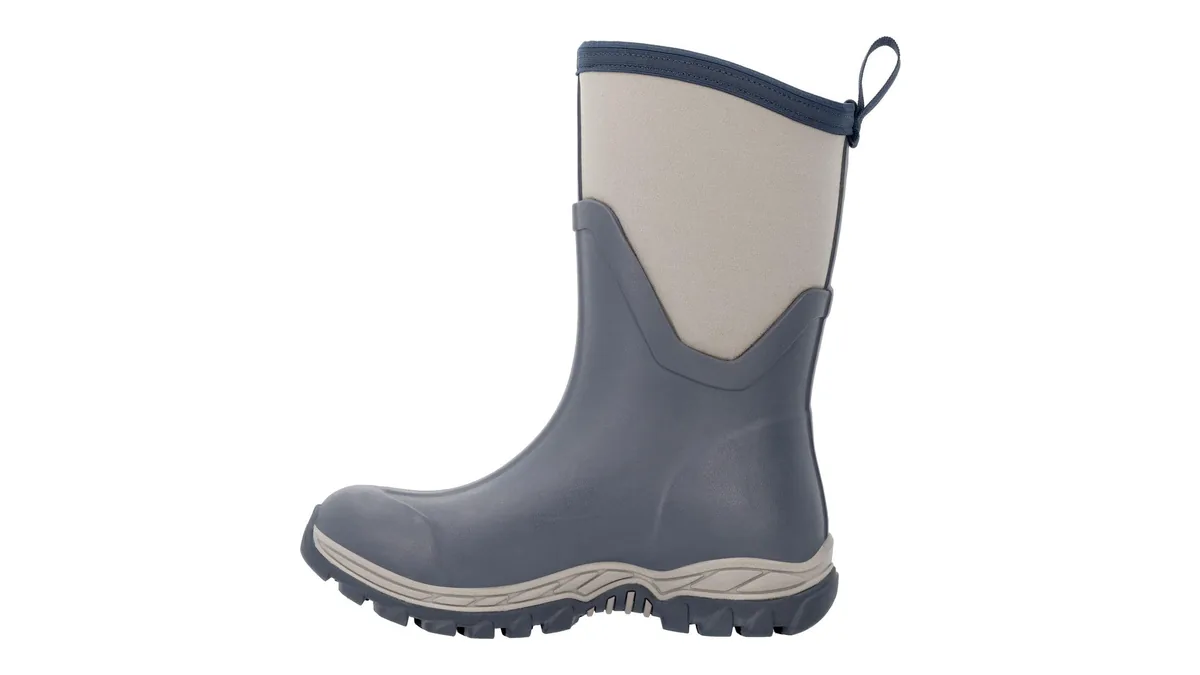
Quick Answer: Muck Boot Arctic Sport Review: The Arctic Sport is a pull-on rubber and neoprene boot built for cold, wet outdoor work. Five millimeters of fleece-lined neoprene and an extra thermal layer under the footbed make it warm enough for standing in freezing mud all morning, and the one-piece build means there is nothing to leak. Grip on soft ground is excellent. It is heavy, it runs hot above freezing, it comes in one width only, and it costs more than most rubber boots. Check latest price.
Tough, warm and genuinely waterproof
The Muck Boot Arctic Sport is the winter version of the boot that made The Original Muck Boot Company a fixture on farms, job sites and in the back of pickup trucks. It is a one-piece design with no seams and no closure: a molded rubber lower bonded to a neoprene upper, pulled on and kicked off at the door. Neoprene is the same stretchy foam rubber used in wetsuits, and here it does double duty as insulation and as the thing that holds the boot to your leg.
Muck sells the Arctic Sport in a few builds. The men’s line runs to a Tall version, a Mid version that stops below the calf and a steel-toe version for job sites. The women’s Arctic Sport has moved on to a second-generation design called the Arctic Sport II, sold in tall, mid and ankle heights. This review covers the men’s Arctic Sport Tall, the version most people mean when they say Arctic Sport.
The buyer this boot is built for has a specific problem: cold ground that is also wet. Livestock, yard work, snow clearing, a wet job site, an hour on a frozen riverbank. If that is your winter, the Arctic Sport is one of a small handful of boots that genuinely solves it. If your winter is a commute, it is the wrong boot entirely.
Specs
Here are the specifications for the Arctic Sport:
| Type | Pull-on insulated waterproof rubber and neoprene boot |
| Heights | Tall and mid calf, plus a steel-toe tall version |
| Closure | None, pull-on |
| Insulation | 5 mm fleece-lined neoprene, plus a 2 mm thermal foam layer under the footbed |
| Manufacturer temperature claim | Comfort claimed from minus 40 F to 40 F (Muck’s own figure) |
| Waterproofing | Fully waterproof, seamless construction |
| Outsole | Rugged molded rubber with a deep self-cleaning lug |
| Weight | Roughly 2 to 2.5 pounds per boot, depending on size and height |
| Sizes and widths | US 5 to 15, medium (D) width only |
| Price | Listed on muckbootcompany.com in September 2026 at $175 for the Tall, $170 for the Mid and $180 for the steel toe. Muck does not publish a launch month for a boot it has sold for years. Check latest price |
Pros
These are the reasons the Arctic Sport has the following it does:
- It is properly warm, and the thermal layer under the footbed matters more than it sounds. Cold gets into most boots through the sole, from the frozen ground you are standing on.
- Nothing leaks, ever. There are no seams, no tongue and no closure, so the only way water gets in is over the top.
- The outsole is excellent on the surfaces it was designed for. Deep, widely spaced lugs bite into mud, wet grass and slush and then shed it instead of clogging.
- It fits trimmer than most rubber boots, which makes it noticeably easier to walk in than the sloppy pull-on boots it competes with.
- Cleaning is a hose and thirty seconds. No conditioning, no drying racks, no salt damage.
Cons
And these are the reasons to think carefully first:
- At up to two and a half pounds per boot, it is among the heaviest footwear you can buy that is not a ski boot.
- Medium width only. Wide feet have no option here, and the neoprene stretch only goes so far.
- It runs hot. Muck’s own range tops out at 40 F for a reason, and above that your feet sweat because neoprene cannot breathe.
- At $175 it is expensive for a rubber boot, and roughly $40 more than the closest neoprene rivals.
- The footbed is thin and unsupportive, which is a real shortcoming in a boot people stand in all day.
What is new versus the Arctic Sport II
There is a slightly confusing situation in the range worth understanding before you buy. Muck has updated the women’s Arctic Sport to a second generation, sold as the Arctic Sport II in tall, mid and ankle heights. The men’s line, at the time of writing, still carries the original Arctic Sport. So a household buying two pairs may end up with two different generations of what looks like the same boot.
The Arctic Sport II is a refresh rather than a rethink. The neoprene construction, the warmth and the pull-on format all carry over. What changes is the shape and the finish: a slightly updated last, a refreshed outsole pattern and an ankle-height option that the original never offered, aimed at people who want the warmth for quick trips outside rather than a full day on wet ground.
For the men’s boot reviewed here, that means the Arctic Sport is still the current model and still what Muck sells at full price. If you see a men’s Arctic Sport II listed somewhere, check the retailer carefully, because it is more likely to be a women’s or unisex listing than a new men’s release.
Who should buy the Arctic Sport
Buy it if cold and wet arrive together in your life. Animals, gates, a flooded driveway, an unheated workshop, snow that turns to standing water by noon: the Arctic Sport handles all of it without needing any thought from you. It is the boot you leave by the back door all winter.
It is also a good choice if you have found other rubber boots too loose. The Arctic Sport is built on a trimmer last than most pull-on boots, and it holds the foot more securely, which is why people who walk a fair amount in rubber boots tend to prefer it. If a previous pair slipped at the heel, this is the one to try.
And it suits anyone who wants a boot they never have to maintain. Leather needs conditioning, membranes eventually wear out and laces snap in the cold. None of that applies here, and for a lot of people that is worth the price difference on its own.
Who should probably skip it
Skip it if your winter is dry and cold rather than wet and cold. All that rubber and neoprene is dead weight if you are only ever on cleared sidewalks, and your feet will sweat for no reason. Skip it if you need a wide fitting, because there is not one. And skip it if you want a boot for walking distances, because two and a half pounds per foot is a genuine handicap over a couple of miles.
- Columbia Fairbanks Omni-Heat: light, warm for its weight, available in a wide fitting and far more comfortable for city walking and commuting (check price)
- Merrell Thermo Chill 2 Mid Waterproof: an insulated hiking boot with a breathable membrane, so your feet stay drier during exertion on frozen trails (check price)
- Sorel Caribou: a classic pac boot whose felt liner lifts out to dry, which is the better system if you need the boot ready again the next morning (check price)
How does the Arctic Sport fit?
The Arctic Sport fits closer to a shoe than most rubber boots do. The last is trimmer through the midfoot with a reasonably roomy toe box, and the neoprene upper hugs the ankle and calf rather than flapping around them. That combination is the main reason it walks better than its rivals.
Fit and sizing
Most people should order their normal size. If your feet are broad, going up a half size is the usual workaround, since there is no wide option, though be aware that the extra length will let your heel move more. Muck sells whole sizes from 5 to 15 in a medium width, so if you normally wear a half size, you will be choosing between rounding up or down. Rounding up and adding a thicker sock is generally the safer call in a boot with no laces.
Upper and step-in comfort
Step in and the first thing you notice is the fleece lining, which feels warm and soft immediately rather than needing a break-in period. The neoprene has enough stretch to get over a heel without a struggle and enough grip to stay put once it is on. There is no hardware anywhere to press on you. Where it disappoints is underfoot: the stock footbed is a thin slab with no shaping at all, which is a strange omission in a boot marketed to people who stand still for hours. Adding a supportive insole is the single best upgrade you can make to this boot.
How does the Arctic Sport perform?
The Arctic Sport is one of those products that does exactly what it says and nothing else. It keeps water out completely, it keeps your feet warm in serious cold, and it grips on ground that defeats ordinary soles. It does not try to be comfortable for walking, breathable, light or cheap, and it is none of those things.
Cushioning and ride
There is no foam midsole in the usual sense. What cushioning exists comes from the neoprene wrapped around your foot and the 2 mm thermal foam layer beneath the footbed, and the result is dense and slightly dead. On soft ground it is fine, because the ground does the absorbing. On concrete or a frozen road it is unforgiving, and a full day of standing on a hard floor in these will make itself felt. The boot also has no defined flex point at the ball of the foot, so your stride ends up flatter and shorter than usual.
Warmth in real conditions
This is the boot’s strongest suit. Five millimeters of neoprene is a serious amount of insulation, the fleece lining adds a layer of trapped air and, crucially, there is thermal foam under the footbed. That last detail is what separates a warm boot from a cold one when you are standing on frozen ground, because conduction through the sole is how most feet actually get cold. Muck’s minus 40 F to 40 F range is a manufacturer figure rather than a tested rating, but it accurately describes the character of the boot: superb in the cold and unpleasant once the weather turns mild.
Stability and support
Stability comes from the wide, flat footprint and the reinforced heel area, and it is adequate rather than impressive. The neoprene collar holds the ankle gently but cannot be tightened, so on side slopes and frozen ruts you get less security than a laced boot gives you. Nothing here is designed to influence how your foot moves through a stride, and there is no arch support at all as it comes. Anyone who relies on a supportive insole should plan to fit one, and should do so before deciding whether the size is right.
Outsole, grip and durability
The outsole is the other thing the Arctic Sport does exceptionally well. The lugs are deep and widely spaced, which means they bite into mud, wet grass and slush and then release it rather than packing into a slick pad. On soft, messy ground there are few better boots at any price. On wet ice it is ordinary, as all plain rubber is, and on smooth indoor floors the aggressive lug pattern is actually a slight liability. Durability is excellent. With nothing to leak, rust or condition, these boots usually wear out at the sole after years of hard use, and the most common failure people report is the neoprene perishing after prolonged storage in sun or heat.
Is the Arctic Sport good for walking?
Better than most rubber boots, and still not a walking boot. The trimmer last holds your foot properly instead of letting it slide around, which is the usual reason pull-on boots are miserable to walk in, and the grip on soft ground means you can cover a muddy field without picking your way. Over a mile or so on a farm track or a snowy path it is perfectly manageable. Push further, or onto pavement, and the weight and the flat, stiff sole start to tell: your stride shortens, your hips work harder and your legs tire well before they would in a proper boot. Standing all day on hard floors is also uncomfortable without an added insole. Think of it as a boot for working ground rather than covering it.
Arctic Sport versus Arctic Pro
Muck’s own range answers the obvious follow-up question, which is what to do if the Arctic Sport is not warm enough:
Feature | Arctic Sport | Arctic Pro |
Neoprene | 5 mm, fleece lined | 8 mm, fleece lined |
Intended use | General cold and wet outdoor work | Extended stationary exposure, hunting and severe cold |
Weight | Heavy | Heavier again |
Comfort in mild weather | Poor above 40 F | Worse |
Availability | Current men’s model | Current, sold alongside |
Buy the Arctic Sport when you are moving about outdoors in winter and want one boot for the season. It is the more versatile of the two by a wide margin.
Buy the Arctic Pro when you are sitting or standing still in deep cold for hours at a time. Its extra neoprene is only an advantage when your body is not generating heat, and it is a liability the rest of the time.
Muck Boot Arctic Sport Alternatives
Three boots cover the usual reasons the Arctic Sport is not the right call.
The Bogs Classic Mid is the closest rival and typically costs less. It uses thicker neoprene, so it is warmer on paper, and it is cut roomier through the foot, which suits people the Muck pinches. The trade is a looser fit that is less pleasant to walk any distance in (check price).
If the warmth is right but the height is not, stay in the same family. The Muck Arctic Sport Mid stops below the calf, which makes it easier to get on and off and less sweaty in milder weather, while giving up some coverage in deep mud and snow (check price).
Where the real problem is that you also need to walk in the boot, The North Face Chilkat V is a better compromise. It is a laced leather winter boot rather than a rubber one, so it is lighter, flexes properly at the ball of the foot and can be tightened for uneven ground. It will not survive being stood in mud every day, which is exactly the trade you are making (check price).
Price and value
At $175 for the Tall, the Arctic Sport asks noticeably more than the neoprene boots it sits next to on the shelf. The case for the money is longevity and fit: this is a boot that routinely lasts many winters of genuinely hard use, and it fits better than its rivals, which matters if you are in it for hours. The case against is that you are paying a premium for a boot with a thin, unshaped footbed and only one width. If you work outdoors in winter, the cost per season works out low and we think it is justified. If you just want a warm boot for occasional use, you are paying for durability you will never use up.
Final verdict
Best for: cold and wet outdoor work, livestock and yard duties, snow clearing and anyone who needs a boot that never leaks and never needs maintenance.
Avoid if: you need a wide fitting, your winters are mild, or you want a boot for covering distance on foot.
Fit: trimmer than most rubber boots, true to size for most people, whole sizes only in a medium width. Budget for a better insole.
Verdict: the Arctic Sport is a specialist tool that happens to be sold in ordinary shoe shops, and it earns its reputation among the people who actually need it. Warmth through the sole, a genuinely excellent outsole and a fit that holds the foot make it the best of the neoprene work boots to spend a day in. Accept that it is heavy, hot above freezing and expensive, and you are getting a boot that will still be doing the job in five years.
Frequently Asked Questions for Muck Boot Arctic Sport
Muck publishes a comfort range of minus 40 F to 40 F, based on 5 mm of fleece-lined neoprene plus a thermal foam layer under the footbed. That is a manufacturer figure rather than an independent test, but the insulated sole genuinely helps when you are standing on frozen ground.
No. Muck lists it in a medium, D width only, in whole sizes from 5 to 15. Broad feet sometimes go up a half size as a workaround, at the cost of some heel hold.
It depends which line you are shopping. Muck currently sells the original Arctic Sport in the men’s range and the updated Arctic Sport II in the women’s range. The II is a refresh of the same idea with a revised last, an updated outsole and an extra ankle-height option.
Not comfortably. The comfort range tops out around 40 F because neoprene does not breathe, so in mild or warm weather your feet get damp from sweat. An uninsulated rubber boot is the right choice for wet summer ground.
Yes. Muck lists an Arctic Sport steel toe tall boot alongside the soft toe version, at a small price premium, for job sites that require protective footwear.
With no seams, laces or leather to fail, most pairs wear out at the outsole after several seasons of regular use. Rinsing off mud and salt and storing them out of direct sun and heat is what prevents the neoprene perishing early.