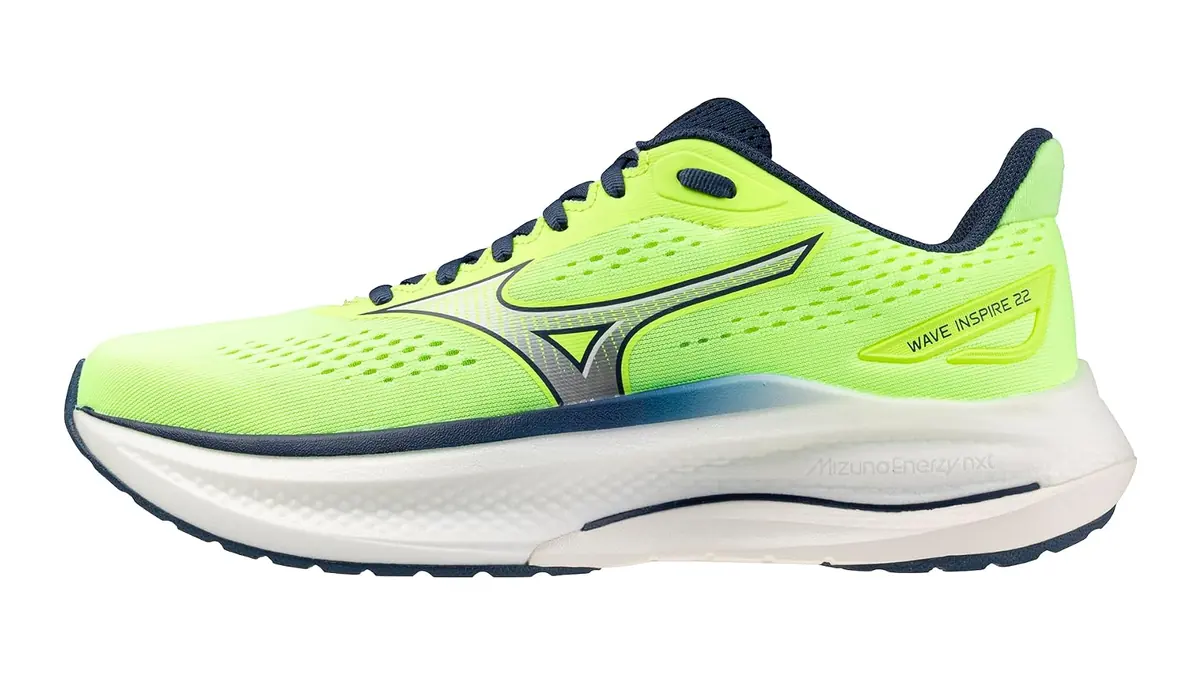
Quietly effective support and a softer ride, let down by a fussy heel
Quick Answer: Mizuno Wave Inspire 22 Review: The Mizuno Wave Inspire 22 is a stability shoe for runners and walkers whose feet roll inward, and this version is the softest the line has been. A full-length nitrogen-infused foam replaces the old firm midsole, the forefoot finally has proper cushioning and a plastic plate in the arch keeps everything steady without a hard wedge. Wide and extra-wide fittings are available. The heel shape does not suit everyone, so try a pair on. Check latest price.
The Mizuno Wave Inspire 22 is the supported version of the Wave Rider, Mizuno’s everyday trainer, and it has been the brand’s answer for overpronation for two decades. Overpronation simply means the foot rolls inward more than usual as it lands, and a stability shoe is built to slow that down. Mizuno has always done it differently from everyone else, using a curved plastic plate in the arch instead of a firm foam wedge on the inside edge.
The Inspire 22 arrived in January 2026 at $149.95 and it is the biggest change the line has seen in years. Mizuno shoes used to be famous for being firm, which some people loved and many did not. This one is not firm. The midsole has been rebuilt around a softer, lighter foam, the forefoot has gained real cushioning and the heel has come down from a very tall 12 mm lift to a more ordinary 10 mm. For anyone who wrote Mizuno off as too harsh, this is the version to revisit.
Specs
Here are the specifications for the Mizuno Wave Inspire 22:
| Type | Road stability daily trainer |
| Gait type | Stability, for mild to moderate overpronation |
| Midsole | Full-length ENERZY NXT, a nitrogen-infused EVA foam, with an extra layer in the heel |
| Support system | Mizuno Wave plate in the arch |
| Stack height | 37 mm heel, 27 mm forefoot. Independent lab measurement put the forefoot nearer 29 mm |
| Heel-to-toe drop | 10 mm, down from 12 mm on the Wave Inspire 21 |
| Weight | 9.9 oz (281 g) men’s size 9; 8.5 oz (241 g) women’s size 8 |
| Upper | Engineered mesh |
| Outsole | X10 carbon rubber |
| Widths | Standard, wide and super wide |
| Price | $149.95 at launch, January 2026. Check latest price |
Pros
Here is what Mizuno has got right:
- Support that works without a hard wedge digging into your arch, so it feels like a normal shoe
- Much softer than any recent Wave Inspire, which fixes the line’s oldest complaint
- A properly cushioned forefoot at last, which makes long walks and steady runs more comfortable
- Wide and super wide fittings, which broad feet rarely get in a stability shoe
- X10 rubber is one of the most durable outsoles in running, so the shoe outlasts its price
Cons
And here is what to weigh against that:
- The heel shape is divisive, and if it does not suit your foot there is no fixing it with lacing
- At 9.9 oz it is on the heavier side for a modern stability trainer
- The support is gentle, so heavy overpronators may need more
- The ride is smooth rather than fun, with no spring or pop
- Softer foam usually means it will pack down sooner than the old firm Mizuno midsoles did
What is new compared with the Wave Inspire 21
Almost everything underfoot. The Inspire 21 used Mizuno’s older foam and had a very tall 12 mm heel lift with a thin forefoot, which made it feel tilted forward and rather hard at the front. The Inspire 22 moves to full-length ENERZY NXT, a nitrogen-infused EVA that is both lighter and softer, and adds an extra layer of it in the heel so the shoe still feels stable when you land.
The two numbers that matter are the drop and the forefoot. The drop is now 10 mm rather than 12 mm, so your heel sits less far above your toes and the shoe feels more level under you. And the forefoot has gained real material: independent lab measurement recorded around 29 mm against 25.1 mm on the Inspire 21. That is the change you feel on a long run, because the front of the shoe is where a thin midsole gets uncomfortable. The Wave plate in the arch carries over, so the character of the support is unchanged. This is a proper update rather than a refresh.
Who should buy the Mizuno Wave Inspire 22
Buy it if you need support but hate feeling it. The Wave plate sits in the arch and stiffens the middle of the shoe, so instead of pushing your foot outward it simply refuses to let the shoe collapse inward. The practical difference is that you do not get that lump under the arch that older stability shoes were known for. For runners and walkers with mild to moderate pronation who want help without a constant reminder, that is a good place to be.
Buy it if you have wide feet. Stability shoes are where width options tend to disappear, and Mizuno offers this one in wide and super wide as well as standard. Combined with the softer forefoot, that makes it a sensible choice for anyone whose feet have spread over the years or who deals with swelling by the end of the day.
Buy it too if durability matters to you. X10 carbon rubber is hard, dense stuff and it lasts. If you are the kind of buyer who keeps shoes until they genuinely wear out rather than swapping them each season, the Inspire tends to repay that. Comfort and suitability always depend on your own feet and history, so if you have persistent pain it is worth being assessed properly rather than choosing by category.
Who should probably skip it
Skip it if your feet roll in severely. The Wave plate gives gentle guidance, not control, and someone who genuinely collapses at the arch will need a firmer, more structured shoe. Skip it if you are counting ounces, because at 9.9 ounces it is heavier than several rivals that support just as well. And be cautious if you have a narrow heel or a bony one, because the heel shape here gets more complaints than anything else about the shoe and it is not something you can lace away.
Any of these would be a better fit:
- Brooks Beast GTS 26: a properly structured shoe with far more control, for feet that need holding rather than guiding (check price | read review)
- Asics GT-1000 15: lighter, cheaper and steadier than you expect for the money, and a good choice if you only need a little help (check price | read review)
- Mizuno Wave Rider 30: the same brand’s neutral trainer, softer and more comfortable still, for anyone who discovers they did not need support after all (check price | read review)
How does the Mizuno Wave Inspire 22 fit?
The Inspire 22 fits like a traditional trainer through the front and a slightly unusual one at the back. The forefoot and midfoot are comfortable and predictable, with a bit more room than Mizuno used to allow, and the range of widths means most feet can be accommodated. The heel is where opinions split.
Fit and sizing
Take your usual size. Length is accurate and the toe box is moderate, neither pinched nor generous, and the wide and super wide options handle broader feet properly rather than just adding length. The heel counter is firm and shaped in a way that works beautifully for some people and rubs or feels loose for others. It is the single most common criticism of this shoe, and it is the reason we would try a pair on in a store rather than ordering blind if you have any history of heel irritation.
Upper and step-in comfort
The upper is an unremarkable engineered mesh, which in a daily trainer is a compliment. It breathes reasonably, holds the midfoot without pressure points and has enough structure to work with the plate underneath. Step-in comfort is noticeably better than in previous Inspires, because the softer foam is obvious the moment you stand in the shoe rather than only once you are running. The tongue and collar are lightly padded, which is enough for daily use without adding bulk.
How does the Mizuno Wave Inspire 22 perform?
This is a shoe that does its work quietly. Nothing about the ride announces itself, which is exactly what most people want from a support trainer they will wear four or five times a week.
Cushioning and ride
ENERZY NXT is a nitrogen-infused EVA, meaning gas is blown into the foam to make it lighter and more resilient than standard EVA. Mizuno uses it full length and adds another layer of it in the heel, which is where a stability shoe needs to stay composed. Stack height, meaning the depth of material between foot and road, is 37 mm at the heel and around 27 to 29 mm at the forefoot. The ride is soft but controlled: your foot sinks a little and then finds something solid, rather than sinking and continuing to sink. Compared with any Inspire from the past five years it is a different shoe, and a considerably more comfortable one.
Ride and running performance
The Inspire 22 is smooth and even rather than exciting. There is no rocker tipping you forward and no plate driving you on, so the pace you get is the pace you put in. At easy and steady efforts it is very pleasant, with a longer, more cushioned forefoot than before, so the last part of each stride no longer feels abrupt. Ask it to go fast and the weight is the limit. Treat it as a shoe for the bulk of your weekly mileage and keep something lighter for workouts.
Stability and support
This is a stability shoe rather than a motion control one, and the distinction matters. The Mizuno Wave is a thin, curved plastic plate set into the midsole at the arch, and it works by stiffening the middle of the shoe so the platform cannot twist and collapse inward as your weight passes over it. Because the plate is in the shoe and not under a specific part of your foot, you do not feel a lump or a push. The effect is guidance, which suits mild to moderate pronation well. It does not correct or fix how your foot moves, and nobody should expect it to.
Outsole, grip and durability
X10 is Mizuno’s hard carbon rubber and it has a long reputation for outlasting everything around it. Coverage is good across the heel and forefoot, grip on dry and wet pavement is dependable and there are no obvious weak spots. The one caution is the midsole rather than the outsole: softer foams generally lose their bounce sooner than firm ones, so the Inspire 22 may feel flat before the sole looks worn. The common 300 to 500 mile guideline is only a rough rule of thumb, and with this shoe the outsole will almost certainly outlive the cushioning.
Is the Mizuno Wave Inspire 22 good for walking?
It is a strong walking shoe, and the changes in this version make it better at it than any recent Inspire. The extra forefoot cushioning matters more when walking than running, because you spend longer rolling through the front of your foot on every step, and the old thin forefoot was exactly where the shoe used to get uncomfortable on a long day. The Wave plate keeps the platform steady under slow, loaded steps too.
It also handles standing well, helped by the wide fittings and the firm heel, and it holds up on concrete thanks to that X10 rubber. The drawbacks for walking are weight, which you feel over a full day, and the divisive heel shape, which is more noticeable at walking speed than it is running. For fitness walking, travel and daily steps with mild overpronation, it is a genuinely good option.
Mizuno Wave Inspire 22 vs Wave Inspire 21
The two versions are further apart than the numbers suggest:
Feature | Wave Inspire 22 | Wave Inspire 21 |
Midsole | Full-length ENERZY NXT, softer | Firmer previous-generation foam |
Heel-to-toe drop | 10 mm | 12 mm |
Forefoot cushioning | About 29 mm, lab measured | 25.1 mm, lab measured |
Support | Mizuno Wave plate in the arch | Mizuno Wave plate in the arch |
Weight, men’s 9 | 9.9 oz (281 g) | Similar to the Inspire 22 |
Price at launch | $149.95, January 2026 | Not confirmed |
Buy the Inspire 22 if you found the previous version too firm or too tipped forward, because both of those have genuinely changed. Stay with a discounted Inspire 21 only if you actively liked the firm ride and the tall heel, since those are the two things this update deliberately gave up.
Mizuno Wave Inspire 22 Alternatives
Three shoes cover the usual reasons to compare.
Saucony Guide 19 is the most direct rival, and it is the lighter, wider-feeling shoe of the two. It also guides the foot with midsole shape rather than a hard post, so the character is similar, and its breathable upper makes it the better summer option (check price | read review).
Where the Mizuno heel is the sticking point, Asics GT-2000 15 is worth trying simply because the fit is more conventional. It has also become lighter and softer recently, and it costs less, which makes it the safer online purchase if you cannot get to a shop (check price | read review).
Runners who want more support than the Wave plate provides, without going all the way to a motion control shoe, should look at Brooks Adrenaline GTS 25. Its GuideRails work at the heel rather than the arch, which suits people whose knees and ankles feel unsteady rather than whose arches flatten (check price | read review).
Price and value
At $149.95 on launch in January 2026, the Inspire 22 sits right in the middle of the stability market, neither a bargain nor a stretch. The value case rests on two things. The first is the X10 outsole, which lasts longer than almost anything else and means the shoe gives you more miles per dollar than the sticker suggests. The second is the width range, because a wide or super wide stability shoe at this price is genuinely hard to find. If neither of those applies to you, cheaper support shoes will do a similar job.
Final verdict
Best for: mild to moderate overpronation, wide feet, high weekly mileage, and walkers who want support with real forefoot cushioning.
Avoid if: your arches collapse badly, you want a light shoe, or you have had trouble with firm heel counters before.
Fit: true to size, moderate toe box, firm and divisive heel. Standard, wide and super wide.
Verdict: The Wave Inspire 22 is the most approachable shoe this line has produced in years. Softening the midsole, lowering the heel and putting proper cushioning under the forefoot have turned a shoe people respected into one they might enjoy, and the support still works exactly as it always did. Get the heel fit checked and it is an easy shoe to live with.
Frequently Asked Questions for Mizuno Wave Inspire 22
It is a thin curved piece of plastic set into the midsole at the arch. Where a traditional stability post is a wedge of firm foam pressing up under the inside of your foot, the Wave plate stiffens the whole middle of the shoe so the platform cannot twist inward. You feel the effect rather than the part, which is why the shoe does not have a lump under the arch.
The 12 mm figure was unusually high for a modern trainer and it made the shoe feel tipped forward. Bringing it to 10 mm, mostly by adding foam under the forefoot rather than removing it from the heel, leaves the shoe feeling more level without asking anything new of your calves.
Yes. Mizuno sells it in standard, wide and super wide, which is a wider range than most stability shoes offer and one of the better reasons to choose it if broad feet usually limit your options.
Usually yes. The insole lifts out and the shoe has enough internal volume for most over-the-counter and many custom devices, particularly in the wide fittings. Bear in mind that an orthotic and the Wave plate are both doing a similar job, so check with whoever supplied your orthotic before pairing them.
For length, yes. Order your normal size. The heel is the part to be careful about, because its shape suits some feet much better than others, so trying a pair on is worth the trip if you can.
The X10 outsole is among the most durable in running and will typically still look healthy long after the midsole has softened. The usual 300 to 500 mile figure is a broad guideline, and with this shoe the cushioning is what will tell you it is time rather than the tread.