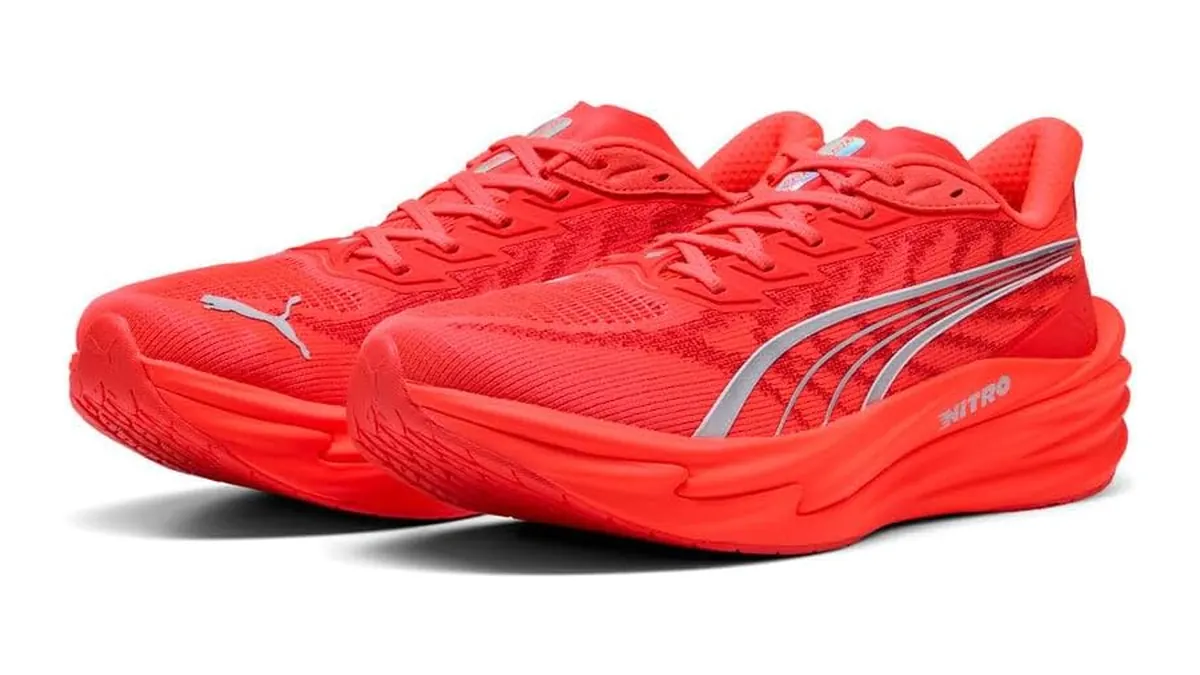
Superb grip and a friendlier fit, held back by a very stiff forefoot
Quick Answer: The Puma Deviate NITRO 4 is a plated road trainer for tempo runs, faster long runs and runners who want more propulsion than a normal daily shoe. Puma lists a 38 mm heel, 30 mm forefoot, 8 mm drop and 250 g weight for the men’s reference size. NITROFOAM provides the cushioning, while the PWRPLATE adds stiffness and forward drive. It is best for faster training rather than easy recovery miles. See the specs.

The Puma Deviate Nitro 4 is a lightweight trainer with a stiff plate inside it, built for the faster end of your week rather than for easy jogging. The plate is a curved sheet in the middle of the sole that stops the shoe bending flat, so it rolls forward instead, and it sits inside a foam made by forcing nitrogen gas into the material to make it lighter and springier.
In the Puma range the Deviate is the workhorse for quick running. The Velocity Nitro is the everyday trainer, the Fast-R line is for racing, and the Deviate sits between them as the shoe you do tempo runs and long runs with fast miles in. It launched in February 2026 at $169.95, which is a good deal less than most plated shoes.
The headline of this version is the fit. Previous Deviates were cut narrow and a lot of runners simply could not wear them. Puma widened the shoe, and that decision defines who it now suits.
Specs
Here are the specifications for the Puma Deviate Nitro 4:
| Category | Plated lightweight trainer for faster running |
| Best for | Tempo runs, long runs with fast miles, and shorter races |
| Support type | Neutral, meaning no built-in features aimed at controlling how much your foot rolls inward |
| Midsole foam | Nitrogen-infused NITROFOAM, Puma’s light and responsive midsole material |
| Plate | PWRPLATE, the stiff plate Puma uses through the Deviate line, noted by independent reviewers as very stiff at the forefoot |
| Stack height | 38 mm at the heel, 30 mm at the forefoot |
| Heel-to-toe drop | 8 mm, down from 10 mm on the previous version, so the shoe is a little flatter than before |
| Weight, men’s | 8.8 oz, 250 g, in a size 9 |
| Weight, women’s | 7.2 oz, 205 g, in a size 8 |
| Upper | Engineered mesh, described by independent reviewers as very supportive, with a wider forefoot than the previous version |
| Outsole | PumaGRIP rubber, the compound Puma is best known for |
| Surface | Road, sidewalk and treadmill |
| Price | $169.95 at its February 2026 launch. Check latest price |
Gender-specific buy links: Men’s version | Women’s version
Pros
These are the reasons the Deviate Nitro 4 is worth a look:
- The grip is exceptional. PumaGRIP is the best road rubber any brand puts on a running shoe, and it holds on wet pavement where others let go.
- The wider forefoot fixes the main complaint about previous Deviates, so runners with broader feet can finally wear one.
- It feels agile rather than stiff and heavy, which is unusual for a plated shoe and makes it enjoyable on twisty routes.
- Dropping the heel from 10 mm to 8 mm makes the transition from landing to push-off smoother.
- At $169.95 it undercuts almost every other plated shoe, and the outsole means it will survive real training weeks.
Cons
These are the reasons it will not suit everyone:
- The forefoot plate is very stiff, and independent reviewers single it out. At easy pace the shoe refuses to bend and that feels awkward.
- At 8.8 oz in a men’s size 9 it is not especially light for a shoe aimed at fast running.
- Thirty-eight millimeters at the heel is modest by current standards, so it is less protective on a very long run than a max-stack trainer.
- It is a shoe with a narrow purpose. Easy days and recovery runs are not what it is for.
- There is no support built in, so it will not suit feet that roll inward a long way.
What is new versus the Deviate Nitro 3
Two changes matter, and one of them is the reason to buy this version.
The first is the fit. Puma widened the Deviate because a great many runners found earlier versions too narrow to use, and the forefoot on the 4 is noticeably broader. That is the kind of change that does not show up in a spec sheet but decides whether a shoe works for you. Independent reviewers have welcomed it as overdue, and it opens the shoe up to a group of runners who previously had to shop elsewhere.
The second is the drop, which fell from 10 mm to 8 mm. Drop is the difference in foam height between the heel and the forefoot, and lowering it puts your foot a little flatter in the shoe. The practical effect is a smoother roll from landing to toe-off, and slightly more load taken by the calves and Achilles rather than the knees.
The upper was reworked around the wider shape and is more supportive than before, holding the foot without hot spots. What has not changed is the character: nitrogen-infused foam over the stiff PWRPLATE, with PumaGRIP rubber underneath. Independent reviewers describe the shoe as staying true to its identity, which is fair. This is a refinement rather than a reinvention.
Who should buy the Deviate Nitro 4
Buy it if you want a plated shoe for your hard days without spending $250. This is the cheapest way to get a genuine super trainer experience, and because the outsole is proper rubber rather than a token patch, you can use it weekly rather than rationing it.
It is the obvious pick if you run in wet weather. PumaGRIP is the single best reason to own a Puma running shoe, and on a rainy tempo session where you are leaning into corners at pace, the difference between good rubber and excellent rubber is confidence. Nothing else in this category grips as well.
Runners with broader feet who have wanted to try the Deviate should look again. The wider forefoot is a real change, not a marketing claim, and it is the version that finally accommodates a foot that spreads on landing.
And buy it if you like a shoe that feels quick and connected rather than tall and floaty. At 38 mm it keeps you closer to the ground than most plated shoes, which makes it agile on winding routes and reassuring on camber.
Who should probably skip it
Skip it if you want one shoe for everything. The stiff forefoot is the problem here: at easy pace the sole will not flex with your foot, so recovery runs feel like hard work. Independent reviewers have flagged the stiffness specifically, and it is not something that softens with use.
Skip it too if you want maximum cushioning for long, slow miles. Thirty-eight millimeters is respectable but modest now, and a max-stack trainer will leave your legs fresher after two hours. And runners who need genuine support for feet that roll inward significantly will get nothing from this shoe on that front.
If that describes your running, these three suit you better:
- Asics Novablast 6: bouncy, flexible and comfortable at any pace, which makes it a far better single shoe for a mixed week (check price | read review)
- Hoka Mach 7: light and plateless, so it can go fast when you want and still feel relaxed on a slow morning (check price | read review)
- Asics GT-2000 15: a supportive daily trainer for runners whose feet need steadying rather than speeding up (check price | read review)
How does the Puma Deviate Nitro 4 fit?
The fit is the best news about this shoe. Where earlier Deviates were cut tight across the ball of the foot, this one has room. The heel and midfoot are held securely by a supportive upper, and the forefoot lets your toes spread without feeling sloppy. It is a performance fit rather than a roomy one, but it no longer excludes broad feet.
Fit and sizing
Take your usual running size. The length is accurate, and if you have tried a previous Deviate and gone up half a size to get width, go back to your normal number this time because the extra room is now built in. Independent reviewers have described the forefoot as noticeably wider than the version before it.
Puma does not offer a separate wide fitting, so the standard last is what you get. For most medium to slightly wide feet that will now be enough, which was not true of the Deviate Nitro 3.
Upper and step-in comfort
The engineered mesh is thin but firm, and independent reviewers have called it very supportive, which is the right word. It does not stretch or bag out when you push hard into a corner, so your foot stays where you put it. Breathability is reasonable for a mesh with this much structure.
Step-in comfort is moderate. There is enough padding at the heel and tongue to be pleasant without being plush, and the stiff sole means the shoe feels firm underfoot when you first stand in it. It is a shoe that feels better once you start moving than it does in the shop.
How does the Puma Deviate Nitro 4 perform?
This shoe is happiest somewhere between comfortable and quick. It is smooth and lively at a decent pace, and awkward when you slow right down. The sections below cover the foam, the ride and the outsole that is the shoe’s calling card.
Cushioning and ride
NITROFOAM is Puma’s nitrogen-infused midsole, which means gas is blown into the material to make it lighter and springier than ordinary foam. Underfoot it feels firm and responsive rather than soft, so you get a clear sense of the road and a definite push back as you leave the ground.
The amount of cushioning is sensible rather than generous. Thirty-eight millimeters at the heel is enough to keep pavement from stinging over an hour, which covers most tempo sessions and a good long run, but it is not the deep protection a max-cushion trainer offers on a three-hour outing. Independent reviewers describe the overall ride as smooth and exciting, which matches the firm-and-springy character.
Ride and running performance
Forward motion comes from the plate and the shape of the sole working together. Because the plate is stiff, particularly at the front, the shoe tips you onto your toes and finishes the step for you. At pace that feels efficient and purposeful.
Its natural home is tempo running, threshold work and long runs where you pick up the pace, and it will happily race a 10K or a half marathon. Lowering the drop to 8 mm made the transition through the step smoother than on the previous version. At easy pace the stiffness becomes the dominant sensation, which is the one place the shoe is genuinely unpleasant.
Stability and support
This is a neutral shoe. There is no medial post, no guidance rails and nothing steering your foot, so what steadiness there is comes from the platform and the firm foam. On that count it does well, because a 38 mm stack of firm foam is inherently more planted than a 45 mm stack of soft foam, and the wider forefoot adds to that.
Independent reviewers have noted the upper contributes here too, holding the foot on the platform rather than letting it slide. For a mildly inward-rolling foot that is plenty. For a foot that rolls in a long way it is not, and nothing in this shoe corrects how you run. We would not put it forward as a treatment for any foot condition, and pain that persists or worsens is worth taking to a physical therapist or podiatrist.
Outsole, grip and durability
PumaGRIP is the reason plenty of runners buy Puma at all. It is a soft, tacky rubber that holds on dry road, wet road, painted lines and metal covers better than any rival compound, and independent reviewers consistently rate the traction here as excellent. If you run early mornings on damp pavement, this alone may decide the purchase.
Durability is a genuine strength too, which is unusual in a plated shoe. The rubber is applied properly rather than sparingly, so this is a shoe you can put a training block through. The familiar 300 to 500 mile guideline is only a broad rule of thumb and your weight and surfaces will move it, but the Deviate has a good reputation for lasting.
Is the Puma Deviate Nitro 4 good for walking?
Not really, and the reason is the plate. Walking asks the sole to bend at the ball of your foot with every step, and this forefoot is among the stiffest on the market, so the shoe resists the movement and the roll feels mechanical. On a long day that tires your feet rather than resting them.
What does work in its favor is the grip, which makes it a confident shoe on wet sidewalks, and the firm, planted platform, which feels steadier than a tall soft shoe when you are standing. But 38 mm of firm foam is not much comfort for a shift spent upright, and there is limited depth inside for a custom insole or orthotic. For walking and standing you would be far better served by a cushioned plateless trainer or a proper walking shoe, and you would spend less doing it.
Deviate Nitro 4 versus Deviate Nitro 3
| Deviate Nitro 4 | Deviate Nitro 3 | |
| Forefoot fit | Noticeably wider | Narrow, a common complaint |
| Stack and drop | 38 mm / 30 mm, 8 mm | 10 mm drop |
| Upper | More supportive engineered mesh | Less structured |
| Midsole and plate | NITROFOAM over PWRPLATE | NITROFOAM over PWRPLATE |
| Feel | Smoother transition, more agile | More heel-biased, tighter fit |
Buy the Nitro 4 if fit has ever been an issue for you, or if you want the smoother ride the lower drop provides. For most runners it is the better shoe and the upgrade is worth paying for at full price.
Buy the Nitro 3 while stock lasts if you have narrow feet, if you found it fitted you well, or if you prefer a 10 mm drop because a flatter shoe loads your calves more than you like. Discounted, it remains a lot of shoe for the money.
Puma Deviate Nitro 4 Alternatives
The closest rival on purpose is the Hoka Mach X 2, another plated shoe built for workouts rather than races. It has more foam underfoot than the Puma and a softer feel, so it is kinder on a long run, though it costs more and its grip is nowhere near as good. Our Mach X 2 review covers where each belongs in a rotation.
Runners who like the firm, direct character here should also try the Adidas Adizero Boston 13. It is firmer still and uses rods rather than a plate, which gives a slightly less abrupt push-off than the Deviate’s stiff forefoot while keeping the same fast, businesslike feel. See the Adizero Boston 13 review for the detail.
If the stiffness is the sticking point, the Saucony Endorphin Azura offers a springy, race-derived foam with nothing stiffening the sole. It flexes naturally through the step, which makes it far more pleasant at easy pace while still being quick when asked. The Endorphin Azura review explains that trade.
For shorter, sharper work there is the Brooks Hyperion 3, which is lighter and lower than the Deviate and has no plate at all. Pick it if you mostly race 5K and 10K and want the most connected feel you can get. Our Hyperion 3 review has more.
Price and value
At $169.95 the Deviate Nitro 4 is the bargain of the plated-shoe category. Rivals with a similar brief sit between $190 and $250, and several race shoes with less practical use cost well over $250. Puma has kept the price sensible while including its best foam, a full plate and its excellent rubber.
The value case is unusually strong because of durability. A plated shoe you have to ration is expensive per mile no matter what it costs, and this one has enough rubber on it to absorb a training block. Add the grip, which saves you buying a separate wet-weather shoe, and the money looks well spent. What you are not buying is versatility: the stiff forefoot means you still need something softer for easy days, so budget for two shoes rather than one.
Final verdict
Best for: tempo runs and long runs with fast miles, 10K and half marathon racing, runners in wet climates, and anyone with broader feet who has wanted to try a Deviate.
Avoid if: you want one shoe for every run, you need deep cushioning for long slow miles, or you need genuine support.
Fit: true to size, secure and supportive, with a forefoot noticeably wider than the previous version.
Verdict: Puma has taken a shoe that was good but exclusionary and made it fit a normal foot, which is the most useful thing it could have done. Add the best outsole rubber in running, a smoother ride from the lower drop and a price well below the competition, and the Deviate Nitro 4 is one of the easiest recommendations of the year for fast training. We rate it highly, with the plain warning that the stiff forefoot means this is a hard-days shoe and you will want something else for the rest of the week.
Check the latest price on the Puma Deviate Nitro 4.
Frequently Asked Questions for Puma Deviate Nitro 4
It can race, and it is well suited to a 10K or a half marathon. For a marathon most runners will want more foam underfoot and a lighter shoe, which is what Puma’s Fast-R line is for.
Puma does not offer a separate wide fitting, but the standard forefoot is noticeably wider than on the previous version, so many runners who needed a wide before will now be comfortable.
It is Puma’s outsole rubber, a soft and tacky compound widely regarded as the grippiest used on road running shoes. It is the main reason the Deviate performs so well on wet pavement.
It might at first. A flatter shoe shifts a little more load to the calves and Achilles, so if you are coming from a 10 mm shoe, introduce it over a few runs rather than doing a long session straight away.
Longer than most plated shoes, because the rubber coverage is generous. The usual 300 to 500 mile guideline is a broad one, and the Deviate line has a good reputation for reaching the upper end of it.
Yes, and the grip is wasted indoors but does no harm. The stiff forefoot is more noticeable on a belt at slower speeds, so it is better suited to treadmill intervals than to steady indoor jogging.
It can handle regular training, but it is best used for tempo runs, faster long runs and workouts where the PWRPLATE is useful. For relaxed easy miles, the Velocity NITRO 5 or Deviate Pure NITRO will feel more natural.
Compare this model with the rest of the current lineup in our Puma shoes hub and Puma running shoes comparison.