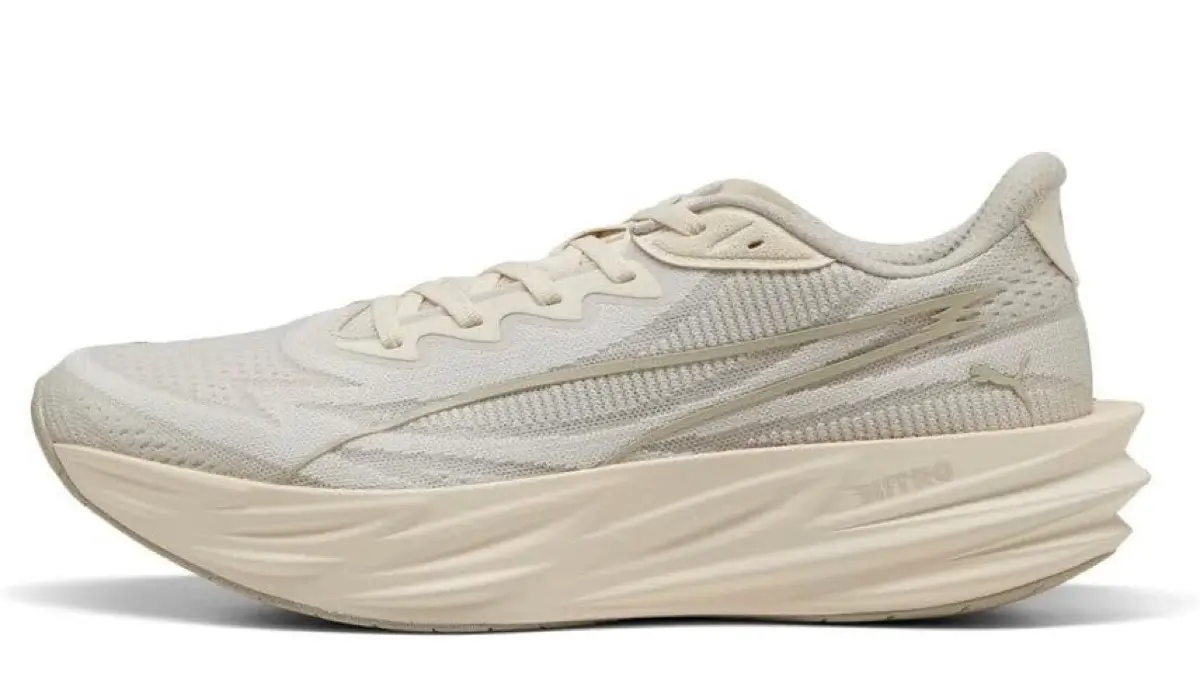
Quick Answer: The Puma Deviate Pure Nitro is a plateless neutral road trainer built for daily runs, long runs and faster sessions. Puma uses lightweight NITROFOAM without a plate, giving the shoe a more flexible feel than the plated Deviate Nitro 4. It has a 38 mm heel, 30 mm forefoot, 8 mm drop and weighs about 220 g in the men’s reference size. It is best for runners who want one light, responsive shoe for varied training rather than a dedicated racer. See the specs.
A Light, Versatile Trainer Without the Plate

The Puma Deviate Pure Nitro is the Deviate with the plate taken out. That sounds like a downgrade and it is not. Plates in running shoes are stiff sheets buried in the foam, and they are brilliant on race day and rather tiring the rest of the time. Puma has built a growing category of plateless shoes around that idea, and this is its entry.
It sits in the middle of the Deviate family: above the plain daily trainers, below the plated Deviate Nitro 4 and well below the $250 racing models. The type of shoe it competes with has come to be called a super trainer, meaning something light and springy enough to enjoy at pace but cushioned and comfortable enough to run every day. At $150 it goes head to head with some very well-regarded rivals.
Specs
Here are the specifications for the Puma Deviate Pure Nitro:
| Type | Plateless super trainer |
| Gait type | Neutral |
| Midsole | Nitrofoam, nitrogen-infused, with no plate and a simplified shape |
| Stack height | 38 mm heel, 30 mm forefoot |
| Heel-to-toe drop | 8 mm |
| Weight | 7.8 oz (220 g) men’s; 6.3 oz (180 g) women’s |
| Upper | Engineered mesh with a secure, close midfoot |
| Outsole | PumaGRIP rubber |
| Widths | Standard only; Puma does not publish alternative width fittings for this model |
| Best for | Daily miles, long runs and tempo efforts in one shoe |
| Price | Launched at $150 in June 2026. Check latest price |
Gender-specific buy links: Men’s version | Women’s version
Pros
- Light for how much shoe it is, at under 8 ounces with 38 mm of foam underfoot.
- Genuinely versatile: comfortable enough for recovery runs and quick enough for tempo work.
- Particularly good on long runs, where the foam keeps its character rather than going flat.
- Without a plate it flexes naturally, which makes it far more comfortable than plated shoes at slow paces.
- PumaGRIP is among the best outsole rubber available, and it grips confidently in the wet.
Cons
- Needs 40 to 50 miles of running before the foam and upper soften into their proper state.
- The last is long and narrow, so anyone with a broad foot will struggle, and there is no wide fitting.
- Without a plate it will not match a race shoe when you really want to move.
- The $150 price puts it against some exceptional competition.
- Firm out of the box, which can be off-putting on the first few runs.
What is new versus the plated Deviate
The Deviate Pure Nitro is a new model rather than an update, so the comparison that matters is against the plated Deviate Nitro 4 it sits alongside. The obvious change is the plate, or rather its absence. In the Nitro 4 a stiff plate runs through the midsole, stopping the shoe bending at the forefoot and giving a firmer, more directed push-off. Take it away and the shoe bends where your foot bends, which feels far more natural at easy paces and rather less urgent at fast ones.
Puma has also simplified the geometry. With no plate to work around, the midsole is a cleaner shape without the aggressive rocker profile a plated shoe usually needs to function. The foam itself is Nitrofoam, meaning nitrogen has been forced into it so it is lighter and bouncier than ordinary foam, and here it carries the whole load rather than sharing it with a plate. The result is a shoe that does a wider range of things well and no single thing brilliantly.
Who should buy the Puma Deviate Pure Nitro
Buy it if you want one good pair of shoes rather than three specialized ones. This is the sort of trainer that handles an easy Tuesday, a hard Thursday and a long Sunday without ever feeling like the wrong tool, which is a genuinely useful thing to own. It is particularly good on longer runs, where the foam holds up and the natural flex keeps your feet from getting fatigued the way a stiff plated shoe can.
It suits runners who have tried plated shoes and found them harsh or awkward at everyday paces, and it suits anyone who wants some of the springiness of modern racing foam without the compromise that comes with a plate. The wet-weather grip makes it a sensible choice if you live somewhere it rains, and the narrow, held fit will feel excellent if that is your foot shape. It is also a good marathon-training shoe for people who race in something else.
Who should probably skip it
Skip it if you have wide feet. The shape is long and narrow, the upper does not have much give and there is no wide fitting on offer, so this is not a shoe that can be persuaded to fit. Skip it if you want instant comfort, because the 40 to 50 mile break-in period is unusually long and the first few runs feel firmer than the shoe eventually becomes. That is a real drawback if you were hoping to run in it the week you buy it.
It is also the wrong shoe if what you actually want is race-day speed, since a plateless shoe will never match a plated one when you are pushing hard. Consider these:
- Brooks Ghost 18: a softer, roomier daily trainer available in wide fittings, comfortable from the first step (check price | read review).
- Puma Deviate Nitro Elite 4: the plated racing version, for anyone whose priority is going faster on race day (check price).
- Asics Novablast 6: a bouncy, roomier trainer that is comfortable from the very first run rather than the fifth (check price | read review).
How does the Puma Deviate Pure Nitro fit?
The Deviate Pure Nitro has a long, narrow shape that holds the foot closely from heel to toe. If your feet are slim it will feel excellent, secure without pressure. If they are not, there is very little the shoe can do to accommodate you, and this is the single thing most likely to decide whether it works for you.
Fit and sizing
The shoe runs long, so some runners find they can drop half a size from their usual. Try before buying if you can. The forefoot is narrow and the midfoot is snug, and Puma offers no wide fitting, so anyone who normally buys a 2E should rule it out. The heel is held well and the collar has enough padding to avoid rubbing. Remember that the upper stiffness eases with the break-in period, so a fit that feels a touch tight on day one may improve.
Upper and step-in comfort
The upper is engineered mesh, meaning the weave is varied across the shoe to be more open where you want airflow and more supportive where you want the foot held. It is on the firmer side when new, which is part of why the shoe takes so long to feel right. Step-in comfort is moderate rather than plush: there is modest padding at the collar and tongue and nothing excessive anywhere. Once broken in it feels considerably better, which is a slightly awkward thing to have to say about a new $150 shoe.
How does the Puma Deviate Pure Nitro perform?
Once it has settled in, this is a very capable shoe with an unusually wide range. It does not excel at any one thing, and that is rather the point: it is built so you never have to think about whether you have the right pair on. Long runs are where it shows best.
Cushioning and ride
Stack height is simply how much material sits between your foot and the ground, and 38 mm at the heel puts this at the generous end of a daily trainer. Nitrofoam is nitrogen-infused, which makes it lighter and springier than plain foam, and it strikes a middle note: soft enough to be comfortable over distance, firm enough that you do not sink. The ride is smooth rather than dramatic. Where it really earns its keep is at the far end of a long run, when the foam is still behaving the same way it did at mile three.
Ride and running performance
With no plate, the shoe bends where your foot bends, which is the key to why it feels so comfortable at easy paces. Plated shoes resist that flex and can feel like running in a splint when you slow down. Here, everything moves naturally. Speed up and the foam responds well enough to make a tempo run enjoyable, though you never get the definite snap a carbon plate gives at toe-off. The 8 mm drop, which means the heel sits 8 mm above the toes, is a comfortable middle ground that suits most people. Call it quick rather than fast.
Stability and support
This is a neutral shoe with no medial post, the wedge of firmer foam that support shoes place under the arch. Despite the height, it feels notably steady, and there are two reasons for that. The foam is on the firmer side of soft, so it does not compress unevenly, and the absence of a plate removes the lever effect that can make tall plated shoes twitchy. Runners with mild overpronation often get on fine with a shoe like this. Anyone who needs real support should look at a dedicated stability model, and it is worth saying that no shoe corrects a gait. Persistent pain deserves a proper assessment.
Outsole, grip and durability
PumaGRIP is the quiet reason to buy Puma shoes. It grips confidently on wet asphalt, painted road markings and metal covers, which are where most runners have their unhappy moments, and it is also hard-wearing. Coverage here is generous, so the outsole should comfortably outlast the foam. Durability overall looks strong for this category: without a plate there is no stiff component to break down, and the firmer foam holds its shape well. The usual 300 to 500 mile guideline is a broad rule of thumb rather than a promise, and this shoe should sit comfortably within it.
Is the Puma Deviate Pure Nitro good for walking?
It walks better than most performance trainers, mainly because there is no plate to fight your foot. Walking involves much more forefoot bend than running, and plated shoes are genuinely uncomfortable to walk in for that reason. This one flexes normally, has 38 mm of foam for protection on hard surfaces and grips well on wet pavement, all of which make it perfectly pleasant for a few hours on your feet. The limits are the shape and the break-in. A long, narrow shoe with a firm upper is not what you want for a full day of standing or for feet that swell, and there is not much room for a thicker orthotic insole. For a walk after a run, or a couple of hours around town, it is fine. As a dedicated walking shoe, there are better options.
Puma Deviate Pure Nitro versus the Deviate Nitro 4
There is no previous Deviate Pure Nitro, so the useful comparison is with the plated model it was derived from.
| Deviate Pure Nitro | Deviate Nitro 4 | |
| Plate | None | Full-length plate |
| Flex | Bends naturally at the forefoot | Stiff, resists bending |
| Best paces | Easy through to tempo | Tempo through to race pace |
| Weight | 7.8 oz men’s | Heavier |
| Launch price | $150, June 2026 | About $170, February 2026 |
Buy the Pure Nitro if you want one shoe for everything and you value comfort at easy paces. Buy the Deviate Nitro 4 if your training skews fast and you like the directed push a plate gives.
Puma Deviate Pure Nitro Alternatives
The obvious competitor is the Saucony Endorphin Azura, which chases the same plateless super trainer idea with a softer, bouncier foam and a friendlier fit. Runners who liked the sound of the Deviate Pure Nitro but need more room in the forefoot should start there (check price | read review).
For sheer range, few shoes beat the Asics Superblast 3. It is taller, softer and wider, it is comfortable from the first run rather than the fifth, and it covers the same easy-to-tempo span. The price is considerably higher, which is the trade (check price | read review).
Hoka’s Mach X 2 comes at the same brief from the plated side, using a winged plate that stiffens the forefoot without the harshness of a full carbon setup. Choose it if you want more urgency at pace and can live with less natural flex (check price | read review).
Runners weighing this against a conventional trainer should also look at the Brooks Ghost AMP, which puts a modern racing foam into a familiar shape and gives you much of the liveliness with none of the break-in wait (check price | read review).
Price and value
At $150 on launch in June 2026, the Deviate Pure Nitro is priced in line with the rest of the super trainer category, which has become one of the most competitive parts of the market. What you get for the money is a light, springy, genuinely versatile shoe with the best outsole rubber in the business and durability that should stand up well. What holds the value case back is the break-in period, which means you are paying full price for a shoe that does not feel like itself for the first month, and the narrow fit, which simply rules out a large number of buyers. For a slim-footed runner who wants one pair to do everything, it is good value. For anyone else, the competition is strong.
Final verdict
Best for: neutral runners with slim feet who want one shoe for easy days, long runs and tempo efforts, particularly in wet weather.
Avoid if: you have wide feet, you want comfort straight out of the box or you are shopping for a race-day shoe.
Fit: runs long and narrow, snug through the midfoot, standard width only.
Verdict: the Puma Deviate Pure Nitro is a well-judged plateless trainer that gets better the more you run in it, and it is excellent on long runs. The narrow shape and the unusually long break-in period are what will put people off.
Check the latest price on the Puma Deviate Pure Nitro.
Frequently Asked Questions for Puma Deviate Pure Nitro
No, and that is the whole point of it. Puma removed the plate used in the Deviate Nitro 4 so the shoe bends naturally at the forefoot. That makes it much more comfortable at easy paces, at the cost of the sharp push-off a plate provides when you are racing.
The foam and the upper are both firm when new, and it takes around 40 to 50 miles of running before they settle. That is longer than most modern shoes, which are designed to feel right immediately. Do not judge the shoe on your first three runs.
It runs long, and a number of runners find they can take half a size down from their usual. It is also narrow. If you can try a pair on before buying, do, because Puma does not offer this model in a wide fitting.
It is the name that has stuck to shoes that sit between an everyday trainer and a racing shoe: light and springy enough to enjoy at pace, but cushioned and comfortable enough to use for daily miles. The Deviate Pure Nitro is a plateless example of the type.
Yes, and this is one of its best features. Puma’s PumaGRIP rubber is among the most dependable outsole compounds available, and it holds well on wet asphalt, road markings and metal covers, which are where most slips happen.
You can, and it will do a respectable job over any distance. It simply will not be as quick as a plated racing shoe, because nothing in it stiffens the forefoot to help roll you forward. Many runners use a shoe like this for training and keep a plated model for race day.
Yes. Puma positions it for training and daily speed runs. Its plateless construction makes it more flexible than a plated racer, while NITROFOAM keeps the ride responsive enough for faster sessions.
Compare this model with the rest of the current lineup in our Puma shoes hub and Puma running shoes comparison.