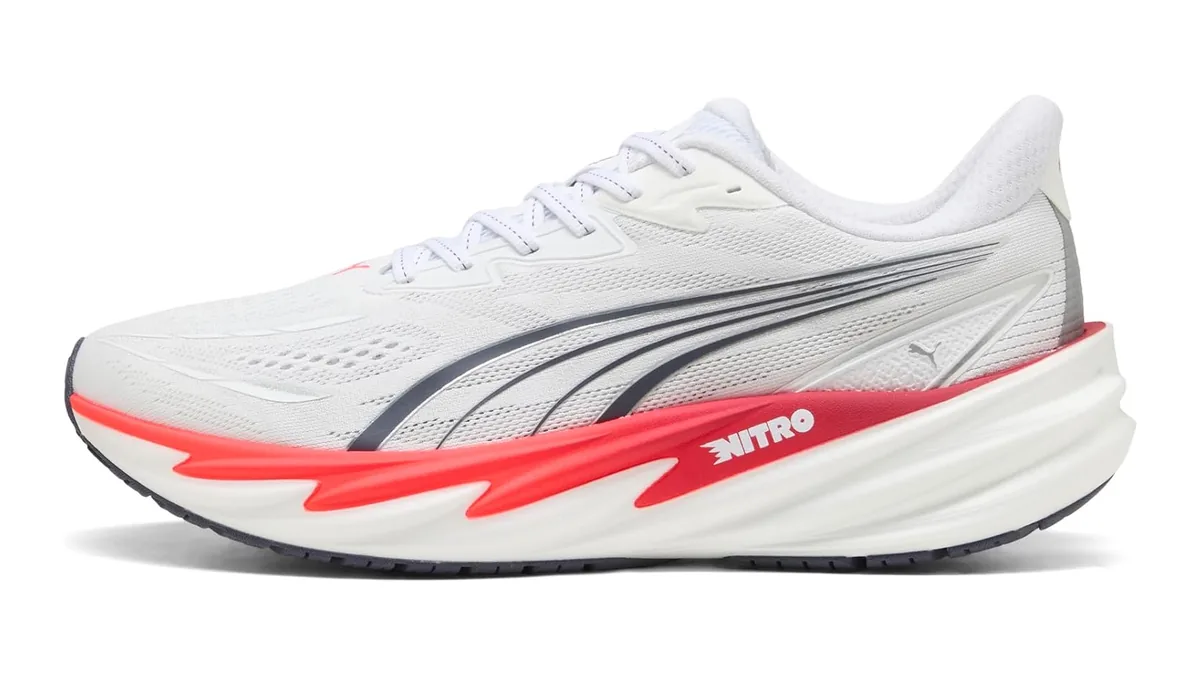
Light, grippy and easy to run in, with less foam than most rivals
Quick Answer: Puma Velocity Nitro 5 Review: The Velocity Nitro 5 is Puma’s everyday neutral trainer, and it is the version that finally fits properly. The platform and the toe box are both wider than before, the nitrogen-injected NITROFOAM midsole is soft without feeling sloppy and the shoe is light for a daily trainer. PumaGRIP rubber gives it the best wet-road traction in its class. Buy it if you want one flexible, lively shoe for runs and walks. Skip it if you want a tall pile of cushioning. Check latest price.
The Puma Velocity Nitro 5 is the workhorse of Puma’s running line. Above it sit the plated Deviate models and the racing Fast-R shoes. Below it there is not much worth talking about. The Velocity is the shoe Puma expects most people to buy, and its job is to be light, comfortable and cheap enough to replace without wincing.
What is different this time is comfort. Puma widened both the platform under the foot and the upper over it, and the change is obvious the moment you put the shoe on. The result is a trainer that suits a broader range of feet than the Velocity has before, and one we would happily suggest to a weekend runner covering three or four runs a week plus everyday walking. It is not a max-cushion shoe and it does not pretend to be.
Specs
Here are the specifications for the Puma Velocity Nitro 5:
| Type | Neutral road daily trainer |
| Gait type | Neutral, so nothing built in to counter feet that roll inward |
| Midsole | NITROFOAM, an ATPU foam with nitrogen forced into it, which makes it lighter and softer than plain foam |
| Stack height | About 33 mm at the heel and 25 mm at the forefoot, which is a moderate amount of cushioning rather than a tall one |
| Heel-to-toe drop | 8 mm, so your heel sits slightly higher than your toes |
| Weight | About 8.6 oz (244 g) in a men’s size 9 and 7.4 oz (210 g) in a women’s size 8 |
| Upper | Engineered mesh, widened through the toe box compared with the Velocity Nitro 4 |
| Outsole | PumaGRIP rubber, the brand’s high-traction compound |
| Widths | Standard only in the US range |
| Surface | Road, wet sidewalk, treadmill and light gravel paths |
| Price | Launched at $139.95 in July 2026. Check latest price |
Pros
- PumaGRIP is the best wet-weather traction on any shoe at this price, which makes winter and rainy mornings far less nervy.
- At about 8.6 oz it is light for a daily trainer, so it never feels like a chore to run in.
- The wider platform and toe box are a real improvement and open the shoe up to more foot shapes.
- The forefoot bends easily, which suits walking and feels natural rather than mechanical.
- NITROFOAM has enough life in it that easy runs do not feel dull.
Cons
- At about 33 mm under the heel there is less foam than most current rivals, so very long runs feel firmer late on.
- The midfoot still holds narrow, so it can feel snug even with the wider toe box.
- That flexible forefoot will feel too soft for anyone who prefers a stiff, rolling shoe.
- Standard width only, so wide feet have no option to size across.
What is new versus the Velocity Nitro 4
Puma aimed this update squarely at comfort rather than performance. The base of the shoe is wider, which gives you more surface to land on and makes the shoe feel more planted when you are tired. The upper is wider too, particularly across the toes, and that is the change existing Velocity owners will notice first. The previous version was known for a narrow, racy fit that ruled out plenty of people, and this one does not have that problem.
The midsole is still NITROFOAM and still tuned to be compliant, which is the industry’s word for foam that gives way easily underfoot. What that means in practice is that the shoe absorbs the repeated small impacts of daily mileage instead of transmitting them into your legs. Everything else is a refinement rather than a rethink. We could not independently confirm the exact stack and weight figures for the Velocity Nitro 4, so we have not put side-by-side numbers on those, but the shoe’s character has clearly shifted toward comfort.
Who should buy the Velocity Nitro 5
Buy it if you want one light shoe that can do everything at a reasonable pace. It suits the runner logging 15 to 30 miles a week who does not want a heavy, tall trainer, and it suits people who like to feel connected to the ground rather than perched above it. Because it is light and flexible, it also works better than most running shoes for gym cardio and for the walk to and from wherever you are running.
It is the obvious pick if you run in bad weather. Wet asphalt, painted crossings and damp autumn leaves are where cheap outsoles let go, and PumaGRIP simply does not. If your route includes hills, wet pavement or a mix of road and packed path, that grip is worth more than another 5 mm of foam. It is also a good buy for anyone who tried the Velocity Nitro 4 and rejected it on fit, because the shoe you tried is not the shoe on sale now.
Who should probably skip it
Skip it if you want deep cushioning. At roughly 33 mm under the heel this is a moderately cushioned shoe in a market where 40 mm is common, and on a two-hour run you will feel the difference. Skip it if you need support, because it is fully neutral with no firmer wedge or guide rail. And skip it if you need a wide fit: the toe box has improved, but the shoe still holds close through the middle of the foot and Puma does not sell a wider version in the US.
Any of those, and one of these will serve you better:
- Hoka Bondi 9: about as much foam as a road shoe carries, and the shoe to choose if long runs or long shifts on hard floors are the problem (check price | read review).
- Saucony Guide 19: a mild stability trainer that keeps the foot centered without feeling rigid, for anyone who has been told they need support (check price | read review).
- New Balance Fresh Foam X 880v15: sold in several widths, which makes it the sensible answer for wide or swollen feet (check price | read review).
How does the Puma Velocity Nitro 5 fit?
This is the roomiest Velocity so far, but it is still a fairly close-fitting shoe. The toes have space, the middle of the foot does not. Order your usual size and expect a secure, athletic fit rather than a relaxed one.
Fit and sizing
True to size for almost everyone. Length is accurate and the widened toe box means your toes are no longer squeezed together the way they were on the previous version. The midfoot is where the shoe holds you, and if you have a high instep you may want to skip an eyelet to take pressure off the top of the foot. Genuinely wide feet will still find it tight, and since there is no 2E option the honest advice is to look at a brand that offers widths.
Upper and step-in comfort
The engineered mesh is thin and breathes well, which is welcome on a shoe you might wear in summer. There is modest padding at the collar and a light, flat tongue, so it feels sporty rather than plush when you step in. Heel hold is good without a stiff plastic counter digging in. It is a no-nonsense upper: not luxurious, not heavy, and it dries reasonably fast if you get caught out in rain.
How does the Puma Velocity Nitro 5 perform?
The Velocity Nitro 5 runs the way a good old-fashioned trainer runs, with modern foam doing the hard work. It is light on the foot, it flexes naturally and it holds the road better than anything else in its price bracket. The trade-off is that it protects you less on long, slow miles.
Cushioning and ride
NITROFOAM gives way easily when you land, so impact is taken out of the stride without the shoe feeling squishy. It is soft rather than bouncy, which suits daily running better than it suits racing. The moderate stack means you can feel the road through the shoe, and whether that is a plus or a minus depends on you. People who dislike feeling perched on top of a shoe will find this reassuring. People who want their joints wrapped in foam will find it thin by comparison.
Ride and running performance
Because it is light and flexible, this shoe covers a wider range of paces than its price suggests. Easy runs feel effortless, steady runs feel natural and it can be pushed into a faster stretch without complaining. What creates the forward motion here is your own foot bending and pushing off, not a plate or a rocker shape, so the shoe rewards a smooth stride rather than doing the work for you. On runs beyond about 90 minutes the lower stack starts to tell and your legs will notice the road more.
Stability and support
We rate this as a stable-neutral shoe. It has no support features, but two things keep it steady. The widened base gives the foot more to land on, and the relatively low stack means there is less shoe to tip over in the first place. Tall soft shoes wobble because your foot sits high above the ground on a compressible platform, and this one avoids that by simply not being tall. It will not slow down or change the way your foot rolls, so it is not a replacement for a support shoe if a professional has recommended one.
Outsole, grip and durability
PumaGRIP is the headline feature. It is a soft, sticky rubber that holds on wet asphalt, painted road markings, wet tile and light gravel in a way most road outsoles do not, and it is the single best reason to buy this shoe over a rival. Coverage is generous, and the compound also resists wear well despite being soft. As a broad guideline daily trainers give 300 to 500 miles before the cushioning fades, though that varies with your weight, stride and surfaces, and we do not guarantee a lifespan.
Is the Puma Velocity Nitro 5 good for walking?
It is a very good walking shoe, and for some people it is a better walking shoe than a running one. Walking asks the foot to bend more than running does, and the flexible forefoot here allows that instead of fighting it. The shoe is light, so it does not tire your legs on a long day of sightseeing, and PumaGRIP is genuinely useful on wet pavement, supermarket floors and train platforms.
Where it is less convincing is standing still for hours, because a softer, taller shoe is kinder when your feet are not moving. It also has less foam to spare if you are walking on concrete all day at work. Thin orthotics fit once you lift the sockliner out, but a bulky custom insert will make the snug midfoot worse. For travel, errands and daily walks, though, it packs light and performs well above its price.
Velocity Nitro 5 versus Velocity Nitro 4
Here is where the two versions differ:
| Velocity Nitro 5 | Velocity Nitro 4 | |
| Platform | Wider, more planted underfoot | Narrower |
| Toe box | Noticeably roomier | Snug and racy |
| Midsole | NITROFOAM, tuned softer for daily miles | NITROFOAM, firmer feel |
| Outsole | PumaGRIP | PumaGRIP |
| Best use | Daily runs and walking for a wider range of feet | Daily runs for narrow feet |
Buy the new model if the fit of the old one was ever a problem, or if you want a softer, steadier version of the same idea. Buy the previous model if you have narrow feet, liked the tighter hold and can find it discounted, because the running character is broadly similar and the outsole is the same.
Puma Velocity Nitro 5 Alternatives
The Velocity Nitro 5 is light, flexible, grippy and moderately cushioned. These four each change one of those things.
- Saucony Ride 19: a similar everyday shoe with more foam underfoot, and the better choice if your long runs keep getting longer (check price | read review).
- Hoka Mach 7: also light and lively, but with a rocker shape that rolls you forward rather than asking your foot to bend, which some people much prefer (check price | read review).
- Asics Gel-Cumulus 28: softer and taller, with a more forgiving fit, for anyone who liked the idea of the Velocity but wanted more protection (check price | read review).
- Brooks Ghost 18: less exciting and less grippy, but the most reliably comfortable neutral trainer on the market if you value predictability over feel (check price | read review).
Price and value
Puma launched the Velocity Nitro 5 at $139.95, and on value it is one of the strongest shoes in the category. You are getting a nitrogen-injected foam midsole and the best outsole rubber in road running for less than most brands charge for a basic trainer. What you give up is stack height, and if long runs are your priority that matters. For everything else, from 5K training to daily walks in bad weather, this is a lot of shoe for the money and it is hard to spend $140 better.
Final verdict
Best for: neutral runners and walkers who want a light, flexible, grippy shoe for daily miles, and who run in wet weather often enough to care about traction.
Avoid if: you want maximum cushioning for long runs, you need support for feet that roll inward or you need a wide fit.
Fit: true to size, roomier at the toes than before, still snug through the midfoot. Standard width only.
Verdict: the Velocity Nitro 5 is the version of this shoe we can recommend without a caveat about fit. Wider where it needed to be wider, still light, still flexible and still fitted with the grippiest outsole in road running. It is not the shoe for someone chasing maximum cushioning, but as an affordable, honest daily trainer that also works beautifully for walking, it is one of the best buys on the shelf. Check the latest price.
Frequently Asked Questions for Puma Velocity Nitro 5
Yes. Order your normal running size. The toe box is wider than on the Velocity Nitro 4, though the midfoot still holds close, so people with high insteps may want to lace it more loosely over the middle of the foot.
It is Puma’s midsole foam with nitrogen gas forced into it during manufacturing. The gas creates tiny bubbles, which makes the foam lighter and softer than the same material without it. The effect is a shoe that cushions well for its weight.
It is a sensible first proper running shoe. It is light, it is easy to run in at slow paces, the fit is now forgiving and the price is reasonable. The main thing to check is whether a running store thinks you need support, because this shoe does not provide any.
You can race a 5K or 10K in it comfortably, since it is light and holds a fast pace without feeling clumsy. For a half marathon or marathon most people will want more foam underfoot or a plated shoe.
Better than most road shoes, thanks to the grippy rubber and the moderate stack, which keeps you closer to the ground on uneven surfaces. It has no lugs and no rock protection, so keep it to packed paths and fire roads rather than technical trail.
The Velocity is the unplated everyday shoe and the Deviate adds a carbon plate for faster running. The Deviate is stiffer and better for workouts, the Velocity is more comfortable and much cheaper for daily use. Many people end up owning one of each.
Compare this model with the rest of the current lineup in our Puma shoes hub and Puma running shoes comparison.