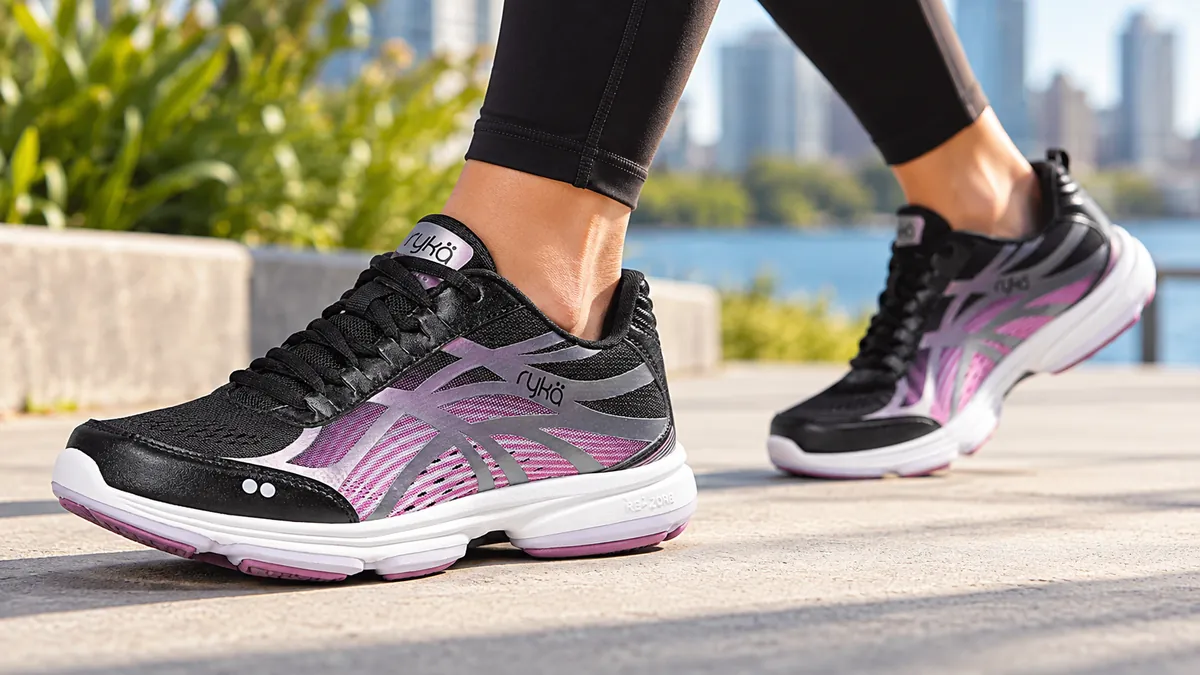
Quick Answer: Ryka Devotion Plus 3 Review: The Ryka Devotion Plus 3 is a budget-friendly walking sneaker on a women’s-specific last, with a narrower heel, a roomy toe box and an anatomical insole that adds real arch and heel support. RE-ZORB foam gives a moderate, absorbing cushion that suits casual fitness walking and long days on your feet, in medium and wide widths. Its weak points are a flexible build unsuited to anyone needing firm stability, and owner reports of the cushioning and outsole wearing down after a few months.
Roomy, arch-supportive comfort at a budget price, with modest long-term durability
The Ryka Devotion Plus 3 sits in the middle of Ryka’s Devotion family, the brand’s best-known line of walking sneakers built only for women. Ryka’s argument is that women’s feet carry a narrower heel, a wider forefoot and a different arch than men’s, and the company shapes its lasts around that rather than shrinking a unisex shoe. The Devotion Plus 3 applies that idea to a shoe meant for everyday fitness walking rather than serious mileage or hard training. For the current brand lineup, see our Ryka shoes guide.
Within the current Devotion lineup, the Plus 3 is the more structured, slightly firmer option next to the lighter Devotion X 2 and the deeply cushioned Devotion X Max models. It suits women who want a comfortable, accommodating shoe for daily walks, errands, standing around a job site or theme park and casual fitness walking, without paying running-shoe prices. Ryka has released the Devotion Plus 4, but the Plus 3 remains on Ryka’s own site and is still marked as a best seller. That makes it an older model rather than an obsolete one, which matters if you find it at a discount.
If you are comparing everyday walkers rather than one model, start with our best walking shoes guide. If fit or support is the bigger question, the Free Shoe Finder can narrow the choices.
Check price, size and availability on Amazon.

Specs
Here are the specifications for the Ryka Devotion Plus 3:
| Type | Women’s fitness-walking sneaker for daily walks, errands and standing |
| Gait type | Neutral, with arch and heel support built into the insole rather than a firm medial post |
| Midsole | RE-ZORB, Ryka’s shock-absorbing EVA foam, which soaks up impact rather than springing back |
| Insole | Anatomical, contoured insole with added arch and heel support |
| Stack height | About 31 mm under the heel, independently measured, a moderate amount of foam |
| Drop | About 10 mm heel-to-toe, independently measured, so the heel sits noticeably higher than the toes |
| Weight | About 8.2 oz per shoe, reported independently; exact sample size not published |
| Upper | Breathable mesh with printed overlays and a padded collar and tongue |
| Outsole | Eight-piece segmented rubber sole with flex grooves for traction |
| Widths | Medium (B) and wide (D) |
| Certification | Not confirmed for this model; other Devotion shoes carry the APMA Seal of Acceptance |
| Price | About $100 when new; the model was already on sale by 2019. Ryka currently lists select colors at $64.99, although pricing changes. Check latest price |
Pros
- Anatomical insole adds real arch and heel support, unusual at this price.
- The women-specific last gives a narrower, secure heel and a genuinely roomy toe box, so fewer pressure points out of the box.
- RE-ZORB foam absorbs shock well for casual walking and standing without feeling stiff.
- Both medium and wide widths are offered, and the eight-piece outsole flexes easily underfoot.
- List price is well under most comfort-walking competitors, and it is frequently discounted further.
Cons
- Flexes more than a true stability shoe, so it will not correct heavy inward rolling of the foot.
- Some owners report the arch support and cushioning flattening out within two to three months.
- Traction on wet surfaces is inconsistent between reviewers, so treat slick floors with caution.
- Base-level cushioning suits casual walking better than long, hard days on concrete.
What is new versus the Ryka Devotion Plus 2
The Devotion Plus 3 is an evolution of the Devotion Plus 2, not a ground-up redesign. Both shoes share the same core idea: RE-ZORB cushioning, an anatomical insole with extra arch and heel support, a narrower heel and roomier toe box built for women’s foot shape, and an eight-piece segmented rubber outsole. The suggested price moved up modestly, from about $85 for the Plus 2 to about $99.99 for the Plus 3, reflecting the added materials rather than a different platform.
Ryka says the main differences from the Devotion Plus 2 are design updates: a new toe cap, quarter overlay, iridescent overlay and tongue patch. The underlying walking-shoe formula stays familiar, including RE-ZORB cushioning, the women-specific fit and the segmented outsole. That makes the Plus 3 more of a refresh than a performance reset. If your Plus 2 still fits well, there is no urgent reason to switch; if you are buying new, the Plus 3 remains easy to find and Ryka still lists it as a best seller.
Who should buy the Ryka Devotion Plus 3
Buy it if you want a comfortable, well-shaped walking sneaker for daily use without spending triple digits. The narrow heel and roomy forefoot solve a fit problem many unisex shoes create for women, and the anatomical insole gives your arch more to lean on than most shoes near this price. It suits neutral feet and mild overpronators wanting extra arch cushioning rather than firm corrective structure.
It also suits people on their feet for stretches of the day in casual settings: retail workers, theme park visitors, frequent dog walkers or anyone who wants one dependable, budget-friendly shoe for errands and short fitness walks. The wide-width option makes it a reasonable pick for broader feet too. If your priority is a soft, accommodating, women-shaped shoe at a friendly price, and you do not need firm stability, the Devotion Plus 3 is a sensible choice.
Who should probably skip it
Skip it if you need a stability or motion-control shoe, since the Devotion Plus 3 bends readily at the toe and midfoot and has no firm post to slow heavy inward rolling. Skip it if you stand on hard floors for a full shift most days, since the base-level cushioning suits casual walking rather than eight- or ten-hour durability. Skip it too if long-term durability matters more than upfront price, since some owners report the arch support and cushioning breaking down within a few months.
For those readers, these are better matches:
- Brooks Addiction Walker 2: a leather motion-control shoe with firm Rollbar support and a slip-resistant sole, built for overpronation and all-day standing (check price | read review).
- New Balance 847v4: a firmer, structured walking shoe with an extensive width range for feet that need real correction, not just extra padding (check price | read review).
- Vionic Walk Max: built-in, more pronounced arch support and a rocker sole for feet that need structure a soft insole cannot provide (check price | read review).
How does the Ryka Devotion Plus 3 fit?
The Devotion Plus 3 fits the way Ryka’s Devotion shoes generally do: true to size, with a heel that sits closer than a men’s-based shoe and a toe box with real room to spread. Independent reviewers describe the fit as accommodating rather than snug, with no meaningful break-in period.
Fit and sizing
Order your usual size. Length runs true in the medium width, and the toe box has noticeably more room than a typical walking shoe, so wide or splayed toes are less likely to rub out of the box. The heel is narrower and shaped to hold the back of the foot in place, which matters if you have slipped out of the heel of a unisex sneaker before. Standard lacing lets you tighten around any pressure points, and the wide (D) width is worth choosing for a broad forefoot or bunions, since the medium is roomy but not built for very wide feet. The insole has enough depth for a slim orthotic, though a thick one will crowd the already generous toe box.
Upper and step-in comfort
Step-in comfort is one of the shoe’s strong points. The mesh upper breathes well, which matters on warm days and long walks, and the padded collar and tongue keep the laces from digging into the top of the foot. The anatomical insole gives an immediate sense of cushioning under the arch that a flat, generic insole does not, and reviewers describe the feeling as close to walking on a soft, supportive pillow rather than a firm platform. The printed overlays add a bit of structure and a more detailed look than the previous Devotion Plus generation, without adding stiffness. The trade-off is that the upper runs a little narrow through the midfoot for some wearers, so anyone between widths may want the wide option rather than stretching the medium.

How does the Ryka Devotion Plus 3 perform?
For casual fitness walking, errands and standing around town, the Devotion Plus 3 performs above its price. Push it toward serious mileage, uneven terrain or heavy structural needs and its limits show, but that is not the job it was built for.
Cushioning and ride
RE-ZORB is the midsole foam, the cushioned layer between your foot and the ground, tuned here to absorb shock rather than spring you forward. Independent lab measurements put the stack at around 31 mm under the heel with roughly a 10 mm drop, a moderate amount of padding that still lets your heel sit noticeably higher than your toes, familiar to most walkers. The anatomical insole adds a further layer of contoured cushioning under the arch. Independent reviewers describe the underfoot feel as adequate rather than plush: enough for comfortable walking, without the marshmallow-soft ride of a maximalist shoe.
Ride and walking performance
Walking feels easy and unstructured in the Devotion Plus 3. The sole bends readily at the toe and midfoot, more than many competing walking shoes, giving it a light, flexible transition from heel to toe rather than a firm, rockered roll. That flexibility suits an easy walking pace and shorter distances well. Independent reviewers generally describe it as better suited to an easy pace than to fast, purposeful fitness walking or running, since the soft build and flexible sole do not hold up as well under a quicker cadence or longer distance.
Stability and support
We would classify the Devotion Plus 3 as a neutral shoe with added arch and heel cushioning rather than a stability shoe. There is no firm medial post or dense foam wedge to slow the inward roll of the foot, which is what a true stability or motion-control shoe uses; the anatomical insole simply gives the arch more to rest on. Independent testing found the support reasonable for neutral walkers and mild overpronators, but anyone needing a shoe to correct heavier overpronation will not get that from this insole alone. The base feels planted on flat ground, less so on uneven surfaces.
Outsole, grip and durability
The outsole is built from eight separate rubber pieces with grooves between them, letting the sole flex while covering the areas that take the most wear. On dry pavement and gym floors, grip is generally rated above average. Independent reviewers disagree on wet-surface traction: some report confident grip in wet and dry conditions, others note occasional slipping, so treat slick or rain-soaked surfaces with caution. Durability is the shoe’s most consistent weak point in long-term owner reports, which describe the arch support and cushioning diminishing after two to three months, along with occasional odor buildup and, less commonly, the sole separating from the upper. Ryka makes no lifespan guarantee, and these are patterns reported by owners rather than a lab result, so experience will vary with body weight and use.

Is the Ryka Devotion Plus 3 good for walking?
Yes, within its intended range. It is marketed specifically as a walking shoe, and independent reviewers place it well for casual fitness walking and all-day wear around town: errands, dog walks, sightseeing, mall walking and moderate time on your feet at work all suit its flexible, cushioned build. The women-specific last and roomy toe box keep it comfortable for extended wear without pinching, and the anatomical insole gives tired feet something to rest on across a day mixing standing and short walks.
Where it is less convincing is distance walking and travel days spent almost entirely on hard floors, such as an airport terminal or a full shift on concrete. The base-level cushioning and unstructured sole are not built to hold up hour after hour the way a firmer, more cushioned shoe would, and owner reports of the support flattening out over a few months suggest it suits moderate daily use better than the heaviest schedules. A slim orthotic can be added for extra structure, though the generous toe box means a bulky insert will crowd it.
Devotion Plus 3 versus Ryka Devotion Plus 2
Here is how the two generations line up:
| Devotion Plus 3 | Devotion Plus 2 | |
| Heel padding | New toe cap, quarter overlay, iridescent overlay and tongue patch | Earlier toe cap and overlay design |
| Cushioning | RE-ZORB midsole, anatomical insole | RE-ZORB midsole, anatomical insole |
| Upper styling | More detailed, layered design | Plainer, minimalist design |
| Outsole | Eight-piece segmented rubber | Eight-piece segmented rubber |
| Fit shape | Women-specific last, narrow heel, roomy toe box | Women-specific last, narrow heel, roomy toe box |
| Price | About $99.99 at launch | About $85 suggested retail |
Buy the new model if you want extra cushioning around the heel collar or the more detailed upper styling, and do not mind the modest price increase. Buy the previous model if you find the Devotion Plus 2 in your size at a discount and are fine with a plainer heel and look, since the core cushioning, insole and outsole are functionally the same shoe underneath.
Ryka Devotion Plus 3 Alternatives
The Devotion Plus 3 is a budget-friendly, women-shaped walker with moderate cushioning and modest durability. A few shoes are worth weighing against it depending on which trait matters most to you.
Shoppers who like the Devotion family’s fit but want something lighter for shorter, easier days should look at the Ryka Devotion X 2, a lighter, softer sibling on the same last, with less structure but a springier, more casual feel for errands and travel (check price | read review). For noticeably more cushioning at a similar budget, the Skechers GO WALK 8 trades the Plus 3’s flexible foam for a softer, slip-on-friendly ride for easy days, though with even less arch structure (check price | read review). Readers who spend long stretches on hard floors and want a rolling, cushioned sole built for that job should look at the Skechers Max Cushioning Elite 2.0, which pairs a deeper foam stack with slip-in and wide-width options (check price | read review). Buyers who liked the Plus 3’s fit and support but would rather save money, or prefer a plainer upper, can look for the earlier Devotion Plus 2, which uses the same core midsole and insole where it is still in stock (check price).
Price and value
The Devotion Plus 3 launched at about $99.99, below most comfort-walking shoes that offer a built-in arch-support insole and a women-specific fit, and it is frequently discounted. For that price, you get a genuinely accommodating fit, real arch and heel cushioning and a flexible, easy-to-wear build, a fair trade for buyers whose priority is day-to-day comfort rather than technical support or maximum durability. What the price does not buy is the firmer structure of a true stability shoe or the long-term resilience some owners want, so weigh that against how hard you plan to use the shoes.
Final verdict
Best for: women who want a comfortable, women-shaped walking sneaker with real arch and heel cushioning for daily walks, errands and standing, at a budget-friendly price.
Avoid if: you need a firm stability or motion-control shoe, you stand on hard floors most of the day, or long-term durability matters more to you than upfront cost.
Fit: true to size, narrower heel, roomy toe box, medium and wide widths, no meaningful break-in.
Verdict: the Ryka Devotion Plus 3 delivers a genuinely comfortable, well-fitted walking shoe for women at a price that undercuts most of the comfort-walking category. It will not correct serious overpronation, and some owners see the support and cushioning fade within a few months, but for casual fitness walking, errands and everyday comfort, it remains a sensible, budget-friendly pick.
Frequently Asked Questions for Ryka Devotion Plus 3
Yes. Order your usual size. The toe box is roomier than most walking shoes and the heel is narrower and more secure, so there is no need to size up for extra room. Wide widths are available for broader feet.
Yes. It is offered in medium (B) and wide (D) widths, which makes it a reasonable option for broader feet as well as narrower ones.
RE-ZORB is Ryka’s shock-absorbing midsole foam. In the Devotion Plus 3 it works with an anatomical insole to cushion the arch and heel, absorbing impact rather than springing the foot forward.
It suits moderate standing and casual walking mixed together, such as a retail shift or a day out, better than a full shift entirely on hard concrete. For all-day standing on hard floors, a firmer, more cushioned shoe is usually a better fit.
It offers extra arch cushioning through its anatomical insole, which can help mild overpronation feel more comfortable, but it has no firm medial post and will not correct heavier inward rolling. A dedicated stability or motion-control shoe is the better choice for that.
Ryka does not publish a lifespan for the shoe. Long-term owner reports describe the arch support and cushioning diminishing after roughly two to three months of regular wear, so treat that as a general pattern rather than a guarantee; individual results vary with body weight and how often the shoes are worn.
Yes. Ryka still lists the Devotion Plus 3 on its own site and marks it as a best seller, although colors and sale pricing vary. It is an older model, so availability can change by size.