Real motion control and unbeatable range of widths, in a firm, old-fashioned shoe
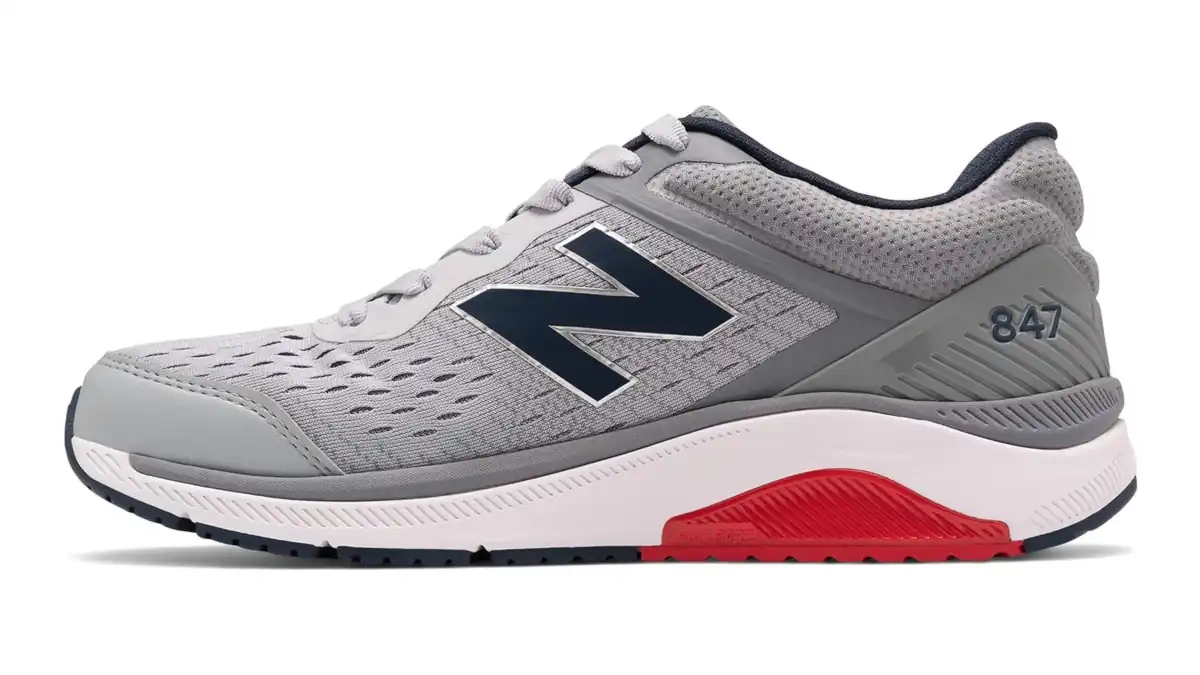
Quick Answer: New Balance 847v4 Review: The 847v4 is a structured walking shoe for people whose feet roll inward and who need the shoe to do something about it. A firm wedge under the heel and a plastic heel clip keep the back of the foot upright, the sole is stiff and steady rather than soft, and the width range runs from very narrow to very wide. It is the pick for orthotics, swelling and long days on your feet. It is also heavy, firm and plain to look at, and it costs more than it appears to. Check latest price.
The New Balance 847v4 is a walking shoe built to an older idea: that a shoe should hold your foot in place rather than let it move freely. Most of the running world has drifted away from that, but for walking, standing and working it still makes a lot of sense, and the 847 has been New Balance’s answer for years.
In the walking range it sits above the everyday models and just below the 1540, which is the brand’s most heavily built support shoe. Think of the 847v4 as the practical middle: enough structure to matter, without the weight and stiffness of a genuine prescription shoe. It is sold in both men’s and women’s versions.
The buyer it suits is someone who has been told they overpronate, or who wears an orthotic, or whose feet swell through the day, or who is on their feet at work and wants something that will not let their arches collapse by the afternoon. If you want a light, soft, modern-looking walking shoe, this is not the one.
Specs
Here are the specifications for the New Balance 847v4:
| Type | Walking shoe with motion control features |
| Gait type | Overpronation, meaning feet that roll inward as you step |
| Midsole | TRUFUSE, a blend of a softer cushioning foam and a firmer supportive foam |
| Support system | ROLLBAR posting under the heel, plus a TPU plastic heel clip |
| Heel-to-toe drop | 12 mm |
| Upper | Structured synthetic leather with breathable mesh panels |
| Sockliner | Removable Ortholite |
| Outsole | Ndurance rubber in the high-wear areas |
| Widths | Extended widths, commonly listed from 2A through 4E depending on the version and retailer |
| Medicare | Listed as an A5500 diabetic style under the therapeutic shoe program |
| Weight and stack | Not published by New Balance, and we have found no reliable independent measurement, so we have not guessed |
| Price | Lists at $149.99. New Balance does not publish a launch month for this version, so we are not quoting one. Check latest price |
Pros
- The firm heel wedge and plastic heel clip genuinely limit how far your foot rolls inward, which very few walking shoes still attempt
- Width choice is exceptional, running from narrow through to 4E on many listings, so you can get the length right without compromise
- The removable Ortholite sockliner comes out cleanly, which makes it one of the easier shoes to fit a custom orthotic into
- Ndurance rubber in the wear zones means the sole outlasts most walking shoes
- A tall heel takes tension off the calf and Achilles, which suits walkers who land heavily on the heel
Cons
- Firm underfoot, so anyone hoping for a soft, plush walking shoe will be disappointed
- Heavy, and it feels every bit of it by the end of a long day
- The styling is dated, and it looks like a shoe bought for a medical reason
- The toe box is tighter than the 847v3, so long-time buyers should not assume the fit carries over
- At $149.99 it is expensive for what appears to be a plain walking shoe
What is new versus the New Balance 847v3
Underneath, very little has changed, and that is deliberate. The TRUFUSE midsole and the ROLLBAR heel post carry over, so the shoe supports the foot the same way it always has. If the 847v3 worked for you, the mechanics of the v4 will not surprise you.
The upper is where the change is. The v3 used leather over the toe box; the v4 puts mesh there instead, with synthetic leather providing the structure elsewhere. That makes the shoe cooler and lighter in feel, and it is a sensible update for anyone who found the older shoe stifling in summer.
It also changes the fit, and this catches people out. The v4’s toe box is tighter than the v3’s, and enough buyers have found their usual size feels different that it is worth ordering with a return in mind rather than assuming your old size carries across. Measure again, and if you are between sizes or widths, take the larger.
Who should buy the New Balance 847v4
Buy it if your feet roll inward and you want the shoe to do something about it rather than just cushion the result. The firmer foam sits on the inner side of the heel, where the collapse starts, and the plastic clip wrapping the heel stops the whole back of the shoe leaning over. You feel this most in the last hour of a long day, when a soft shoe would have given up.
Buy it if width is your problem. Very few brands still make a walking shoe in this spread of fittings, and getting the width right matters more than most people think: if your foot spills over the edge of the sole, none of the support underneath can work properly.
Buy it if you wear an orthotic. The sockliner lifts straight out, the shoe is built with the volume to take a replacement, and it is listed as an A5500 style under the Medicare therapeutic shoe program, which is worth asking a certified supplier about if you have diabetes and qualify.
Who should probably skip it
Skip it if you want soft cushioning. This shoe holds and steadies; it does not pamper. If you have been walking in a plush max-cushion shoe and enjoying it, the 847v4 will feel hard and unyielding, and no amount of breaking in will change that, because the firmness is the support.
Skip it too if your feet are neutral. Support features you do not need are just weight you are carrying, and there is a lot of shoe here. And skip it if appearance matters: this is a plain white or gray walking shoe of a very traditional kind, and it will not pass for anything else.
These are better choices for those readers:
- Brooks Ghost Max 3: deep, soft cushioning on a wide, steady base, in wide fittings, for neutral feet that want comfort rather than correction (check price | read review)
- Hoka Transport 2: far lighter, better looking and built for walking and commuting, with a rolling sole that makes distance easier (check price | read review)
- Skechers GO WALK 8: the cheapest and lightest way to be comfortable if your feet need nothing in particular (check price | read review)
How does the New Balance 847v4 fit?
The 847v4 fits like a proper walking shoe: secure through the heel and midfoot, with a squarer toe than a running shoe. The headline is the width range, which is broader than almost anything else on the shelf. The complication is that the fit has changed from the previous version, so past experience is not a safe guide.
Fit and sizing
Measure rather than assume. Buyers moving up from the 847v3 have found the v4 fits differently, with a tighter toe box, and some need a different size entirely. Widths are commonly listed from 2A at the narrow end through B, D and 2E to 4E, though not every color comes in every fitting, so check the specific listing. Each step up in width adds roughly half an inch across the foot, which is a meaningful amount. If you plan to use your own orthotic, fit the shoe with it in place, because it lifts your foot and takes up room.
Upper and step-in comfort
The upper mixes synthetic leather panels, which give the shoe its shape and hold your foot down over the arch, with mesh across the toes for airflow. It feels substantial rather than soft, and it wipes clean easily, which matters if the shoe is worn for work. Step-in comfort comes mostly from the Ortholite sockliner, a thin foam insole that feels springy at first and settles down after a week or two. The heel is well padded and the plastic clip is buried in the sole, so you do not feel it against your ankle.
How does the New Balance 847v4 perform?
This shoe is judged by hours, not miles. It is built to keep your foot in the same position at the end of a long day as it was at the start, and it does that well. It gives up almost everything else to manage it: softness, lightness and any sense of fun.
Cushioning and ride
TRUFUSE is New Balance’s name for a midsole that fuses two foams together: a softer one to take the impact and a firmer one to resist collapse. The result underfoot is protective but noticeably firm, closer to a good work shoe than to a modern trainer. The heel sits 12 mm higher than the forefoot, which is a lot by current standards, and it means your heel has plenty of material under it and your calf is not stretched at the back of each step. If your Achilles complains in flatter shoes, that helps.
Ride and everyday performance
Walking in it feels planted and slightly deliberate. There is no curved rocker sole to tip you forward, so the shoe flexes at the ball of the foot in the traditional way and your legs do the work. On flat pavement and indoor floors that is fine and dependable. Over a long distance it is more tiring than a rockered shoe, and it never feels quick. It is not a running shoe, and New Balance does not sell it as one.
Stability and support
We would classify the 847v4 as motion control, the strongest category of support, rather than a milder stability shoe. Two things do the work. ROLLBAR is a firmer wedge of foam built into the heel on the inner side, which resists the inward lean at the moment it starts. The TPU heel clip is a piece of stiff plastic that cups the back of the shoe and stops the whole heel unit tipping. Together they reduce how far the rearfoot moves. The design is intended to guide the foot and hold it steady, and many people with flat feet find that reduces aching. It does not correct your gait, and no shoe does.
Outsole, grip and durability
New Balance uses Ndurance, a harder rubber compound, in the places that scuff first, chiefly the outer heel and the ball of the foot. Grip on dry pavement, indoor flooring and packed paths is dependable, though it is not a certified slip-resistant sole for wet or greasy floors. Durability is a genuine strength: the combination of a firm midsole, a synthetic leather upper and hard-wearing rubber means this outlasts most soft walking shoes, and the sockliner is replaceable when it flattens.
Is the New Balance 847v4 good for walking?
Walking is its entire purpose, so the honest question is what kind of walking. For standing all day and for the stop-start walking of a shift at work, it is one of the better options available, because the support holds up when your feet are tired and swollen and the wide fittings give the swelling somewhere to go. For a few miles on pavement it is dependable but hard work compared with a cushioned, rockered shoe, since you supply all the forward motion yourself. For travel it is heavy and takes up suitcase space. Where it wins outright is orthotics: the sockliner lifts out and there is room underneath, so a prescribed insole goes in and still works with the support already built into the sole.
New Balance 847v4 vs New Balance 847v3
847v4 | 847v3 | |
|---|---|---|
Midsole | TRUFUSE | TRUFUSE |
Support | ROLLBAR heel post and TPU heel clip | ROLLBAR heel post |
Toe box material | Mesh over the toes | Leather over the toes |
Fit | Tighter toe box than the v3; sizing has caught buyers out | Roomier over the toes |
Widths | Extended, commonly 2A to 4E | Extended |
Buy the new model when you want a cooler, more breathable shoe and you are happy to check your size afresh, or when the v3 is simply no longer stocked in your fitting.
Buy the previous model when you can still find it, you know your size in it and you value the extra room and weather resistance that the leather toe box gives you.
New Balance 847v4 Alternatives
The 847v4 trades softness and style for support and width. These alternatives each keep the support and give something back.
Brooks Addiction Walker 2: the closest rival, a leather walking shoe with its own support frame, and the better pick if you need a shoe that looks smart enough for a uniform and wipes clean at the end of a shift (check price | read review).
Where the 847v4 is firm, the Hoka Gaviota 6 is soft, and it still supports. It uses a frame around a thick cushioned midsole, so you get the steadying effect without the hard ride, which is the single most common complaint about this style of shoe (check price | read review).
On a tighter budget, the Skechers Arch Fit 2.0 gets you a shaped, supportive insole under the arch for a fraction of the price. You give up the heel post and the width range, but for milder needs it covers a lot of the same ground (check price | read review).
For work on wet floors, neither support nor width is the priority, and the Hoka Bondi SR is the answer instead. It pairs a wipe-clean leather upper with a slip-resistant sole and very deep cushioning, which is a different set of trade-offs for a different job (check price | read review).
Price and value
At a list price of $149.99 the 847v4 asks premium money for a shoe that looks basic, and that is the honest sticking point. What the money buys is the width range, the ROLLBAR support system, hard-wearing rubber and the depth to take an orthotic, none of which shows in a photograph. Discounting is common, so it is rarely worth paying full price. If you qualify under the Medicare therapeutic shoe program the cost may be lower again. For a neutral foot it is poor value. For the foot it is built for, there is not much else like it.
A note on foot pain and support
How a shoe feels depends on your own fit, gait, foot shape, arch, injury history, body weight, the surfaces you walk on and personal preference, so support that helps one person can feel wrong on another. Nothing here is medical advice. If you have foot, ankle or knee pain that is severe, persistent or getting worse, or you have diabetes or reduced sensation in your feet, get assessed by a podiatrist or your doctor before choosing footwear.
Final verdict
Best for: walkers and workers who overpronate, wear orthotics, have wide or narrow feet outside the usual range, or need a shoe that still supports them at the end of a long shift.
Avoid if: your feet are neutral, you want soft cushioning, you care how the shoe looks, or you want something light for travel.
Fit: check your size afresh rather than assuming, because the toe box is tighter than the 847v3, and choose from the wide range of fittings.
Verdict: the New Balance 847v4 is one of the last proper motion-control walking shoes, and it does that job seriously. It is firm, heavy and plain, and it is priced higher than it looks. If your feet need holding rather than cushioning, that is a trade worth making.
Frequently Asked Questions for New Balance 847v4
It is listed as an A5500 style, which is the code used for depth shoes supplied under the Medicare therapeutic shoe program for people with diabetes. You still need a qualifying diagnosis, a certifying doctor and a supplier enrolled to bill for it.
Both are support shoes, but the 1540 is the heavier, more rigid option built for the strongest control and is the one most often prescribed for serious flat foot problems. The 847 is lighter and easier to wear day to day, with less aggressive support.
Color choice is limited and varies by season and retailer, but plain black and neutral grays and whites are the usual options, which is why it is a common choice for uniformed work.
Longer than most walking shoes, because of the firm midsole and the hard-wearing rubber. The insole flattens before the shoe does, and replacing it is the cheapest way to restore the feel.
Many people do, because of the support and the wide fittings. Be aware that it is not sold with a certified slip-resistant sole, so if your employer requires one, choose a shoe that is rated for it.
No. The mesh panels across the toes let water in. It sheds a light shower, but it is not a wet weather shoe.