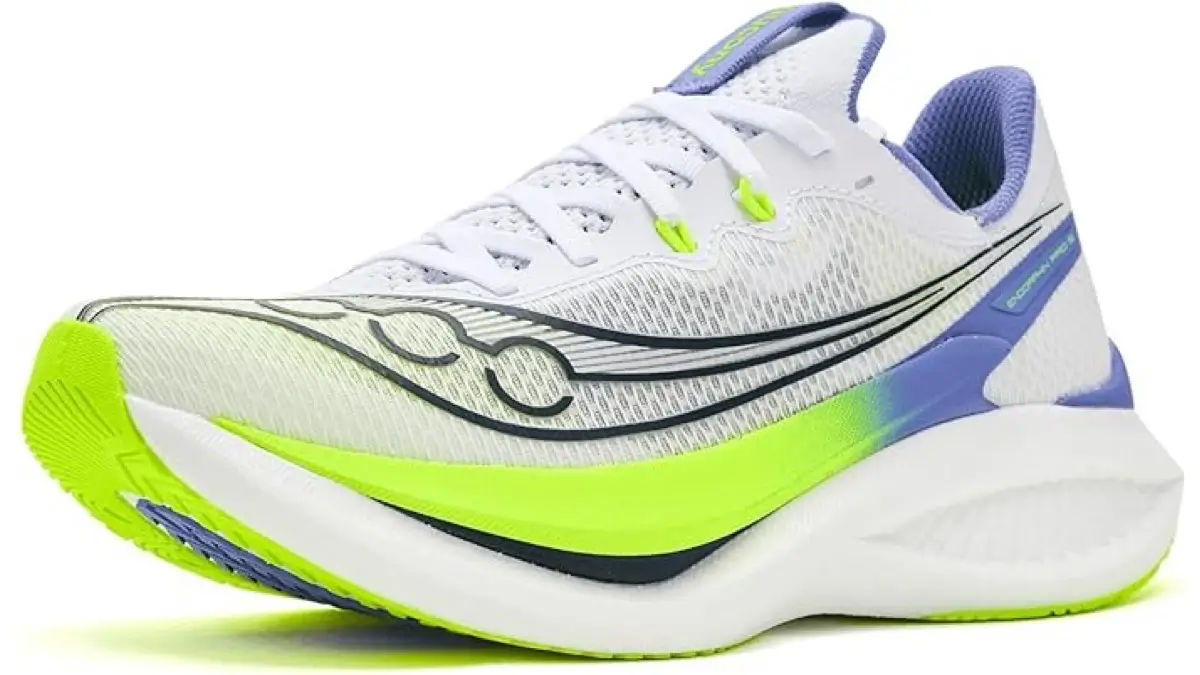
Exceptional marathon comfort with less of a race-day kick
Quick Answer: Saucony Endorphin Pro 5 Review: The Endorphin Pro 5 is a carbon-plated marathon racer for neutral runners chasing a personal best over the half and the full. Saucony slotted the carbon plate so it flexes along the foot’s natural lines, and kept the PWRRUN HG top layer over a PWRRUN PB base, which gives a cushioned rather than harsh race ride. Grip and stability are strong for a supershoe. The trade-off is that it feels smooth and forgiving rather than sharply aggressive. Check latest price.
The Saucony Endorphin Pro 5 is the fifth version of Saucony’s flagship racing shoe and the first substantial update to it in two years. It sits at the top of the Endorphin family, above the Endorphin Speed, which uses a nylon plate, and above the plateless Endorphin Azura. Where those are training shoes that can go fast, the Pro 5 is a race shoe first.
The headline change is the plate. Saucony cut slots into the carbon fiber so it can bend along the lines the foot naturally follows, instead of acting as one rigid sheet. The point of a plate in a racing shoe is to stop the toes bending backward at the end of the step, which wastes energy, while the rocker shape of the sole tips you forward into the next stride. Slotting it keeps that benefit but softens the abruptness, and it is why the Pro 5 feels less like it is fighting your foot than some rivals.
Under and over the plate, Saucony kept the recipe from the Pro 4: PWRRUN HG, a dense high-rebound foam, sits on top where the foot lands, and PWRRUN PB, the lighter PEBA-based foam, forms the base. Together they hit roughly 39.5 mm at the heel, right at the legal limit for road racing, while the shoe still weighs about 7.3 ounces in a men’s US 9.
Specs
Here are the specifications for the Saucony Endorphin Pro 5:
| Type | Road racing shoe, neutral, carbon plated |
| Best for | Half and full marathon racing, race-pace long runs |
| Midsole | PWRRUN HG top layer over a PWRRUN PB base |
| Plate | Slotted full-length carbon fiber, with Speedroll rocker geometry |
| Stack height | 39.5 mm heel / 31.5 mm forefoot, approximate |
| Heel-to-toe drop | 8 mm |
| Weight | About 7.3 oz (206 g) men’s US 9, about 6.3 oz (178 g) women’s US 8 |
| Upper | Thin racing mesh with minimal padding and a light heel structure |
| Outsole | PWRTRAC rubber |
| Widths | Standard width only |
| Price | Launched at about $225 in February 2026. Check latest price |
Pros
These are the qualities that make it a strong marathon choice:
- Cushioned enough to stay comfortable deep into a marathon, where firmer racers start to hurt
- The slotted plate flexes with the foot, so the forefoot feels less locked than in most carbon shoes
- PWRTRAC outsole grips well on wet roads, which is a common weak point in racing shoes
- More composed and less tippy than many supershoes of the same height
- Light at roughly 7.3 ounces despite the amount of foam
- Fits securely without needing to be laced painfully tight
Cons
These are the reasons some runners may choose a rival:
- Smoother and more measured than aggressive, so it lacks the immediate snap of the sharpest racers
- Better over the marathon than over 5K, where a firmer, lower shoe suits most runners
- Expensive at about $225, and the useful life of any racing foam is short
- No wide fitting, and the racing last is narrow
- Limited value at easy paces, so it cannot double as a trainer
What is new versus the Endorphin Pro 4
Saucony left the midsole materials alone and changed how the shoe transitions. The plate is the main story: the Pro 4 used a solid carbon sheet, and the Pro 5 slots it so that different parts of the forefoot can bend at slightly different moments. Runners who found the Pro 4 unforgiving through the front of the foot should notice this immediately.
Saucony also revised the Speedroll geometry, its name for the curved sole that rolls the foot forward. The curve is tuned to work with the new plate, and the result is a longer, smoother roll rather than a sharp tip at one point in the stride. That change is what makes the Pro 5 feel more marathon-oriented than its predecessor.
The third change is the outsole, now a PWRTRAC compound with better wet grip. That matters more than it sounds, because racing shoes have historically traded traction for weight and spring marathons are frequently run in rain. The upper is refined rather than reinvented, still thin and light with minimal padding. Anyone happy in the Pro 4 will find the Pro 5 familiar, just smoother and surer footed.
Who should buy the Endorphin Pro 5
Buy the Endorphin Pro 5 if you are racing a marathon and comfort over three or four hours matters as much as raw speed. The generous cushioning and the long, gentle roll are aimed squarely at runners who fall apart in the last 10 kilometers, and the shoe holds its composure when form gets ragged in a way that firmer, twitchier racers do not.
It is also the sensible pick if carbon plates have never agreed with you. The slotted design lets the forefoot bend more naturally, so runners who felt their calves or feet complaining in a rigid racer often get on better here. Neutral runners with a mid or forefoot strike get the most out of the geometry, though the 8 mm drop keeps it workable for heel strikers too.
Anyone racing in unpredictable weather should note the outsole. PWRTRAC grip is a genuine advantage on a wet spring marathon course, and it removes one of the standing worries about racing in a supershoe.
Who should avoid the Endorphin Pro 5
Runners chasing 5K and 10K times should look elsewhere. Over short distances most runners are better served by a lower, firmer racer that turns over quickly, and the Pro 5’s tall, cushioned platform is built for the opposite problem. The smoothness that helps at mile 22 does nothing for you at mile two of a 5K.
Runners who want an obvious, aggressive kick will also be disappointed. This is a shoe that gets you to the finish efficiently rather than one that feels dramatic underfoot, and if the sensation of speed is part of what you are paying for, some rivals deliver more of it.
Finally, avoid it if you want a shoe you can train in. Racing foams are light because they are not built to endure, and using the Pro 5 for daily mileage wastes an expensive shoe quickly. Runners with wide feet should also note there is no wide fitting and the last is cut narrow.
How does the Endorphin Pro 5 fit?
Fit and sizing
The Pro 5 fits true to size for most runners, with the narrow, close shape you expect from a racing shoe. The midfoot is snug, the heel is held firmly and the toe box gives enough room for the toes to splay slightly but not to move around. Saucony’s racing last is friendlier than some, so runners who cannot get on with the narrowest supershoes often manage here.
There is no wide fitting. If your feet swell noticeably over a marathon, and most do, half a size up is worth considering rather than trying to force a race-day fit that is comfortable only in the first hour.
Upper and step-in comfort
The upper is thin racing mesh with very little padding, a light heel structure and a slim tongue. Step-in comfort is unremarkable in the way race shoes always are, but the shoe does not need to be cranked down to feel secure, which spares the top of the foot on a long effort.
Breathability is good, which matters in warm-weather racing, and the mesh dries quickly if you run through aid station sponges or rain. There is minimal protection from cold or wet, so treat it as a race-day upper rather than an all-conditions one.
How does the Endorphin Pro 5 perform?
Midsole and cushioning
The two foams split the work. PWRRUN HG is dense and highly resilient, and putting it on top means the foot lands on the layer that returns the most energy. PWRRUN PB, the lighter PEBA-based foam, forms the base and keeps overall weight down while adding depth. The blend reads as cushioned but controlled: soft enough to absorb repeated impact for two or three hours, firm enough that the platform does not wallow.
That balance is the shoe’s real strength. Marathon fatigue is largely about accumulated impact, and 39.5 mm of resilient foam under the heel does more for the last hour of a race than an extra fraction of an ounce saved would.
Ride and running performance
The ride is long and rolling. Speedroll geometry and the slotted plate combine to carry the foot from landing to toe-off in one continuous motion, without the distinct tipping point some rockered shoes have. At marathon and half marathon effort that feels efficient and easy to sustain.
Ask for a sudden change of pace and the shoe is less convincing. It accelerates willingly enough, but there is no sharp snap, and runners used to the most aggressive racers will read that as the shoe holding back. Think of it as a shoe that helps you hold a pace rather than one that helps you change it.
Stability and support
The Pro 5 is a neutral shoe with no support features, but it is among the steadier tall racers. The firmer PWRRUN HG layer directly under the foot resists sinking, the plate spreads load across the platform and the sidewalls hold the foot centered. That combination keeps the shoe from feeling perched, which is a common complaint at this stack height.
Runners who need genuine stability features should not choose a racing shoe for that purpose, and anyone with persistent pain should get a professional assessment rather than expect footwear to resolve it.
Outsole, grip and durability
PWRTRAC rubber is placed where a racing shoe wears, with foam exposed elsewhere to keep weight down. Wet-road grip is a clear step up from earlier Endorphin Pro models and better than several rivals, which is worth real money if your goal race is in spring.
Durability follows the rules of the category. PEBA-based racing foams lose their spring long before the upper or outsole gives out, so the practical life of a shoe like this is measured in races and key sessions rather than in the usual 300 to 500 mile guideline. Save it for the efforts that matter and it will repay you.
Is the Endorphin Pro 5 good for walking?
No. A carbon plate exists to stop the forefoot bending, and walking depends on the forefoot bending through a larger range than running requires. Even slotted, the plate resists that motion, so the shoe pushes you along its rocker rather than letting your foot roll through the step. Over a short walk it feels merely strange. Over a long day it becomes tiring and can make the calves work in ways they are not used to.
There are practical reasons to avoid it too. The upper is cut narrow for racing and offers little give as feet swell, the padding is minimal and the exposed midsole foam is not made to survive scuffing on curbs and pavement. Most of all, it is an expensive shoe whose foam degrades with use, so wearing it for errands spends the performance you bought it for. Walkers should choose a cushioned walking shoe instead.
Endorphin Pro 5 vs. Endorphin Pro 4
Here is how the two racers differ where you will notice it:
Endorphin Pro 5 | Endorphin Pro 4 | |
Plate | Slotted carbon, bends along natural lines | Solid carbon sheet |
Transition | Longer, smoother roll | Sharper tipping point |
Midsole | PWRRUN HG over PWRRUN PB, unchanged | PWRRUN HG over PWRRUN PB |
Outsole | PWRTRAC, better wet grip | Less confident in the wet |
Feel | More forgiving through the forefoot | Stiffer up front |
Buy the 5 if the Pro 4 felt harsh at the front of the foot, or if wet-weather grip matters for your goal race. Buy the 4 while it is discounted if you liked its stiffer feel and you want a second racing pair without paying full price.
Saucony Endorphin Pro 5 Alternatives
Runners who want more of a kick and less of a cruise should consider the Nike Vaporfly 4. It is lighter, lower and far more aggressive, which suits 5K to half marathon racing where the Pro 5’s long, smooth roll is less of an advantage. It gives up the Saucony’s late-race cushioning to get there (check price | read review).
If the plate is the problem rather than the price, the Saucony Endorphin Azura keeps the PEBA bounce and drops the carbon entirely. That makes it usable across the whole week rather than only on race day, and it suits runners whose calves object to a stiff forefoot (check price | read review).
A racing shoe needs a training partner, and the Hoka Mach 7 fills that role sensibly. It is light and quick enough for workouts at a fraction of the price, and pairing the two means the Pro 5’s foam is saved for the races it was bought for (check price | read review).
For everything the Pro 5 should not be doing, the Asics Novablast 6 covers the easy and steady miles with a tall, bouncy midsole and no plate telling your foot what to do. It is the obvious third shoe in a marathon build (check price | read review).
Price and value
The Endorphin Pro 5 launched at about $225 in February 2026, which is normal for a carbon marathon racer and slightly below the most expensive rivals. What that buys is a slotted carbon plate, two performance foams and a genuinely grippy outsole, in a shoe light enough to race in and stable enough not to punish tired form. The value question is not the sticker price but the mileage: racing foam loses its spring quickly, so this is a shoe to ration. Runners with one or two goal races a year will feel it was worth it, while runners who wear a racer casually will not.
Final verdict
Best for: half and full marathon racing, race-pace long runs and neutral runners who want cushioning that lasts to the finish.
Avoid if: you mostly race short, you want an aggressive snap underfoot, you need a wide fitting or you want a shoe you can also train in.
Fit: true to size, narrow racing shape, standard width only, with enough room for feet to swell late in a race if you size sensibly.
Verdict: The Pro 5 is a marathon shoe in the truest sense, built to feel as good in the last hour as it did in the first. It will not thrill you over 5K, and that is the point. You can check online prices before your build begins.
Frequently Asked Questions for Saucony Endorphin Pro 5
Yes for most runners. The shape is narrow in the way racing shoes usually are, though Saucony’s last is more forgiving than some. There is no wide fitting, so runners whose feet swell a lot during a marathon often go up a half size.
Cutting slots in the plate lets different parts of the forefoot bend at slightly different moments instead of moving as one rigid sheet. You still get the plate resisting the toes bending back at push-off, but the transition feels smoother and less locked in.
Racing shoes are limited by foam rather than by outsole wear, and PEBA-based midsoles lose their rebound relatively quickly. The usual 300 to 500 mile guideline is optimistic for a shoe like this, so most runners save it for races and a handful of key sessions.
The marathon, clearly. The tall, cushioned platform and the long Speedroll transition are built to keep you comfortable and efficient for hours. Over 5K and 10K most runners are faster in a lower, firmer racer.
Buy the Pro 5 if you want a dedicated race shoe and you already have trainers for workouts. Buy the Endorphin Speed if you want one shoe for tempo sessions and racing, since its nylon plate is more forgiving and it stands up to regular use far better.
More than most. The firmer PWRRUN HG layer sits directly under the foot so you do not sink into the platform, and the plate spreads load across the sole. It is still a neutral shoe with no support features, so runners who need stability should not rely on it for that.