Most runners concentrate on the road ahead. Retro runners do the opposite. What looks like a novelty is also a competitive discipline, a coordination challenge and a subject of biomechanics research.
Some people spend a few seconds running backward during a workout. Others cover marathons. Here is how the activity works, where it came from and what beginners need to know.
What Is Retro Running?
Retro running is running backward while facing away from the direction of travel. It is sometimes called reverse running or retrorunning. Unlike backward walking, running includes a brief flight phase when both feet leave the ground. Retro running is not merely normal running in reverse: foot contact, stride length, muscle activity, balance and route awareness all change. Some runners use it as a brief exercise; others compete over sprints, marathons and longer distances.
Who Invented Retro Running?
No one can reliably be credited with inventing backward running. Historical backward-running performances reach back to the 19th century in the sport-specific records database, well before the modern fitness movement. Two people helped introduce it to a wider audience in the 1980s. Albert Freese attracted attention for running marathons backward in California; the Los Angeles Times reported on his training in February 1985. Ron Austin promoted a fitness program called Retro Training; his work was described in a June 1985 Los Angeles Times report. Austin was a promoter, not an established inventor of the movement.
For a detailed chronology of the sport and its early pioneers, explore our history of backwards running, from the 1980s to modern 100K attempts.
A Brief History of Retro Running
The international backward-running records database documents historical competitive performances, including attempts over short and marathon distances. Public attention grew during the 1980s around marathoners such as Albert Freese and advocates such as Ron Austin. International retro-running competitions later helped the activity develop into a more organized sport. Canadian athlete Kathryn Clewley told BWF she started retro running while encouraging her aging dog, Vanilla, on a summer run. She raced the Road2Hope Marathon backward in 2015 and again in 2017. Her 2017 time of 4:26:06 is listed in the historical backward-running records database, though she says her attempts at Guinness certification were unsuccessful because her video equipment lost power. Race Roster’s published leaderboard reports that Clewley set an unofficial women’s backward-running 100K record in Hamilton on Oct. 17, 2026, finishing 250 laps in 15:29:01. Her fastest recorded 4K segment was 30:49, between kilometers 24 and 28 (about 7:42 per kilometer). Guinness World Records certification is pending. Read the race report and splits. Remember that a time appearing in a sport-specific historical database is not necessarily a Guinness World Records-certified performance.
How Does Backward Running Work?
Compared with forward running at similar speeds, backward running generally involves shorter steps, a higher step frequency and different muscle activation. A 2018 review published in Sports Medicine summarizes these differences. Initial foot contact during backward running is often closer to the forefoot, rather than the heel or midfoot, though form varies with individuals and speed. The quadriceps, calves, hamstrings and glutes still work, but their timing and loading change. Beginners should take short, controlled steps rather than trying to stride as far as they do when running forward.
What Are the Benefits of Retro Running?
Backward running challenges coordination and can increase exercise demand at a given speed. A 2020 laboratory study involving eight participants found higher metabolic cost when running backward under the conditions studied. An approximately 35% difference reported in the research is not a universal calorie-burning guarantee. The 2018 research review also discusses improvements in selected measures of strength, power and change-of-direction performance after backward-running training. A small 2015 study reported improved forward-running economy among trained male runners after backward-running training. These early results are interesting, but the research groups were small and should not be treated as proof that backward running benefits every runner.
Is Retro Running Good for Your Knees?
Backward running changes the forces acting around the knee, which makes it interesting to rehabilitation researchers and physical therapists. But different joint loading does not automatically make the activity safer or prove it can treat knee pain. People with arthritis, an injury, recent surgery or ongoing pain may have specific limitations. A qualified health professional can help decide whether backward locomotion belongs in a rehabilitation program. Stop if the activity causes joint pain or instability.
Is Retro Running Safe?
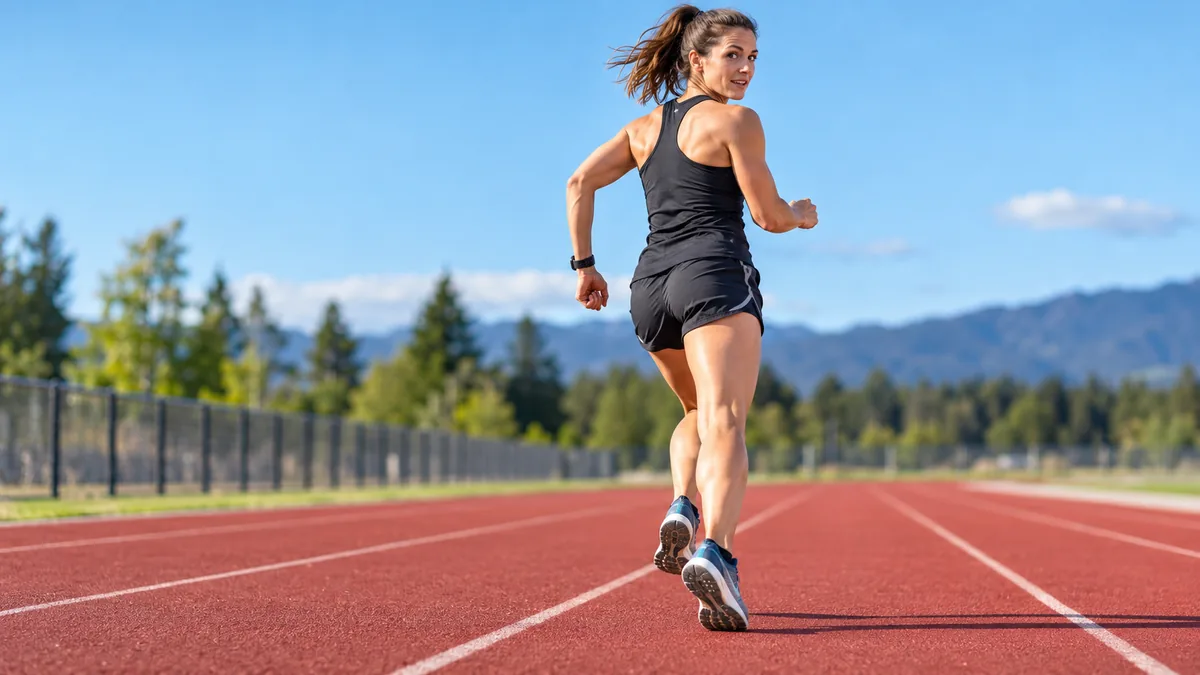
Moving backward presents a major visibility challenge: you cannot continuously see where you are going. Choose a dry, level, unobstructed surface, such as an empty section of an athletics track, and avoid traffic, curbs, crowded sidewalks, hills and rough trails. A partner who can watch the route can be helpful. Stop often to check the path rather than twisting continuously to look behind. Begin with walking; unfamiliar muscle demands may make backward running tiring even for experienced forward runners. Stop if you feel dizzy, lose balance or experience pain.
How to Start Retro Running: A Five-Minute Beginner Workout
You do not need to attempt a long backward run on your first outing. The following introductory session is a practical suggestion for healthy beginners, not a validated medical protocol.
| Time | Activity |
|---|---|
| Minute 1 | Walk forward and inspect the route for obstacles. |
| Minute 2 | Walk backward slowly, taking short, deliberate steps. |
| Minute 3 | Continue backward walking and concentrate on balance. |
| Minute 4 | If comfortable, alternate very brief backward jogging with walking. |
| Minute 5 | Return to easy forward walking and assess how your legs feel. |
Maintain a reasonably upright posture and avoid exaggerated strides. If walking backward already feels challenging, skip jogging. Increase the distance and intensity only as you gain control and confidence.
Do You Need Special Shoes for Retro Running?
No specific retro-running shoe is universally required. A well-fitting athletic shoe with dependable traction on the intended surface is a sensible starting point. Our Best Shoes for Retro Running in 2026 roundup compares four specific models. The Best Running Shoes guide explains the major features of ordinary running shoes. For retro running, consider secure fit, outsole grip, a stable-feeling platform, appropriate cushioning and forefoot flexibility. Tall midsoles and rocker shapes may feel different in backward motion, but there is not enough direct evidence to declare all highly cushioned shoes unsuitable. The shoe roundup distinguishes evidence-backed features from individual preferences and explains how to assess fit, traction and forefoot comfort before buying.
Is Retro Running a Competitive Sport?
Yes. Athletes race backward over sprint, track and long-distance events, including marathons. A backward marathon covers the conventional 42.195-kilometer distance, but athletes face away from the direction of travel. The backward-running record list documents many historical achievements. Competition records and Guinness-certified achievements are not always the same, and each claim should identify its record authority. See our backward-running marathon and 100K records guide for times, historical record holders and source notes.
Frequently Asked Questions About Retro Running
Yes. Retro running, backward running, backwards running, reverse running and retrorunning generally describe running while facing away from the direction of travel.
There is no verified inventor. Competitive backward running predates the 1980s, when figures such as Albert Freese and Ron Austin brought it wider attention.
It can be, particularly at the same speed, because backward running has different mechanical and metabolic demands. Experience and training make a difference.
Laboratory studies have found higher metabolic cost at matched speeds, but no single percentage applies to everyone.
Not necessarily. It changes knee loading, but is not a proven universal treatment. Seek qualified guidance for persistent pain or injuries.
It is possible, but moving belts introduce additional fall risks. Beginners should learn on a stationary, clear surface, and rehabilitation treadmill work should be supervised.
It uses the quadriceps, calves, hamstrings, glutes and other muscles involved in running, with different loading and timing.
No. Start with properly fitted running shoes that provide suitable traction and control. Footwear preference may change with experience and distance.
Some small studies suggest benefits for selected performance measures, but the findings are not guaranteed for every runner.
Many healthy adults can start with short periods of backward walking in a safe environment and progress gradually. People with significant balance problems or injuries should obtain professional advice.