Last Updated on October 16, 2026
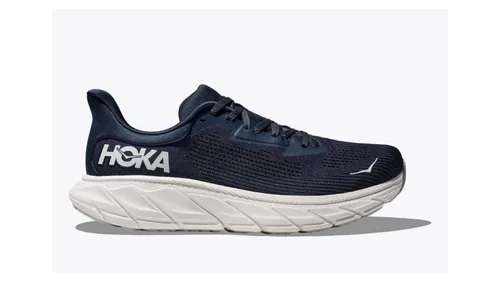
Quick Answer: The Hoka Arahi 7 is a firm, lightweight stability shoe built around Hoka’s J-Frame support system. It works best for walkers and runners who want guidance without a heavy traditional stability shoe. The ride is more controlled than soft, and the fit can feel snug through the midfoot. The Arahi 7 has since been replaced by newer generations, with the Arahi 9 now the current model. Check remaining Arahi 7 availability.
Current-model note: The Arahi 7 is no longer the latest version. If you are buying new today, start with our Hoka Arahi 9 review. Keep reading here if you found the Arahi 7 on sale or want to compare an older pair with the current line.
Who the Hoka Arahi 7 is for
The Arahi 7 makes the most sense for walkers and runners who know they prefer a stability shoe but do not want the bulky feel that older motion-control shoes often had. Hoka uses its J-Frame design, which places firmer foam around part of the midsole to help limit excess inward movement without putting a hard post directly under the arch.
That creates a planted feel without making the shoe especially heavy for its category. The tradeoff is that the ride is firmer than many people expect from Hoka. If you are shopping for a soft, bouncy or plush trainer, this is not the model I would start with.
How the Arahi 7 feels underfoot
The Arahi 7 feels stable first and cushioned second. The compression-molded EVA midsole has enough protection for daily walking and easy running, but the foam is not especially springy. The rocker shape helps the shoe roll forward smoothly, which keeps the firm ride from feeling flat.
That combination can work well for steady mileage, long walks and people who spend a lot of time on their feet. It is less convincing for faster sessions, where the foam can feel dull compared with newer daily trainers.
Fit and comfort
The Arahi 7 uses a structured knit upper with a more padded tongue than the Arahi 6. Hoka also used a dual-gusset design to help keep the tongue in place. The fit is secure through the midfoot, which is useful in a stability shoe, but some people with wider feet may find the standard width too close.
Hoka offered wide versions, so do not automatically size up in length if the shoe feels tight across the forefoot. Choosing the correct width is usually the better fix. If you are not sure, see our guide to checking whether you need wide shoes.
Hoka Arahi 7 specifications
| Specification | Arahi 7 |
|---|---|
| Type | Stability road running and walking shoe |
| Support | J-Frame |
| Heel-to-toe drop | 5 mm listed |
| Men’s listed weight | About 9.9 oz. |
| Women’s listed weight | About 8.1 oz. |
| Upper | Zonally engineered flat knit |
| Outsole | Zonal rubber |
| Launch price | $145 |
| Status | Previous generation |
The 5 mm drop and J-Frame were carried over from the Arahi 6, while the upper was the more noticeable change. Hoka focused the update on fit, tongue comfort and midfoot lockdown rather than changing the basic ride.
Arahi 7 vs. Arahi 6
The Arahi 7 was an evolutionary update rather than a redesign. The core support system stayed the same, but the upper became more structured and padded. It also gained some weight compared with the Arahi 6.
| Feature | Arahi 7 | Arahi 6 |
|---|---|---|
| Support system | J-Frame | J-Frame |
| Drop | 5 mm | 5 mm |
| Upper | More structured knit, plusher tongue | Lighter engineered mesh |
| Ride | Firm and stable | Firm and stable |
| Weight | Slightly heavier | Slightly lighter |
| Best reason to choose | More secure upper | Lower weight if discounted |
Arahi 7 vs. the current Arahi 9
The bigger change came later. The current Arahi 9 uses Hoka’s newer H-Frame approach rather than the older J-Frame. It also has a softer feel and a cooler upper, while remaining an everyday stability shoe for walking and easy running.
If you already own the Arahi 7 and like its firmer, more connected ride, you may not see the newer shoe as automatically better. If you are buying from scratch, though, the Arahi 9 is the logical place to start because it is current, easier to replace and reflects Hoka’s latest support design.
Is the Arahi 7 good for walking?
Yes. Walking is one of the Arahi 7’s better uses. The shoe feels stable at slower speeds, the rocker helps keep the stride moving, and the relatively low weight makes it less tiring than many traditional stability shoes.
It is especially useful if you prefer a firmer, controlled platform. If you want something softer or more accommodating, compare the current Arahi 9 or use our free Shoe Finder to narrow your choices by cushioning, support and width.
Who should skip the Arahi 7
Skip the Arahi 7 if you want a soft max-cushion feel, a lively shoe for speed work or a roomy standard-width fit. The shoe’s strengths are control, predictability and a secure hold rather than bounce or flexibility.
Also do not buy it simply because you have foot or knee pain. A stability shoe can change how steady the foot feels, but it is not a treatment for plantar fasciitis, Achilles problems, knee pain or other medical conditions. Persistent pain is a reason to speak with a qualified clinician rather than to rely on a shoe change alone.
Hoka Arahi 7 alternatives
- Hoka Arahi 9: The current continuation of the Arahi line, with a softer ride and newer support design. Read our Arahi 9 review.
- Saucony Guide 19: A modern supported daily trainer with a smoother, more conventional feel. Read our Saucony Guide 19 review.
- Mizuno Wave Inspire 22: A good alternative if you want support with a livelier ride. Read our Mizuno Wave Inspire 22 review.
Gender-specific buy links: Men’s version | Women’s version
Is the Arahi 7 still worth buying?
It can be, if you already know you like the Arahi 7 and find a fresh pair at a meaningful discount. The launch price was $145, so old stock only makes sense when the price reflects that it is now several generations behind.
For most new buyers, I would start with the Arahi 9 instead. It is the current model, uses Hoka’s newer support system and will be easier to replace later if it works for you.
Frequently Asked Questions
The Arahi 7 is a previous generation and is no longer the current Arahi. Hoka has since released the Arahi 8 and Arahi 9.
The Arahi line continued through the Arahi 8 and now the Arahi 9. If you are buying new, the Arahi 9 is the current model to compare first.
Yes. Its stable platform, rocker shape and relatively low weight make it a good walking shoe for people who prefer a firmer supported feel.
Yes. Hoka lists the Arahi 7 with a 5 mm heel-to-toe drop.
The Arahi 7 is on the firmer side for a Hoka. Its strength is a stable, controlled ride rather than a plush or bouncy feel.
Yes. Hoka offered the Arahi 7 in wide versions. If the standard width feels tight, choosing the wide version is usually better than sizing up in length.
Choose the Arahi 7 only if you know you prefer its firmer ride and can find fresh old stock at a good discount. For most new buyers, the Arahi 9 is the better place to start because it is current and uses Hoka’s newer support design.